
Share this post:
Need planning advice fast?
Get clear answers on extensions, drawings, and permissions without the stress.
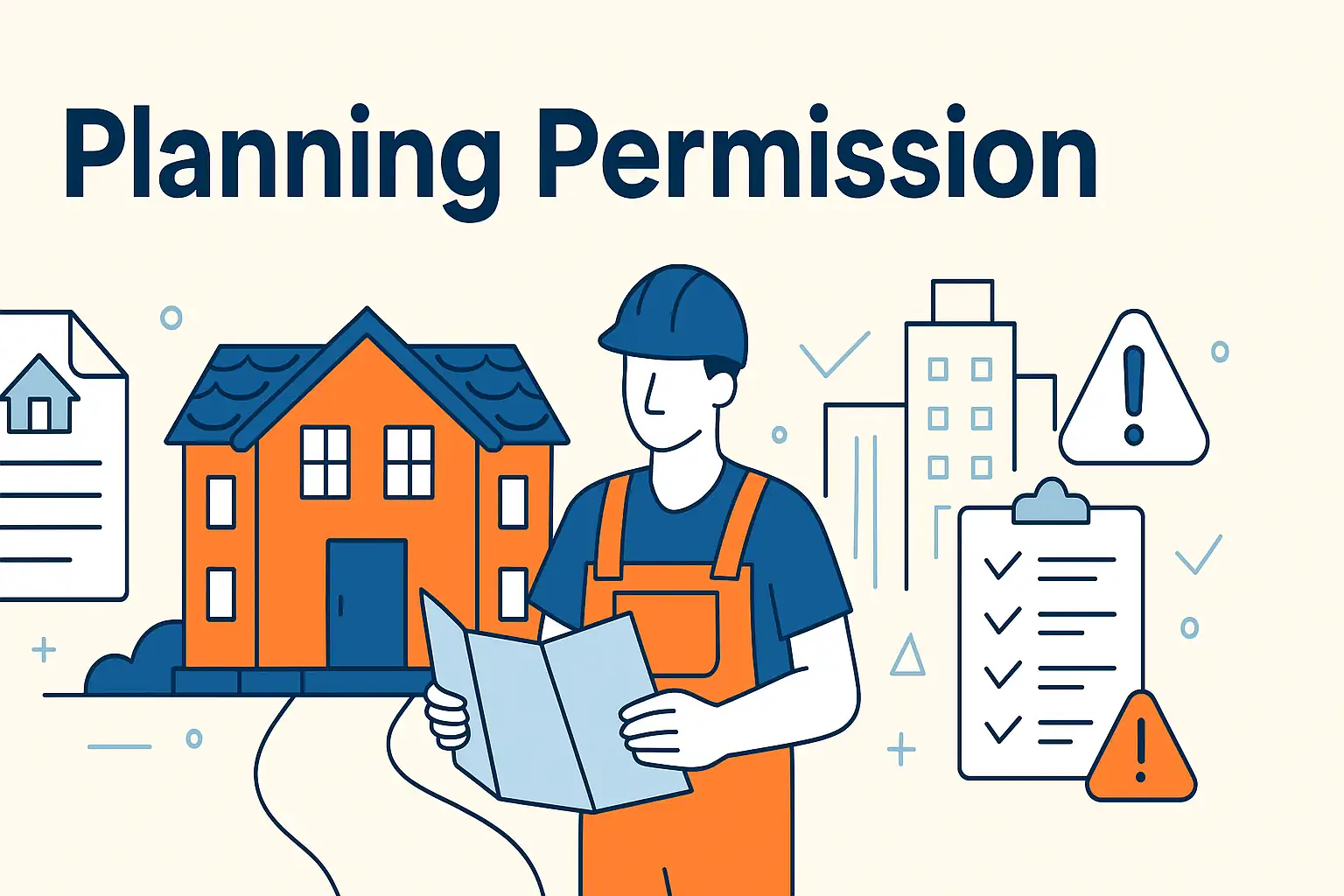
Short answer: Planning permission is the council’s approval to develop or change the use of land or buildings. Many smaller home projects fall under Permitted Development (PD) and don’t need a full application. When you do need permission, accurate drawings, policy-aware design and complete documents keep costs down and decisions timely.
- Learn when planning is required vs PD
- See the drawings & documents councils expect
- Understand costs, timelines and validation
- Navigate conservation areas, listed buildings and flats with confidence
External references: Planning Portal · GOV.UK
What is planning permission?
Planning permission is formal approval from your local planning authority (LPA) to carry out development—such as building an extension, creating a new dwelling, changing a building’s use, or making significant external alterations. The LPA assesses your proposal against national and local policy and its impact on neighbours, streetscene and the environment.
If you’re unsure where your idea sits, start here: Do I Need Planning Permission?
Do I need planning permission?
Many household projects are allowed under PD—national rights that permit specific work without a full application (as long as you meet the rules and your property isn’t restricted). You’ll likely need permission if your project:
- Exceeds PD size limits for extensions, dormers, or outbuildings
- Is on a flat/maisonette (PD is very limited) or a listed building
- Is within a Conservation Area or subject to an Article 4 Direction removing PD rights
- Creates a new dwelling or changes use beyond what Use Class or PD rules allow
- Alters the roof profile significantly or involves prominent front alterations
Permitted Development (PD): when you may not need permission
PD allows some development without an application, provided your proposal stays within the detailed limits (depth, height, eaves, roof volume, materials, % of garden coverage, highway rules) and meets exclusions (no verandas/balconies, protected frontages, etc.). Common PD routes include certain single-storey rear extensions, loft dormers within volume limits, and incidental outbuildings.
Unsure if your idea is PD? We can check your drawings before you commit. Also see: Planning Permission Timelines (stages & limits).
Drawings & documents you’ll need
Clear, compliant drawings are the backbone of a smooth application. A typical Householder application needs:
- Existing drawings — measured plans, elevations and (if relevant) sections
- Proposed drawings — plans, elevations, sections and roof plan; key dimensions and materials called up
- Location plan (1:1250) & Block/Site plan (1:500)
- Design & Access Statement (where required) to explain policy context and rationale
- Specialist reports when relevant (Heritage, Trees, Flood, Highways)
Deep dive: Planning Permission Drawings – Complete Guide and Making Plans – Costs, Drawings & Approval.
How much does planning permission cost?
How long does it take?
- Preparation: 1–3 weeks for survey + drawings (longer for structural or heritage work)
- Validation: after submission, expect ~1–2 weeks for checks
- Decision period: target is 8 weeks for Householder cases (can extend if issues arise or by agreement)
How to apply (step-by-step)
| Step | Action | Outcome |
|---|---|---|
| 1. Route check | Is it PD or full planning? Use our guide: Do I Need Planning Permission? | Correct application path |
| 2. Survey | Measured survey of the existing property | Accurate base drawings |
| 3. Design & drawings | Prepare existing/proposed plans, elevations and (if needed) sections | Validation-ready set |
| 4. Policy sense-check | Ensure size/height/overlooking meet local policy; adjust early | Reduced refusal risk |
| 5. Submit via Portal | Upload forms, drawings, certificates; pay fee on Planning Portal | Application lodged |
| 6. Validation & consultation | LPA checks completeness then consults neighbours/statutory bodies | Case officer appointed |
| 7. Decision & conditions | Officer report; approval/refusal; conditions likely on approvals | Decision issued |
| 8. Amend/discharge & move to Building Regs | Submit non-material amendments or discharge conditions as needed; then progress to Building Control | Construction-ready |
Not sure if your idea fits Permitted Development?
We’ll check your project against PD rules and let you know if you need a full planning application.
Common refusal reasons (and how to avoid them)
1) Overbearing / overshadowing / overlooking
Extensions too deep or high near a shared boundary can dominate a neighbour’s window or garden. Keep massing modest and step down near boundaries.
2) Poor design or materials
Clashing roof forms or mismatched materials harm streetscene character. Pick a coherent palette and keep forms simple.
3) Heritage impact
In Conservation Areas or for Listed Buildings, detail matters. Expect heritage statements and refined drawings.
4) Parking / highway safety
Loss of parking or visibility splays can trigger objections. Provide a plan showing retained/altered spaces and sightlines.
5) Amenity & noise
Roof terraces, balconies and side windows near boundaries can cause overlooking. Consider privacy screens/obscure glazing.
Special cases & tricky scenarios
- Conservation areas / Listed buildings: may require Listed Building Consent alongside planning; heritage-led design is key.
- Flats & maisonettes: PD is limited; full planning is often required even for small changes.
- Dropped kerb / crossover: separate highways approvals; check visibility, drainage and materials.
- Solar panels: often PD on houses but restrictions apply (projection/placement, heritage, highways). See GOV.UK.
- Decking & raised platforms: PD height and proximity limits apply.
- Garage conversions: often planning-free if internal only; Building Regs still apply. External changes can trigger planning—see Garage guide.
- Lawful Development: for PD or existing use, a Lawful/Notice route context plus evidence helps protect value.
After approval: conditions, building control & next steps
Most approvals include conditions—materials, privacy glazing, tree protection, or details to approve before you start. Discharge any “pre-commencement” conditions first.
Then move to detailed Building Regulations drawings/specification, coordinate with a structural engineer, and notify your chosen control body. Helpful reads: Building Control Inspections · Certificates & Compliance Documents to Keep.
Local council quirks (policies, heritage, London)
Regulations are national but policy application varies by LPA:
- London boroughs: often tighter on design/overlooking and amenity; expect thorough drawings and daylight/sunpath clarity.
- Heritage authorities: prefer repair over replacement, authentic materials and proportioned detailing; earlier pre-apps help.
- Green belt/rural councils: stricter volume controls and openness tests—expect detailed justification.
Planning Permission: FAQs
How long is planning permission valid?
Most permissions must be started within 3 years of the decision date. Conditions continue to apply during and after construction.
How long does a decision take?
Allow ~8 weeks from validation for Householder cases, plus 1–2 weeks for validation itself. Complex or heritage cases can take longer.
Can planning permission be revoked once granted?
Revocation is legally possible but extremely rare and subject to compensation rules. Minor changes are usually handled via non-material amendments or s73 (varying conditions).
Do I need planning for an extension?
Some rear extensions fall under PD if within depth/height/eaves limits and other criteria. Larger or two-storey proposals usually need permission. See our Extension guide.
Is planning permission required for a loft conversion?
Many lofts are PD within roof volume/height limits and with suitable dormer placement. Others need planning—see Loft Conversion Planning.
Do I need planning for a garage conversion?
Internal garage conversions often don’t need planning, but external alterations can trigger it. Building Regulations will apply. Read: Garage guide.
Are solar panels PD?
Often yes on houses, with limits on projection/placement. Restrictions apply in conservation areas and for listed buildings—confirm on GOV.UK.
How much does planning cost?
Check the current Householder fee on the Planning Portal. Budget also for professional drawings, statements and any required surveys.
Which planning authority am I in?
Use your postcode on the Planning Portal to find your LPA and links to policies and applications.
Can I appeal a refusal?
Yes—appeal to the Planning Inspectorate or redesign and resubmit. We can review reasons for refusal and advise a route forward.
What documents should I keep for selling?
Decision notice, stamped plans, discharged conditions, any Lawful Development Certificates, and Building Control completion certificates. See Certificates & Compliance Documents.
Want us to check your plans before you submit?
A quick PME review de-risks validation and speeds up decision time.
Next steps & useful guides
- Do I Need Planning Permission?
- Planning Permission Drawings – Complete Guide
- Making Plans – Costs, Drawings & Approval
- Planning Permission Timelines (Key Stages & Limits)
- House Extensions – UK Guide
- Loft Conversions — Rules, Costs & Council Quirks
- Garden Rooms — Do You Need Planning?
- Building Control Inspections — What to Expect
External resources
Ready to move your project forward?
Plans Made Easy can prepare compliant plans, manage submissions, and guide you from idea to approval.
Performance Verified ✅
This page meets PME Optimisation Standards — achieving 95+ Desktop and 85+ Mobile PageSpeed benchmarks. Verified on

