
Share this post:
Quick summary: how much does planning permission cost?
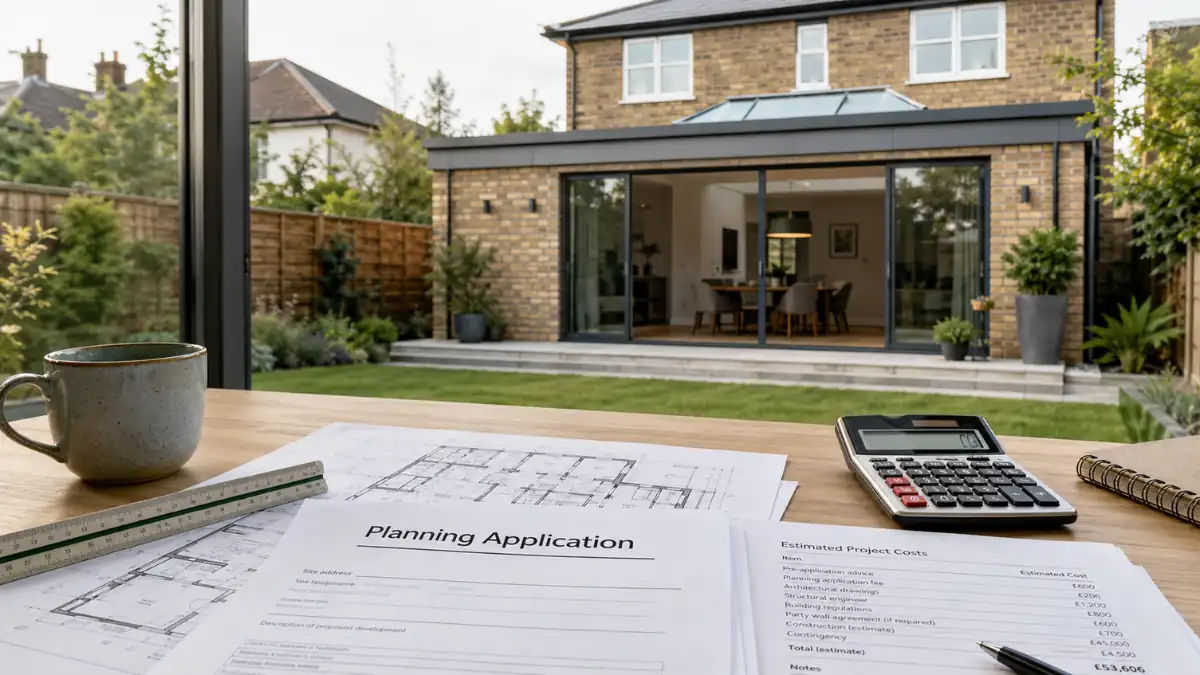
If you are wondering how much does planning permission cost, the answer depends on whether you mean the council application fee alone or the complete cost of getting an application ready and submitted.
- Standard householder alterations in England: the statutory planning application fee is £548 from 1 April 2026.
- Certain ancillary works within a home's boundary: the statutory fee can instead be £272, depending on the type of development.
- Planning Portal submission: applications attracting a fee above £100 currently carry a separate £75.83 + VAT Planning Portal service charge when submitted through its online system.
- Drawings and professional help: these are separate from the council fee and can add hundreds or sometimes thousands of pounds depending on the project.
- Extra reports: structural, heritage, tree, ecological, drainage or other specialist information can increase the overall budget where required.
Therefore, a straightforward homeowner project may cost considerably more than the application fee shown on the council website. This guide explains what you are actually paying for, which costs are optional, and where extensions, loft conversions, garages and other common projects can differ.
Trying to budget for planning before you extend?
Tell us what you are hoping to build and we can help you work out which approvals, drawings and supporting information your project is likely to need.
How much does planning permission cost in practice?
The first figure most homeowners see is the council application fee. However, that is only one part of the planning budget.
You may also need existing and proposed drawings, a measured survey, location and block plans, professional design input and, depending on the site, specialist reports. Therefore, it is useful to separate the statutory application charge from the cost of preparing the application.
Before spending money on an application, it is also worth checking whether permission is actually required. Some domestic work can fall within permitted development rights instead. Our guide explaining how to check whether your proposed work needs approval is a useful starting point.
How much does a planning application cost in England?
From 1 April 2026, the statutory application fee for the enlargement, improvement or alteration of an existing single dwellinghouse in England is £548.
That is the category that commonly covers householder work such as extensions and significant alterations. However, not every domestic proposal falls into the same fee category.
When can the planning fee be £272?
The current England fee schedule also specifies a £272 fee for certain operations within the boundary of an existing dwellinghouse that are ancillary to its enjoyment, including relevant buildings, gates, fences, walls and other means of enclosure.
Remember the Planning Portal service charge
If you submit a fee-paying application through the Planning Portal's online application system, there is currently a separate service charge of £75.83 + VAT where the planning application fee is over £100.
Consequently, for a £548 householder application submitted through that service, the amount paid at submission can be higher than £548 even before professional drawings or design fees are considered.
Quick costs snapshot: getting planning permission
- England householder alteration application: £548 statutory fee.
- Certain ancillary domestic works: £272 statutory fee.
- Planning Portal online service charge: £75.83 + VAT where applicable.
- Planning drawings: separate professional cost.
- Pre-application advice: may be charged separately by your council.
- Specialist reports: additional where your site or proposal requires them.
- Building Regulations: a separate approval process with separate costs.
How much should you budget to get planning permission?
The statutory application fee is relatively easy to identify. The harder question is the total cost of preparing a good-quality application.
A normal homeowner planning budget may include:
- measuring or surveying the existing property;
- existing floor plans and elevations;
- proposed plans and elevations;
- a location plan and block or site plan;
- design revisions before submission;
- preparation and submission of the application;
- communication with the planning authority;
- the statutory planning fee;
- the online submission charge where applicable; and
- specialist reports if circumstances require them.
For many straightforward homeowner schemes, the professional drawing package is therefore a larger part of the overall planning-stage budget than the statutory application fee itself.
Our separate breakdown of typical fees for preparing the drawings explains what is commonly included and where additional charges can arise.
How much does planning permission cost for an extension?
An extension is one of the most common reasons homeowners ask about planning costs. If a proposed extension requires a standard householder application in England, the statutory application fee is currently £548.
However, an extension that qualifies for permitted development may not require a normal planning application at all. You may still choose, or sometimes be advised, to obtain a Lawful Development Certificate so that you have formal evidence that the work was lawful.
This is why the sensible first question is not simply “what is the fee?”, but “which planning route applies to my extension?” Our step-by-step extension planning guide explains the approval route in more detail.
Planning is only one part of an extension budget
Even after the planning stage is resolved, most extensions still involve design development, Building Regulations, structural calculations and construction costs.
If you are trying to understand the whole project rather than the application fee alone, see our complete homeowner guide to extension costs.
Not sure which costs apply to your extension?
We can review your proposed work and explain whether you are likely to need planning drawings, a planning application, Building Regulations information, or a combination of them.
Planning permission costs for garages, loft conversions and garden rooms
Search results often make planning fees look as though every home improvement has its own fixed price. In reality, the fee depends on the type of application being made and the planning route that applies.
How much does planning permission cost for a garage?
A domestic garage can sometimes be permitted development. In other situations, its position, scale, use or relationship with the house means a planning application is required.
Therefore, check the planning route first rather than assuming a standard application is necessary. Our guide explains when a garage may be possible without a full application.
How much does planning permission cost for a loft conversion?
Many loft conversions can be undertaken using permitted development rights, provided all relevant conditions and limitations are met. More extensive roof alterations or properties where permitted development rights are restricted may require a planning application.
You can read our homeowner guide to the planning route for loft conversions before budgeting for an application.
How much does planning permission cost for a garden room or shed?
Outbuildings can also fall within permitted development in suitable circumstances. However, height, position, intended use, the amount of land covered and restrictions affecting the property can all matter.
As a result, a homeowner should not budget for a planning fee until the correct route has been checked.
What extra costs can be added to a planning application?
For a simple extension on an uncomplicated site, drawings and the application fee may form most of the planning-stage cost. More sensitive projects can need additional information.
Pre-application planning advice
Some councils offer paid pre-application advice. This can be useful where a proposal is unusual, the site is sensitive or you want an officer's initial view before committing to a full design.
Charges are set locally, so check your own council's current service and fee schedule rather than relying on a national average.
Planning drawings and surveys
A designer may charge separately for the measured survey, planning drawings, revisions and management of the submission. Always check whether a quotation includes all four.
Specialist reports
Depending on the project and site, a local authority may require additional material such as:
- tree or arboricultural information;
- heritage information;
- ecology assessments;
- flood or drainage information;
- transport or access information; or
- other supporting assessments relevant to the proposal.
Not every household application needs these. Nevertheless, where they are required they should be allowed for before you commit to the project.
Building Regulations and structural calculations
Building Regulations approval is separate from planning permission. An extension may also require structural calculations for elements such as beams, openings, foundations or roof alterations.
Our guide comparing the planning and Building Regulations stages explains why homeowners should budget for them separately.
Does planning permission cost the same across the UK?
No. Planning is devolved, so England, Scotland, Wales and Northern Ireland have their own systems and fee arrangements.
How much does planning permission cost in England?
In England, the current statutory fee for enlargement, improvement or alteration of a single dwellinghouse is £548 from 1 April 2026. Different development categories attract different fees.
How much does planning permission cost in Scotland?
Scotland operates a separate fee regime. Fees depend on the development category and scale, and homeowners should use the current Scottish Government planning guidance or fee calculator rather than an English figure.
How much does planning permission cost in Wales?
Wales also has its own planning application fee schedule. Welsh Government guidance confirms that most applications require a fee and that the amount depends on the type and size of development.
What about Northern Ireland?
Northern Ireland has a separate planning system as well. Therefore, homeowners there should check the current requirements and charges applicable to their local council rather than using an England, Scotland or Wales fee.
How to work out your planning permission cost step by step
A simple budgeting process can prevent the application fee from becoming confused with the total design and approval cost.
Planning cost checklist for homeowners
- Define the project. Write down exactly what you want to extend, alter, convert or build.
- Check whether permission is required. Establish whether the work needs full planning permission, qualifies for permitted development, or needs another planning procedure.
- Confirm the correct application type. The fee depends on what you are actually applying for.
- Check the current statutory fee. Use the official fee schedule or confirm the amount with your local planning authority.
- Allow for the submission charge. If using Planning Portal, check whether its online service charge applies.
- Price the drawings. Confirm whether measured survey work, existing drawings, proposed drawings and revisions are included.
- Ask about supporting documents. Establish whether the council is likely to require any specialist reports.
- Keep Building Regulations separate. Budget independently for technical drawings, structural calculations and Building Control where required.
Does paying more make planning permission quicker?
Paying a larger professional fee does not buy a planning approval. What good professional input can do is help ensure that your proposal is clearly designed, properly documented and submitted with the information required for validation.
For most planning applications, the standard decision period is normally around eight weeks once the application is valid, although complex applications can take longer and extensions of time may sometimes be agreed.
If programme is important to your wider build budget, our guide to planning application timescales explains the main stages.
FAQs: how much does planning permission cost?
How much does it cost to get planning permission in England?
For the enlargement, improvement or alteration of a single existing dwellinghouse, the statutory planning application fee in England is £548 from 1 April 2026. Professional drawings, surveys, specialist reports and any applicable Planning Portal service charge are separate.
What is the average cost of planning permission?
There is no single meaningful UK average because the application charge depends on the development and the nation in which the property is located. In addition, the total amount a homeowner spends will depend heavily on drawings, professional advice and any specialist reports required.
How much does planning permission cost for an extension?
Where an extension requires a normal householder application in England, the statutory fee is currently £548. However, some extensions can qualify for permitted development, so the correct planning route should be confirmed before an application fee is budgeted.
How much does retrospective planning permission cost?
A retrospective application does not provide a cheaper route for avoiding the planning process. The correct fee depends on the development being regularised, and making a retrospective application does not guarantee approval. If work has already been completed without the required permission, obtain project-specific advice before proceeding.
How much does outline planning permission cost?
Outline permission is generally associated with development proposals rather than a normal householder extension. Fees in England are calculated according to the relevant development category and, for some proposals, site area. Homeowners should therefore check the specific application type rather than applying a householder fee.
Does permitted development mean there is nothing to pay?
Not necessarily. The absence of a normal planning application does not mean every planning-related cost disappears. You may still want drawings or professional advice, and some projects use prior approval or a Lawful Development Certificate, each of which can involve a fee.
How much does planning permission cost for a garage conversion?
Many garage conversions do not require a normal planning application, although this depends on the property, the work proposed and any restrictions affecting permitted development rights. Building Regulations are a separate consideration. Check the planning route before allowing for a full application fee.
Do I pay for planning permission and Building Regulations separately?
Yes. They are separate approval systems. Planning considers whether the development is acceptable in planning terms, whereas Building Regulations deal with matters such as structural safety, fire safety, insulation, ventilation and other technical requirements.
How long does planning permission usually take?
GOV.UK states that most planning applications are decided within eight weeks, although unusually large or complex applications can have longer statutory periods and actual timescales can vary. The clock normally relates to a valid application, so missing information can delay the process.
Want to know the likely planning route before you spend money?
Send us your project details and we can help identify which drawings and approvals are likely to be relevant before you commit to the next stage.
Next steps & useful guides
Once you have an idea of the planning-stage budget, these PME guides will help you understand the next decisions:
- Extension Costs – Complete Homeowner's Guide
- Do I Need Planning Permission?
- Planning Permission Drawings Cost – What to Expect
- Planning Permission for an Extension – Step-by-Step Guide
- Planning Application Timelines – Key Stages Explained
- Planning Approval and Building Regulations – Understanding the Two Stages
- Retrospective Applications – How the Process Works
- England householder fee £548 from 1 April 2026 for enlargement, improvement or alteration of a single existing dwellinghouse.
- Certain ancillary works £272 for the relevant category of domestic curtilage works in England.
- Planning Portal charge Currently £75.83 + VAT for online planning applications attracting an application fee over £100.
- Drawings included? No. The statutory application fee does not pay your designer for surveys, plans, elevations or revisions.
- Building Regulations included? No. Planning permission and Building Regulations are separate processes and should be budgeted separately.
- Typical decision period Most planning applications are normally decided within around 8 weeks once valid, although some take longer.
- UK-wide fee? No. England, Wales, Scotland and Northern Ireland have separate planning arrangements and fees.
- Best first step Confirm whether you actually need planning permission before commissioning a full application package.
Unsure which route applies? Ask Plans Made Easy to check your project.
Official planning cost and application guidance
Planning fees and procedures can change, so use current official information when you are ready to submit.
- Planning Portal – current application fees and payment guidance
- GOV.UK – when planning permission is required
- Scottish Government – planning applications and fee calculator
- Welsh Government – planning application fee guidance
So, what should you allow for planning permission?
The important point is that the council's planning application fee is not the same as the total cost of getting your proposal through the planning stage.
For an extension or alteration requiring a standard householder application in England, the current statutory fee is £548. However, you should also allow for drawings, any professional advice, the applicable submission charge and specialist information where required.
Equally, do not assume that you need to pay for a full application at all. Some extensions, loft conversions, garages, garden buildings and other domestic projects can use permitted development rights where the relevant rules are met.
Our team can help you establish the correct route first, prepare the drawings you actually need and guide the application through the appropriate process. That way, your planning budget is based on the project in front of you rather than a generic online figure.
Ready to move your project forward?
Plans Made Easy can prepare compliant plans, manage submissions, and guide you from idea to approval.
Performance Verified ✅
This page meets PME Optimisation Standards — achieving 95+ Desktop and 85+ Mobile PageSpeed benchmarks. Verified on

