
Share this post:
Quick summary: Retrospective Planning Permission
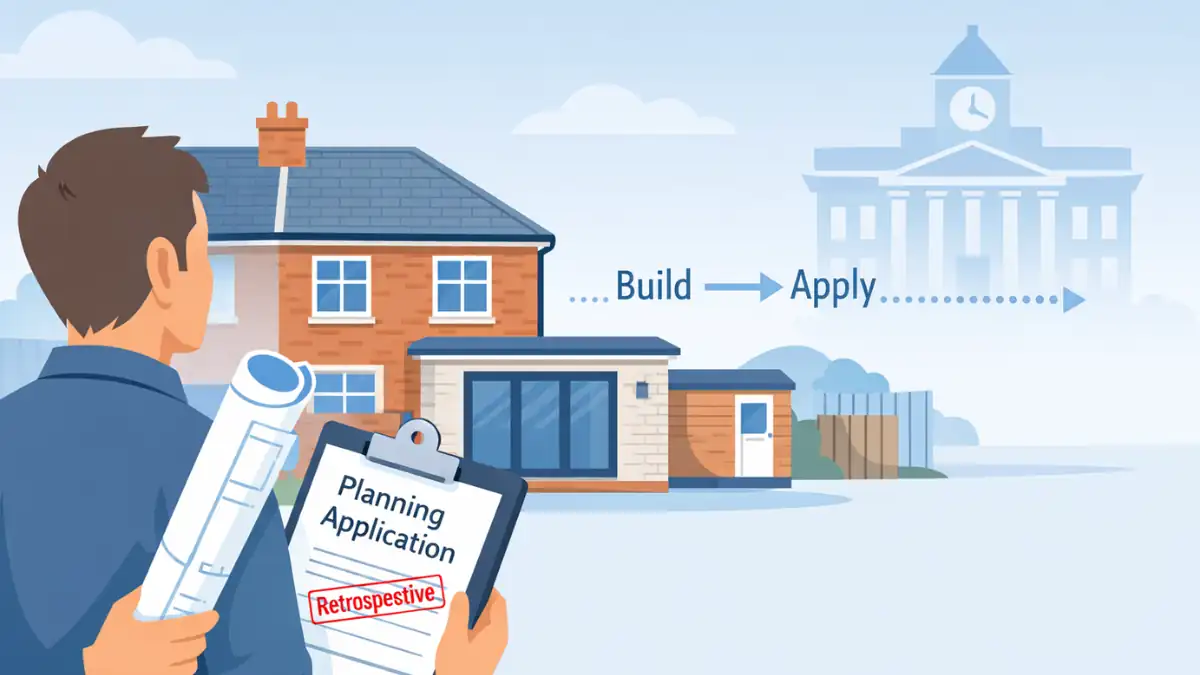
Retrospective Planning Permission is a normal planning application made after building work has already started (or even finished). It can help you regularise what’s been done — but it is not a “rubber stamp”, and the council will assess it in the same way as any other application.
- You can apply even if the work is complete — this is often referred to as a “Section 73A” application.
- If refused, the council may take enforcement action and require changes or removal.
- Time limits matter: in England, enforcement time limits changed from 25 April 2024, and the rules can differ for older works and for listed buildings.
- Best next step: pause further work (where safe), gather evidence, and get drawings that match what exists on site.
Worried you’ve built first and asked later?
Tell us what’s been built (and when). We’ll explain your options, what the council is likely to focus on, and the cleanest way to move forward.
Retrospective Planning Permission: what it is (and what it isn’t)
Retrospective Planning Permission is simply a planning application submitted after development has already taken place. In England this is commonly linked to Section 73A, which allows an application to be made for development already carried out.
The important bit: the council does not approve it just because the work is already there. They assess it against the same policies they would have used if you applied up front — things like design, neighbour impact, highways, conservation constraints and local plan policies.
When retrospective planning permission is needed — and when other routes fit better
In practice, we see homeowners look at retrospective applications for a few common reasons:
- Work started without permission (misunderstanding permitted development, wrong measurements, or a builder “just cracked on”).
- The build changed mid-project (extra height, different materials, larger footprint).
- You bought a home with historic unauthorised work and you want it regularised for peace of mind or future sale.
Retrospective planning permission vs a Certificate of Lawfulness
If the issue is mainly “has this become lawful because of time?”, a Certificate of Lawfulness may be the better route — because it’s evidence-led (you prove what exists, for how long, and that it was continuous/open).
Retrospective planning permission vs Building Regulations “regularisation”
Planning and Building Regulations are separate systems. You may need one, the other, or both:
- Planning permission is about whether the development is acceptable in principle (impact, appearance, neighbour amenity, policy).
- Building Regulations are about safety and performance (structure, fire safety, insulation, drainage, electrics, etc.).
If the issue is Building Regulations only, you may be looking at a regularisation process with Building Control — not a planning application. Our guides can help you separate those two tracks: Building Regulations and Building Control.
Quick costs snapshot (what homeowners typically pay)
- Planning application fee: depends on application type (paid to the council via the Planning Portal).
- Drawings & planning support: varies by complexity — simple outbuildings are usually cheaper than extensions, lofts, or heritage sites.
- Extra reports: may be needed (heritage statement, ecology, trees, drainage, highways).
Tip: a “cheap” drawing quote can become expensive if the application is refused and you need redesign + resubmission.
How to apply for retrospective planning permission (step-by-step)
The goal is to submit something that matches what exists on site, answers the council’s likely concerns, and gives you the best chance of approval without months of back-and-forth.
Step-by-step process
- Pause further work (where safe). Continuing to build can make the situation harder, especially if neighbours have complained.
- Get clear “as built” information. Photos, measurements, and a basic timeline (when works started/finished).
- Check constraints. Conservation area, listed building, Article 4, trees, or boundary/rights of way issues can change everything.
- Prepare drawings that match what’s there. Existing + proposed may look similar in a retrospective application — but the council still needs clarity.
- Decide the right application type. Householder vs full planning, plus any linked consents if relevant.
- Submit via the Planning Portal (or your council portal). Pay the fee and upload drawings/supporting documents.
- Respond quickly to queries. Keep replies factual, polite, and supported by drawings/evidence.
- If needed, negotiate amendments. A small change (height, window position, materials) can turn a “no” into a “yes”.
Checklist table: what to gather before you submit
| Item | Why it matters | Common homeowner miss |
|---|---|---|
| As-built measurements | Ensures drawings match reality | Using original “intended” sizes instead of what was built |
| Site / location context | Helps the planner assess neighbour impact | Missing boundary distances, overlooking angles, or levels |
| Timeline (when works happened) | Relevant to enforcement position | No dated evidence (photos, receipts, contractors) |
| Constraints check | Some areas need extra consents/reports | Assuming PD applies in conservation/Article 4 areas |
Not sure what to submit (or what to say to the council)?
We’ll help you choose the right application route, prepare compliant drawings, and present the proposal in the strongest, most “planner-friendly” way.
Retrospective planning permission cost, fees and timelines
How long does retrospective planning permission take?
Most householder-type applications are normally determined within a set period (often quoted as around 8 weeks for non-major applications), although timelines can extend if information is missing, neighbours object, or specialist input is needed.
What affects the overall cost?
- Drawings complexity: a simple shed or garden room is very different to a rear extension with level changes.
- Whether a survey is needed: “as-built” surveys are common for retrospective cases.
- Extra documents: heritage statements (listed/conservation), drainage, ecology, trees, highways.
- Revisions: changes after officer feedback can add cost — but often improve approval odds.
Pitfalls, “gotchas” and common refusal reasons
Retrospective applications often fail for the same handful of reasons — and most are fixable if you tackle them early.
Common reasons councils refuse retrospective applications
- Neighbour impact: overlooking, loss of light, overbearing bulk near boundaries.
- Design/appearance: materials, roof form, awkward proportions visible from the street.
- Overdevelopment: too much built form in a small plot, poor garden space, cramped parking.
- Policy constraints: conservation area character, listed building impacts, protected trees.
What happens if retrospective planning permission is refused?
A refusal doesn’t automatically mean demolition tomorrow — but it can lead to formal enforcement action, and the council may require changes or removal. In many cases, a redesign and resubmission (or an appeal) is the practical path forward.
If you want to understand refusals and next steps, these guides help: Planning Permission Refusal and Planning Permission Appeal.
Technical details homeowners often miss
Enforcement time limits (England) — why dates and evidence matter
In England, the enforcement time limits changed from 25 April 2024. For certain developments completed on/after that date, the enforcement time limit is generally 10 years, with transitional arrangements for earlier cases.
Neighbour objections (and how to handle them calmly)
It’s common for retrospective cases to trigger objections because neighbours feel “it’s already been done”. The council will still assess planning merits — so your best approach is to focus on measurable points: privacy, daylight, scale, and design quality.
Related comparisons that help homeowners decide the right route
- Retrospective vs normal application: same assessment, but you need “as-built” clarity and a cleaner explanation of impacts.
- Retrospective vs Certificate of Lawfulness: one seeks permission; the other proves lawfulness through evidence and time.
- Retrospective planning vs Building Regulations regularisation: planning is permission; building regs are compliance and safety.
Local council quirks to watch for
Even within England, councils can differ in what they expect for validation, drawings, and how they interpret design policies. In retrospective cases, we often see extra attention on:
- Boundary builds: height, eaves, and neighbour amenity tests.
- Materials: especially in conservation areas.
- Outbuildings: garden rooms, sheds and “home office” buildings (use class, height, positioning).
If your situation involves a specific type of structure, these guides can help you sense-check what the council is likely to focus on: Planning Permission for a Shed, Planning Permission for a Garden Room, Outbuildings Planning Permission, Extension Built Without Planning Permission.
FAQs: Retrospective Planning Permission
Apply for retrospective planning permission: how does it work?
You submit a normal planning application (usually through the Planning Portal), but your drawings and description reflect what has already been built. The council assesses it against planning policies in the usual way — it’s not automatically approved because the work exists.
Objecting to retrospective planning permission: can neighbours stop it?
Neighbours can object, and the council must consider material planning issues (privacy, daylight, scale, design). However, objections don’t decide the outcome on their own — what matters is whether the development is acceptable in planning terms.
Cost of retrospective planning permission: what should I budget for?
Budget for (1) the council’s application fee, and (2) professional costs such as drawings, surveys, and any specialist reports. Retrospective cases often need accurate “as-built” drawings and sometimes extra supporting documents, which can increase total cost.
Retrospective planning permission for a garden room: is it possible?
Yes — but garden rooms can trigger issues around height, boundary position, use (sleeping vs ancillary), and impact on neighbours. If you want a garden-room-specific checklist, see: Planning Permission Garden Room and Do Garden Rooms Need Planning Permission?.
Retrospective “right way”: what’s the safest approach?
Get clear as-built information, understand constraints (conservation/listed/Article 4), and submit a well-prepared application with drawings that match reality. If there’s a policy issue, a small amendment can often make the difference — rather than pushing a weak application through.
Rules on retrospective planning permission: is it treated differently?
The process is broadly the same as a standard application: validation, consultation, officer assessment and a decision. The key difference is practical — you must clearly show what exists now and address any harm that has already occurred.
Fees for retrospective planning applications: do they cost more?
The council fee is based on the application type rather than whether it’s retrospective. However, your total spend can be higher if you need “as-built” surveys, extra reports, or redesign work to make it acceptable.
Indemnity insurance for retrospective planning permission: should I get it?
This is a legal/insurance decision rather than a planning one. Importantly, many policies can be invalidated if the council has already been contacted. If insurance is on your mind (often during a purchase), speak to your solicitor before approaching the local authority.
What is a retrospective request?
In homeowner terms, it usually means asking the council to approve something after the fact — typically by submitting a retrospective planning application for works already carried out.
Time limit for retrospective planning permission: is there a deadline?
There isn’t a “deadline” to apply, but enforcement time limits can affect the council’s ability to take action. In England, enforcement time limits changed from 25 April 2024 and are generally longer for newer breaches (with transitional arrangements).
Refusal of retrospective planning permission: what happens next?
If refused, the council may take enforcement action requiring changes or removal. Often the practical options are: amend and resubmit, negotiate changes, or appeal (depending on the refusal reasons).
How long for retrospective planning permission?
Timeframes vary, but non-major applications are typically intended to be decided within a standard determination period. Missing documents, objections, or specialist constraints can extend this.
Help with retrospective planning permission: what should I do first?
First, stop further work where safe. Then gather evidence (photos, dates, measurements) and get accurate drawings. If you want a wider overview of the planning system and process, see our pillar guide: Planning Permission (UK): The Complete Homeowner’s Guide.
Want a calm, realistic view of your chances?
We’ll review what’s been built, flag the likely sticking points, and suggest the simplest route to get you back on track.
Next steps & useful guides
If you want to go deeper (or your situation overlaps other permissions), these guides are usually the most helpful next reads:
- Do I Need Planning Permission?
- Planning Permission Timelines
- Planning Permission Drawings
- Planning Permission Cost
- Extension Built Without Planning Permission
- Retrospective Building Regulations Time Limit
- Planning Permission Refusal
- How to View Planning Applications and Permissions in Your Area
- What it is A planning application made after work has started or finished — assessed like any other application.
- Will it be approved? Not automatically. It must meet local and national planning policies.
- If refused The council may take enforcement action requiring changes or removal.
- Time limits (England) Enforcement time limits changed from 25 April 2024, generally moving to a 10-year limit for newer breaches, with transitional arrangements.
- What you need to submit Accurate drawings that match what exists, plus any supporting documents required by your council.
- Best homeowner move Pause further work (where safe), gather evidence, and get professional help to avoid a messy refusal/enforcement spiral.
If you’re unsure what route fits your case, message Plans Made Easy and we’ll explain your options clearly.
Official guidance (worth checking)
For up-to-date official wording and processes, these are the best starting points:
- Planning Portal guidance on applying after development has taken place
- GOV.UK overview of the planning permission system
- GOV.UK Planning Practice Guidance on enforcement and time limits
- GOV.UK guidance on how planning applications are determined (and typical timeframes)
Conclusion: the quickest way to reduce risk and move forward
If you’re in a retrospective situation, the priority is to take control of the narrative: get the facts straight, get drawings that match reality, and submit the strongest possible case against the policies your council actually uses. Done well, Retrospective Planning Permission can resolve problems cleanly. Done poorly, it can lead to refusal, redesign costs, and a longer, more stressful process.
Our team at Plans Made Easy helps homeowners prepare compliant drawings, manage submissions, and reduce the chances of the “one missing detail” delay. If you’d like a calm sense-check, we’re happy to help.
Ready to move your project forward?
Plans Made Easy can prepare compliant plans, manage submissions, and guide you from idea to approval.

Performance Verified ✅
This page meets PME Optimisation Standards — achieving 95+ Desktop and 85+ Mobile PageSpeed benchmarks. Verified on

