
Share this post:
Quick summary: Inspiring Home Offices
If you are searching for Inspiring Home Offices, the biggest “make or break” is usually not the desk or the paint colour — it is where the space sits (garden room, extension, loft, garage conversion, spare room) and whether it will be comfortable, quiet, warm and compliant.
- Best overall (year-round comfort): a properly insulated garden room or a small extension with good daylight + ventilation.
- Best for value: converting an existing room (spare bedroom / box room) — fewer permissions and usually lower cost.
- Most common “regret”: underestimating noise, overheating, glare and power/broadband until after it’s built.
- Planning & Building Regs: garden rooms and outbuildings can sometimes be Permitted Development, but rules change with location (conservation areas, listed buildings, Article 4). Building Regulations can still apply depending on the build and use.
Below we share practical, UK-relevant ideas (garden rooms, extensions and reworked rooms) and the planning/building control checks that help you avoid expensive rework later.
Not sure which home office option suits your house?
Tell us what you’re thinking (garden room, extension, loft or conversion) and we’ll help you sanity-check the route, the drawings you’ll need, and the planning/building control steps.
Quick summary: Inspiring Home Offices
The most Inspiring Home Offices feel effortless to use: they are bright without glare, warm without being stuffy, and quiet enough for calls. In the UK, getting that right usually comes down to three decisions:
- Location: garden room, extension, loft/garage conversion, or reworking an existing room.
- Comfort details: insulation, ventilation, heating, acoustics and lighting.
- Compliance: whether you need planning permission, and whether Building Regulations / building control applies.
This guide focuses on practical ideas you can actually build — plus the checks that help you avoid council issues or costly redesign later.
Inspiring Home Offices: what actually makes a space work
Pinterest-perfect photos are great, but the Inspiring Home Offices homeowners love living with are the ones that work on an ordinary Tuesday: video calls, school runs, deliveries, and a British winter in the background.
In our experience, a home office feels “right” when it nails these basics:
- Daylight + control: natural light with a blind/shade so you are not squinting all day.
- Temperature stability: warm in winter, not a greenhouse in summer.
- Quiet: reduced echo inside the room and less sound transfer from the house (and outside).
- Power + data: enough sockets, sensible cable routes, and reliable broadband.
- Storage: paperwork, chargers and “life clutter” have a home — so your desk stays clear.
Garden room vs extension vs spare room: choosing the right “type”
Before you pick colours and furniture, decide where your office should live. Below are the most common routes UK homeowners take, with the real-life pros and cons.
Option 1: Garden room office (separate space, proper “switch off”)
A garden room is often the most “work-like” option because it is physically separate from the house. That said, the details matter — especially insulation, heating and electrics.
- Best for: focused work, calls, and creating a boundary between home and work.
- Watch-outs: overheating, noise from neighbours, running power/data, and whether the build is truly year-round.
- Planning: sometimes Permitted Development, but not always (location and constraints matter).
If you are exploring this route, these guides are useful: garden office rules explained and the full garden room planning guide.
Option 2: Home office extension (integrated space, easiest access)
A small rear/side extension can create a brilliant office, especially when it borrows light from bifolds/rooflights. It can also add value because it is fully integrated into the house.
- Best for: families (easy supervision), anyone needing a WC/kitchen nearby, long-term flexibility.
- Watch-outs: overlooking, neighbours, and whether your proposal stays within permitted development limits.
- Drawings: you will usually need a clear set of plans for planning and/or building control.
If your office is part of an extension project, start here: extension permission basics.
Option 3: Loft or garage conversion office (use existing volume)
Conversions can be a smart use of space. Lofts can be calm and bright; garages can be practical and close to the kitchen. Both need careful attention to insulation, fire safety and headroom/structure.
- Best for: gaining a dedicated room without changing the footprint.
- Watch-outs: sound transfer, thermal performance, and (for lofts) stairs/layout compromises.
- Compliance: Building Regulations are usually a bigger factor than planning.
Helpful next reads: Building Regulations overview and how building control works.
Option 4: Reworking a spare room (fastest and lowest-friction)
For many homeowners, the most realistic “transformation” is upgrading an existing room: better lighting, acoustic treatment, storage and a proper desk setup. It is also the least likely to trigger planning complications.
Inspiring home office design ideas that improve day-to-day working
Below are design moves we see working again and again in Inspiring Home Offices — because they solve real problems (not just style goals).
1) Put your desk in the “best light”, then control glare
Aim for daylight from the side, if possible. If your screen faces a window, glare becomes exhausting. Add a blind and consider a matte screen filter if needed.
2) Build in storage (so the room stays calm)
A room can look tidy at 9am and chaotic by 4pm. Shallow wall cabinets, floating shelves, or a built-in cupboard for printers and paperwork keeps the space feeling intentional.
3) Plan power properly: sockets where you actually sit
Most home offices fail on small details: extension leads, messy cables, chargers everywhere. Plan sockets for your desk, monitors, printer, and “spare” power for guests. If you are building a garden room, power routes and certification matter.
4) Treat acoustics for calls (soften echo and block noise)
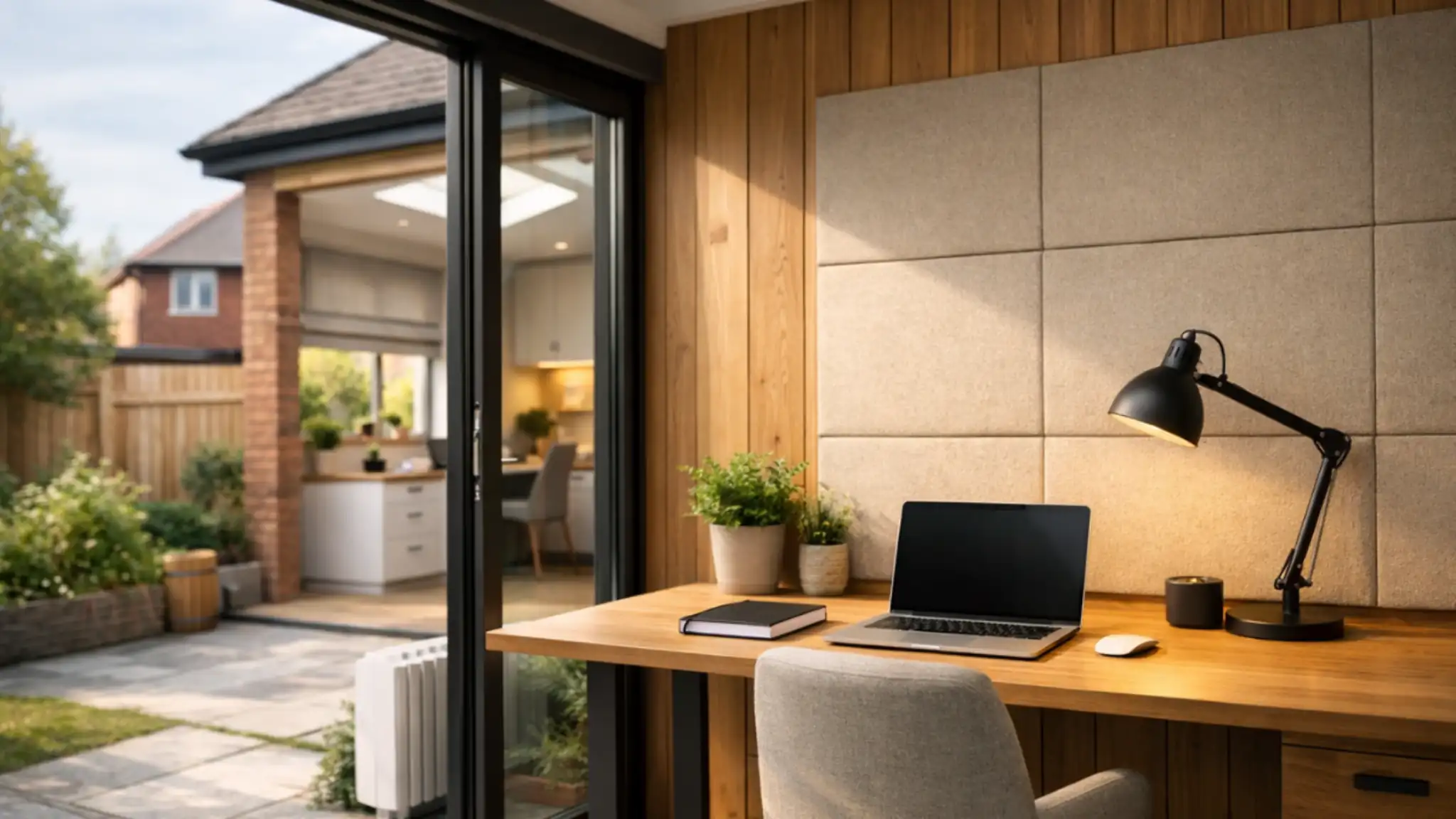
Hard floors and bare walls can make calls sound harsh. Rugs, curtains, bookcases and acoustic panels can improve things dramatically. If you are building a new room, include sound-reducing insulation in walls/ceilings where practical.
5) Design for overheating (especially garden rooms)
South-facing glazing looks fantastic — but it can overheat quickly. Consider solar control glass, external shading, opening windows, and a realistic ventilation plan. Heating and cooling choices should match how often you use the space.
If a garden room is your plan, you may also find this useful: heating options explained.
Planning permission & Building Regulations: what homeowners miss
When people search for Inspiring Home Offices, they often focus on design first — and only think about planning/building regs when they hit a snag. A quick check early on can save weeks.
Do I need planning permission for a home office?
It depends on what you’re doing. Some work is covered by permitted development, but limits apply and local constraints can change what is allowed (for example conservation areas, listed buildings, or local restrictions).
- Garden rooms / outbuildings: may be permitted development if they meet size/height/location limits and are for incidental use — but not in every case.
- Extensions: may be permitted development within limits, but many proposals still need a planning application.
- Conversions: often planning-light, but building regs-heavy (especially lofts/garages).
If you want a plain-English starting point, use: Do I need planning permission?
Building Regulations and building control (comfort and safety)
Even where planning is straightforward, Building Regulations can be the bigger issue for home offices — particularly for insulation, ventilation, electrics, fire safety, and structural alterations.
If you are unsure what “sign-off” looks like, these guides help: Building Regulations guide and Building Control explained.
Want to build an office without planning headaches?
We can advise on the best route for your home, prepare compliant drawings, and guide you through planning and building control.
Step-by-step: how to plan a home office project (without stress)
Whether your office is a garden room, extension, or conversion, a simple process keeps things calm and avoids expensive U-turns.
Home office planning checklist (UK homeowners)
| Step | What to do | Why it matters |
|---|---|---|
| 1) Define how you work | Calls all day? Dual monitors? Client visits? Storage needs? | Stops you building a “pretty room” that is awkward to use. |
| 2) Choose the best location | Garden room vs extension vs conversion vs spare room. | Determines cost, disruption, and compliance route. |
| 3) Sketch the layout | Desk position, storage, sockets, lighting, window/door positions. | Solves glare, cables, and clutter before they happen. |
| 4) Check permissions early | Planning permission / PD checks + Building Regs overview. | Avoids redesign after you’ve committed to a layout. |
| 5) Get drawings & scope | Clear plans for pricing, approvals, and build accuracy. | Reduces “guesswork” quotes and variations on site. |
| 6) Build with comfort in mind | Insulation, ventilation, heating, acoustics, shading. | Creates a space you actually want to use year-round. |
Common gotchas (noise, heat, electrics and neighbours)
Noise and echo (especially on calls)
If you are in a lively household, prioritise sound. Soft finishes help echo, while construction build-up helps block noise transfer. If you are converting a garage/loft, think about how sound travels through ceilings and party walls.
Overheating and glare
Glass is brilliant for light, but too much sun can make the room uncomfortable. Plan shading and ventilation from the start — it is far easier than retrofitting later.
Undersized electrics and weak broadband
Add more sockets than you think you need and plan data. A separate office at the end of the garden can be a Wi-Fi dead zone without proper thought.
Neighbours, boundaries and “visual impact”
Even when something looks small on paper, a building close to a boundary can feel big next door. Thoughtful height, roof form and window positions can avoid complaints and delays.
Garden room vs extension vs conversion: which creates the best home office feel?
If you want a quick rule of thumb:
- Garden room: best separation and focus, but needs the best insulation/ventilation to feel “proper”.
- Extension: best long-term flexibility and value, but more likely to need drawings and neighbour-sensitive design.
- Conversion: efficient use of existing space, but comfort depends on structure, insulation and layout constraints.
- Existing room upgrade: fastest route — perfect when you want impact without a major build.
FAQs: Inspiring Home Offices
These are the most common homeowner questions we see around home office ideas and feasibility.
Home office inspiration UK: what’s the easiest way to get a “proper” setup?
Start with comfort and function, then style. The easiest “proper setup” usually comes from improving an existing room: good lighting (plus a blind), a desk position that avoids glare, extra sockets, storage, and a few soft finishes to reduce echo. If you want true separation, a garden room can be excellent — but only if it is designed for year-round use.
Home office industry: are garden rooms and conversions actually common in the UK now?
Yes — we are seeing far more homeowners create dedicated workspaces through garden rooms, garage conversions and loft conversions. The key is choosing the route that suits your house and budget, then checking planning/building control early so you do not end up reworking the design later.
Home office insights: what do people regret most after building a home office?
The biggest regrets tend to be practical: overheating in summer, poor sound control for calls, not enough sockets, messy cable routes, and weak Wi-Fi. Style is easy to change later; comfort and infrastructure are not — so it’s worth getting insulation, ventilation and power/data right from day one.
How many offices does home instead have?
This is a brand-specific question. If you mean “how many offices does Home Instead have in the UK?”, the number changes over time as franchises open/merge. If you tell us which area you are looking at, we can point you to the right official listing and help you compare options for your own home office project if that is what prompted the search.
Next steps & useful guides
If you are turning inspiration into a real build, these PME guides will help you move forward with fewer surprises:
- Garden office rules explained
- Garden room planning guide
- Extension permission basics
- Building Regulations guide
- Building Control explained
- Best “feel”A separate garden room or well-designed extension tends to feel most like a dedicated workspace.
- Best low-friction optionUpgrading an existing room (light control, power, storage, acoustics) is usually the quickest win.
- Most common mistakesOverheating, poor sound control, not enough sockets, and weak broadband to the workspace.
- Compliance reminderPlanning permission and Building Regulations depend on the project type and local constraints — check early to avoid rework.
External references (for UK guidance)
Ready to turn your home office idea into a compliant plan?
Plans Made Easy can advise on the best route, prepare drawings, and guide you through planning permission and building control — so your new workspace feels great and stays problem-free.

Performance Verified ✅
This page meets PME Optimisation Standards — achieving 95+ Desktop and 85+ Mobile PageSpeed benchmarks. Verified on

