
Share this post:
Quick summary: how big can I build a garage without planning permission?
In many cases across England, you can build a garage without needing full planning permission, provided you follow Permitted Development rules. These rules allow outbuildings like garages within certain size and height limits — but there are important conditions.
- Max height: 2.5m if within 2m of a boundary; up to 4m for a dual-pitched roof elsewhere.
- Max eaves height: 2.5m in all cases.
- Max coverage: No more than 50% of your garden’s original area can be covered by outbuildings.
- Use: The garage must be for “incidental use” (e.g. storage, parking), not for living or business purposes.
While many garages are allowed under Permitted Development, there are restrictions — especially in conservation areas, for listed buildings, or where your council has removed PD rights. Always check before you build.
Unsure if your garage needs planning permission?
Send us the size, location and use of your proposed garage – we’ll tell you if it likely falls under Permitted Development.
What are the rules for garage Permitted Development?
Under the General Permitted Development Order (GPDO), homeowners can build certain types of structures without applying for full planning permission. Garages often qualify — but only if they meet all the conditions under Class E of the GPDO.
These rules apply only if the garage is:
- Within the curtilage of a single dwellinghouse (not flats or maisonettes),
- Incidental to the enjoyment of the home (e.g. storage, car parking),
- Not forward of the principal elevation (i.e. not in front of your house),
- Within the height and footprint limits below.
Size and height limits: how big can a garage be without planning permission?
If you’re building a standalone garage or outbuilding under PD rights, the following limits apply:
✔️ Height limits for garages
- Max eaves height: 2.5 metres (for all garages)
- Max overall height:
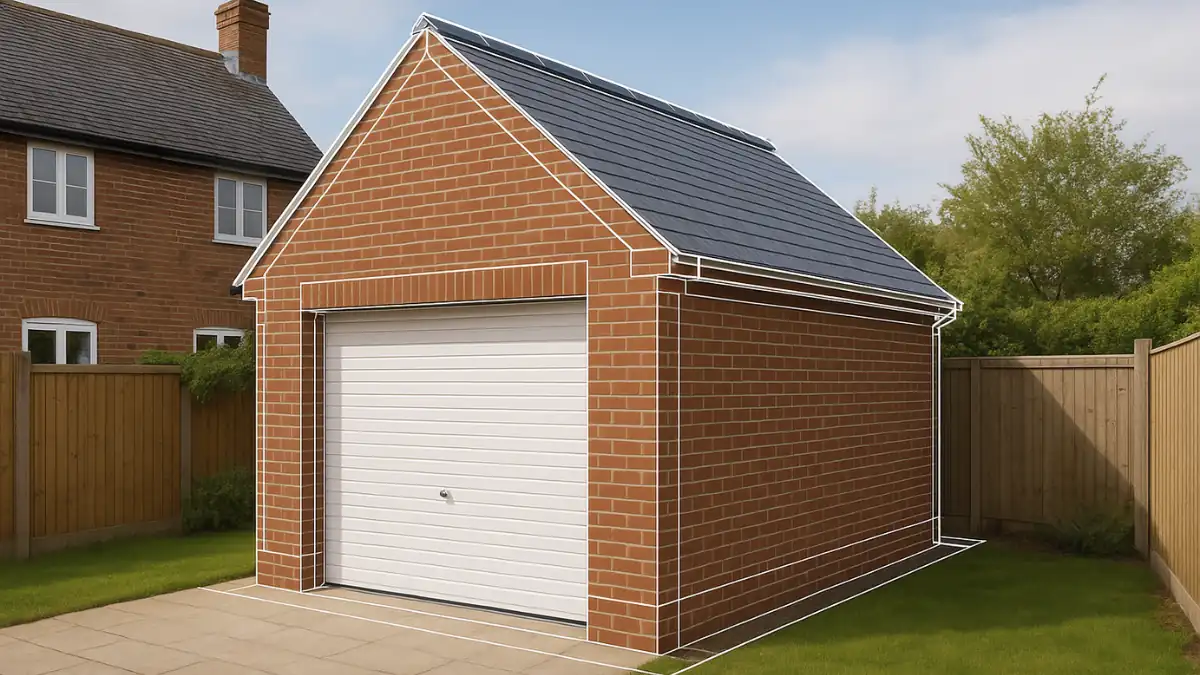
- 4 metres for a dual-pitched (e.g. gable) roof
- 3 metres for any other roof (e.g. flat roof)
- 2.5 metres if within 2 metres of the boundary
✔️ Footprint and coverage
- Garages must not take up more than 50% of the total garden area (excluding the original house footprint).
- That includes all outbuildings combined — not just the garage.
✔️ Distance from boundaries and roads
- No part of the garage can be in front of the principal elevation facing a highway.
- Garages within 2 metres of a boundary are restricted to 2.5 metres height.
When do you need planning permission for a garage?
You will likely need full planning permission for a garage if:
- The garage exceeds any of the height or coverage limits above,
- You want to place it in front of your house (facing the road),
- Your property is in a Conservation Area, National Park or AONB,
- Your house is listed and any part of the garage touches the main house,
- Your Permitted Development rights have been removed — for example, on newer housing estates.
What “use” is allowed under Permitted Development?
Garages built under Permitted Development must be used for “incidental” purposes — not as a main living space.
- ✅ Acceptable: storage, vehicle parking, home gym, garden equipment, workshop (light use)
- 🚫 Not allowed: self-contained living, separate dwelling, business use, Airbnb/letting, full home office in some cases
If you want to use the garage as a home office or for something more than incidental use, it may trigger planning permission or even Building Regulations upgrade.
Not sure if your garage plans fall under Permitted Development?
Send us your proposed dimensions and we’ll confirm if it’s likely to qualify — or if planning permission is safer.
Local council restrictions and quirks
Even if your garage falls within the general PD rules, it’s smart to check:
- If your area has an Article 4 Direction removing PD rights
- Whether you’re in a Conservation Area or have other designations
- If a previous planning permission removed PD rights
Some councils also have informal expectations about garage appearance, materials and positioning — even if PD technically applies. If in doubt, a Lawful Development Certificate is worth considering.
Do garages need Building Regulations approval?
Yes — in many cases. Even if you don’t need planning permission, your garage may still need to meet Building Regulations depending on:
- Whether it’s attached to the house,
- Its size,
- If it contains electrics or drainage,
- How it’s constructed (foundations, walls, roof, fire separation).
Our guide on Building Regulations explains more — or you can ask our team to check what’s required for your project.
FAQs: how big can I build a garage without planning permission
Can I build a garage up to 4 metres high without planning?
Yes — but only if it has a dual-pitched roof and is at least 2 metres from any boundary. If it’s closer than 2m to a boundary, the limit is 2.5m regardless of the roof type.
Does a garage count towards the 50% garden coverage limit?
Yes. All outbuildings (shed, garage, summerhouse etc.) combined must not cover more than 50% of your garden, excluding the area covered by the original house.
Can I convert my garage into a room later without planning?
Possibly — but converting a garage to a living space usually requires planning permission, especially if it changes the appearance of the building or its use class.
Can I put a garage in front of my house under PD?
No. PD rights don’t allow garages (or any outbuilding) to be placed forward of the principal elevation facing a highway. You’ll need planning permission in this case.
What if I’ve already used up my PD rights with other extensions?
If previous works (e.g. large extension, garden room) have used up your PD “allowance,” a garage may require planning permission even if it’s small. Always check first.
Still not sure if your garage qualifies?
We’ll review your layout and flag whether a planning application is needed — or if a Lawful Development Certificate is a safer bet.
- Max height (dual-pitched)4m — if over 2m from any boundary
- Max height (flat roof)3m — if over 2m from boundary
- Height near boundary2.5m max within 2m of any boundary
- Max garden coverage50% of the total area around the original house
- Permitted Development conditionsNo siting forward of principal elevation; must be for incidental use only
- Common planning triggersListed buildings, conservation areas, estate restrictions, over height/coverage
Next steps & useful guides
If you're still planning your garage or checking what’s allowed, these PME guides are essential reads:
- Do I Need Planning Permission?
- Planning Permission for a Shed — Rules, Sizes, Council Quirks & PD Checklist
- Planning Permission Drawings: A Complete Guide for Homeowners
- Do I Need Planning Permission for a Garage?
- Building Regulations: Complete Homeowner’s Guide
- Planning Permission: The Complete Homeowner’s Guide
- Outbuildings Explained – What You Can (and Can’t) Build Without Permission
Official guidance
Check the official sources for national guidance and permitted development rules:
- Planning Portal — Permitted Development and Outbuilding Guidance
- GOV.UK — Planning Permission Rules in England & Wales
How Plans Made Easy can help
Every garage project is slightly different — and the consequences of guessing wrong on planning rules can be expensive. Our team reviews garage plans every week and can quickly tell you whether you’re covered under PD or if a full application is needed.
We can also prepare Lawful Development Certificate drawings to confirm your garage is compliant — giving you peace of mind if you ever sell the property or face enforcement.
Need clear drawings or guidance on your garage plans?
We help homeowners stay compliant and avoid surprises. Send us your garage idea — we’ll guide you from sketch to approval.

Performance Verified ✅
This page meets PME Optimisation Standards — achieving 95+ Desktop and 85+ Mobile PageSpeed benchmarks. Verified on

