
Share this post:
Quick summary: Home Offices Garden
If you’re planning Home Offices Garden space (a garden room, cabin or shed-style workspace), you often won’t need planning permission if it meets Permitted Development rules — but there are common triggers that mean you do need to apply.
- Most people need planning when it’s too tall, too close to a boundary, takes up too much garden, or the property has restrictions (e.g. conservation area, listed building, Article 4).
- How you use it matters: a quiet home-working room is usually fine, but anything that looks like a separate dwelling or a business with regular visitors can push you into full planning.
- Building Regulations can still apply even when planning permission doesn’t — especially for electrics, insulation, fire safety and foundations.
The safest route, if you want certainty for future sales and mortgages, is often a Lawful Development Certificate (LDC) — it’s not mandatory, but it’s a very practical “proof” document to keep.
Not sure if your garden workspace needs planning permission?
Tell us your rough size, height and where it will sit in the garden — we’ll sense-check it against Permitted Development and flag any local “gotchas”.
Quick summary: Home Offices Garden
For many homes in England, Home Offices Garden projects can be built under Permitted Development (meaning no planning permission) if the structure stays within key limits and it remains incidental to the main house.
However, planning permission is common where the building is tall, sits near a boundary, covers too much of the garden, or the property is in a restricted area (like a conservation area) — and Building Regulations can still apply even when planning doesn’t.
Home Offices Garden: do you need planning permission?
Most homeowners start with the same question: “Can I put a small workspace at the bottom of the garden without involving the council?”The reassuring answer is: often, yes — provided your project fits within Permitted Development (PD) rules and it’s genuinely an outbuilding that’s incidental to the main house.
That said, Home Offices Garden proposals get caught out in predictable ways: height limits, boundary rules, over-development of the garden, and (surprisingly often) the intended use.A quiet, insulated room for home working is usually straightforward. A setup that looks like a separate dwelling, a rental, or a business with regular client visits is where you need to slow down and check properly.
This article supports our pillar guide:our outbuildings explainer— it’s the best place to start if you’re comparing different garden structures and what you can (and can’t) build without permission.
Permitted Development vs full planning: what changes?
Homeowners sometimes assume “no planning permission” means “no rules”. In reality, there are two separate checks:
- Planning (PD vs full planning): Is the development acceptable in principle and does it meet PD limits?
- Building Regulations / Building Control: Is it safe, structurally sound, insulated/ventilated correctly, and compliant (electrics in particular)?
Under PD, you’re essentially saying: “This garden building stays within the national rules, so it doesn’t need a planning application.”Under full planning, you’re asking the council for permission because you’re outside PD limits or your property has restrictions.
The main planning permission triggers for Home Offices Garden projects
Below are the most common reasons a garden office / room ends up needing full planning. Some are hard limits, and some depend on context — but these are the checks we run first when homeowners ask us for a quick answer.
1) Height limits and “close to boundary” rules
Height is one of the fastest ways to fall outside PD — especially if you’re trying to create a more “room-like” feel with taller walls, deep roof build-ups, or a pitched roof.Also, PD treats structures differently when they’re close to a boundary, so where it sits matters almost as much as how tall it is.
2) Coverage: taking up too much of the garden
Even if height is fine, PD can be lost if the total area of buildings/structures starts to look like over-development of the plot.Councils also tend to be less relaxed where garden buildings dominate the space or significantly change the character of the rear garden.
3) Location: forward of the principal elevation
Outbuildings are usually expected to be to the rear. If the only workable spot is in front of the main elevation (or looks prominent from the street), it often moves you away from a simple PD position.
4) Restricted properties and local constraints
Planning permission is more likely (or PD rights can be limited) if your home is:
- in a conservation area,
- a listed building or within its curtilage,
- subject to an Article 4 direction, or
- a newer estate with planning conditions restricting outbuildings.
If you’re in any of the above, it’s worth reading our guides onarea restrictionsandworks to protected buildingsbefore you commit to a design.
5) Use: “home office” vs separate living accommodation
“Home office” use is normally considered incidental to the enjoyment of the dwellinghouse — which is what PD expects for an outbuilding.Problems start when the space looks or functions like:
- a self-contained annexe (kitchen facilities, full-time sleeping, independent access/use),
- a rental unit, or
- a business premises with regular visitors, deliveries, signage or parking impacts.
Building Regulations for Home Offices Garden spaces (what most people miss)
Even when planning permission isn’t needed, Building Regulations can still apply — and “I bought a pod online” doesn’t remove your responsibility as the homeowner.The key is: will it be used as a proper, year-round room with electrics, heating and insulation? If yes, you should treat it as a serious building project.
Common Building Regs touchpoints for a garden office
- Electrics (Part P): new circuits and most external electrical work should be designed/installed and certified properly.
- Thermal performance (Part L): if it’s a habitable, heated space, insulation and heat loss matter.
- Ventilation (Part F): condensation and mould risk rises fast in small insulated rooms.
- Fire safety (Part B): materials, separation and escape considerations can come into play depending on layout and proximity.
- Structure and foundations (Part A): ground conditions, drainage runs, trees, and settlement are real-world issues.
If you want a clear overview of how Building Control gets involved and what inspections look like, see:our Building Control guideandour Building Regulations overview.
Quick costs snapshot (typical ranges homeowners budget for)
- Basic garden workspace shell: often £5,000–£12,000+ depending on size/spec.
- Insulated, year-round room spec: commonly £12,000–£30,000+ (higher if bespoke glazing/finishes).
- Drawings & compliance support: varies by scope — especially if you need an LDC, planning submission, or Building Regs drawings.
- Council fees: planning fees (if needed) are paid to the local authority; LDC fees (if chosen) are separate too.
These are broad UK homeowner ranges. The biggest price drivers are usually size, insulation/heating approach, glazing, groundworks, and how much is prefabricated vs built on site.
Costs & timelines: what to expect
Timing depends on whether you’re staying within PD or applying for permission.A PD-compliant build can move quickly once the design is set and contractors are booked.If full planning is needed, you’ll usually need to allow time for drawings, submission and the council’s decision window.
- Design + drawings: often 1–3+ weeks depending on survey needs and revisions.
- Planning decision (if required): typically weeks rather than days — and can extend if further information is requested.
- Build programme: anything from a few days (some modular installs) to several weeks (bespoke builds with groundworks and services).
If you’re trying to plan around a deadline (for example, a house move or a return-to-office policy), our guide toplanning timescaleshelps you set a realistic schedule.
Want a clear “PD or planning?” answer before you spend money?
We’ll check your proposed location, height and use, and tell you the safest route (including whether an LDC is worth it).
Step-by-step: how to plan Home Offices Garden space properly
If you want to avoid delays, neighbour complaints and expensive redesigns, follow this simple process before you order a kit or hire a builder.
Home Offices Garden checklist (quick “do this first” list)
- Confirm your property type and constraints. Houses are usually eligible for PD; flats are not. Check for conservation/listed/Article 4 restrictions.
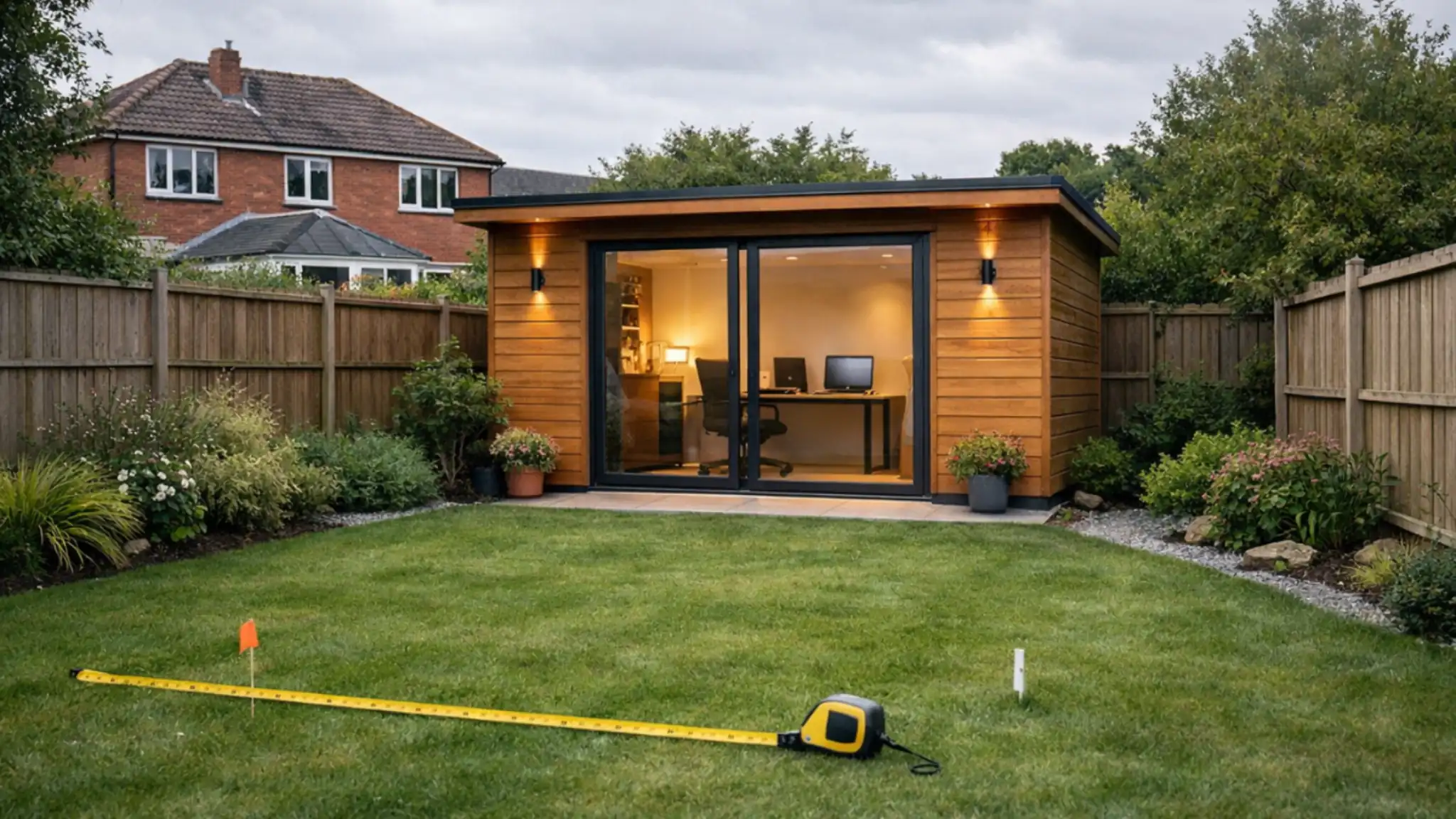
- Mark the proposed footprint on the ground. It’s the quickest way to sense-check bulk, overlooking and how it feels from neighbours’ windows.
- Check heights realistically. Include base build-up, finished floor levels, roof thickness and any upstands.
- Decide the use in plain English. Home working is usually fine; avoid anything that looks like a separate dwelling unless you’re planning for permission.
- Plan services early. Power, data, drainage (if any), and how you’ll heat/ventilate it changes the build approach.
- Get the right drawings. For PD certainty, consider an LDC; for planning, ensure your submission drawings are clear and complete.
- Line up Building Control where needed. Especially for electrics, insulation and anything structural beyond a basic shed.
If you’re unsure what drawings are normally needed for a smooth submission, these guides help:our planning drawings guideandour drawings checklist.
Pitfalls & gotchas (the things that cause refusals or complaints)
Here are the issues we see most often when homeowners try to move fast on a garden workspace:
- “It’s only a shed” thinking. Once it’s insulated, heated and wired, it needs a more careful compliance approach.
- Boundary sensitivity. Height, overlooking and visual dominance can trigger neighbour objections even when PD is possible.
- Drainage and trees. Groundworks near drains or tree roots can create expensive surprises.
- Buying a design that doesn’t fit your site. Off-the-shelf sizes don’t always suit narrow gardens, sloping ground or awkward access.
If you’re worried you might already be in a risky position, our guide onwhat refusals mean and what to do nextis a sensible read before you take action.
Related comparisons (to help you choose the right route)
- Shed-style workspace vs fully insulated garden room: quicker and cheaper vs better year-round comfort and compliance needs.
- Permitted Development vs full planning: faster route vs more flexibility if you need extra height/scale.
- Planning drawings vs Building Regulations drawings: “is it acceptable?” vs “is it buildable and compliant?”
Local council quirks (why checking locally still matters)
Even with national PD rules, different councils can be stricter on what they expect to see in drawings and how they interpret “incidental” use.If your area is sensitive (tight plots, overlooking risks, conservation constraints), getting the wording and drawings right can prevent delays.
FAQs: Home Offices Garden
Do I need planning permission for a garden home office?
Often no — many garden workspaces fall under Permitted Development if they meet key limits (especially height and boundary rules) and remain incidental to the main house. However, you may need planning permission if the building is too large/tall, placed in a sensitive position, or your home has restrictions such as a conservation area, listed status or an Article 4 direction.
Does it matter if it’s a “garden room”, “shed”, “cabin” or “studio”?
The label matters less than the facts: size, height, siting, and how it’s used. A shed-style structure can still need permission if it breaks PD limits, and a high-spec garden room can still be PD-compliant if it’s designed correctly for your site.
Can I sleep in it or rent it out without planning permission?
This is where caution is needed. If the space functions like separate living accommodation (or is used as a rental unit), it’s more likely to be treated as something beyond an incidental outbuilding, and full planning may be required. If that’s your aim, it’s best to take advice before building.
Do I need Building Regulations for a garden office?
Sometimes, yes. Even when planning permission isn’t required, Building Regulations can apply depending on how the room is built and used — especially for electrics, insulation, ventilation and structural elements. Treat any heated, insulated, wired workspace as a “real” building project from a compliance perspective.
Should I apply for a Lawful Development Certificate (LDC)?
If you want certainty (and an easy proof document for solicitors/buyers later), an LDC can be a sensible move. It’s optional, but it reduces uncertainty if there’s any doubt about PD compliance or restrictions affecting your property.
What drawings do I typically need?
For a clean, low-hassle process, you usually want clear existing and proposed drawings showing size, position in the garden, and heights. If you’re applying for permission (or an LDC), accuracy matters — it’s worth using properly prepared drawings to avoid delays and rework.
Want us to sanity-check your garden office plan?
We’ll highlight any planning triggers, suggest risk-reducing tweaks, and tell you whether an LDC is worth it.
Next steps & useful guides
If you’re ready to move from idea to a compliant build, these PME guides are the most helpful next clicks:
- Outbuildings explained (pillar guide)
- Our plain-English planning permission checklist
- Guide to permissions for garden buildings used as rooms
- Guide to permissions for shed-style garden buildings
- Building Regulations for garden rooms (what matters most)
- Planning timelines and what can delay approval
- What good planning drawings include (and why it matters)
- What Building Control inspections look for
- Planning permission (often)Many garden workspaces can be built under Permitted Development, but height, boundary position, coverage and restrictions are common triggers for full planning.
- Use mattersA quiet home-working room is usually “incidental”. Anything that looks like a separate dwelling or a rental is higher risk and often needs proper planning advice.
- Building RegulationsCan still apply even when planning doesn’t — especially for electrics, insulation, ventilation and structure.
- Best “certainty” optionA Lawful Development Certificate is optional but useful as written proof that the build is lawful under PD.
- Common gotchaQuoted heights can be misleading once you add floor build-ups, foundations and roof thickness — check final heights before you order.
- Practical next stepDo a quick PD check, confirm constraints, then get the right drawings so you don’t pay twice.
If you want a calm, clear answer for your property, send your rough dimensions and a sketch to Plans Made Easy and we’ll point you to the safest route.
Official guidance
For national rules and the most up-to-date official guidance, these are the best starting points:
- Planning Portal – national planning guidance and application information
- GOV.UK – planning permission in England and Wales
Conclusion: the low-stress way to get your garden office approved
A well-designed garden workspace can be one of the most useful upgrades you make — but it’s worth getting the compliance side right first time.In most cases, you can keep things simple by designing to Permitted Development limits, choosing a sensible position in the garden, and being clear that the use is incidental to the house.
Where homeowners run into trouble is usually preventable: heights that creep over limits, boundary placements that raise objections, and layouts that look like separate accommodation.If you check those early — and treat Building Regulations seriously where relevant — you avoid delays, complaints and costly redesigns.
Ready to move your project forward?
Plans Made Easy can prepare compliant plans, manage submissions, and guide you from idea to approval.

Performance Verified ✅
This page meets PME Optimisation Standards — achieving 95+ Desktop and 85+ Mobile PageSpeed benchmarks. Verified on

