
Share this post:
Quick summary: Garden Office planning permission
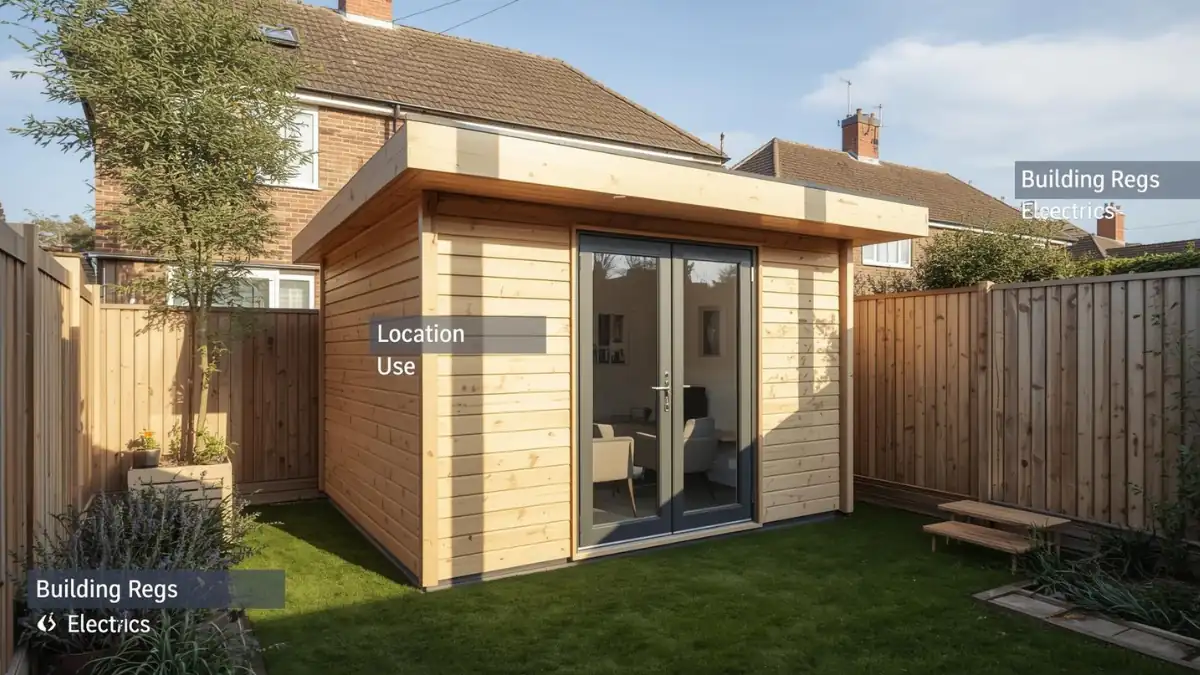
Most homeowners can build a Garden Office under permitted development, meaning you may not need a full planning application — but only if you stay within key rules on height, location and use.
- Height matters most: within 2m of a boundary, the overall height is usually limited to 2.5m.
- It must be incidental to the house (working space, hobbies, storage) — not a separate dwelling.
- Coverage limits apply: outbuildings can’t take up more than 50% of your garden (as a rule of thumb).
- Conservation areas / listed buildings: rules tighten and you may need consent even for small changes.
- Building Regulations can still apply (especially for electrics, insulation, fire safety, or if you add a toilet).
If you’re close to a boundary, planning to run a business from it, or you want to sleep in it, it’s worth getting a quick check (and often a Lawful Development Certificate) before you commit.
Not sure if your garden building idea is permitted development?
Tell us what you’re planning and we’ll sense-check it against the common council rules before you spend money on installation.
Quick summary: Garden Office planning permission
In many cases, a Garden Office can be built without a planning application because it falls under permitted development. However, you still need to follow the main limits on height, position, and how it’s used. If you get one of these wrong, a “quick install” can quickly turn into a planning headache.
If you want certainty (especially near boundaries or in a conservation area), a Lawful Development Certificate is often the calmest way to protect yourself before you build.
Do you need planning permission for a Garden Office?
This is the big question we hear every week. The honest answer is: sometimes yes, sometimes no.A Garden Office often counts as an outbuilding in planning terms. If it meets the permitted development rules, you may not need to apply.If it doesn’t, then a householder planning application is usually required.
Also, remember that planning and Building Regulations are separate systems. Even when planning permission isn’t needed, you may still need Building Control involvement for things like electrics, insulation standards, or fire safety.Our team sees people trip up here because they assume “no planning” means “no rules”.
Permitted development rules for a Garden Office (size, height & location)
Permitted development is basically a set of pre-approved rules that allow certain household changes without a full planning application.For a Garden Office, the key checks usually revolve around where it sits, how tall it is, and whether it stays “incidental” to the house.
Garden Office location rules (where you can place it)
- It should usually be within the curtilage of the house (your normal garden area).
- It shouldn’t be placed forward of the principal elevation (in front of the house) in most typical setups.
- On designated land (which can include conservation areas and similar), extra restrictions can apply.
Garden Office use rules (what you can use it for)
For permitted development, the building must be for a purpose that is incidental to the enjoyment of the dwelling.In normal homeowner language, that includes things like:
- Working from home (desk space, meetings on video calls, admin).
- A hobby room or studio.
- A gym, workshop, or storage area (as part of the home use).
When planning permission is required for a Garden Office
Planning permission is more likely when the design, location, or use goes beyond what permitted development allows.In practice, we see the same triggers come up again and again:
- Height and boundary issues (especially if you’re close to neighbours).
- Using it as accommodation (bedroom, annex-style use, or anything that looks like “living independently”).
- Business use that changes the character of the property (regular client visits, staff, deliveries, signage, noise).
- Conservation areas, listed buildings, or Article 4 directions that restrict permitted development.
- Balconies, raised decking, verandas or features that increase overlooking and neighbour impact.
If you’re in any of these categories, it doesn’t mean you can’t build it. It just means you should plan the process properly(and avoid a stressful “retrospective” situation later).
Not sure if your Garden Office fits permitted development?
We’ll check your idea against the common PD rules and tell you whether you’re likely to need a planning application or an LDC.
Garden Office size & height rules explained simply
Most planning “surprises” happen because the supplier focuses on floor area, while the council focuses on height and siting.Here are the typical limit areas to be aware of before you buy or design anything.
Garden Office height limits (what usually matters)
- Within 2m of a boundary: overall height is typically limited to 2.5m.
- Further than 2m from a boundary: you may have more flexibility (for example, taller ridges with pitched roofs).
- Eaves height can also be relevant, particularly on pitched roof designs.
Garden Office footprint and “50% garden coverage” rule of thumb
Another common permitted development limit is that outbuildings and additions shouldn’t cover more than roughly half of the curtilage(your garden area around the original house). This isn’t always as obvious as it sounds, because patios, sheds and previous extensions can affect the calculation.
Garden Office placement: boundaries, neighbours and overlooking
Even if you’re within the permitted development rules, it’s still sensible to think like a planning officer:will this create overlooking, noise, or an overbearing structure next door?If yes, it’s worth adjusting the design early — it’s much easier than fixing conflict after installation.
Quick costs snapshot – what people usually budget for
- Design + drawings: varies depending on complexity and whether you need an LDC or full planning submission.
- Groundworks + base: can be a major cost driver, especially with awkward access or sloping gardens.
- Electrics + data: power, lighting, sockets, and often a more robust Wi-Fi solution.
- Insulation + heating: important for comfort, and can trigger Building Regs expectations depending on the build.
If you want to understand wider project costs and what fees sit where, our guide on overall planning fees can help you build a realistic budget.
Building Regulations for a Garden Office (Part P, insulation & fire)
Planning permission is only half the story. A Garden Office can still fall under Building Regulations depending on size, construction, proximity to boundaries, and what you intend to use it for.The most common triggers we see are electrical work, insulation/thermal upgrades, and fire safety expectations.
When Building Regulations may apply
- Electrics: new circuits and certain electrical work are controlled under Part P.
- Sleeping accommodation: using it as a bedroom changes the risk profile and usually increases compliance expectations.
- Large or complex buildings: bigger footprints and higher-spec builds can bring Building Control into play.
- Close to boundaries: materials and fire performance can become especially important.
If you want the deeper Building Regs picture (including typical exemptions and what inspectors look for), these guides are worth reading before you finalise your design:our Building Regulations overviewandour plain-English guide to Part P.
Step-by-step: how to check if your Garden Office is compliant
If you want to avoid council issues, the best approach is to check compliance before you order anything.Here’s the process we use with homeowners when we’re sense-checking a proposal.
How to check your Garden Office (simple checklist)
| Check | What you’re looking for |
|---|---|
| Property type | House vs flat/maisonette; any restrictions or removed permitted development rights. |
| Location | Not forward of principal elevation; within the normal garden/curtilage. |
| Height | Distance to boundaries; roof type; confirm final overall height (not brochure height). |
| Coverage | Roughly no more than 50% of curtilage covered by buildings (including existing sheds/outbuildings). |
| Use | Incidental to the home; avoid “separate dwelling” features unless you’re planning properly. |
If you want a clear “paper trail”, you can also consider a Lawful Development Certificate.It’s not always mandatory, but it’s a very practical way to prove your build was lawful — especially if you plan to sell later.(We often recommend it when the design is close to the limits.)
If you’re still at the “do we need permission at all?” stage, start with this guide:our planning permission checker guide.
Common Garden Office planning pitfalls (the “gotchas”)
Even careful homeowners can get caught out, because marketing brochures don’t always match planning definitions.Here are the biggest issues we see in real projects.
- Building too close to the boundary and accidentally exceeding the 2.5m limit.
- Raising ground levels (new platforms, bases, or landscaping) which changes how height is measured.
- Adding a veranda or deck that increases overlooking and triggers neighbour complaints.
- Using it as living accommodation without planning for that use properly.
- Ignoring constraints in conservation areas, listed buildings, or estates with removed PD rights.
If you’re in a sensitive area, these two guides are useful background reading before you commit:our conservation area guideandour listed building guide.
Garden Office comparisons (garden room vs log cabin vs home extension)
Homeowners often compare a Garden Office to other options before deciding what to build. This is a sensible step, because the best choice depends on how you’ll use the space year-round.
Garden building vs a home extension
- Faster build: garden buildings are usually quicker and less disruptive than a house extension.
- Separate space: it can feel more like “going to work”, which many people prefer.
- Different compliance triggers: extensions bring different planning and Building Regs requirements than outbuildings.
Garden building vs log cabin
Log cabins can look great, but the planning and Building Regs questions don’t disappear just because the material is timber.Height, boundaries, and use still matter — and in some locations, the appearance can influence neighbour impact more than you’d expect.
FAQs: Garden Office planning permission
Do I need planning permission for a Garden Office in the UK?
Often, no — many garden buildings fall under permitted development. However, you must meet the rules on height, location, garden coverage, and “incidental” use. If you’re close to a boundary, in a conservation area, or planning anything like living accommodation, get it checked first.
What size Garden Office can I build without planning permission?
There isn’t one single “magic size”. Councils usually care more about whether the proposal fits permitted development limits (including overall garden coverage) and whether it creates neighbour impact. The safest way forward is to confirm your footprint, siting and height together rather than focusing on floor area alone.
How tall can a Garden Office be?
Height limits depend on roof type and, crucially, distance to boundaries. The most common issue is being within 2 metres of a boundary, where the overall height is typically limited to 2.5 metres. Always check the final external height from ground level (not the internal ceiling height).
Can I use a Garden Office as a bedroom?
This is where you need to be careful. Sleeping accommodation can change how the council views the building, and it may trigger planning and Building Regs requirements that wouldn’t apply to a simple workspace. If overnight use is part of the plan, it’s worth getting proper advice early.
Can a Garden Office have a toilet?
Potentially, yes — but adding a WC usually increases the compliance considerations (drainage, ventilation, electrics, and sometimes Building Control involvement). It can still be doable, but it’s rarely a “no paperwork” upgrade, so factor it in from the start.
Do I need permission for a Garden Office in a conservation area?
Possibly. Conservation areas can come with tighter controls, and some permitted development rights may be restricted. The safest approach is to check local constraints and consider an LDC if you’re relying on permitted development.
Does a Garden Office add value?
It can, especially if it’s a comfortable, usable space with good insulation, power, and a sensible layout. Value is very property- and location-dependent, though, so focus first on building something compliant and well-finished — that’s what tends to protect resale.
Is a Garden Office tax deductible or a business expense?
This depends on your personal tax position and how the space is used. We can help with the planning and compliance side, but for tax treatment you should speak to an accountant who can advise based on your exact circumstances.
Can a Garden Office be moved later?
Some modular buildings can be moved, but planning and Building Regs questions can still apply to the original installation. Also, moving it later may create a new set of compliance checks for the new location, especially if boundaries and heights change.
Next steps & useful guides
If you want to go a level deeper (or you’re planning a larger garden building with heating, electrics and year-round use), these guides can help:
- Read the full guide for standalone garden buildings
- Permitted development rules for outbuildings explained
- What Building Control does (and what inspectors look for)
- Building regs considerations for garden buildings
- How to view local planning decisions near you
- Typical routeMany garden offices fall under permitted development, but you still must meet the limits.
- Biggest trip-upHeight near boundaries (especially within 2m) and unclear “incidental” use.
- Use ruleShould remain incidental to the home — avoid anything that looks like a separate dwelling unless you’re planning properly.
- Sensitive locationsConservation areas, listed buildings and Article 4 directions can reduce permitted development rights.
- Building RegsPlanning and Building Regs are separate. Electrics (Part P) and fire/insulation considerations can still apply.
- Best “peace of mind” optionA Lawful Development Certificate is often worth it when your design is close to the limits.
Want us to sense-check your proposal before you buy? Send our team your rough dimensions and a sketch.
Official guidance
For national guidance and the latest official wording, it’s always worth checking:
- Planning Portal – national guidance and application information
- GOV.UK – planning permission in England & Wales
Ready to move your project forward?
Plans Made Easy can prepare compliant plans, guide you on permitted development, and help you submit the right application (or LDC) with confidence.
Performance Verified ✅
This page meets PME Optimisation Standards — achieving 95+ Desktop and 85+ Mobile PageSpeed benchmarks. Verified on

