
Share this post:
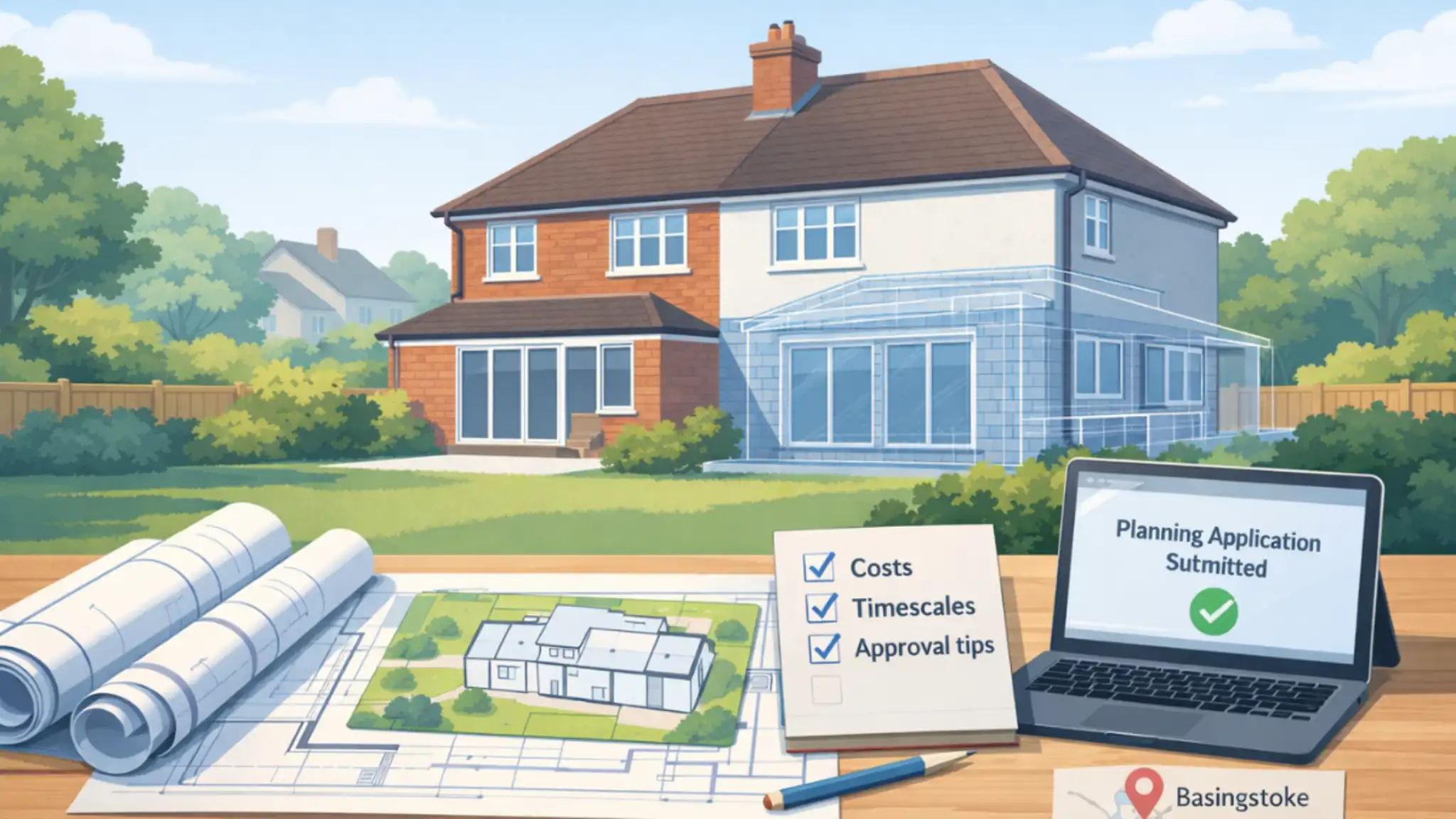
Quick summary: Planning Permission Basingstoke
If you’re researching Planning Permission Basingstoke, the process is broadly the same as anywhere in England — but the difference is how your proposal fits Basingstoke & Deane’s local policies, neighbour impacts, and validation requirements.
- Typical council decision time: many householder applications are decided in around 8 weeks from validation (longer if information is missing or the scheme is complex).
- Typical council fee (householder): in England, a standard householder planning application is currently £528 (always double-check current fees before you submit).
- Most delays are avoidable: the biggest issues we see are incomplete drawings, unclear measurements, missing supporting documents, and not addressing neighbour impacts up front.
- Permitted Development may apply: you might not need full planning permission — but you may still want a Lawful Development Certificate for certainty (especially if you’re selling later).
In the full guide below, we explain costs, realistic timescales, how the Basingstoke & Deane process works, and the practical steps that usually improve approval chances first time.
Not sure if you need planning permission in Basingstoke?
Tell us what you’re planning and we’ll sense-check whether it looks like Permitted Development, a householder application, or something more complex — before you waste time.
Quick summary: Planning Permission Basingstoke
For most homeowners, Planning Permission Basingstoke comes down to two things: (1) whether your project qualifies as Permitted Development, and (2) if not, how well your proposal addresses neighbour impact, design and local policy.
If you submit a clear, complete application (with the right drawings and a sensible design), you give the planning officer far fewer reasons to delay, request changes, or refuse.
Planning Permission Basingstoke: what homeowners actually need to know
When people search “planning permission in Basingstoke”, they’re usually trying to answer one of these questions:
- Do I need planning permission for my extension, loft, garage conversion or garden room?
- How much will it cost (council fee + drawings + everything else)?
- How long will it take in reality — not just the headline 8 weeks?
- What makes the council say yes (or no)?
The key thing to remember is that “planning permission” is only one part of the wider compliance picture. Even if you don’t need planning permission, you may still need Building Regulations approval and inspections for structural work, insulation, drainage, fire safety and more.If you’re not sure where planning ends and building regs begins, our Building Regulations guide explains it in plain English.
Who decides planning applications in Basingstoke & Deane?
In most cases, householder applications are decided by a planning officer under delegated powers. Some applications go to a planning committee — usually where the proposal is more sensitive, receives significant objections, or raises wider policy issues.
You can view and comment on local applications via the council’s online planning register (useful if you want to see what tends to get approved on your street):View planning applications (Basingstoke & Deane).
Planning application types in Basingstoke (householder, LDC, etc.)
Most homeowner projects fall into one of these routes:
1) Permitted Development (PD) — no planning application needed
Some extensions, loft conversions, outbuildings and alterations can be done under Permitted Development if they meet specific limits and conditions.Our checklist-style guide Do I need planning permission? is the quickest way to sense-check this.
2) Lawful Development Certificate (LDC) — proof that it’s lawful
If you believe your project is PD, an LDC gives you written confirmation from the council. It’s not legally required, but it can be extremely helpful for peace of mind — and it often makes life easier when you remortgage or sell.(We see LDCs used a lot for lofts, rear extensions and outbuildings that are “close to the line”.)
3) Householder planning application — the common “normal” route
This is the most common route for extensions and external alterations to houses (not flats). If your proposal doesn’t meet PD rules, this is usually the correct application type.
4) Listed Building Consent / Conservation Area constraints
If your home is listed, or you’re in a conservation area, the rules can change dramatically — even for work that looks minor.If either might apply, read our guides on Conservation Areas and Listed Buildings before you commit to designs.
Planning Permission Basingstoke costs: council fees, drawings & “extras”
Budgeting is where many projects wobble, because homeowners often focus only on the council fee. In reality, the total cost is usually a mix of:
- Council planning fee (paid when you submit)
- Drawings / measured survey (what most people actually pay the most for)
- Supporting documents (sometimes needed depending on site constraints)
- Optional but sensible certificates (like an LDC if you’re going down the PD route)
Quick costs snapshot – what most homeowners pay for (typical)
- Householder council application fee (England): currently £528 (check latest fees before submission).
- Planning drawings + survey (typical): often £700–£1,500 depending on complexity and revisions.
- “Extras” that sometimes apply: design & access statements (rare for householder), ecology/tree info, heritage statements, or drainage notes — usually only where the site demands it.
Want the wider picture? Our guide to overall planning permission costs breaks down what’s included and what catches people out.
If you submit via Planning Portal, there can also be a separate service charge for some applications. Not every homeowner notices this until checkout, so it’s worth allowing for it.
Planning Permission Basingstoke timescales: realistic timelines
People often hear “8 weeks”, but it helps to understand what the 8 weeks actually means. The clock usually starts once the council has validated the application (i.e., confirmed it includes the required documents and correct fee).
A realistic homeowner timeline (typical householder project)
- 1–3 weeks: measured survey + first draft drawings (depends on availability and complexity)
- 1–2 weeks: revisions / finalising drawings + preparing submission documents
- Validation period: varies — faster when everything is complete
- Decision target: often around 8 weeks from validation for most householder applications
Want to improve your approval odds before you apply?
We’ll review your rough idea and advise what usually helps in Basingstoke & Deane — drawings, layout tweaks, neighbour impacts, and the cleanest application route.
Step-by-step: how to apply smoothly (and avoid delays)
Here’s the simplest “do it once, do it properly” process we recommend for most homeowners.
Step-by-step checklist: Planning Permission Basingstoke
- Confirm the route. Start by checking whether you need permission at all (PD vs householder). If you’re unsure, use our when planning permission is required guide.
- Look at local precedents. Search nearby applications for similar work so your design isn’t wildly out of keeping.
- Get the drawings right. Clear existing/proposed plans and elevations make everything easier. If you’re budgeting, our guide to planning drawings cost helps set expectations.
- Think neighbour impact early. Overlooking, loss of light, and “overbearing” extensions are common objection points — small design tweaks can often reduce risk.
- Submit a complete pack first time. Missing plans, incorrect scales, or unclear dimensions can stall validation.
- Respond quickly (and calmly) to queries. If the case officer asks for clarification, a fast, clear response can prevent weeks of drift.
- Read conditions properly if approved. Many permissions come with conditions (materials, obscure glazing, drainage, etc.). Get them right so you don’t stumble into enforcement later.
Approval tips: what helps applications succeed
While every site is different, most householder approvals come down to clear evidence that the proposal is:
- In keeping with the house and street (scale, materials, roof form)
- Reasonable for neighbours (privacy, daylight, outlook)
- Well explained (drawings that leave little room for doubt)
- Policy-compliant (local plan considerations, constraints)
Design choices that often reduce risk
- Keeping upper-floor side windows high level or using obscure glazing where privacy is tight
- Reducing bulk at the boundary (e.g., stepping in, lowering eaves)
- Showing accurate relationship to neighbours (site plan, sections where helpful)
- Being realistic about materials and rooflines on prominent elevations
If you’re planning an extension specifically, our step-by-step guide planning permission for an extension is a useful companion read.
Local council quirks (Basingstoke & Deane): what to watch for
Every council has its own “rhythm”. In Basingstoke & Deane, the most practical things to keep in mind are:
- Validation is key. If required documents are missing or unclear, the application can sit in limbo until it’s made valid.
- Public comments are easy to view. Neighbours can comment online — so it’s worth addressing the usual concerns (privacy/light) in the design.
- Constraints matter. If your property is listed, in a conservation area, near protected trees, or affected by other constraints, the documentation expectations can jump up quickly.
Practical homeowner move: check the council’s application requirements before you finalise your drawings:Basingstoke & Deane planning forms & requirements.
Related comparisons homeowners in Basingstoke often ask
- Permitted Development vs Planning Permission: PD is rule-based (limits/conditions), while planning is discretionary (policy + judgement).
- Planning Permission vs Building Regulations: planning is about acceptability (impact/appearance); building regs is about safety and performance.
- Lawful Development Certificate vs “just doing it”: an LDC gives written confirmation — often helpful when you sell.
FAQs: Planning Permission Basingstoke
How much is a planning application in Basingstoke?
The council fee is set nationally (so it’s not unique to Basingstoke). For a standard householder planning application in England, the fee is currently £528. Your bigger costs are often drawings, surveys, and any supporting information needed for your site.
How long does planning permission take in Basingstoke?
Many householder applications aim to be decided in around 8 weeks from the date the application is made valid. In practice, delays are more likely where validation is slow, information is missing, or revisions are requested after neighbour feedback.
Do I need Planning Permission Basingstoke for an extension?
Sometimes yes, sometimes no. Many smaller extensions can fall under Permitted Development, but only if they meet strict limits (size, height, materials and position). If you’re unsure, start with our extension planning checklist to avoid guessing.
Can I get planning permission refused because of neighbours?
Neighbour objections don’t automatically mean refusal — but they can highlight genuine planning issues like overlooking, loss of light, or overbearing scale. The best approach is to design those risks out early and submit clear drawings that show the true impact.
Do I need drawings for a planning application in Basingstoke?
Yes. Even simple householder applications normally need clear existing and proposed plans and elevations, plus location and site plans. If you want a checklist of what “valid drawings” typically include, see our guide on drawings for a planning application.
What’s the difference between planning permission and Building Regulations?
Planning permission is about whether the development is acceptable in principle (appearance, neighbour impact, policy). Building Regulations are about construction safety and performance (structure, insulation, fire safety, drainage, ventilation). Many projects need both, even if planning isn’t required.
How do I check existing planning applications in Basingstoke?
You can use the council’s online planning register to search by address, postcode or reference number and view documents and decisions. It’s a helpful way to see what tends to be approved locally:Basingstoke & Deane: view planning applications.
Want a quick “will this fly?” opinion before you apply?
We’ll sense-check your proposal and tell you what usually helps with approval — plus what to fix before you submit.
Next steps & useful guides
If you want to go deeper (or you’re about to instruct drawings), these guides are the most relevant next reads:
- Planning Permission (UK): The Complete Homeowner’s Guide
- Do I Need Planning Permission?
- Planning Permission Cost (UK): Complete Guide for Homeowners
- Planning Permission Drawings: A Complete Guide for Homeowners
- Planning Permission Refusal: What It Means and What to Do Next
- Building Control: What It Is, When You Need It, and How to Pass Inspections
- Most common routeHouseholder planning application (if the project isn’t Permitted Development).
- Typical decision targetOften around 8 weeks from validation for many householder applications.
- Typical council feeHouseholder application in England is currently £528 (always check the latest fee table).
- Biggest avoidable delayIncomplete drawings / missing documents causing validation delays or extra officer queries.
- Best approval leverDesigning for neighbour impact (privacy/daylight/scale) and showing it clearly on the drawings.
- Often overlookedEven if planning isn’t needed, Building Regulations often still are.
If you want a calm, expert view before you spend money, message Plans Made Easy and we’ll help you choose the cleanest route.
Official guidance
For the latest national rules and application fees, these are the most reliable references:
- Planning Portal – national planning guidance and application information
- GOV.UK – planning permission in England and Wales
How Plans Made Easy can help
Getting Planning Permission Basingstoke is rarely about luck. It’s usually about choosing the right route, producing clear drawings, and removing the common planning objections before the council (or neighbours) raise them.
If you’d like help, our team can prepare compliant plans, advise on the best application route, and support you through to approval — with clear, homeowner-friendly guidance at every step.
Ready to move your project forward?
Plans Made Easy can prepare compliant plans, manage submissions, and guide you from idea to approval.

Performance Verified ✅
This page meets PME Optimisation Standards — achieving 95+ Desktop and 85+ Mobile PageSpeed benchmarks. Verified on

