
Share this post:
If you’re researching Planning Consultants, you’re probably trying to avoid the two big homeowner headaches: (1) submitting the wrong thing to the council and losing weeks, or (2) building something that later becomes hard to sell because the paperwork isn’t right.
Quick summary
- A planning consultant helps you choose the right planning route, prepare the case, and manage the process with your local authority.
- You’re most likely to benefit if your project is borderline, has constraints (conservation area, neighbours, design sensitivity), or you’ve had a refusal.
- For simpler, clearly permitted development projects, you may only need good drawings and a tidy submission — not a full consultant-led strategy.
Key facts snapshot
- Best for: tricky extensions, planning risk, neighbour objections, conditions, refusals, appeals
- What they do: strategy, pre-app advice, planning statements, design negotiation, application management
- What they don’t replace: proper drawings, building regulations compliance, structural design
- Top tip: always agree the scope and deliverables in writing before you start
Planning consultants: what they are (and what they aren’t)
In simple terms, a planning consultant is the person who helps you navigate the planning permission system and present your project in a way the council can support. They’re used to how local authorities think, what officers look for, and which details tend to trigger objections.
That said, it helps to be clear on what a consultant isn’t. They don’t replace good drawings, they don’t “guarantee approval”, and they don’t remove your need to meet building regulations. Instead, they focus on the planning strategy and planning case — and that can be a big stress reliever when the project isn’t straightforward.
Helpful way to think about it: drawings show what you want to build; a planning consultant explains why the council can support it.
What a planning consultant actually does for homeowners
Different firms package things differently, however most homeowner work falls into a few familiar buckets. Here’s what planning consultants typically do on domestic projects in England.
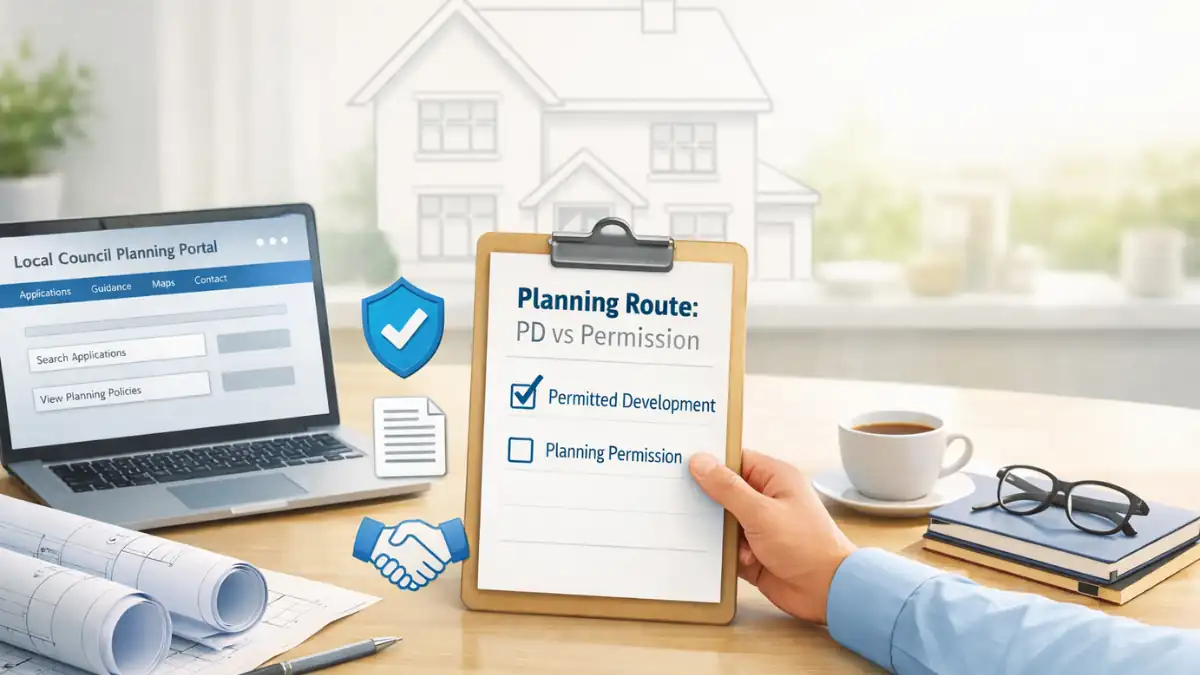
1) Planning route check: permitted development vs planning permission
Before anyone draws up a big scheme, a consultant can sense-check whether your idea is likely to be:
- Permitted development (PD) (no planning application needed, but rules still apply)
- Householder planning permission (the most common route for extensions)
- Something more specialist (for example, listed building consent, conservation area sensitivities, or conditions)
If you’re unsure which route applies, this guide can help: do you need permission for your project?
2) Risk check: constraints, neighbours, and “council quirks”
Good planning work is often about spotting risk early. A consultant may review things like:
- conservation area or listed building constraints
- overlooking, daylight, and privacy impacts
- street scene and design character
- previous planning history on your property
- likely neighbour objections (and how to reduce them)
If your home is in a protected area, it’s worth reading our guide on extra controls and permissions before you spend on design.
3) Pre-application advice: testing the waters before you apply
For borderline projects, pre-app advice can be a smart move. It’s not always quick, and it’s not always cheap, but it can:
- flag likely objections before you commit to a final design
- help you position the proposal more clearly
- reduce back-and-forth once the formal application is live
4) Writing the planning case: statements and supporting documents
Homeowner applications often fail for a simple reason: the council can’t see the justification clearly enough. A consultant can prepare or coordinate documents such as:
- a planning statement (plain English, policy-aware reasoning)
- design and access style reasoning where appropriate
- responses to neighbour objections
- negotiation letters if the case needs small amendments
5) Managing the submission and negotiations
Once an application is in, planning consultants can manage queries, respond to officer feedback, and keep the process moving. That includes advising when to:
- amend drawings to address specific concerns
- provide extra information quickly (without overcomplicating the case)
- push back politely when requests go beyond what’s reasonable
Important: A consultant can improve your chances, but nobody can promise a “guaranteed approval”. Planning is a judgement call, and local context matters.
When you actually need a planning consultant
Many homeowners only need a consultant when there’s genuine planning risk. In practice, we see the strongest value in these situations:
Planning consultants for “borderline” extensions
If your extension is close to what the council might consider overbearing, out of character, or harmful to neighbours, a planning consultant can help you shape the scheme so it reads as reasonable and policy-friendly.
If you’re still working out whether permission is likely, start here: our complete homeowner guide to the process.
Planning consultants for conservation areas and listed buildings
Protected settings often need a more careful approach, because the council’s focus isn’t only on “can you build it”, but also on heritage impact and design quality. This is one of the most common reasons a simple DIY application becomes stressful.
If the building is listed, read this first: what counts as consent and why it matters.
Planning consultants after a refusal (or when refusal risk is high)
A refusal isn’t the end, but it does mean you need a calmer, more structured response. The right next step might be a revised scheme, a clearer planning case, or in some situations an appeal.
- Refusal explained: what it means and what to do next
- Appeals: how the process works and when it’s worth it
Planning consultants for neighbour objections and tricky relationships
When neighbours object, it can feel personal. In reality, the council is looking for evidence and impacts: overlooking, light, noise, scale, and character. A consultant can help keep the response factual, and propose small design changes that protect your goals without escalating tension.
When you might not need one
You don’t always need a planning consultant to get a good outcome. In fact, if your project is clearly compliant, you can often succeed with:
- strong, accurate drawings
- a well-structured submission
- a realistic design that respects neighbours
If you’re at the drawings stage, these guides are usually the most helpful:
Tip: If your project is permitted development but you want peace of mind, consider a lawful development certificate. It’s not always required, but it can make future selling and remortgaging much simpler.
Planning consultant fees: how pricing usually works
Homeowners often ask, “How much will this cost?” The honest answer is: it depends on scope. Most planning consultants price in one (or a mix) of these ways:
- Fixed fee for a defined package (strategy + statement + submission support)
- Hourly rate for advice, negotiation, or refusal response work
- Staged pricing (for example, a lower-cost initial review, then optional add-ons)
A good quote should clearly say what’s included: how many revisions, whether it covers speaking to the case officer, and whether refusal/appeal support is included or separate.
Don’t forget the wider budget, too — planning fees and professional fees are only part of the overall picture. This breakdown helps: typical planning permission costs for UK homeowners.
How to choose the right planning consultant
Choosing well is less about fancy promises and more about fit, experience, and clarity. Here’s the checklist we recommend.
Ask about relevant experience (not just “planning in general”)
- Have they handled projects like yours (rear extension, loft, outbuilding, conversion)?
- Do they understand local constraints that commonly apply in your area?
- Can they explain the likely risks in plain English?
Agree the scope in writing
Make sure you know exactly what you’re paying for. A clear scope usually covers:
- what they will produce (for example, a planning statement)
- what they will manage (submission, queries, negotiation)
- what is excluded (new drawings, specialist reports, appeals)
- how many iterations are included
Check who is doing the work
Some firms sell you on a senior person, then pass you to a junior. That isn’t always a problem, but you should know who your day-to-day contact is and how quickly they respond.
Be wary of “guarantees”
Planning decisions involve judgement. A strong professional will talk about probability, risk reduction, and options — not certainty.
Typical process: from first call to decision
While every council is different, most domestic projects follow a similar pattern:
- Initial review – what you want to build, planning history, constraints, likely route
- Strategy – PD vs planning application, whether pre-app makes sense, key risks
- Drawings and documents – coordinated with your designer/technician
- Submission – correct forms, correct drawings, clear supporting statement
- Consultation period – neighbours, consultees, officer review
- Negotiation/amendments – if the officer requests changes
- Decision – approval (often with conditions) or refusal (with reasons)
If you’re trying to plan your build schedule, this will help set expectations: typical planning timelines and why they vary.
Common mistakes we see (and how to avoid them)
1) Treating planning as “just a form”
The form is easy. The judgement isn’t. The strongest applications reduce uncertainty: they show context, explain impacts, and make it easy for the case officer to support the proposal.
2) Submitting weak drawings
Even if the design is good, unclear or incomplete drawings create delays and questions. If you want a sanity check on what should be included, use: a homeowner checklist of required drawings.
3) Ignoring building regulations while focusing on planning
Planning and building regs are separate systems. You can get planning approval and still fail compliance later — particularly around structure, insulation/energy, ventilation, drainage, and fire safety. For a clear overview, read: building regulations for domestic projects.
4) Responding emotionally to objections
It’s normal to feel frustrated, but councils respond to evidence. A factual, calm response (sometimes paired with a small design tweak) often works better than a long back-and-forth.
Want a calm, honest view on your planning risk?
If you’re not sure whether you need full planning support or just the right drawings and submission strategy, our team can point you in the right direction.
FAQs: Planning consultants
What does a planning consultant do for a homeowner?
Do I need a planning consultant for an extension?
How much do planning consultants charge in the UK?
Are planning consultants worth it?
Can a planning consultant speed up a planning decision?
What’s the difference between a planning consultant and an architect?
Next steps
If you’re weighing up whether to bring in a planning specialist, the best next step is to get clarity on your route and risk. Start by checking whether you’re likely to need permission at all, then make sure your drawings and submission approach match what your council expects.
- How to tell when permission is required
- How to view local planning applications (useful for context)
- What plans you need for building regs later
Talk to Plans Made Easy
If you’d like a sensible, homeowner-friendly steer on your project — whether that’s the right planning route, the right drawings, or support handling council feedback — our team can help you move forward without the stress.

Performance Verified ✅
This page meets PME Optimisation Standards — achieving 95+ Desktop and 85+ Mobile PageSpeed benchmarks. Verified on

