
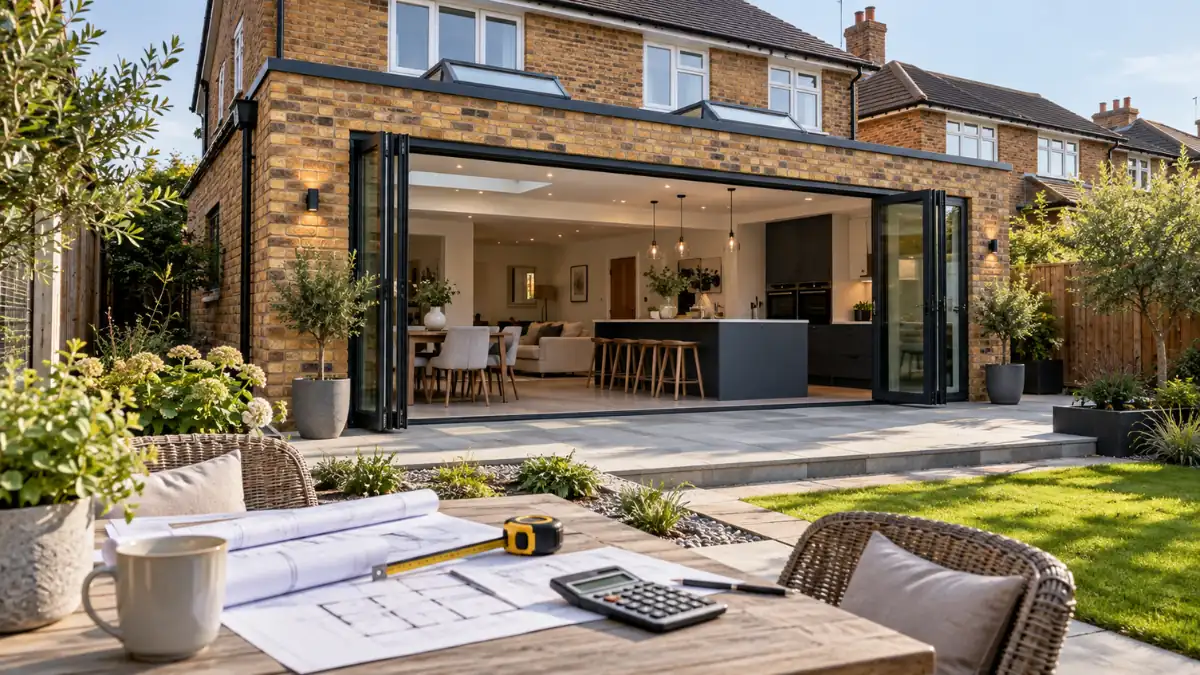
Share this post:
Quick summary: house extension how much should you budget?
If your starting question is “house extension how much should I budget?”, a useful 2026 guide for a straightforward UK single-storey extension is roughly £2,200–£3,300 per m² of new internal floor space, before VAT where applicable. That means a typical 30m² extension could cost around £66,000–£99,000 for the building work alone.
- 20m² extension: approximately £44,000–£66,000 before VAT where applicable.
- 30m² extension: approximately £66,000–£99,000.
- 40m² extension: approximately £88,000–£132,000.
- Higher-spec, complex or difficult-access projects: can cost considerably more.
However, square-metre rates are only a starting point. Kitchens, glazing, structural steelwork, drainage alterations, professional fees, Building Control, planning requirements and the condition of your existing home can all change the final figure.
Trying to work out what your extension could realistically cost?
Tell us what you are hoping to build and our team can help you understand the drawings, permissions and professional work you may need before asking builders for firm prices.
House extension how much? Typical UK costs explained
When homeowners ask us “house extension how much is it likely to cost?”, the most useful answer is usually a range rather than one headline figure. The size of the extension matters, but so do its shape, specification, location and the amount of structural work needed to connect it to your existing home.
As a broad 2026 budgeting benchmark, a straightforward single-storey extension can sit at around £2,200–£3,300 per m² of new internal space, excluding VAT. Therefore, a 30m² project might indicate a basic construction budget of roughly £66,000–£99,000 before VAT where applicable.
Quick costs snapshot: how much could a house extension be?
- 20m²: around £44,000–£66,000.
- 30m²: around £66,000–£99,000.
- 40m²: around £88,000–£132,000.
- Premium or complex builds: potentially above these ranges.
Figures are indicative construction estimates using £2,200–£3,300/m² and exclude VAT where applicable, professional fees and project-specific extras.
House extension cost per m²: why builders use square-metre prices
Cost per square metre is useful during the early planning stage because it allows you to compare different sizes quickly. However, it should not be treated as a substitute for a detailed specification and builder's quotation.
For example, two 30m² extensions can cost very different amounts. One may be a straightforward rectangular family room with standard windows. Another might contain a new kitchen, large sliding doors, rooflights, underfloor heating and extensive structural steelwork.
If you want to explore this calculation in more detail, our guide to working out prices from floor area explains how the figures are built up.
How much would different house extension sizes cost?
How much would a small house extension cost?
A 15–20m² extension may appear inexpensive because of its size, but smaller extensions can have a relatively high cost per square metre. Foundations, drainage, structural openings, professional fees and site setup still have to be paid for.
Using the broad range above, 20m² gives an early building-cost indication of approximately £44,000–£66,000.
How much would a 30m² extension cost?
At approximately £2,200–£3,300/m², a 30m² extension suggests around £66,000–£99,000 before VAT where applicable. A kitchen extension with premium cabinetry, worktops and appliances could push the total project budget higher.
How much would a 3 metre extension cost?
A three-metre depth alone is not enough to calculate the price. You also need the width. For example, a rear extension measuring 3m deep by 6m wide creates around 18m² of new floor space, whereas a 3m by 10m extension creates 30m².
Why are house extensions so expensive?
An extension is not simply four walls and a roof. You are creating a new part of an existing building while making sure the old and new structures work safely together.
Typical costs can include:
- excavation, foundations and groundworks;
- brickwork, blockwork and insulation;
- structural steelwork and beams;
- roof construction and waterproofing;
- windows, rooflights and external doors;
- electrics, plumbing and heating;
- plastering, flooring and decorating;
- drainage alterations;
- kitchens or bathrooms;
- making good where the extension joins the existing house.
Construction prices can also change over time. Official construction statistics show that output prices continue to move, which is another reason an older quotation or online article should not be relied on as a fixed current price.
House extension fees and costs homeowners often forget
The builder's quotation is only one part of the overall budget. Depending on your project, you may also need to allow for professional and statutory costs.
- Measured survey and design drawings.
- Planning drawings and application work, if required.
- Building Regulations drawings.
- Structural engineer calculations.
- Building Control charges.
- Party wall advice, where relevant.
- Drainage or build-over requirements.
- Specialist reports where the site or local authority requires them.
Our guide to budgeting for the design and drawing stage explains the professional-plan element separately.
Not sure what needs to be included before you ask builders to quote?
We can help you establish the drawings, planning route and Building Regulations information your project is likely to need, so your quotations are based on a clearer scope.
How to work out how much your house extension could cost
Rather than starting with one internet figure, build your budget in stages. This reduces the risk of discovering major omissions once construction has started.
Step-by-step extension budgeting checklist
- Measure the approximate floor area. Work out the new internal space in square metres.
- Choose an initial £/m² range. Use it only as a feasibility figure.
- Decide your specification. Standard windows and finishes will cost less than large-format glazing and premium interiors.
- Add professional costs. Include drawings, engineering and other consultants where required.
- Check planning requirements. Do not assume every extension is permitted development.
- Allow for Building Regulations. Most extensions require Building Regulations approval.
- Obtain comparable quotations. Give contractors the same drawings and scope so you can compare like-for-like.
- Keep a contingency. Existing homes can reveal unexpected drainage, ground or structural issues once work begins.
For the wider process, see our complete guide to planning, design, council requirements and the construction journey. This article is designed to sit alongside that main guide and concentrate specifically on budgeting.
House extension vs moving: is extending worth it?
Whether an extension is worth the cost depends on more than the final build figure. If you like your location, schools, neighbours or commute, creating more space may solve a problem without the upheaval of moving.
However, you should compare the expected total project cost with the likely value of the finished property. An extension does not automatically add more value than it costs to build.
Estate-agent advice and recent sold prices for similar extended properties can help you test the financial case. The quality of the new space also matters: a useful kitchen-family room or additional bedroom may appeal more strongly to future buyers than poorly planned additional floor area.
For more focused budgeting, you can also compare our single-storey project cost breakdown with our two-storey project budget guide.
How planning permission and Building Regulations affect extension costs
Planning permission and Building Regulations are separate systems. Some extensions in England can be carried out under permitted development rights if all relevant limits and conditions are satisfied. Other projects require a householder planning application.
In addition, most domestic extensions need Building Regulations approval. Building Control considers matters such as structure, fire safety, insulation, ventilation and drainage rather than whether the design is acceptable in planning terms.
You can read our project permission checklist and our Building Control compliance guide before deciding what needs to be included in your budget.
FAQs: house extension how much should you allow?
How much will a house extension cost?
As an early 2026 benchmark, a straightforward single-storey extension may fall around £2,200–£3,300 per m² before VAT where applicable. Therefore, 30m² could indicate roughly £66,000–£99,000 for the construction work. Specification, access, structural work and location can move the final figure significantly.
How much is a small house extension in the UK?
A 20m² extension might indicate roughly £44,000–£66,000 using the broad benchmark in this guide. However, small projects can have a relatively high price per square metre because fixed costs such as foundations, drainage, structural openings and site setup are spread across less new floor space.
How much does a back-of-house extension cost?
A rear extension is normally priced according to floor area, construction method and specification rather than simply because it is at the back of the property. A 30m² rear extension could therefore fall within the same broad £66,000–£99,000 starting range, although kitchens, large glazed doors and structural alterations commonly push budgets higher.
Why are house extensions so expensive?
You are paying for foundations, structure, insulation, roofing, windows, services, finishes and the work needed to connect the new structure safely to the existing house. Professional fees, Building Control, engineering, kitchens and drainage can also sit outside a basic construction quotation.
Are house extensions worth it?
They can be, particularly when an extension gives you the space you need while allowing you to remain in a location you value. However, the financial return varies by area. Compare your complete project budget with local sold prices and obtain valuation advice rather than assuming every pound spent will be added to the property's value.
Does an extension add value to a house?
A well-designed extension can make a property more useful and attractive to buyers, but the amount of value added depends on location, layout, quality and local ceiling prices. More floor space alone does not guarantee that the value increase will exceed the build cost.
How much extension can you do without planning permission?
There is no single universal size. Permitted development in England is subject to several limits and conditions involving height, depth, position, previous additions and the type and location of the property. Larger rear extensions may also use the prior approval process in qualifying circumstances. Check the rules for your exact property before starting work.
How long does a house extension take?
Construction time depends on size and complexity, but your overall programme should also allow for design, engineering, permissions, Building Regulations information, tendering and contractor availability. A realistic programme is therefore much longer than the physical build period alone.
Have a rough budget but not sure what it will actually buy?
Plans Made Easy can help you turn the idea into a clear scope, suitable drawings and an approval route before you commit to construction.
Next steps & useful guides
If you are moving from an early budget towards an actual project, these related PME guides will help:
- Understand the complete planning, design and approval journey
- See how floor-area pricing is calculated
- Explore a single-storey budget in more detail
- Compare the economics of adding a second storey
- Budget for surveys, drawings and design work
- Check which planning route could apply
- Understand what Building Control will expect
- 2026 budgeting benchmark Approximately £2,200–£3,300/m² for a typical single-storey extension before VAT where applicable.
- 20m² example Approximately £44,000–£66,000 for building work using the benchmark above.
- 30m² example Approximately £66,000–£99,000.
- 40m² example Approximately £88,000–£132,000.
- Main cost drivers Size, specification, location, access, glazing, structural alterations, kitchens, drainage and ground conditions.
- Common extras Drawings, structural calculations, statutory charges, Building Control, party wall matters and specialist reports.
- Planning Some extensions can use permitted development rights, but the conditions must be checked against your specific property.
- Building Regulations Most house extensions require Building Regulations approval even where planning permission is not required.
Need to turn a rough figure into a workable project? Ask Plans Made Easy about the drawings and approvals your extension is likely to need.
Official guidance and useful cost references
Extension costs and regulations change, so it is sensible to check current information before committing to a project:
- Planning Portal – current extension planning and permitted development guidance
- GOV.UK – permitted development rights for householders technical guidance
- Office for National Statistics – current UK construction industry and price data
- Homebuilding & Renovating – practical 2026 extension cost benchmarks
So, how much should you budget for your house extension?
If you are asking “house extension how much will mine actually cost?”, start with floor area and a sensible £/m² benchmark, but do not stop there. Your specification, structural work, glazing, services, professional fees and site conditions can change the final budget substantially.
The safest route is to develop the design far enough that builders are pricing the same scope of work. That gives you a far more dependable figure than comparing headline prices from unrelated projects.
Plans Made Easy can help with the drawings, planning route and Building Regulations information needed to turn an early idea into a properly defined extension project.
Ready to move your project forward?
Plans Made Easy can prepare compliant plans, manage submissions, and guide you from idea to approval.
Performance Verified ✅
This page meets PME Optimisation Standards — achieving 95+ Desktop and 85+ Mobile PageSpeed benchmarks. Verified on

