
Share this post:
Planning Permission Oxford can feel confusing because you’ve got two different planning authorities in the area (Oxford City Council and the surrounding district councils), plus extra sensitivities like conservation areas, listed buildings, parking pressure and neighbour impact.
Key facts snapshot: Planning Permission Oxford
- First step: confirm which council area your property sits in (Oxford City vs district).
- Many home projects may be “permitted development” — but constraints (conservation area, Article 4, flats) can remove those rights.
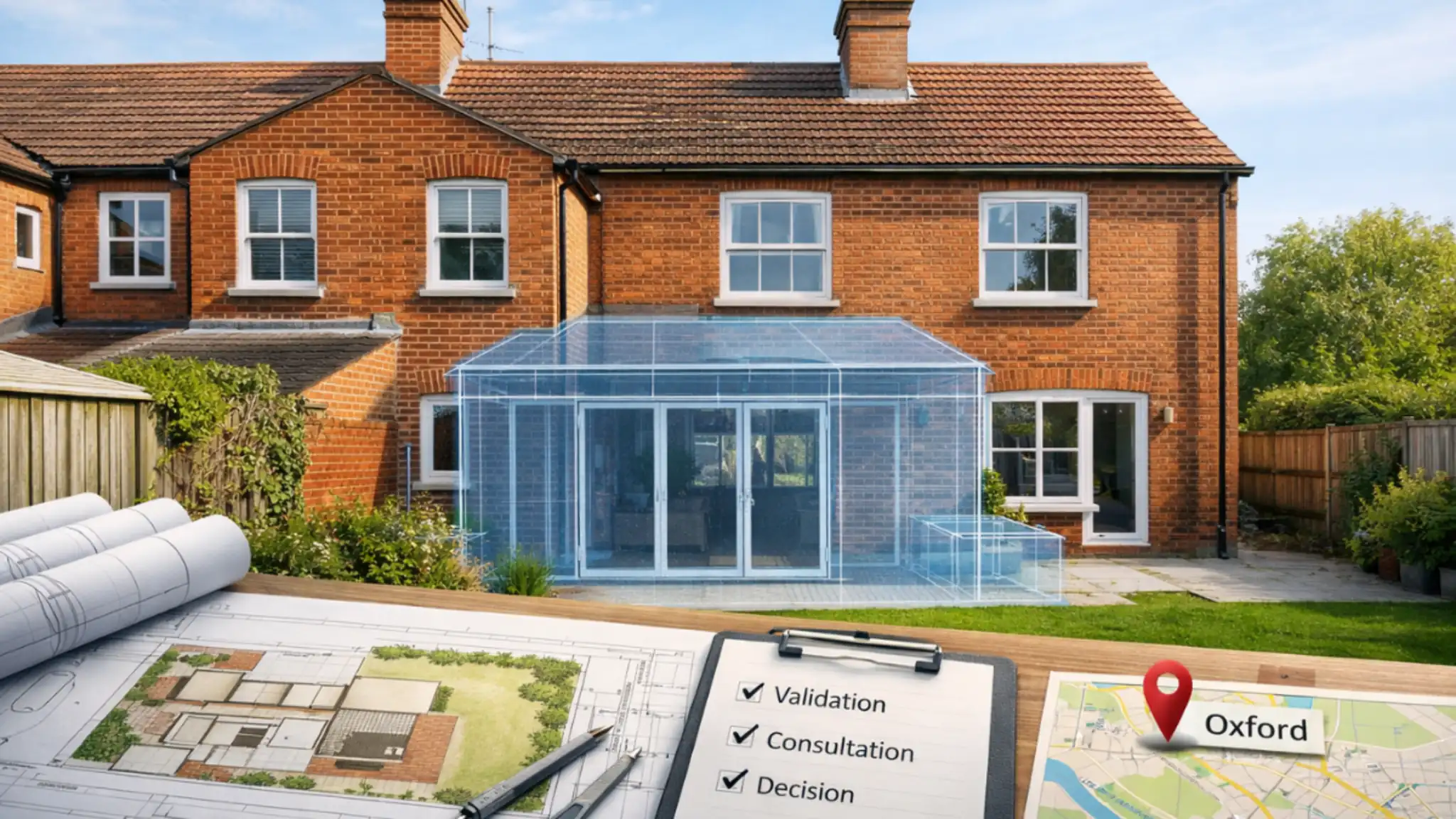
- Most householder decisions follow a formal validation stage, consultation, then an assessment against local and national policy.
- Drawings matter: poor plans are one of the fastest routes to delays, invalid applications, and refusal.
- Approval tip: address overlooking, daylight, scale, parking and materials clearly in your submission.
Note: This guide assumes England and typical homeowner projects. If you’re in a conservation area, a listed building, a flat/maisonette, or an Article 4 area, your “normal” routes may change.
Contents
- Step 1: Which “Oxford” council deals with your application?
- Do you need permission, or is it permitted development?
- Typical costs to budget for (fees, drawings, surveys)
- Planning process in Oxford: what happens after you apply
- Approval tips that matter in Oxford
- How to check applications and decisions in Oxford
- If it’s refused: realistic next steps
- Don’t forget Building Regulations
- FAQs
Step 1: Which “Oxford” council deals with your application?
Before you spend money on drawings, it’s worth confirming which local planning authority you’re actually applying to. “Oxford” searches often mix up Oxford City Council with the surrounding districts (for example, places like Witney are not within the city authority).
Important: the “Oxford council” on Google may not be your council
Your planning authority depends on your property’s boundary. Even if your postal address says “Oxford”, you may fall under a different district council. Start by checking your council area using your postcode, then use that council’s planning portal for applications and searches.
Getting the right council matters because local policies, constraints, validation requirements and even common design expectations can differ. It also affects whether you’ll need extra items such as heritage statements or special reports.
Helpful next reads:how to tell if you need consent,how to view applications and decisions,what timescales to expect.
Do you need permission, or is it permitted development?
A lot of homeowner projects can be done under permitted development (PD). However, in Oxford and the surrounding areas, PD is commonly restricted by things like conservation areas, Article 4 directions, previous planning conditions, or the fact the property is a flat/maisonette.
Common projects that may be permitted development
- Some rear extensions within size/height limits (subject to property type and constraints)
- Some loft conversions and dormers (with strict volume/design rules)
- Some outbuildings (garden rooms, studios) if height/coverage/boundaries comply
- Certain internal alterations (although listed buildings are different)
Note: “PD” is not a guarantee
Even if your neighbour did something similar, you may not have the same rights. Your property could have a condition removing PD, or be in an area where extra controls apply.
When Oxford homeowners most often need a planning application
- Flats/maisonettes: PD rights are very limited compared to houses.
- Conservation areas: stricter rules on appearance, rooflines, windows, cladding and demolition.
- Listed buildings: you may need listed building consent even for works that seem “minor”.
- Side extensions / corner plots: visual impact on the street scene is scrutinised.
- Parking, cycle storage, bin storage: often more sensitive in city settings.
If you’re unsure, the safest approach is a quick “planning route check” before you commit to design. That avoids the classic stress spiral of redesigning after you’ve already paid for drawings.
Want a quick route check before you spend money?
Send us your postcode and a short description of what you’re planning. We’ll help you identify the likely route (PD, householder application, listed building consent, or something else) and what information you’ll need for a clean submission.
Typical costs to budget for (fees, drawings, surveys)
When people search Planning Permission Oxford, they usually want to understand two things: (1) the council fee, and (2) the overall “real” cost once drawings and reports are included.
1) Council planning fees (application fees)
Planning application fees are largely set nationally (and depend on what you’re applying for). The fee you pay is usually the same whichever council you apply to, although you should always confirm the exact fee for your specific proposal before submitting.
- Householder applications are a common route for extensions and alterations.
- Other application types (lawful development certificates, listed building consent, approvals of conditions) have different fees and rules.
Tip: Don’t budget purely around the council fee. In practice, drawings and supporting information often make up the bigger chunk of the spend — especially if your project has design constraints.
2) Drawings and documents
Most successful submissions include clear, consistent drawings that show exactly what’s changing. That usually means existing and proposed floor plans and elevations, plus site plans and location plans. For anything sensitive (heritage, tight terraces, big glazing, roof changes), the written justification can matter just as much.
Related guides:what drawings you typically need,how much drawings tend to cost,overall cost breakdowns for UK homeowners.
3) Surveys and specialist reports (only if needed)
Some Oxford projects need extra reports. You don’t always need them — but if you do, missing them can delay validation or trigger refusal.
- Heritage statement (common in conservation areas / listed buildings)
- Daylight/sunlight or overshadowing notes (where neighbour impact is a concern)
- Tree constraints / arboricultural information (if protected trees are nearby)
- Ecology (occasionally relevant for certain locations/buildings)
- Flood risk information (site dependent)
Tip: spend your budget where it increases approval odds
Clear drawings + a short, sensible planning statement that addresses the likely concerns (overlooking, bulk, materials, parking) typically gives better value than “throwing in” generic documents that don’t apply to your site.
Planning process in Oxford: what happens after you apply
Although each council has its own workflow, most follow a similar pattern. Knowing the stages helps you avoid panic when you see “invalid”, “consultation” or “extension of time” appear on the portal.
Stage 1: Validation (the make-or-break admin check)
The council checks your application includes the correct forms, ownership certificates, fee, and the required drawings/documents. If something is missing or inconsistent, the application can be made invalid until it’s fixed.
Stage 2: Consultation
Neighbours and relevant departments (and sometimes external consultees) are invited to comment. This is where issues like overlooking, noise, parking, bin/cycle storage, design and heritage tend to surface.
Stage 3: Officer assessment
The case officer assesses the proposal against national guidance and local plan policies. They’ll weigh up the planning balance, including the impact on neighbours, the street scene and any special constraints.
Stage 4: Decision (approval, approval with conditions, or refusal)
Many approvals come with conditions. Common ones include matching materials, obscure glazing, restricting openings, or requiring details before work starts.
If you want realistic timing expectations, see:our guide to typical timelines.
Approval tips that matter in Oxford
If you want the best chance of success with Planning Permission Oxford, it’s usually less about “tricks” and more about presenting a proposal that answers the predictable concerns upfront.
1) Overlooking and privacy: show it clearly
Where rear elevations face each other (common in terraces and dense areas), councils can be sensitive to new windows, raised patios, balconies and roof terraces. If your design includes any of these, provide a clear privacy strategy (window positions, obscure glazing where appropriate, and sensible screening).
2) Daylight and scale: avoid the “it feels overbearing” problem
Even if something is technically within a limit, the visual impact can still be a refusal reason. Keep massing sensible, step down where needed, and explain the choices. Simple sections and a short design note can help here.
3) Materials and rooflines: get the basics right
In many Oxford streets, consistent rooflines, brick types and detailing matter. If you’re in a sensitive area, cheap-looking materials or awkward dormers can be an uphill battle. Aim for a design that looks intentional, not “bolted on”.
4) Parking, bins and cycle storage: don’t ignore the practical stuff
City schemes can be tripped up by practicalities. If you’re changing a front garden, converting a garage, or altering access, make sure you’ve shown where bins and bikes will realistically go, and whether parking arrangements change.
Important: avoid “competing claims” in your submission
One of the most common avoidable problems is inconsistent drawings (dimensions don’t match, elevations don’t align with floor plans, or the site plan contradicts the block plan). Councils often spot this quickly, and it can cause delays or mistrust in the proposal.
If you’d like support presenting the proposal properly:what a planning consultant actually doesandhow the drawings + submission process works.
How to check applications and decisions in Oxford
If you’re trying to “check planning permission Oxford” or see what’s been approved nearby, the simplest approach is:
- Confirm the correct local planning authority for the address.
- Use the council’s online planning search to look up applications by address, postcode or reference.
- Read the decision notice and conditions carefully (conditions often control materials, windows, hours, and “pre-commencement” details).
If you want a step-by-step walkthrough of what to look for on a planning portal (documents, conditions, drawings, decision notices), use this guide:how to view permissions and applications.
If it’s refused: realistic next steps
Refusals do happen. The good news is that many refusals are fixable with a better design response, clearer evidence, or a re-think on privacy/scale.
What to do first
- Read the refusal reasons slowly and translate them into practical actions (for example, “overbearing” usually means massing/height/relationship to boundaries).
- Check consultee comments and see if the officer relied on them.
- Decide on the route: revise and reapply, negotiate amendments (if offered), or appeal (where appropriate).
Useful guides if you’re in this position:what refusal really meansandhow appeals work.
Don’t forget Building Regulations
Planning and Building Regulations are separate systems. Even if you don’t need a planning application, you may still need Building Regulations approval — especially for structural changes, thermal upgrades, drainage, electrics, fire safety and loft/garage conversions.
- Building control checks safety and compliance (structure, insulation, fire, ventilation, drainage).
- Planning focuses on impact, appearance and policy.
Read next:our Building Regulations homeowner guide,what building control does.
Need help getting your Oxford application approved?
At Plans Made Easy, we help homeowners create clear planning drawings, prepare a sensible submission pack, and avoid the common mistakes that cause delays and refusals.
FAQs: Planning Permission Oxford
What are the planning permission requirements in Oxford?
They depend on (1) which local planning authority your property falls under, (2) what you’re building, and (3) whether any constraints apply (conservation area, listed building, Article 4, flats). In practice, most homeowners need clear existing/proposed drawings, correct plans (location + site), the right forms/certificates, and sometimes a short statement addressing neighbour impact and design.
Do you need planning permission for permitted development in Oxford?
If it is genuinely permitted development and you still have PD rights, you normally don’t need a planning application. However, Oxford-area constraints can remove or restrict PD. If you want certainty (for peace of mind, lenders, or future sale), a lawful development certificate is often the cleanest way to evidence it.
Is planning permission required for permitted development?
Not usually — but you must comply with all PD limits and conditions. If any part fails (height, depth, materials, roof form, boundary rules, previous conditions, or property type), it stops being PD and you may need an application. This is why a quick pre-check can save you from building something that becomes difficult to certify later.
How do I do an “Oxford planning permission search” or check an application?
First confirm the correct planning authority for the address, then use that council’s online planning portal to search by postcode, address or reference number. Always open the decision notice and read the conditions — conditions often affect windows, materials and “details to approve before starting”.
How many objections does it take to stop a planning application?
There isn’t a “magic number”. Councils consider planning reasons, not a vote. One well-made objection on a relevant planning issue can matter more than twenty comments that aren’t planning-related. The best approach is to design the scheme so the predictable issues (privacy, daylight, scale, parking) are addressed upfront.
How often is planning permission refused?
Refusal rates vary by council, project type, and how well the proposal responds to policy and neighbour impacts. The most common homeowner reasons include overbearing scale, overlooking, poor design fit, and missing/unclear information. A tidy set of drawings and a short, site-specific justification can significantly improve your odds.
Does “Witney planning permission” come under Oxford City Council?
Not usually. Witney is generally outside Oxford City Council’s boundary. Always confirm the local planning authority using your postcode before you apply or search for decisions — it prevents wasted time and incorrect assumptions about local requirements.
Can I buy “land with planning permission” near Oxford and just start building?
Be careful. You’ll need to read the permission, approved drawings, and conditions. Many permissions have pre-commencement conditions (things you must discharge before work starts) and time limits. You may also need Building Regulations approval. If you want, we can help you review the decision notice and conditions before you commit.
Next step: get your Oxford project checked properly
If you’re planning an extension, loft conversion, garage conversion or garden room in the Oxford area, we can help you choose the right route, produce the right drawings, and submit an application that’s clear and policy-aware.

Performance Verified ✅
This page meets PME Optimisation Standards — achieving 95+ Desktop and 85+ Mobile PageSpeed benchmarks. Verified on

