Share this post:
Quick summary: Planning Permission Garden Office
For many UK homeowners, Planning Permission Garden Office questions come down to one thing: does your garden office count as permitted development (no full application) or do you need full planning permission because of size, height, location, or how you plan to use it.
- Often no full planning application is needed if it’s a typical outbuilding used as a home office and it stays within permitted development limits.
- Planning permission is more likely if it’s tall, close to boundaries, takes up a large part of the garden, sits forward of the house, or is in a conservation area / affected by Article 4.
- Adding a toilet doesn’t automatically trigger planning permission, but it can increase the chances you’ll need Building Regulations approval (especially for drainage/ventilation).
- Using it as a bedroom / separate living space is where projects often fall into “needs planning” territory.
In this guide, we’ll show you the garden office planning rules that matter most, how councils typically interpret them, and a simple checklist to help you decide what to do next (including when a Lawful Development Certificate is worth it).
Not sure if your garden office needs permission?
Tell us the size, height and where it will sit in the garden — we’ll sense-check whether it’s likely to fall under permitted development or needs a full application.
Quick summary: Planning Permission Garden Office
Most standard garden offices in England can be built under permitted development (meaning no full planning application) if they’re genuinely incidental to the enjoyment of the house and stay within the key limits on height, location and garden coverage.
However, planning permission becomes more likely when the building is large, tall, close to boundaries, sits on land forward of the principal elevation, is intended as a separate living space, or your property is in a restricted area (such as a conservation area or an Article 4 area).
Do you need planning permission for a garden office?
If you’re researching Planning Permission Garden Office rules, you’re not alone. Garden offices and pods are one of the most common “outbuilding” projects we’re asked about — and the rules feel simple until you hit the details.
In England, a garden office is usually treated as an outbuilding. Many outbuildings can be built under permitted development (PD) as long as they meet the PD criteria. That said, PD is not a free-for-all — it’s a checklist, and one or two details can move you from “fine under PD” to “you’ll need to apply”.
If you want a broader grounding first, our complete guide explains how permissions work and what councils look for:read our full planning permission guide.
Permitted development garden office rules (plain English)
Permitted development generally means you can build a garden office without submitting a full planning application — but only if your proposal fits within the PD conditions for outbuildings.
What “incidental use” really means
A garden office can be “incidental” to the enjoyment of your home (for example, a home workspace, hobby room, gym, studio or storage). This is one of the biggest deciding factors.
- Usually fine: working from home, a desk setup, meetings on Zoom, light storage.
- Higher risk: using it as a self-contained annexe, renting it out, or treating it as a separate dwelling.
We cover outbuilding rules in more detail here:see our outbuildings guide.
Garden office size, height & boundary rules (what trips people up)
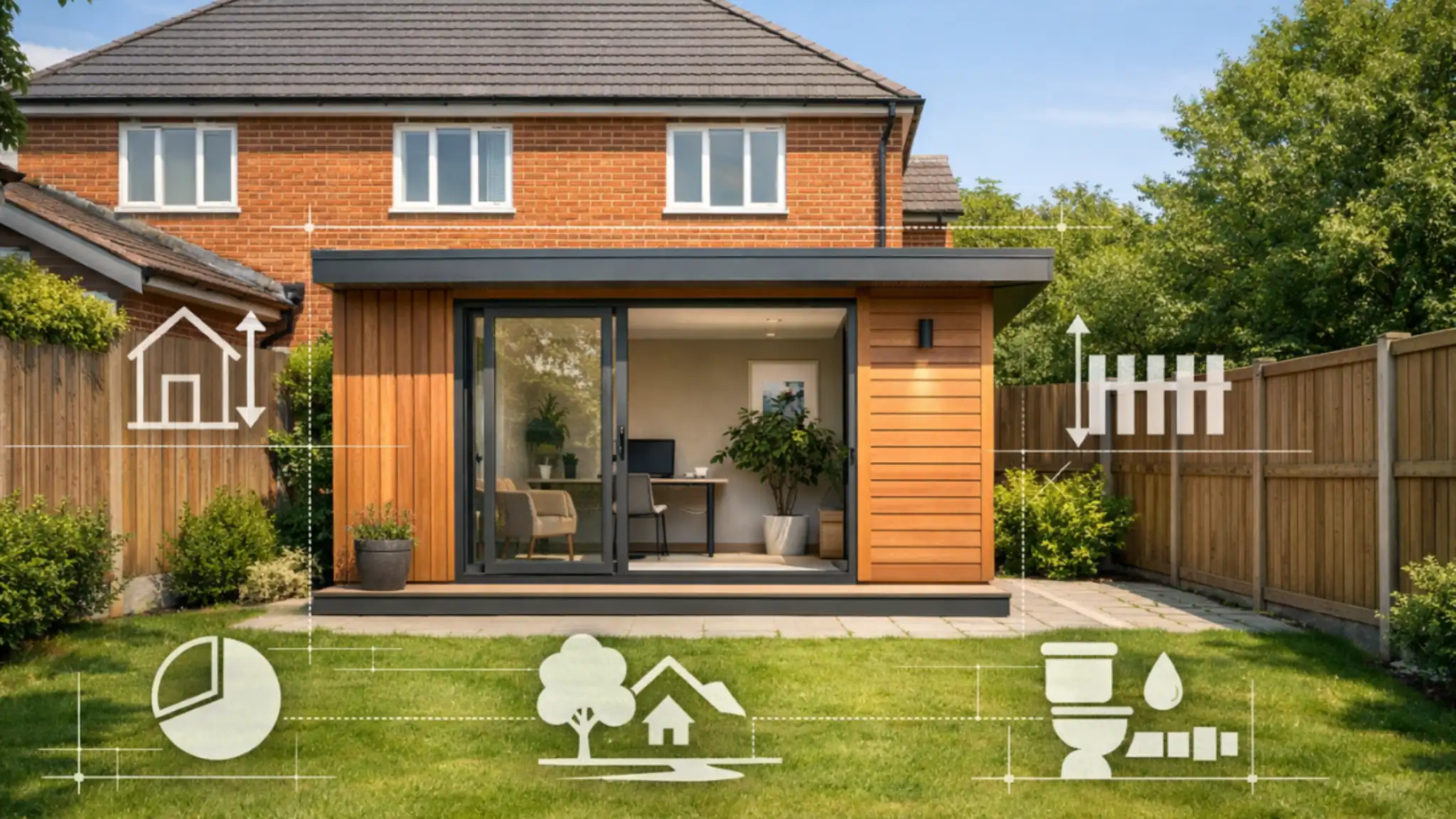
Most “surprise planning permission” problems come from a mismatch between what homeowners assume and what PD actually restricts. The three big ones are: height, where it sits, and how much of the garden it covers.
1) Height limits (especially near boundaries)
Height is one of the most common reasons garden offices fall outside permitted development. In practical terms, roofs that look modest on a brochure can end up too tall once you include base build-up, insulation thickness, and ground levels.
2) Position in the garden (forward of the house)
Outbuildings under PD have restrictions about being placed on land forward of the principal elevation. In plain terms, if the structure sits in front of the main face of the house (even to the side on a prominent plot), you may need planning permission.
3) Garden coverage (how much “curtilage” is built on)
PD rules also limit how much of the garden area can be covered by buildings and extensions. If your garden office is large, and you already have a shed, summerhouse, extension or previous outbuilding, the total coverage can push you outside PD.
Quick check: the 5 details we ask for first
- Overall height and the roof type (flat, mono-pitch, dual pitch).
- Distance to boundaries (nearest fence line, side boundary, rear boundary).
- Where it sits relative to the front of the house (especially on corner plots).
- Existing outbuildings and extensions (for garden coverage).
- Intended use (home office vs sleeping / annexe / business use).
If you’re unsure on any of these, it’s worth doing a quick plan sketch with dimensions before you buy a kit or sign a build contract.
Garden office with a toilet — planning permission & Building Regs
One of the most searched questions we see is: do you need planning permission for a garden office with a toilet?The reassuring answer is: a toilet doesn’t automatically mean planning permission — but it can change the compliance conversation.
Planning: the “separate living space” concern
From a planning perspective, what matters is whether the building starts to function like independent accommodation. A WC plus a small kitchenette and a shower, for example, can look a lot like an annexe — and that’s where councils may say it’s no longer incidental.
Building Regulations: where toilets often trigger approvals
Building Regulations are separate from planning. Even if you don’t need a full planning application, you may still need Building Regs approval for elements such as:
- drainage connections (new soil pipe runs, pumping stations, manholes),
- ventilation (Part F),
- electrics (Part P),
- insulation/energy expectations if it’s a heated workspace (Part L considerations),
- structure and foundations (Part A).
If you want a clear Building Regs view before you design, these guides help:Building Regulations for garden roomsandwhat Building Control actually checks.
Want certainty before you buy a garden office?
We can review your site constraints, check PD fit, and advise whether you should apply for an LDC or go straight to full planning — so you don’t waste time or money.
When full planning permission is usually needed
Even if you’ve seen “no planning needed” adverts, full planning permission is common in certain scenarios. In our experience, these are the biggest triggers:
1) It’s too tall, too close to the boundary, or both
Height + boundary proximity is the classic PD failure point — particularly with pitched roofs, high base build-ups, or gardens that slope.
2) It sits forward of the principal elevation
Side gardens and corner plots are the tricky ones. Something that feels “in the garden” to you might read as prominent from the street to a planning officer.
3) The use looks like separate accommodation
If the layout and services look like an annexe (sleeping, showering, cooking, independent access), councils often treat it as more than incidental use. That doesn’t mean it can’t be approved — it simply means it’s much less likely to be PD.
4) You’re in a conservation area, listed building setting, or Article 4 area
Restricted areas can remove or limit permitted development rights. If you live in one, it’s worth checking early:our conservation area guideexplains what usually changes.
5) Your permitted development rights have been removed
Some newer estates and some properties with past planning conditions have PD rights removed or restricted. If a previous permission includes conditions about outbuildings, you may need planning even for a small office.
Step-by-step: how to check before you build
Here’s the simple process we recommend to homeowners. It avoids the most common mistakes and gives you a clear route to certainty.
Step-by-step checklist: garden office permission
- Confirm where you are in the UK. If you’re not in England, get local guidance first (rules differ).
- Mark the proposed location on a sketch plan. Include the house, boundaries, and any existing sheds/outbuildings.
- Write down the key dimensions. Footprint (length/width), overall height, and roof type.
- Check boundary proximity. Note the closest distance from the building to each boundary.
- Check the use. Home office / hobby space is usually safer than anything that looks like separate accommodation.
- Check constraints. Conservation area, listed building setting, conditions, or Article 4 can change everything.
- Decide whether to apply for an LDC. If you want proof for future buyers (or peace of mind), it can be well worth it.
- Only then finalise the design and order. Avoid buying a kit until the compliance route is clear.
If you want a broader “do I need permission?” framework for any home project, use:our planning permission checklist.
Local council quirks (conservation areas, Article 4, neighbours)
Even where PD applies nationally, councils differ in how strictly they interpret details like “incidental use” and how cautious they are about outbuildings that could become annexes.So, if your site is sensitive, it’s smart to plan for a bit of council variation.
Conservation areas and design expectations
In conservation areas, you may find more focus on external appearance, materials, and visual impact — especially if the structure is visible from public viewpoints. Even when permission isn’t required, we often advise keeping the design modest and well-sited.
Neighbours: privacy, overlooking, and “visual dominance”
A garden office can still cause objections if it feels overbearing, blocks light, or creates overlooking from raised decking or high windows. Good design choices that usually help:
- keeping heights down near boundaries,
- using high-level or obscure glazing where appropriate,
- avoiding roof terraces / balconies,
- positioning doors and main glazing away from neighbours.
Timing: don’t underestimate the admin
If you do need an application or an LDC, allow time for drawings and decision periods. Our guide here helps you plan realistically:planning permission timelines.
Related comparisons homeowners often search
If you’re still deciding what to build, these related topics usually come up in the same research phase:
- Garden office vs garden room: often the same planning category (outbuilding), but insulation, heating and Building Regs expectations can differ depending on spec and use.
- Garden office vs shed: councils usually care less about the label and more about size, height, siting, and whether it looks like accommodation.
- Pod vs traditional build: pods can still fail PD if the final installed dimensions and ground levels aren’t compliant.
If you’re building something closer to a “garden room” setup, you may find this guide useful:our garden room planning guide.
FAQs: Planning Permission Garden Office
Do I need planning permission for a garden office in the UK?
Often, no — many garden offices can be built under permitted development in England if they meet the PD rules for outbuildings (especially on height, location and garden coverage) and the use remains incidental to the house. If the building is large, tall, close to boundaries, forward of the house, or intended as separate accommodation, planning permission becomes more likely.
What size garden office can I build without planning permission?
There isn’t one single “magic size” because PD compliance depends on several limits working together (including height, siting and how much of the garden is already covered by buildings). As a rule, smaller footprints and modest heights are easier to keep within PD, while big garden offices are more likely to trigger a full application — particularly in smaller gardens.
How big can a garden office be without planning permission?
“How big” usually means both footprint and height. The safest approach is to design from the constraints backwards: confirm boundary distances, check ground levels (especially on sloping gardens), then choose a roof form and size that stays comfortably within PD limits. If you’re right on the edge, an LDC can be a sensible next step.
Do you need planning permission for a garden office with a toilet?
A toilet doesn’t automatically mean you need planning permission, but it can increase scrutiny because councils may worry the building could become independent accommodation. Separately, a WC can make Building Regulations approval more likely because of drainage, ventilation and electrics. It’s worth getting the drainage strategy clear early.
Can I build a garden office right next to the boundary?
This is where height rules commonly catch people out. Being close to the boundary can reduce the height you’re allowed under permitted development. Also, councils measure height from the highest adjacent natural ground level — so sloping gardens need extra care. If you want it right on the boundary, plan for a low-profile design or expect a planning route.
Does a garden office count as permitted development in a conservation area?
Sometimes yes, sometimes no. Conservation areas can restrict what you can do under PD, and Article 4 directions can remove PD rights altogether in specific streets or areas. If you’re in a conservation area (or think you might be), it’s worth checking early and choosing a design that won’t create visual impact issues.
Do I need planning permission for a garden office in Scotland?
Scotland has different rules and terminology compared with England, so you shouldn’t rely on an England-based PD checklist. If you’re in Scotland, use your local authority guidance and get a location-specific view before you commit to a design.
Should I get a Lawful Development Certificate for a garden office?
If your garden office fits within PD and you want certainty (especially for future buyers, remortgaging, or to avoid disputes), an LDC can be a sensible investment. It’s not mandatory, but it creates a written decision confirming the development was lawful at the time.
- Most common routeMany garden offices in England can fall under permitted development if they meet the outbuilding limits and remain incidental.
- Most common “PD fail”Height + boundary proximity (especially on sloping gardens or with thick roof build-ups).
- Toilet addedDoesn’t automatically trigger planning permission, but it can increase Building Regs needs and “separate accommodation” concerns.
- Restricted areasConservation areas, Article 4 directions and planning conditions can reduce or remove PD rights.
- Best way to get certaintyApply for a Lawful Development Certificate if your design fits PD but you want a formal record.
- What we recommendConfirm site constraints first (levels, boundaries, location), then finalise the design — not the other way round.
Want a quick yes/no with reasons? Ask Plans Made Easy to sense-check your garden office plan.
Next steps & useful guides
If you’re moving forward, these guides will help you plan the next stage without nasty surprises:
- Outbuildings Explained – What You Can (and Can’t) Build Without Permission
- Garden room permissions made simple
- Building Regulations for Garden Rooms – what you need to know before you build
- Building Control – what it is and how to pass inspections
- Conservation Areas – what changes for homeowners
- Planning timelines – key stages and what to expect
- Do I need planning permission? (fast checklist)
Official guidance
For the latest national guidance, it’s always worth checking:
- Planning Portal – national planning guidance and application information
- GOV.UK – planning permission in England and Wales
How Plans Made Easy can help
Getting Planning Permission Garden Office decisions right is mostly about checking the constraints early and choosing the correct route — permitted development, LDC, or full planning — before you spend money on a design that doesn’t fit your site.
Our team helps homeowners understand what’s realistic, prepare clear drawings, and manage applications in a calm, practical way. If you want a quick sense-check, we’ll tell you what matters and what to do next.
Ready to move your project forward?
Plans Made Easy can prepare compliant plans, manage submissions, and guide you from idea to approval.
Performance Verified ✅
This page meets PME Optimisation Standards — achieving 95+ Desktop and 85+ Mobile PageSpeed benchmarks. Verified on

