
Share this post:
Quick summary: Planning Permission Bedfordshire
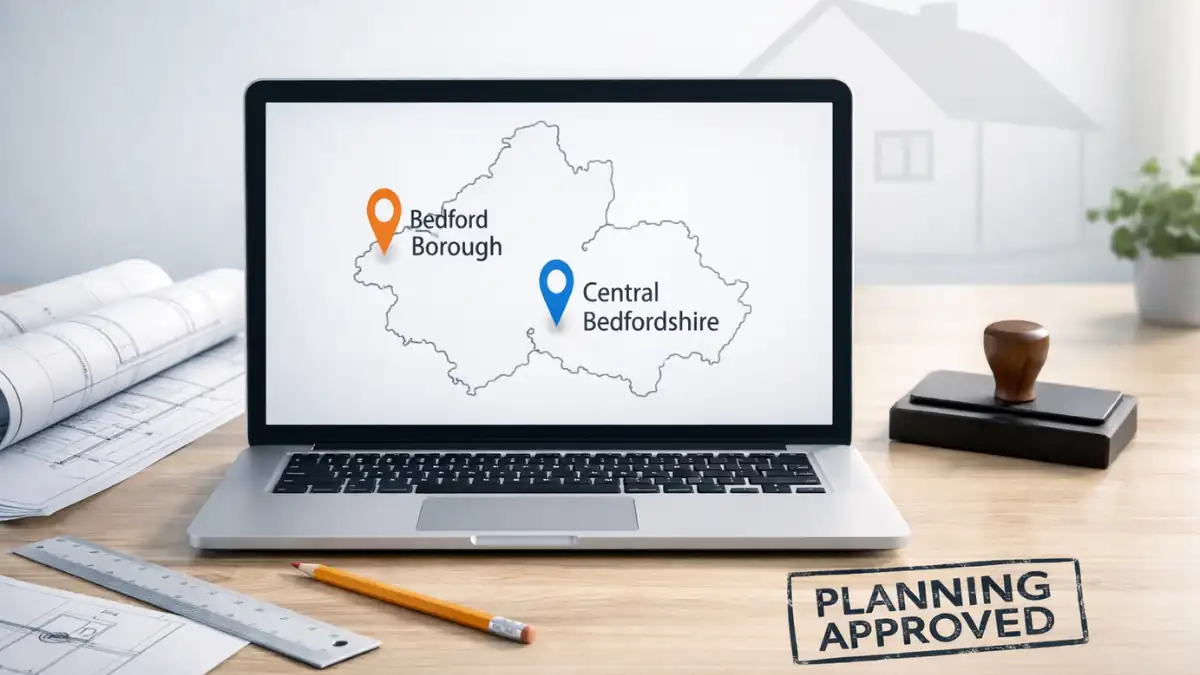
If you’re trying to figure out Planning Permission Bedfordshire for an extension, loft conversion, garden room, new driveway, or even a fence, the first step is working out which local planning authority covers your postcode (Bedford Borough Council, Central Bedfordshire Council, or in some areas nearby, Luton Borough Council).
- Most householder decisions are normally targeted at around 8 weeks once your application is validated (longer if extra reports are needed).
- Permitted Development may apply — but restrictions can kick in for conservation areas, listed buildings, flats/maisonettes, or Article 4 areas.
- Drawings matter: unclear or incomplete plans are one of the quickest ways to trigger delays, “invalid” notices, or a refusal.
- Budget for “extras” such as location plans, design statements, heritage statements, tree info, drainage notes, or highways input — depending on your site.
If you want a low-stress route, aim to (1) confirm whether you need a full application, (2) prepare a clean drawing pack, and (3) deal with neighbour impact early (overlooking, overshadowing, massing and boundary positions).
Not sure which council covers your postcode — or what route you need?
Tell us your postcode and what you’re building, and we’ll point you to the right route and the right documents before you submit anything.
Planning Permission Bedfordshire: what homeowners need to know first
Planning Permission Bedfordshire is one of those topics that feels simple until you actually try to submit an application. The rules are broadly national, but the practical “what the case officer expects” part can vary by area, street character, and local policy.
In most cases, the planning officer is looking for a few core things: does the proposal fit the area, does it harm neighbours, and is it compliant with local policy (design, parking/highways, heritage, flood/drainage where relevant).
If you’re early in the process, it can help to start with a simple “do I even need an application?” check. We cover that in our quick checklist here:a quick “do I need it?” checklist.
Which council do you apply to in Bedfordshire?
A common reason homeowners get stuck is searching for “Bedfordshire council planning” and ending up on the wrong portal. In practice, you apply to the local planning authority for your postcode.
- Bedford Borough — covers Bedford and surrounding areas within the borough.
- Central Bedfordshire — covers a large area including many towns and villages (e.g. around Leighton Buzzard, Dunstable, Biggleswade and surrounding settlements).
- Luton — a separate local authority; some homeowners near boundaries understandably get mixed up.
Local policy still matters
You’ll see searches like “Central Bedfordshire planning policy” because local plans and supplementary guidance influence what gets approved. Typical policy themes include:
- design and materials (especially on prominent elevations),
- impact on neighbours (privacy, daylight, overbearing effect),
- parking and access,
- heritage constraints, and
- flood/drainage considerations in certain locations.
Planning Permission Bedfordshire: which application type fits your project?
Homeowner projects generally fall into one of these routes. Choosing the right route saves time, because the wrong route often leads to “invalid” notices or rework.
1) No application (works allowed without applying)
Some projects can be done without a formal application if they meet national allowances. That said, the safest route for many homeowners is still to get the position confirmed in writing.
2) Certificate route (for certainty)
If you believe your work is allowed without a full application, you may still choose to apply for a Lawful Development Certificate. This is often used for extensions, lofts and outbuildings where you want a clear record for future buyers and solicitors.
3) Householder application (most common)
For many extensions and external alterations, this is the main route. It’s normally the “standard” homeowner submission and is assessed against local policy and neighbour impact.
4) Listed building or conservation-related consents
If your home is listed, or if you’re in a sensitive heritage area, the rules change. You may need additional heritage information, and the acceptable design approach can be stricter.
What you normally need to submit (drawings + documents)
Most delays at the start happen because an application is invalid (the council can’t register it because something is missing). A clean, complete pack makes everything smoother.
Typical drawing set for a householder submission
- Existing and proposed plans (floor layouts),
- existing and proposed elevations (outside appearance),
- site/block plan showing boundaries and where the work sits,
- location plan (usually based on mapping),
- roof plan and/or sections where needed (especially for lofts and taller extensions).
If you’re unsure what “good enough” looks like, our guide here is a useful reference:what drawings councils typically expect.
Common supporting documents (site-dependent)
- Design and Access Statement (often required for certain sites),
- heritage statement (listed buildings / certain heritage contexts),
- tree information (Tree Preservation Orders / important trees),
- drainage or flood notes (where relevant),
- highways/parking information (if access or parking is affected).
If your project also needs Building Control sign-off (many do), these two guides help you understand the “other half” of compliance:building regs explained in plain English andwhat Building Control actually does.
Planning Permission Bedfordshire costs and timelines (realistic expectations)
The cost of Planning Permission Bedfordshire isn’t just “the council fee”. A realistic budget includes drawings, mapping/location plans, and any specialist info your site requires.
Quick costs snapshot (what homeowners typically budget for)
- Council fee: varies by application type (check current figures before paying).
- Drawings / measured survey: depends on project size and complexity.
- Optional certainty: a certificate route can be worth it for future sale paperwork.
- Site “extras”: heritage, trees, drainage, highways/parking — only if your site triggers it.
For a broader view of where fees sit within your overall project spend, read:a homeowner guide to typical fee breakdowns and hidden extras.
How long does it take?
Once validated, many householder applications are targeted for a decision in around 8 weeks. However, real-world timings depend on validation speed, consultation responses, and whether revisions are needed.
If you’re planning around builders, lead times and mortgage deadlines, it helps to understand the “whole timeline” (including validation and conditions):a practical guide to typical decision timescales.
Want to reduce the chance of delays or refusal?
We can review your outline, flag any likely issues (neighbours, design policy, constraints), and tell you what documents will actually be expected for your site.
How to apply in Bedfordshire: step-by-step checklist
Here’s the simple, homeowner-friendly route we use to keep applications tidy and reduce surprises.
Step-by-step: Planning Permission Bedfordshire checklist
- Confirm the right council. Use your postcode to identify the correct authority (don’t rely on “Bedfordshire” searches alone).
- Check constraints early. Conservation area, listed status, Article 4, flood risk, TPOs, access/parking issues.
- Pick the right route. Full householder, certificate route for certainty, or another consent type if heritage applies.
- Prepare a clean drawing pack. Existing/proposed plans and elevations, site and location plans, plus sections where needed.
- Write a short, clear description. Make it easy for the case officer to understand what changes, and what stays the same.
- Talk to neighbours early (where sensible). It doesn’t remove the need for compliance, but it can reduce objections and misunderstandings.
- Submit and watch for “validation”. If the council asks for missing items, respond quickly to avoid the clock being reset.
- Be ready for small amendments. Minor tweaks (window positions, materials notes, boundary clarity) are common.
If you’re also trying to work out what to submit (and in what order), this wider guide is helpful:how to prepare a full set of plans for a home project.
Common pitfalls (and how to avoid them)
1) “Invalid” applications due to missing plans or wrong scales
This is one of the most frustrating delays, because you feel like you’ve “submitted”, but the process hasn’t properly started. A consistent drawing set and correct plans prevent most of these problems.
2) Underestimating neighbour impact
Many refusals come down to simple impacts: overlooking, overshadowing, height/massing, or building too close to a boundary with an overbearing effect. A small design change early can save months later.
3) Assuming “it’s allowed everywhere”
National allowances don’t apply in the same way to every property type or location. If your site is constrained, what feels like a standard extension may need a different approach.
4) Forgetting Building Control entirely
A “yes” from planning doesn’t mean you can build without Building Regulations compliance. If you’re altering structure, adding insulation, changing drainage, or creating new habitable space, Building Control usually needs to be involved.
If your application is refused, don’t panic — you normally have options (amendments, resubmission, or appeal depending on the circumstances). This guide explains sensible next steps:what to do after a refusal.
Related comparisons homeowners often search for
We regularly see these “comparison-style” questions alongside Planning Permission Bedfordshire. If any apply to your project, it’s worth understanding them early:
- Application vs Building Regulations: one is about acceptability in principle; the other is about technical compliance and inspections.
- Certificate route vs full application: one is for confirming lawfulness; the other is for seeking permission for development that needs it.
- Doing it yourself vs using an agent: DIY can work for experienced homeowners, but a managed submission often reduces “back-and-forth”.
- Checking nearby proposals: seeing what’s been approved locally can help set expectations for design and scale.
If you want to check what’s been submitted around you, this guide shows the easiest way to do it:how to look up nearby applications.
FAQs: Planning Permission Bedfordshire
Which council do I apply to for Planning Permission Bedfordshire?
It depends on your postcode. In Bedfordshire, the local planning authority is typically either Bedford Borough Council or Central Bedfordshire Council (and some neighbouring boundary areas can be confusing). The safest approach is to confirm the authority using your postcode before you submit anything.
How long does Planning Permission Bedfordshire usually take?
Once an application is validated, many householder submissions are targeted for a decision in around 8 weeks. In practice, it can take longer if the council asks for extra information, amendments are needed, or there are site constraints (heritage, trees, drainage, highways).
How do I apply for planning permission for a fence in Bedfordshire?
Start by checking whether the fence is on a boundary facing a highway, whether it exceeds typical height limits, and whether your property has restrictions (for example, conservation area or listed building status). If you do need to apply, the council will normally expect a clear site plan showing the fence position, height, and materials.
What documents do I need to submit with a householder application?
Most applications need existing and proposed plans and elevations, plus a location plan and a site/block plan. Depending on your site, you may also need additional supporting information (heritage statement, tree details, drainage notes, highways/parking information).
Can I submit an application myself, or do I need a professional?
You can submit yourself, as long as the drawings and documents meet the council’s requirements. However, many homeowners choose professional support because it reduces validation issues, improves drawing clarity, and helps avoid common neighbour-impact pitfalls that lead to refusal or redesign.
What if my application is refused?
A refusal doesn’t always mean “the end”. Often there’s a clear reason (privacy, scale, design, policy conflict) and the solution is a targeted amendment and resubmission. In some cases an appeal may be appropriate, but it depends on the decision notice and the planning merits of the scheme.
Want us to sense-check your drawings before you submit?
A quick review can catch missing plans, unclear elevations, boundary issues and common neighbour-impact problems before they become delays.
Next steps & useful guides
If you’re planning a project in Bedfordshire and want to go deeper, these homeowner guides will help:
- A quick “do I need it?” checklist
- What drawings councils typically expect
- A practical guide to typical decision timescales
- Building regs explained in plain English
- What Building Control actually does
- What to do after a refusal
- How to look up nearby applications
- Our complete UK home project guide
- First thing to confirmWhich local planning authority covers your postcode (don’t rely on generic “Bedfordshire” searches).
- Typical decision targetMany householder submissions aim for around 8 weeks after validation, but delays happen if info is missing or revisions are needed.
- Most common friction pointsNeighbour impact (privacy/daylight), unclear plans, and site constraints (heritage, trees, drainage, highways).
- What usually helps mostA complete drawing pack (existing + proposed), clear boundary info, and early checks on constraints and policy.
- Separate compliance trackMany projects also need Building Control sign-off — planning and Building Regulations are different checks.
Want a calm, clear route? Message Plans Made Easy with your postcode and project outline and we’ll tell you the most sensible next step.
Official guidance
For national guidance, current fee information, and the official rules, it’s always worth checking:
- Planning Portal – national guidance and application information
- GOV.UK – planning permission in England and Wales
How Plans Made Easy can help
Getting Planning Permission Bedfordshire right is mostly about doing the basics well: correct council, correct route, clear drawings, and a proposal that addresses neighbour impact and local policy. When those pieces are in place, the process is far less stressful.
Our team helps homeowners prepare compliant plans, manage submissions, and avoid the common mistakes that cause delays. If you want us to sense-check your project before you press “submit”, we’re happy to help.
Ready to move your project forward?
Plans Made Easy can prepare compliant plans, manage submissions, and guide you from idea to approval.

Performance Verified ✅
This page meets PME Optimisation Standards — achieving 95+ Desktop and 85+ Mobile PageSpeed benchmarks. Verified on

