
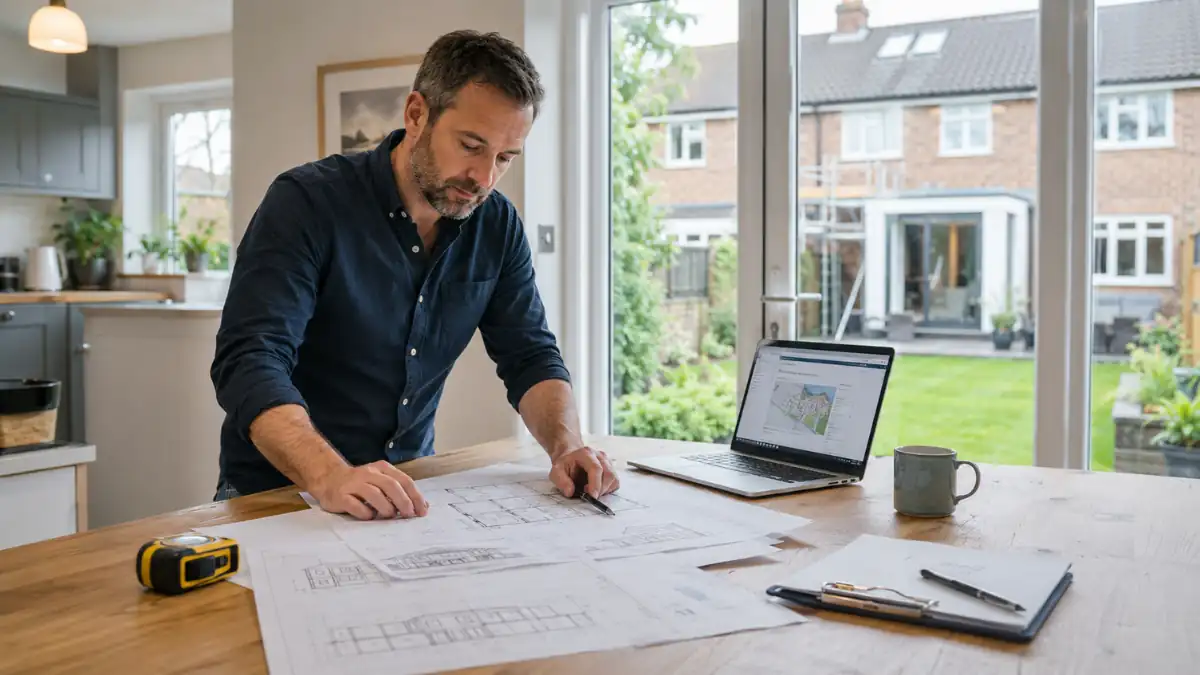
Share this post:
Quick summary: Planning Permission Advice
If you’re looking for Planning Permission Advice before you extend, convert or build, the key is to work out (1) whether your project is Permitted Development or needs a planning application, and (2) what your council is likely to focus on (neighbours, appearance, highway safety, policy and site constraints).
- Start with the basics: many household projects are allowed under Permitted Development, but there are strict limits.
- When in doubt: a Lawful Development Certificate is often the safest way to “prove” a project is lawful.
- If you do need permission: getting the right drawings and supporting info early reduces delays and refusal risk.
- Local matters: conservation areas, listed buildings, Article 4 Directions, trees and parking rules can change what’s possible.
In this guide, we explain the most reliable routes to get the right advice, what to ask before you pay for drawings, and the common “gotchas” that catch homeowners out.
Not sure what rules apply to your home?
Tell us what you’re planning and we’ll point you to the right route: Permitted Development, Lawful Development Certificate, or a full planning application.
Quick summary: Planning Permission Advice
Good Planning Permission Advice helps you avoid two expensive mistakes: designing something that can’t get approved, or starting work thinking you’re “fine” under Permitted Development when you’re not.
In most cases, the best starting point is: confirm your constraints (conservation area, Article 4, listed status), check whether you’re likely to be Permitted Development, and then decide whether you need a Lawful Development Certificate or a full planning application.
Planning Permission Advice: what it actually means (for homeowners)
Homeowners often search for “planning advice” when they’re trying to answer one practical question: can I build what I want without the council stopping it?The reality is that Planning Permission Advice is less about opinions and more about evidence — your home, your site constraints, and the rules that apply in your area.
In England, most projects fall into one of three buckets:
- Permitted Development (PD): you can build without applying for planning permission, as long as you stay within PD limits.
- Lawful Development Certificate (LDC): optional but very useful “proof” from the council that your PD project is lawful.
- Householder planning application: a formal application for permission (common for larger extensions, sensitive areas, or anything outside PD).
Planning Permission Advice vs applying: what you should do first
The best time to get advice is before you lock in a design. Once drawings are finished, changing size, roof form, windows or layout can mean paying twice.A sensible order usually looks like this:
- Check constraints (conservation area, listed building, Article 4, trees, flood risk, highways).
- Check PD potential (if relevant) and decide whether an LDC is worth it.
- Sense-check policy risk (especially for two-storey extensions, loft dormers, outbuildings and side extensions).
- Only then invest in full drawings and the application route.
If you want a broader foundation, this article supports our main pillar guide:Planning Permission (UK): The Complete Homeowner’s Guide.
Planning application routes homeowners use (and when)
Here are the routes we most often help homeowners choose between.
1) Permitted Development (with or without an LDC)
PD can be a great option for straightforward rear extensions, loft conversions and internal changes. However, PD has strict limits on height, depth, eaves, materials, side extensions, roof alterations and more.Where there’s any doubt, an LDC is a strong “belt and braces” move.
2) Householder planning application
This is the most common route when you’re outside PD, in a sensitive area, or your project needs a judgement call on design and impact.Supporting drawings matter here — particularly elevations, site context, and anything affecting neighbours.(If you’re preparing drawings, our guide to what drawings councils expect for planning applications is a useful companion.)
3) Prior Approval (in specific situations)
Some projects use a “prior approval” route rather than full planning permission. It’s not a free-for-all — you still submit details and the council assesses specific impacts.If you think your project might fit a prior approval route, getting tailored advice early can save months.
What to ask when you’re getting planning advice
Not all advice is equal. The most useful advice is specific, written down, and tied to your site and proposal.Whether you’re speaking to the council, a planning consultant, or a designer, these questions cut through the noise.
Questions that lead to clear answers
- What constraints apply to my property? (Conservation area, listed status, Article 4, trees, flood zone, highways, etc.)
- Is my idea likely to be Permitted Development? If yes, what are the “fail points”?
- Should I apply for a Lawful Development Certificate? And what evidence will the council expect?
- If it needs permission, what policies are most relevant? (Design, amenity, parking, character, heritage.)
- What changes are most likely to get a “yes”? (Depth, height, glazing, roof form, materials.)
- What supporting information is needed? (Design statement, heritage statement, daylight, trees, drainage.)
If you’re still at the “do I even need permission?” stage, this checklist is often the quickest starting point:Do I need planning permission?
Planning Permission Advice: typical costs and timelines (without surprises)
Homeowners usually want two things: how long it will take, and how much it might cost overall.Exact fees vary by project and area, so treat figures as guide-only — but the structure of costs is predictable.
Quick costs snapshot (guide-only)
- Advice stage: can be free (basic signposting) or paid (site-specific review).
- Drawings: survey + planning drawings are often the main pre-application spend for homeowners.
- Application fee: paid to the council (varies by application type and can change).
- Extra reports: only needed on certain sites (heritage, trees, drainage, highways, daylight).
If you want a wider budget view, see our guide to planning permission costs and where drawings/reports sit within the total.
How long does planning take?
Timeframes depend on the route. PD checks can be quick, but formal decisions (like an LDC or a householder application) take longer because the council has to validate documents, consult, and then assess the case.Delays often happen when:
- the submission is missing key plans or the correct plan scales,
- neighbour impacts haven’t been thought through,
- the proposal conflicts with local design guidance, or
- there are constraints (heritage/trees/highways) that need specialist input.
Not sure which route is right for your project?
We’ll sense-check your idea against PD rules and local constraints, then tell you the simplest compliant path forward.
Step-by-step: how to get reliable Planning Permission Advice
If you follow this process, you’ll usually avoid the most common false starts (like paying for drawings that need redoing).
Homeowner checklist: getting planning advice the smart way
| Step | What to do | What you’ll get |
|---|---|---|
| 1 | Confirm property constraints (area designations, listed status, Article 4, trees, flood, parking). | Clarity on what rules override “typical” PD assumptions. |
| 2 | Define your “must-haves” (rooms, depth, roof shape, windows) and your compromises. | A brief that makes advice specific and actionable. |
| 3 | Check whether you’re likely to be PD; decide if an LDC is worth it. | A safe route that reduces neighbour and resale stress. |
| 4 | If a planning application is needed, identify the top 2–3 risks (amenity, parking/highways, character, heritage). | A design direction that avoids “obvious refusal” triggers. |
| 5 | Prepare the right drawings and supporting documents for the route you’re taking. | A smoother validation process and fewer council queries. |
Need help with drawings? These two guides are a solid next read:what planning drawings usually include andhow to plan and brief your project.
Pitfalls & gotchas that cause refusals and delays
The same issues come up again and again, especially with extensions and loft conversions.A little Planning Permission Advice at the right time can prevent months of frustration.
Common reasons councils push back
- Neighbour impact: overlooking, loss of light, dominance, boundary proximity.
- Overdevelopment: too much built form for the plot, poor garden space, cramped layout.
- Street scene: poor design fit, awkward roof changes, unbalanced front elevations.
- Parking/highways: loss of parking, unsafe access, increased highway risk.
- Constraints: conservation/listed buildings, protected trees, Article 4 Directions.
Local council quirks (and why neighbours matter)
This is where generic advice falls down. Two councils can view the same design quite differently because:
- they use different local design guides and policies,
- street context varies (terrace vs detached vs corner plot), and
- constraints and precedent differ from area to area.
Neighbour comments also matter more than most people expect. Objections don’t automatically “stop” an approval, but they can trigger closer scrutiny.The practical approach is to design out the obvious concerns (privacy, height, boundary impact) and submit a clear set of drawings.
Related comparisons (useful if you’re deciding what to do next)
- Permitted Development vs planning permission: PD is rule-based; planning is a judgement against policy and impact.
- LDC vs planning permission: an LDC confirms lawfulness; planning permission grants approval for development that isn’t PD.
- Advice first vs drawings first: a short advice check often saves paying for redesigns later.
Conclusion: the simplest way to avoid council problems
The best Planning Permission Advice is the advice that keeps your project legal, buildable, and low-stress.Start by checking constraints, then decide whether your project is PD, needs an LDC, or needs a full application.If you do end up applying, invest in clear drawings and a submission that answers the council’s likely questions upfront.
FAQs: Planning Permission Advice
How do I get advice on planning permission for my house?
Start by checking whether your property has special constraints (conservation area, listed status, Article 4 Directions, protected trees).Then work out whether your proposal is likely to be Permitted Development. If there’s any doubt, consider a Lawful Development Certificate.If the project is outside PD, a householder planning application is usually the right route — and getting a quick professional sense-check before final drawings can save time and money.
How much does planning permission cost?
Planning costs usually include (1) the council’s application fee, (2) drawings/survey costs, and sometimes (3) specialist reports if your site needs them (heritage, trees, drainage, highways).The council fee varies by application type and can change, so always check current figures before you submit.For a full budget view, see our guide to planning permission costs.
How long are planning permissions valid for?
In many cases, planning permissions come with a time limit that requires you to start work within a set period.However, the exact wording is in your decision notice and can vary, so always check your approval document and any conditions.If you’re near the deadline, get advice before you spend money — the fix might be simple, but leaving it late can be costly.
How many times can planning permission be refused?
There isn’t a simple “number of tries”. A refusal means the council has set out planning reasons why the proposal didn’t meet policy or caused unacceptable impacts.You can often revise and resubmit, but the smartest approach is to address the refusal reasons directly — or seek advice on whether a different route (or design) has a better chance.
How many objections does it take to stop planning permission in England?
There is no set number. Councils decide based on planning considerations (policy, design, neighbour impact, highway safety and constraints), not a vote.That said, objections can highlight issues the council must consider. Designing out privacy/height/boundary impacts and submitting clear drawings helps reduce risk.
How much for planning permission to build a house?
New build costs usually go beyond the council fee. You’ll typically need a fuller drawing package, more supporting information, and sometimes specialist reports depending on the site.Early advice is especially valuable on new builds because policy and site constraints tend to play a bigger role than they do on simple householder extensions.
Want a clear answer, not guesswork?
We’ll review your idea and tell you the most realistic route to approval — before you waste money on the wrong drawings.
Next steps & useful guides
If you want to go deeper, these guides are the most useful next reads for homeowners:
- Planning Permission (UK): The Complete Homeowner’s Guide
- Do I need planning permission? (Homeowner checklist)
- What drawings do I need for a planning application?
- Planning permission drawings: what’s included and why it matters
- Plans for Building Regulations: what you need & when
- Making plans: how to brief, budget and avoid redesigns
- Fastest safe starting pointCheck constraints first, then decide if you’re likely PD, need an LDC, or need a householder application.
- Most common homeowner routesPermitted Development, Lawful Development Certificate, or a householder planning application.
- What councils care aboutNeighbour impact, design/appearance, highway safety/parking, and local policy constraints.
- Best way to reduce refusalsGet advice before final drawings, then submit clear plans that address the obvious risks (privacy, height, boundaries, character).
- Common “gotcha”Assuming PD without checking constraints (conservation areas, Article 4, listed buildings, trees) can lead to enforcement and expensive redesign.
- When to get helpIf your site is constrained, neighbours are close, or you’re near PD limits — a short review can save months.
Want us to sense-check your project? Contact Plans Made Easy for practical planning advice.
Official guidance & trusted references
For current rules, fees and official guidance, these sources are worth checking:
- Planning Portal – national guidance on applications and household projects
- GOV.UK – planning permission in England and Wales (overview)
- GOV.UK – planning application statistics (data and trends)
- Royal Town Planning Institute (RTPI) – professional planning body
Ready to move your project forward?
Plans Made Easy can prepare compliant plans, manage submissions, and guide you from idea to approval.
Performance Verified ✅
This page meets PME Optimisation Standards — achieving 95+ Desktop and 85+ Mobile PageSpeed benchmarks. Verified on

