
Share this post:
Quick summary: planning drawings
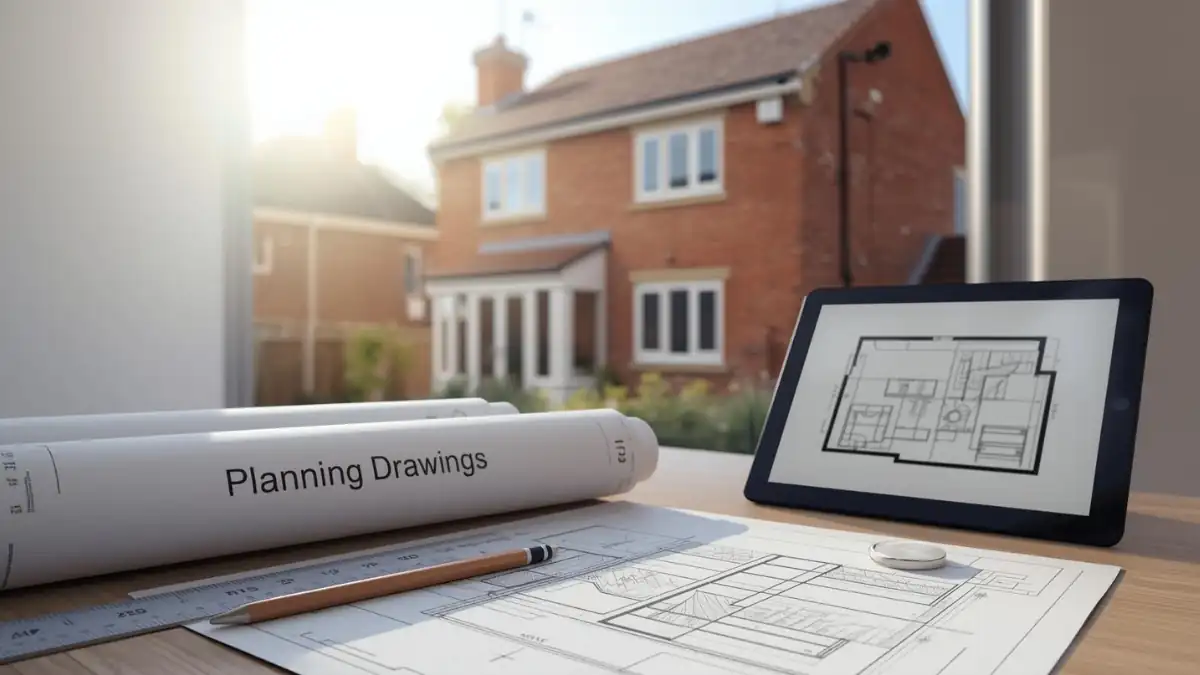
Planning drawings are the scaled plans the council uses to understand what you’re proposing and how it affects neighbours, the street and the character of the area. For most householder projects, you’ll usually need a location plan, a site/block plan, plus existing and proposed floor plans and elevations.
- Most common reason applications get delayed: missing/incorrect plans, wrong scales, or drawings that don’t match each other.
- Typical homeowner set: location plan + block plan + existing/proposed plans + existing/proposed elevations (and sometimes a roof plan/sections).
- Permitted Development still needs drawings if you want a Lawful Development Certificate (or simply want accurate builder quotes).
- Planning and Building Regulations are different: planning is “is it acceptable?” — Building Control is “is it compliant and buildable?”.
In this guide, we’ll show you exactly what the council expects, what to double-check before you submit, and when it’s worth getting a professional to prepare the package so you avoid rejections and back-and-forth.
Not sure what the council will accept?
Tell us what you’re building and where you are — we’ll confirm what plan set you’re likely to need for a valid submission.
What planning drawings are (and why councils reject them)
If you’re applying for planning permission, the council needs to see a clear, scaled set of planning drawings that accurately show what exists now and what you want to build. In other words, it’s not about pretty visuals — it’s about clarity, scale, and consistency so the planning officer can assess impact.
Most delays happen for boring (but fixable) reasons: the site plan doesn’t match the elevations, the scale bar is missing, neighbours aren’t shown properly, or the proposal is unclear. The good news is that once you know what the council is looking for, you can avoid 90% of the back-and-forth.
Planning drawings for planning permission: what you actually need
For a typical householder application (extensions, loft conversions, garage conversions, outbuildings), the council normally expects a core set of plans. Some projects need extra items, but this is the starting point.
The “core set” most homeowners need
- Location plan (usually OS-based) showing the site in context.
- Site/block plan showing boundaries, neighbouring buildings, access, and where the proposal sits.
- Existing floor plans (current layout).
- Proposed floor plans (what’s changing).
- Existing elevations (all relevant sides of the house).
- Proposed elevations (how it will look from outside).
Often required (depending on the project)
- Roof plan (helpful for dormers, hip-to-gable, large rear extensions, changes to ridgelines).
- Sections to show heights, floor/ceiling levels, relationship to neighbouring windows, or sloping sites.
- Materials notes (especially if you’re changing cladding/brick/roof finishes).
- Street scene / context elevation where character or matching is a key issue.
- Design & Access Statement (more common for sensitive sites; sometimes requested for listed buildings and certain areas).
Quick costs snapshot: what homeowners usually budget for
- Measured survey: often priced separately if the designer visits site.
- Planning set: commonly priced as a package for householder work.
- Council fees: separate from any drawing/design cost.
- Building Regulations package: usually a second stage once planning is approved.
Costs vary by region and complexity, so it’s worth comparing like-for-like quotes (same scope, same number of revisions, and clear confirmation of what’s included).
Scales, accuracy and common technical checks
Councils validate applications partly by checking whether the drawings are clear and measurable. That’s why scale, labelling and consistency matter more than homeowners expect.
Typical scales you’ll see
- Floor plans and elevations: commonly 1:50 or 1:100.
- Site/block plan: often 1:200 or 1:500.
- Location plan: often 1:1250 (sometimes 1:2500 depending on setting).
How accurate do the drawings need to be?
They don’t need to be “millimetre-perfect” like a manufacturing drawing, but they do need to reflect the real building closely enough that the proposal can be assessed fairly. If the existing layout or elevations are wrong, it can cause problems later — especially if neighbours object or the case officer asks for clarifications.
Validation details people forget
- North point on the site plan (and sometimes on floor plans).
- Correct drawing titles: “Existing” vs “Proposed”.
- Scale bar + stated scale on every sheet.
- Consistent dimensions/heights across plans, elevations and sections.
- Neighbouring windows/boundaries shown where relevant to privacy and outlook.
Planning drawings vs Building Regulations drawings
One of the biggest confusions we see is assuming “planning” and “Building Regs” are the same set. They aren’t — and paying for the wrong thing at the wrong time often leads to wasted cost or missing detail.
Planning set (what the council’s planning team assesses)
- Overall size, massing and appearance.
- Impact on neighbours (overlooking, daylight, dominance).
- Impact on street scene and character.
- Basic relationship to boundaries, access, and the site.
Building Regulations set (what Building Control checks)
- Structure (Part A), insulation/energy (Part L), fire safety (Part B), ventilation (Part F), drainage, stairs, and more.
- Construction build-ups, specifications and technical details.
- Coordination with structural calculations where required.
Who can prepare the drawings (architect vs technician vs DIY)
You don’t legally need an architect for a householder planning application. However, you do need drawings that meet your council’s validation requirements and clearly communicate the proposal.
Your main options
- Architect: great where design quality, sensitive context, or negotiation is likely.
- Architectural technologist/technician: often a strong, cost-effective option for typical extensions and conversions.
- Design & build contractor: can work well, but make sure the scope and ownership of drawings is clear.
- DIY: possible for simple projects, but only if you’re confident with scale, accuracy and council requirements.
Not sure if your idea fits Permitted Development?
We’ll check your project against PD rules and tell you whether you need a full application (or whether an LDC is the safer route).
Step-by-step: getting your drawings ready to submit
If you want to avoid delays, the aim is simple: submit a complete, consistent set that makes the proposal easy to assess.
Checklist: what to do before you press “submit”
- Confirm the application type. Householder, full planning, listed building consent, or Lawful Development Certificate.
- Collect good starting info. Photos, rough measurements, and a clear description of what you want to change.
- Agree the plan list. Location plan, block plan, existing/proposed plans and elevations — plus roof plan/sections if needed.
- Do a consistency check. Heights match across drawings, boundaries are correct, and the proposal is shown clearly.
- Check scales and labels. Scale bar + stated scale on every sheet; “Existing” and “Proposed” clearly titled.
- Plan for queries. If the council asks for an amendment, respond fast with an updated sheet (and clear revision notes).
Gotchas that cause delays (and how to avoid them)
1) The drawings don’t show enough context
Councils need to see how your proposal sits on the plot and relates to neighbours. If the site plan is too vague, you’ll often get a validation query or a request for additional information.
2) The proposal looks different across sheets
A classic problem is a window that appears in one elevation but not the other, or a roof height that changes between drawings. Small mismatches create big delays because planners can’t confidently assess impact.
3) Height and neighbour impact isn’t clear
If privacy, overshadowing, or bulk is likely to be an issue, add a section early. It’s often quicker to include it up front than to wait for the council to ask.
Local council quirks to watch for (England)
Even with national guidance, different planning teams can be stricter on different things. You’ll often see extra scrutiny where sites are sensitive or where neighbour impact is finely balanced.
- Conservation areas: more focus on materials, detailing, and street scene impact.
- Article 4 areas: Permitted Development rights may be restricted, so the application route can change.
- Corner plots and side extensions: visibility from the street tends to increase design scrutiny.
- Flats/maisonettes: Permitted Development rules are more limited than for houses.
FAQs: planning drawings
What are planning drawings?
They’re scaled plans that show the existing house and the proposed changes clearly enough for the planning officer to assess acceptability (size, appearance, neighbour impact and context). They usually include a location plan, a site/block plan, and existing/proposed plans and elevations.
What drawings are required for planning permission?
Most householder applications need: location plan, block plan, existing and proposed floor plans, and existing and proposed elevations. Depending on the project, you may also need a roof plan, sections, or a short supporting statement — especially on tricky sites or in sensitive areas.
Can I do my own plans for planning permission?
Yes, in principle. However, they must be to scale, accurately labelled, and consistent across every sheet. If you’re not confident with scale and validation requirements, it’s often cheaper in the long run to get a professional set prepared so you don’t lose weeks to resubmissions.
How accurate do the drawings need to be?
They need to reflect the real building closely enough that the proposal can be assessed properly. Inaccurate existing drawings can trigger validation issues and create bigger problems later if the built result doesn’t match what was approved.
Do I still need drawings if my project is Permitted Development?
You’ll still want clear plans for builder pricing and to avoid mistakes on site. If you’re applying for a Lawful Development Certificate, you will need a proper scaled set so the council can confirm the work is lawful.
Want a quick sanity-check before you submit?
We can review your plan list and tell you what’s missing (and what’s likely to trigger council questions) before it becomes a delay.
Next steps & useful guides
If you’re still planning your wider project, these guides usually help homeowners avoid expensive surprises:
- Start with our “do I need permission?” checklist
- Read our complete UK planning guide for homeowners
- Understand typical timescales from submission to decision
- Budget properly with our costs breakdown
- Get clear on Building Regulations before you start building
- Learn how Building Control works (and how to avoid failed inspections)
- Compare Full Plans vs Building Notice routes
- Core set (typical householder)Location plan + block plan + existing/proposed floor plans + existing/proposed elevations.
- Common add-onsRoof plan and/or sections where heights, neighbours, or sloping sites need clarifying.
- Most common delayWrong/missing scales, unclear labelling, or drawings that don’t match each other.
- Planning vs Building RegsPlanning is about acceptability and impact; Building Control is about compliance and construction detail.
External references (official guidance)
Ready to move your project forward?
Plans Made Easy can prepare compliant plans, manage submissions, and guide you from idea to approval — with fewer delays and less stress.

Performance Verified ✅
This page meets PME Optimisation Standards — achieving 95+ Desktop and 85+ Mobile PageSpeed benchmarks. Verified on

