
Share this post:
Quick summary: How Long Does Planning Permission Take
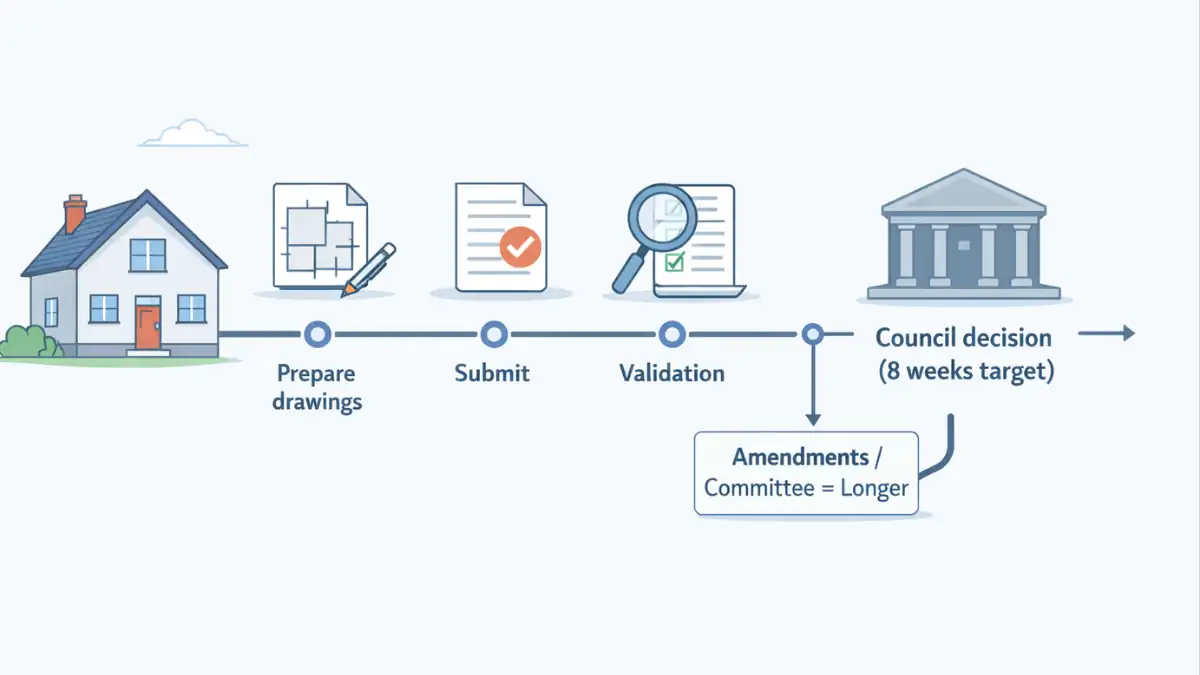
If you’re asking How Long Does Planning Permission Take, the honest answer is: for most straightforward home projects in England, the council’s target decision time is 8 weeks from validation — but in real life, many homeowners experience something closer to 8–12 weeks from submission once you include validation, queries, and any amendments.
- Best-case (well-prepared householder application): around 8–9 weeks from submission to decision.
- Common experience: 10–12 weeks if the council requests clarifications or minor changes.
- Large / complex schemes: usually 13+ weeks from validation, sometimes longer if committee or specialist reports are needed.
- Key detail: the “clock” usually starts once the application is validated (accepted as complete), not the day you press submit.
The biggest time-saver is simple: submit a complete, clear application (right drawings, correct forms, correct fee, and a sensible proposal). That reduces validation delays and avoids the “please provide…” email that can add weeks.
Want a realistic timescale for your own project?
Tell us what you’re planning and where you live — we’ll explain the likely timeline, the common delay points, and how to submit in a way that avoids unnecessary back-and-forth.
So… how long does planning permission take in practice?
Homeowners often hear “it’s eight weeks”, then feel blindsided when a decision doesn’t arrive on week eight.The reason is that there are two timelines happening at once:
- Submission to validation (admin checks: are the drawings right, is the fee correct, is everything uploaded?).
- Validation to decision (the statutory target time — the “planning clock”).
For many householder projects (extensions, dormers, garage conversions), a realistic expectation is:8 weeks from validation — and more like 8–12 weeks from submission once you include validation time and any council queries.
The target decision times (8 weeks vs 13 weeks)
In England, planning authorities are expected to decide applications “as quickly as possible” and within statutory time limits — unless a longer period is agreed in writing. :contentReference[oaicite:1]{index=1}
Typical targets you’ll hear most often
- 8 weeks — most householder and “minor” applications (typical home projects).
- 13 weeks — major or more complex proposals.
- 16 weeks — where an Environmental Impact Assessment (EIA) is required (rare for normal home projects).
The typical stages and where delays happen
Most planning applications follow a similar pattern. Here’s what usually happens, and what each step means for timescales.
1) Preparation (before you submit)
This stage is entirely in your control — and it’s also where we see the biggest time savings.If your drawings are clear and your proposal is sensible for your street, you reduce the chance of delay later.
- Measure and survey the existing house properly.
- Prepare existing and proposed drawings at the right scales.
- Check constraints like conservation areas, listed status, and Article 4 directions.
- Speak to neighbours early if the proposal is likely to be sensitive.
2) Submission and validation (often 1–3+ weeks)
The council checks whether your application is complete and valid.If anything is missing, they’ll ask for it — and your timeline can pause until you supply it.
3) Consultation and assessment (runs within the decision period)
Once validated, the council consults neighbours and relevant bodies (depending on the proposal).The case officer then assesses the impact — such as privacy, daylight, design, parking, and policy compliance.
If the officer has concerns, they may contact you for amendments. Small revisions can still be fine, but each revision adds time.
4) Decision (delegated or committee)
Many householder decisions are made under delegated powers.However, some go to planning committee, which can extend the timeline because you’re then working around committee dates.
What slows a planning decision down
If a planning decision is taking longer than expected, it’s usually due to one (or more) of these issues.
Incomplete applications and validation delays
- Missing drawings (or missing key labels such as heights and boundary distances).
- Incorrect forms or ownership certificates.
- Wrong fee or incorrect application type.
Design concerns that trigger amendments
- Overlooking distances to neighbours (privacy and overlooking are common pinch points).
- Size/scale that doesn’t fit the street scene.
- Windows, roof forms, and materials that appear out of character.
Constraints and specialist input
- Conservation areas and listed buildings typically require more careful justification.
- Trees, highways matters, drainage constraints, and heritage input can add consultation time.
How to speed up your planning permission decision
You can’t control the council’s workload, but you can absolutely reduce the chances of avoidable delays.Here’s the approach we recommend for homeowners who want a clean, fast run at it.
Step-by-step: how to keep your planning application moving
- Start with a quick “do I need it?” check. If your project may fall under Permitted Development, you might avoid a full application altogether (or apply for a Lawful Development Certificate instead).
- Get the drawings right first time. Clear existing/proposed plans and elevations, correct scales, and consistent dimensions reduce officer queries.
- Check constraints early. Conservation areas, listed status, and Article 4 directions can change what’s acceptable.
- Pre-empt neighbour concerns. Where possible, tweak windows, heights, and boundaries before submission — it’s easier than revising under pressure.
- Submit a complete package. Correct forms, correct certificates, correct fee, correct plans, and the right supporting info from day one.
- Respond quickly to case officer questions. Fast replies help your application stay on the officer’s active list.
- Be strategic with amendments. Minor changes can help; repeated redesigns mid-process often extend the timeline significantly.
Not sure why your application is taking so long?
We can review what you’ve submitted, explain the usual delay points, and tell you what to do next (including how to handle extensions of time and amendments).
After approval: conditions, Building Regs, and expiry
Even after you get a “yes”, you may still have steps to complete before you can build — and those steps affect your real project timeline.
Planning conditions can add weeks (sometimes months)
Many approvals come with conditions — for example materials details, obscure glazing, construction management, or drainage requirements.Some conditions must be discharged before work starts, so you need to allow time for that.
How long does planning permission last once it’s granted?
In most cases, you have three years from the date permission is granted to begin the development — unless your decision notice states otherwise.
“Starting” has a legal meaning. It typically requires genuine commencement (not just ordering materials).If you’re approaching the deadline, get professional advice so you don’t accidentally let a permission lapse.
FAQs: How Long Does Planning Permission Take
How long does planning permission take UK?
For many home projects in England, the target is 8 weeks from validation. In practice, allow 8–12 weeks from submission because validation checks and minor queries often add time. :contentReference[oaicite:6]{index=6}
How long does planning permission take to be granted?
If your application is valid on day one and doesn’t need redesigns, you may get a decision close to the target date (often around week 8 for householder proposals).However, if amendments are requested or it goes to committee, it can take longer.
On average how long does planning permission take?
A sensible “average” for homeowners is 10–12 weeks from submission for straightforward projects, because that includes validation time plus the decision period.More complex proposals can push beyond that.
How long does planning permission last UK?
Most permissions are time-limited. Commonly, you have three years from the decision date to start the approved development, unless your approval notice states a different timeframe. :contentReference[oaicite:7]{index=7}
How long does planning permission last once started?
Once a development has lawfully commenced within the allowed period, the permission does not usually “expire” in the same way.The key risk is failing to start properly within the deadline — or starting in a way that doesn’t count as commencement.
How long does a planning application take to come back?
Councils usually aim to issue a decision notice within the statutory target period once validated (often 8 weeks for householder/minor schemes).If you’ve heard nothing close to the target date, check whether your application was validated and whether an extension of time has been requested. :contentReference[oaicite:8]{index=8}
How long does planning permission take Scotland / Wales / Northern Ireland?
Timescales and processes can differ outside England. If your project is in Scotland, Wales, or Northern Ireland, treat the targets above as a guide only and check your local authority’s published planning performance information.
Want to avoid delays before you submit?
We’ll sense-check your drawings pack and flag the common “validation killers” that cause weeks of delay.
Next steps & useful guides
If you want to go deeper (and avoid the most common pitfalls), these PME guides are the best next reads:
- Our complete homeowner guide to the planning system
- A quick checklist to work out whether permission is needed
- What drawings you typically need for a valid submission
- A breakdown of fees and what to budget for overall
- What to do if you get refused (and your options next)
- When professional support makes sense — and when it doesn’t
- How Building Regulations and inspections fit into your project timeline
- Typical target (householder/minor)8 weeks from validation for many home projects (England).
- Common real-world experience8–12 weeks from submission once you include validation and queries.
- Complex / major proposalsOften 13+ weeks from validation (and longer if committee or specialist input is needed).
- Biggest avoidable delayAn application that isn’t valid on first submission (missing plans/forms/fee).
- How long permission lasts once grantedUsually 3 years to begin, unless your decision notice states otherwise.
If you want a realistic timeline for your council and project type, send us your idea and we’ll map out the likely stages.
Official guidance
For the most up-to-date national guidance on decision periods and the planning process, these are the best starting points:
- Planning Portal – national guidance and application information
- GOV.UK – planning permission in England and Wales
- GOV.UK – determining a planning application (decision times and process)
How Plans Made Easy can help
The quickest route to approval usually isn’t chasing the council — it’s submitting an application that’s clear, compliant, and proportionate for your area.When we prepare a planning pack for homeowners, we focus on the two things that most affect speed: validation-ready documents and a proposal that addresses the common reasons for delay.
If you’re trying to work out how long your planning permission will take (and what might slow it down), our team can sense-check your proposal, prepare the drawings, and guide you through submission so you avoid the usual pitfalls.
Ready to move your project forward?
Plans Made Easy can prepare compliant plans, manage submissions, and guide you from idea to approval.

Performance Verified ✅
This page meets PME Optimisation Standards — achieving 95+ Desktop and 85+ Mobile PageSpeed benchmarks. Verified on

