
Share this post:
Quick summary: House Drawing Plan for UK planning permission
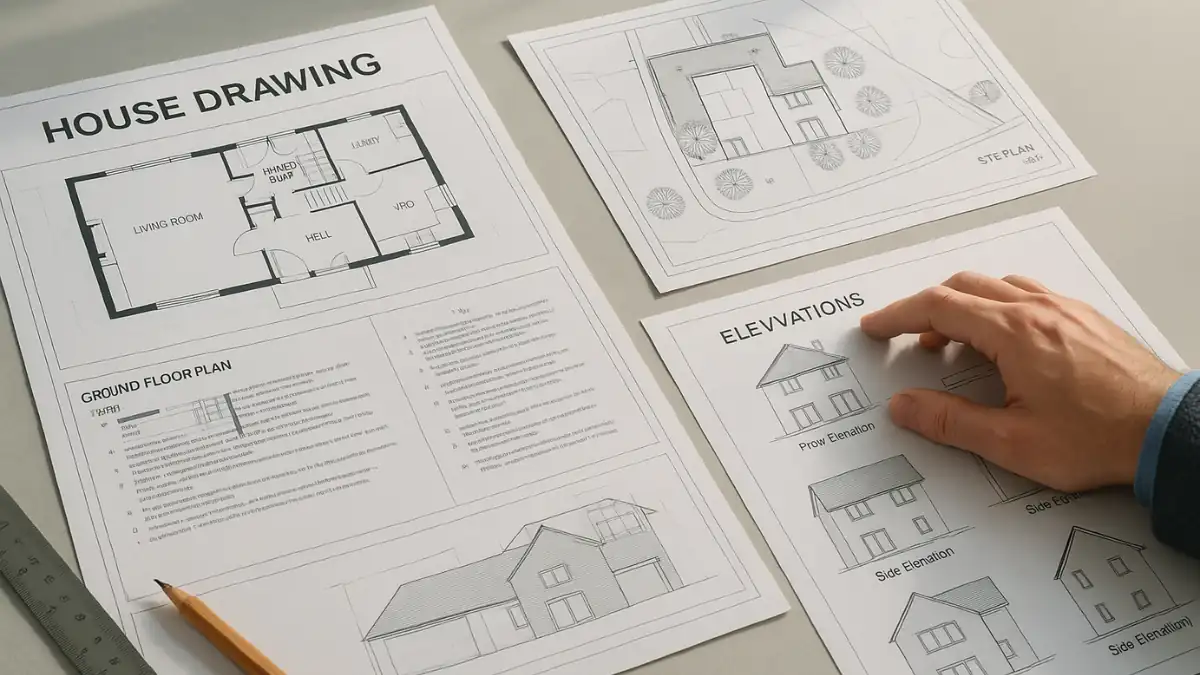
A house drawing plan is the set of scaled drawings that shows your existing home and the changes you want to make – for example an extension, loft conversion or new porch. Councils use these drawings to decide on planning permission and Building Control use them to check compliance with Building Regulations.
In this guide, our team at Plans Made Easy explains what a house drawing plan includes, who can prepare it, rough costs, and how it fits into planning permission and building regulations approval in England. By the end, you’ll know exactly what you need for your project and how to avoid the common mistakes that cause validation delays and refusals.
- Most home projects that need planning permission require properly scaled plans.
- Even if work falls under permitted development, you may still want drawings for a lawful development certificate and for your builder.
- Plans must usually be drawn to recognised scales (for example 1:50 or 1:100) with a north arrow, dimensions and boundary lines clearly marked.
- You can draw simple plans yourself, but councils expect professional-quality drawings for most extensions and larger changes.
Thinking about getting your house drawing plan sorted?
Share your ideas with us and we’ll let you know what level of drawings you’re likely to need for planning permission and Building Control.
What is a house drawing plan?
A house drawing plan is a set of scaled drawings showing your property as it is now and how it will look after the work. Councils use these drawings when they assess planning applications, and Building Control uses them to check compliance with the Building Regulations.
For a small project, such as a porch or simple internal alteration, the house drawing plan may be only a few sheets. For larger projects like house extensions, loft conversions or major remodelling, you will usually need a fuller pack of drawings and sometimes structural calculations too.
House drawing plan vs other types of drawings
Homeowners often hear several phrases: “plans”, “drawings”, “blueprints”, “construction drawings” and “building regs plans”. They sound similar, but the purpose is slightly different in each case.
House drawing plan vs planning permission drawings
A house drawing plan for planning permission focuses on how the proposal affects the outside of the house and the surrounding area. It shows things like:
- Overall size, height and footprint of the change.
- Distances to boundaries and neighbouring windows.
- Roof shape, window positions and materials.
These are sometimes called planning permission drawings. They do not always show every construction detail, but they must be clear enough for the planning officer to understand the project and check planning policies.
House drawing plan vs Building Regulations plans
Building Regulations plans go further. They include details of insulation, structure, fire safety and drainage so Building Control can check compliance with Parts A, B, L and the other technical sections. Our guide to plans for Building Regulations explains this in more depth.
How house drawing plans fit into different application types
The house drawing plan you need depends on the type of consent you are applying for. Broadly, there are three common situations for UK homeowners.
1. Full planning permission
For most extensions, new roofs, significant window changes and new dwellings, you will need a full planning application. Your house drawing plan must meet your council’s validation requirements, which usually follow the national standards on the Planning Portal.
Drawings at this stage focus on layout, appearance and impact on neighbours. Construction details can often wait until the Building Regulations stage.
2. Lawful development certificate (permitted development)
If the work is permitted development, many homeowners still apply for a lawful development certificate. The house drawings need to prove that what you are building meets the permitted development criteria. For example, the plans may show eaves height and projection of a rear extension.
Our article on when planning permission is required explains how to decide whether you need a full application or a certificate.
3. Building Regulations approval
Whatever happens on the planning side, most structural work will need Building Regulations approval. You can apply by Building Notice or Full Plans. If you choose the Full Plans route, you will submit detailed house drawings and get them checked before work starts.
This can reduce risk on site and help you avoid surprises once the build is underway.
Not sure what level of plans you need?
We’ll review your project and advise whether you only need planning drawings, full Building Regulations plans, or both.
What a good house drawing plan should include
Councils in England follow similar requirements, though each has its own validation checklist. For a typical extension or conversion, a complete house drawing plan usually contains:
Location and block plans
- A location plan at 1:1250 or 1:2500 showing where the property sits in the wider street.
- A block or site plan at 1:200 or 1:500 showing boundaries, nearby buildings, access and trees.
Existing and proposed floor plans
- All relevant floors drawn to scale (often 1:50 or 1:100).
- Rooms labelled clearly, with main dimensions shown.
- Existing and proposed layouts shown on separate sheets – not combined.
Elevations and sections
- All external sides of the house, again existing and proposed.
- Any changes in materials, roof forms, windows and doors.
- Sections where heights or levels are important, for example in loft conversions or split-level sites.
Notes and schedules
For Building Regulations, the house drawing plan will usually have specification notes explaining insulation, structure and fire protection. These can sit on the drawings themselves or in a separate document, depending on the complexity of the project.
Who can prepare a house drawing plan?
There is no legal rule saying an architect must draw your house plans. However, the drawings do need to be accurate and clear enough for the council to rely on them. Broadly, you have three options.
1. Draw the plans yourself
Some homeowners create their own house drawing plan using graph paper or basic software. This can work for very small projects, but there are risks:
- Scales and dimensions can easily be slightly wrong.
- Key information such as levels, roof heights or materials may be missed.
- Applications may be delayed or made invalid if drawings do not meet the local list.
2. Use a designer, technician or architect
Most homeowners choose a professional – an architectural technologist, technician or architect – to prepare their house drawings. They will usually visit your home, measure it carefully and prepare accurate CAD plans.
A good designer will also talk through what is realistic under planning policy and suggest options you may not have considered. Our guide to architect drawings for planning permission explains how this process works.
3. Online plan-drawing services
Some services work remotely, using your own measurements and photographs. These can be cost-effective but they rely on you measuring accurately. They may be best suited to simpler changes, where the risk of survey errors is lower.
House drawing plan costs and typical timelines
Costs vary with location, property type and project complexity. However, many UK homeowners find that professional house plans for a modest extension cost less than they expect, especially compared with overall build costs.
- Simple internal alteration plans: from a few hundred pounds.
- Typical single-storey extension: often in the low four figures for survey and planning drawings, with extra for full Building Regulations plans.
- Larger two-storey extensions or complex projects: higher fees, often staged in line with planning and technical design phases.
These are broad ranges only. Always obtain specific quotes for your project and remember that fees are separate from council application charges.
As for timing, a straightforward house drawing plan may be turned around in two to four weeks once the survey has been done. More complex projects can take longer, especially where options are being tested or where other specialists are involved.
Remember to allow additional time for the planning process itself – our planning permission timelines guide explains the key stages and decision periods.
Step-by-step: how to get your house drawing plan sorted
House drawing plan checklist
| Step | What to do | Why it matters |
|---|---|---|
| 1. Clarify your brief | Decide what problems you’re trying to solve – more space, better light, new layout – and gather inspiration. | Gives your designer clear direction and avoids wasted time. |
| 2. Check if permission is needed | Use our guides on whether you need planning permission and permitted development as a starting point. | Influences how detailed your house drawing plan must be. |
| 3. Arrange a measured survey | Either your designer measures the property or, for simple jobs, you provide accurate measurements. | Good measurements are essential for reliable drawings and avoiding problems on site. |
| 4. Review initial drawings | Look at layout options from your designer and check they work for furniture, storage and movement. | This is your chance to tweak the design before it goes to the council. |
| 5. Finalise planning drawings | Agree the final house drawing plan set for submission, including elevations and site plan. | Ensures your application is complete and meets the validation checklist. |
| 6. Prepare Building Regulations plans | Once planning is secure, add construction details to create a technical set for Building Control and your builder. | Reduces risk on site and helps you obtain competitive quotes. |
Common pitfalls with house drawing plans
Most planning delays we see come back to drawings that are unclear or incomplete. Here are some of the main issues to watch for.
- Missing or incorrect scales – plans must be to scale and labelled clearly.
- Only showing the proposed layout, with no existing drawings for comparison.
- Not including neighbouring properties where they are affected by overshadowing or overlooking.
- Leaving out levels where ground slopes, which can hide the true height of an extension.
- Using old or inaccurate Ordnance Survey mapping for the site plan.
Technical details councils expect to see on a house drawing plan
Each local authority publishes a validation checklist, but most follow the standards set out by national guidance and the Planning Portal. For a typical domestic project, you should expect to include:
- Drawings at recognised scales, usually 1:50 or 1:100 for elevations and floor plans.
- A scale bar on each sheet, so officers can check dimensions even if prints are reduced.
- North arrow and clear labelling of rooms, elevations and boundaries.
- Site levels where relevant, especially if building on a slope or near neighbours.
- Materials and finishes called out on elevations – for example “brick to match existing”.
For Building Regulations, extra details are needed. These may include insulation thicknesses (Part L), escape windows and smoke alarms (Part B), structural elements (Part A) and drainage layouts. Our Building Regulations guide and Building Control overview provide more context.
FAQs: house drawing plan and planning permission
What is a house drawing plan?
It is the set of scaled drawings that show your property before and after the proposed changes. Councils and Building Control use these drawings to understand what you want to build, check planning policies and assess compliance with the Building Regulations.
Do I always need a house drawing plan for planning permission?
For most planning applications, yes. A few very small changes may rely on photographs or simple sketches, but almost all extensions, loft conversions and porches need proper scaled drawings. Your council’s validation checklist will confirm the minimum requirements.
Can I draw my own house plans?
You can, and some homeowners do this for very simple projects. However, the council can reject an application if the drawings are not accurate or clear enough. For anything beyond the basics, it is usually safer to use a professional designer or technician who understands planning standards.
Who draws plans for buildings if I don’t use an architect?
Many householder applications are prepared by architectural technologists, technicians or specialist plan-drawing companies. They may not call themselves architects but can still produce high-quality plans and handle the planning process for you.
How much do house drawing plans cost in the UK?
Costs vary widely depending on the region and complexity of the work. As a very broad guide, internal alterations may cost a few hundred pounds in drawing fees, while plans for a typical single-storey extension are often in the low four figures. Technical Building Regulations drawings are usually an additional stage.
How long are house plans valid for?
Planning permission normally lasts three years from the date of approval. The drawings submitted with that application usually remain valid for the life of the permission. Building Regulations approval has its own rules, and it is best to check with your Building Control body if a project has been on hold for some time.
Do I need different house drawing plans for Building Regulations?
Often yes. Planning drawings focus on appearance and layout, while Building Regulations drawings add technical information about structure, insulation, fire safety and drainage. Sometimes they are combined into one evolving set, but they still need to satisfy both planning and Building Control requirements.
Need help turning your ideas into clear, council-ready plans?
We prepare measured surveys, house drawing plans and submissions so you can focus on the big decisions, not the paperwork.
- Main purpose To show your existing home and proposed changes clearly so the council and Building Control can assess them.
- Typical scales 1:50 or 1:100 for floor plans and elevations; 1:200 or 1:500 for site plans; 1:1250 or 1:2500 for location plans.
- When needed Most extensions, loft conversions, porches, major window changes and new dwellings; also useful for permitted development certificates and Building Regulations.
- Who can prepare them? Architects, architectural technologists, technicians or specialist plan-drawing services. Simple projects may be drawn by confident homeowners, but quality is crucial.
- Common problems Incorrect scales, missing existing drawings, poor site plans and lack of technical detail for Building Regulations.
Next steps & useful guides
If you are planning work on your home and want to understand more about how a house drawing plan fits into the bigger picture, these guides will help:
- Making Plans: Complete Guide to Costs, Drawings & Approval
- Planning Permission Drawings: A Complete Guide for Homeowners
- Drawings for Planning Application (UK Guide for Homeowners)
- Plans for Building Regulations – What Drawings You Need & When
- Extension Drawings Explained – What’s Included and Why You Need Them
- Building Regulations Approval Explained – What Every Homeowner Must Know
External guidance
For official guidance on planning applications and drawing standards, you may also find these sites useful:
Bringing your house drawing plan together
A clear, accurate house drawing plan is one of the most important foundations for a successful home project. It helps the council understand what you are proposing, gives Building Control the detail they need, and lets your builder price and build with confidence.
Whether you are planning a small internal change or a full extension, getting the drawings right early will almost always save time, money and stress later on.
Ready to move your project forward?
Plans Made Easy can prepare compliant plans, manage submissions, and guide you from idea to approval.

Performance Verified ✅
This page meets PME Optimisation Standards — achieving 95+ Desktop and 85+ Mobile PageSpeed benchmarks. Verified on

