
Share this post:
Quick summary: Garden Buildings Office
Thinking about a garden buildings office so you can work from home without sacrificing a bedroom or dining room? A well-designed garden office can usually be built under permitted development, but the rules on size, height, use and location in the garden really matter.
In this guide we explain when you need planning permission, how building regulations apply, rough costs, and the key design choices so you can brief your designer or supplier with confidence.
Key facts snapshot – garden buildings office
- Many garden office buildings are allowed under permitted development if they stay under specific height and size limits and are used as a home office, not a separate dwelling.
- You are more likely to need planning permission if the garden office is large, close to the boundary, in front of the house, or the property is in a conservation area or is listed.
- Building regulations may apply to insulation, electrics and structure — especially if the garden office is heated all year or used as sleeping accommodation.
- Typical turn-key costs for a good quality garden buildings office start around £15,000–£25,000+, depending on size, specification and groundwork.
- Good design (insulation, orientation, shading and ventilation) is essential if you want a garden office that’s warm in winter but not boiling in summer.
Planning a garden buildings office and not sure where to start?
Our team can check your idea against planning and building regs, then prepare the drawings you need for council and builders.
Garden buildings office – how they work in planning and building regs
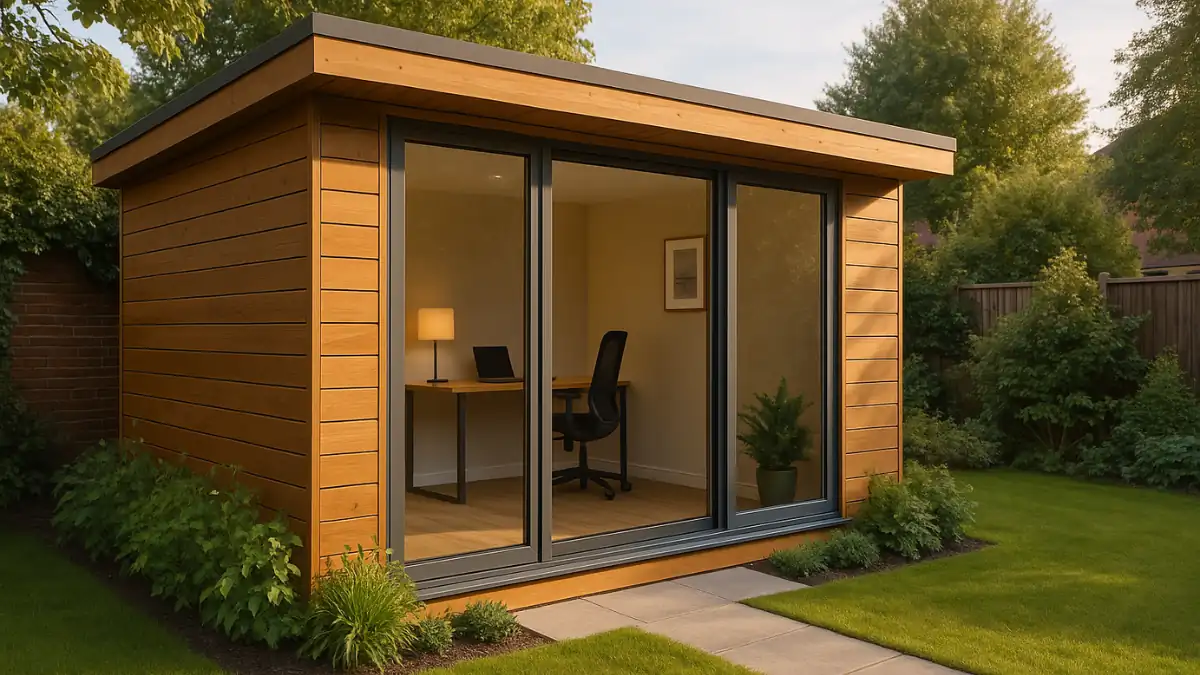
A garden buildings office is usually a detached, insulated structure in your back garden, used mainly as a home office or studio. Unlike a full extension, it is kept separate from the main house, which can make planning simpler and reduce disruption during the build.
In England, many domestic garden offices are treated as “outbuildings” and can be built under permitted development (PD) rights. These rights allow certain works without a full planning application, provided you stay within strict rules on height, footprint, location and use.
For a deeper overview of garden structures generally, see our pillar guide on garden rooms, which this article supports.
Garden buildings office vs extension, conservatory or garage conversion
If you are still deciding between a garden buildings office and changing the main house, it helps to compare options side by side.
Garden buildings office vs house extension
- Disruption: A garden office is built outside, so there’s less mess inside the house compared with a rear or side extension.
- Planning risk: A modest garden buildings office is often easier to keep within permitted development than a large extension, which can quickly trigger a full planning application. For more on extension rules, see planning permissions for extensions.
- Connection to the house: Extensions give you fully integrated space; a garden office gives separation and quiet but involves walking outside.
Garden buildings office vs conservatory
- Temperature control: A properly insulated garden office should be easier to keep comfortable year-round than a basic conservatory, which can overheat or feel cold.
- Use: Conservatories are usually extra living space; a garden buildings office is designed around desks, storage and tech.
Garden buildings office vs garage conversion
If you have a garage, converting it is another popular way to create an office. Our guides to garage conversions and planning permission for a garage conversion cover this in detail.
- Location: Garage conversions keep the office attached to the house, which some people prefer in bad weather.
- Parking & storage: You lose covered parking and storage, whereas a garden buildings office keeps the garage free.
- Planning: Many garage conversions also fall under permitted development, but councils can be stricter if it affects parking on the street.
When does a garden buildings office need planning permission?
A garden buildings office will normally fall under permitted development if it is genuinely incidental to the enjoyment of the dwelling house (for example, used as a home office, hobby room, gym or studio) and if it stays within the standard PD limits.
Typical permitted development limits for a garden buildings office
- The garden office must be in the curtilage of your house (normally the garden) and not forward of the principal elevation (not in the front garden).
- Maximum overall height typically 2.5 m if within 2 m of a boundary, or up to 3–4 m with a pitched roof if set further away.
- The building must not take up more than 50% of the garden area (including any other outbuildings).
- No veranda, balcony or raised platform higher than 0.3 m.
- Use should remain ancillary to the house – not a separate dwelling or self-contained flat.
When a full planning application is usually needed
- The garden buildings office is very large or close to the boundary and exceeds PD height limits.
- The property is a listed building or in some conservation areas with stricter controls.
- You want to use the garden office as separate living accommodation (e.g. a small dwelling or regular guest bedroom).
- The garden office will be in the front garden or highly visible from the street.
Our main guides to planning permission for a garden room and do garden rooms need planning permission? give more examples of when you will need to apply.
What a good garden buildings office should include
A well-designed garden buildings office is about more than just a box with sockets. It should be comfortable, secure and properly connected so it genuinely works as a daily workspace.
- Insulation & U-values: Walls, roof and floor should meet or exceed current Building Regulations U-values if you plan to heat the space regularly.
- Heating & cooling: Simple electric radiators or underfloor heating are common. Consider shading, opening windows and trickle vents to avoid overheating on sunny days.
- Electrics & data: A dedicated supply from the house, with appropriate protection and certification, plus strong Wi-Fi or data cabling.
- Foundations: Options include concrete slabs, ground screws or pad foundations, depending on soil and supplier system.
- Glazing: Double or triple-glazed doors and windows to balance natural light with heat loss.
- Finishes: Many garden buildings offices use timber cladding; some offer low-maintenance composite boards, render or metal profiles.
For more on how regulations apply to garden structures, see our guide to building regulations for garden rooms.
Who prepares plans and documents for a garden buildings office?
For an off-the-shelf garden office from a specialist supplier, they will often provide standard drawings and specification. However, you may still need tailored plans if:
- you need a planning application,
- you are close to boundaries or sewers,
- you want to connect the building to a bathroom or kitchenette, or
- your council has particular concerns about design or appearance.
In those cases, homeowners typically use a designer, architectural technologist or planning consultant. Our team at Plans Made Easy prepares planning permission drawings and plans for building regulations that are tailored to what your council and building control officer expect to see.
If you are unsure what level of detail you need, start with our overview of drawings for a planning application and building regulations approval.
Garden buildings office costs & timelines
Costs vary widely depending on size, specification, access and groundwork. However, there are some typical ranges.
- Small garden buildings office (around 3 m × 2.5 m): from roughly £10,000–£18,000.
- Medium (around 4 m × 3 m) with good insulation and electrics: typically £18,000–£30,000.
- Larger, bespoke designs with bathroom or kitchenette: often £30,000–£50,000+.
- Professional drawings, planning and building regs support: usually a small fraction of the build cost.
These are ballpark figures only. Ground conditions, access, specification and local labour rates can push costs up or down. For wider context, our extension costs guide shows how garden offices compare with adding space to the main house.
Typical timeline
- Concept & design: 2–4 weeks to decide layout, position and appearance.
- Planning (if required): 8–10 weeks from validation in most councils.
- Building regulations details / building control setup: 2–4 weeks.
- Construction on site: many prefabricated garden offices are completed in 1–3 weeks once groundwork is ready.
Not sure if your garden buildings office fits permitted development?
We’ll check your proposed size, height and location against PD rules and tell you if you need a full planning application.
Step-by-step: how to plan a garden buildings office
To keep things manageable, it helps to follow a simple process from idea through to sign-off.
Garden buildings office – planning checklist
| Step | What to do | Why it matters |
|---|---|---|
| 1. Define how you’ll use it | Decide if the garden buildings office is purely for work, or also for hobbies, guests or storage. | Use can affect planning status and whether building regulations apply. |
| 2. Measure and sketch | Roughly plot size, height and position in your garden. | Helps check permitted development limits and impact on neighbours. |
| 3. Check planning rules | Review PD rules and local constraints, or ask us to review. | Avoids building something the council could later challenge. |
| 4. Consider building regulations | Look at insulation, structure and electrics in line with Building Regulations. | Ensures the office is safe, warm and insurable. |
| 5. Prepare plans & quotes | Get drawings prepared, then obtain quotes from reputable suppliers or builders. | Comparable quotes reduce surprises and help you budget. |
| 6. Set up approvals | Submit any planning application and arrange building control if needed. | Gives you written approval or confirmation of lawful development. |
| 7. Build and keep certificates | During construction, keep all inspection records and completion certificates. | Vital when selling your home – see our guide to certificates & compliance documents. |
Pitfalls & “gotchas” with garden buildings offices
Most issues we see with garden offices come down to boundaries, over-optimistic sizing, or forgetting that planning and building regulations are separate systems.
- Placing the garden buildings office too close to a boundary and exceeding the 2.5 m height limit.
- Using it as a bedroom or separate dwelling without planning permission or full building regs compliance.
- Building over a public sewer without permission – see our guide to building over sewers.
- Assuming PD still applies in conservation areas or for listed buildings – it often doesn’t. See conservation areas and listed buildings.
Technical details & building regulations for a garden buildings office
Planning permission and building regulations are separate. Even if your garden buildings office is allowed under permitted development, parts of the Building Regulations can still apply.
- Part A – Structure: The office must be structurally sound and able to resist wind and snow loads.
- Part B – Fire safety: Distance to boundaries and materials can affect what is acceptable, especially on larger or more permanent buildings.
- Part L – Conservation of fuel & power: Insulation levels and thermal bridges matter if the office is heated on a regular basis.
- Part P – Electrical safety: Domestic electrical work must be designed, installed and certified by a competent person.
Many “off-the-shelf” garden offices are marketed as exempt from full building regulations. This can be true for smaller, unheated buildings, but you should still check carefully if you want a year-round workspace. Our building regulations guide explains how the rules are applied in practice.
FAQs
Do garden buildings offices always need planning permission?
Not always. Many garden offices are built under permitted development as outbuildings, provided they stay within height and size limits and are used as a home office rather than a separate dwelling. You’re more likely to need planning permission if the building is large, close to the boundary, in the front garden or in a sensitive location such as a conservation area.
Do I need building regulations approval for a garden office?
It depends how big it is and how you use it. Small, unheated garden offices can sometimes be exempt, but a larger, heated building that functions like a normal room will often need to comply with parts of the Building Regulations. Electrically, any new circuits must still meet Part P, and you will want suitable insulation to avoid condensation and heat loss.
How close to the boundary can my garden buildings office be?
Permitted development normally limits an outbuilding to 2.5 m overall height if it is within 2 m of the boundary. You can usually go higher with a pitched roof if you move the building further away. Fire separation and neighbour impact also need to be considered, so it’s worth getting a quick professional check before committing to a final position.
Are garden offices warm enough to use all year round?
A well-built garden buildings office with decent insulation, airtightness and appropriate heating can be very comfortable year-round. Cheaper, thin-walled structures, on the other hand, can be chilly in winter and hot in summer. Ask for details of wall build-ups, U-values and ventilation before you buy.
Are garden offices worth it compared with an extension?
For many homeowners, yes. A garden office can create a dedicated workspace without disrupting the main house and can sometimes be installed under permitted development with less hassle than an extension. However, an extension usually adds more conventional living space and may be better recognised in property valuations.
How long do garden offices last?
Lifespan depends on the quality of structure, cladding and ongoing maintenance. A well-constructed garden buildings office, built to similar standards as a timber-frame house and looked after properly, should last several decades. Budget structures with minimal foundations or untreated timber may have a much shorter life.
Does a garden office increase house value?
Many buyers see a high-quality, properly approved garden office as a positive, especially with more people working from home. While it may not add value pound-for-pound with the build cost, it can make your property more attractive and help it stand out in the market – particularly where internal space is tight.
Can I sleep in my garden buildings office?
Occasional naps or very infrequent overnight stays are unlikely to worry the council, but if the main purpose becomes sleeping or independent living then you are moving towards an annex or new dwelling. That will normally require full planning permission and full building regulations compliance, including proper escape routes and heating.
Still unsure what’s allowed for your garden buildings office?
Send us a sketch or estate agent plan and we’ll outline your likely planning and building regs route.
Next steps & useful Plans Made Easy guides
If you are serious about a garden buildings office, these guides will help you go deeper into the planning, design and approval process:
- Garden rooms – do you need planning permission?
- Planning permission for a garden room
- Do garden rooms need planning permission?
- Building regulations for garden rooms
- Building Regulations – complete homeowner’s guide
- Plans for Building Regulations
- Planning permission – complete homeowner guide
- Building regulations approval explained
- Typical project type Detached insulated outbuilding used mainly as a home office or studio, within the rear garden.
- Planning route Often under permitted development if size, height and location limits are met. Full planning more likely in conservation areas, for listed buildings or where the office is very large or in the front garden.
- Building regulations Smaller, unheated buildings may be exempt, but heated, year-round garden offices usually need to comply with key parts of Building Regulations (structure, insulation and electrics).
- Budget range Roughly £10,000–£30,000+ for most domestic garden offices, with bespoke, high-spec or plumbed-in buildings often higher.
- Typical timescale 2–4 weeks design, 8–10 weeks for planning (if needed), 2–4 weeks for building control setup and drawings, then 1–3 weeks on site for many prefabricated systems.
- Biggest risks Exceeding permitted development height near boundaries, ignoring Article 4 restrictions, under-specifying insulation, or forgetting about sewers and building regulations.
Official guidance on planning for garden buildings
For extra reassurance, you can also read the national guidance on outbuildings and planning permission:
These sites explain the national rules. However, local councils can add extra policies and Article 4 Directions, so always check how your authority applies the guidance in practice.
Ready to move your project forward?
Plans Made Easy can prepare compliant plans, manage submissions, and guide you from idea to approval.

Performance Verified ✅
This page meets PME Optimisation Standards — achieving 95+ Desktop and 85+ Mobile PageSpeed benchmarks. Verified on

