
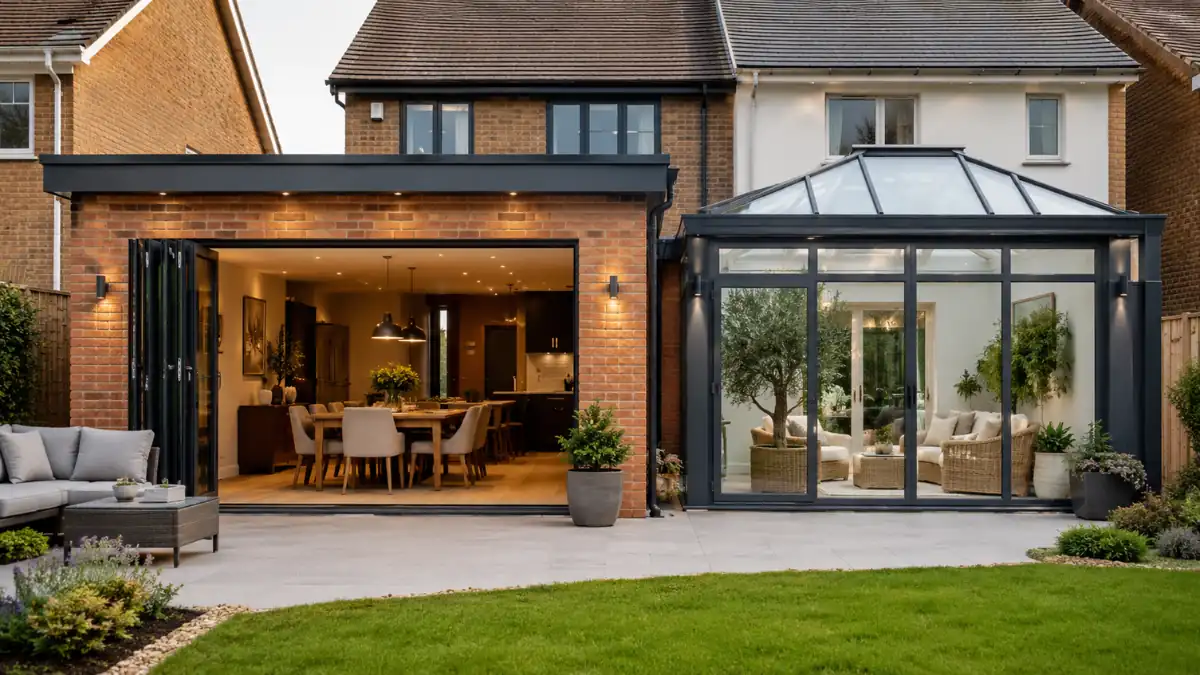
Share this post:
Quick summary: Extensions and Conservatories
If you’re weighing up Extensions and Conservatories, the key difference is this: an extension is usually “proper house space” (solid roof, insulated walls, full Building Regulations), while a conservatory is typically a lightweight glazed room that may be exempt from Building Regulations only if it stays separated from the main house and meets a few conditions.
- Best for year-round living space: a traditional extension (or an orangery-style build with proper insulation).
- Best for light + garden connection: a conservatory or glazed “sunroom” — but comfort in winter depends on the build spec.
- Planning permission: some projects are Permitted Development, but rules vary by site, previous works, and local constraints.
- Building Control: many conservatories are exempt only when they remain “separate” and meet thermal/fire safety conditions.
In this guide we’ll help you choose the right route, avoid common council/Building Control problems, and understand what typically drives cost and timescales.
Not sure which route is best for your home?
Tell us what you’re trying to achieve (space, warmth, light, budget) and we’ll advise whether a traditional build or a glazed room makes the most sense — and what permissions you’re likely to need.
Quick summary: Extensions and Conservatories
For most UK homes, Extensions and Conservatories sit on a spectrum: at one end you have a fully insulated extension that behaves like the rest of the house; at the other, a more lightweight glazed room that can be quicker and cheaper, but may be harder to make comfortable year-round.
The “right” choice depends on how you’ll use the space, how open you want it to be to the house, and what your council and Building Control will accept on your specific site.
Overview: Extensions and Conservatories (what most homeowners mean)
Homeowners often start with a simple question: “Should we build a proper extension, or add a conservatory?” In reality, there are a few common “middle ground” options too — such as orangery-style builds or highly insulated glazed rooms — and they can change the planning and Building Regulations picture.
As a rule of thumb:
- Extension = permanent, insulated house space (solid roof, insulated walls), usually fully controlled under Building Regulations.
- Conservatory = glazed room, often exempt from Building Regulations only if it meets specific conditions (especially separation from the main house).
- Orangery-style / insulated glazed room = can feel like an extension in use, but details matter (roof, glazing spec, insulation levels, openings).
Key differences in Extensions and Conservatories: comfort, structure, and compliance
1) Year-round comfort (and energy bills)
If you want the space to be used like a dining room, playroom or kitchen extension all year, an extension (or a properly insulated orangery-style build) is usually the more reliable route. Conservatories can be bright and uplifting, but temperature swings are common unless the build is upgraded significantly.
2) How “open” you want it to be
This is one of the biggest decision points. Many conservatory exemptions rely on the new room being separated from the main house by external-quality doors (or equivalent separation). If you remove that separation and make it fully open-plan, Building Control often treats it more like an extension.
3) Foundations and structure
Extensions typically require deeper foundations and more structural coordination, particularly if you’re opening up the rear wall with steelwork. Conservatories can still need proper foundations depending on the system, ground conditions, and roof loads — but the structural demands can be different.
4) Permissions and paperwork
Some projects fall under Permitted Development, but it depends on your property type, previous extensions, constraints, and how the proposal is measured. Even where planning permission isn’t needed, you may still want a Lawful Development Certificate for peace of mind.
Planning routes for Extensions and Conservatories: Permitted Development vs planning permission
Many homeowners assume conservatories are “planning free”. Sometimes they are — but not always. Planning depends on the same things that affect other rear/side additions: size, height, proximity to boundaries, materials in some contexts, and whether your home has special restrictions.
Common reasons you may need planning permission
- Your home is a flat/maisonette (Permitted Development is different).
- You’re in a conservation area, National Park, AONB, or similar protected area.
- Your property has an Article 4 Direction or planning conditions removing Permitted Development rights.
- The size/height/layout goes beyond Permitted Development limits.
- You’re changing the front/side appearance in a way that triggers permission.
If you want a bigger rear addition but prefer a simpler application process, you may also come across the prior approval route for larger home extensions (where eligible). Whether it applies to your exact idea depends on your home and the proposal.
What drawings and info you’ll typically need (whichever route you choose)
Even when a project is straightforward, having the right drawings makes everything smoother — for the council, for Building Control, and for getting accurate builder quotes.
Typical planning / application drawing set
- Existing and proposed floor plans
- Existing and proposed elevations
- Site/block plan and location plan
- Sections (often helpful for roof design, height and relationships to neighbours)
Typical Building Regulations package (for extensions, and for “open” glazed rooms)
- Construction details (walls, floors, roof build-ups, insulation)
- Structural notes and, where needed, engineer input for openings/steelwork
- Ventilation, drainage considerations, and fire safety notes where relevant
- Energy efficiency approach (Part L) — especially where the new space is heated and open to the house
Quick costs snapshot (guide only)
- Design + drawings: varies by complexity, but allow a sensible budget for measured survey, planning drawings, and Building Regulations details if needed.
- Build cost drivers: ground conditions, amount of glazing, roof type, openings/steelwork, and the spec needed for year-round comfort.
- Hidden extras: drainage changes, relocating services, and thermal upgrades if you’re making the space open to the house.
Costs vary heavily by region and specification. Use this as a “what affects price” checklist, rather than a fixed quote.
Costs and timelines: what affects the budget for Extensions and Conservatories
Budget and timeline differences usually come down to structure, specification, and how integrated the new space will be with the main house.
What tends to push costs up
- Large spans of glazing or complex glazing systems
- Solid roof systems (especially if you’re aiming for extension-like comfort)
- Wide openings into the existing house that need steelwork
- Upgraded insulation and ventilation strategies to meet expectations for year-round use
- Drainage moves or manhole alterations
Timelines (what to expect)
- Design and drawings: usually faster when the brief is clear and the measured survey is done properly.
- Planning decision (if required): allow time for validation, consultation, and decision.
- Building Control: plan for approvals/inspections if you’re doing a regulated build.
- Build programme: heavily depends on groundworks and how disruptive the connection to the house is.
Not sure if your idea fits Permitted Development?
We’ll check your project against PD rules and let you know if you need a full planning application.
Step-by-step HowTo: choosing between Extensions and Conservatories
If you’re stuck between options, this quick process usually makes the decision much clearer.
HowTo checklist: make the right decision in 30 minutes
- Write your “use case”. Is this everyday living space, or a bright garden room you’ll use mainly in mild weather?
- Decide on separation. Do you want doors between the new room and the house, or a fully open layout?
- Set comfort expectations. “Warm in winter and cool in summer” usually pushes you toward extension-level specification.
- Check your constraints. Prior extensions, corner plots, protected areas, and conditions can change what’s possible.
- Map the services. Heating, drainage, electrics and ventilation can affect feasibility and cost.
- Sense-check permissions. Work out whether you’re likely in PD territory or heading toward a householder planning application.
- Get drawings early. Good drawings reduce build surprises and help you avoid compliance problems later.
Related comparisons (to help you choose)
- Extensions and conservatories: best when you’re balancing year-round comfort vs natural light and speed.
- Extensions and orangeries: useful if you want a “hybrid” feel (more solid/insulated than a conservatory, often more glazed than a traditional extension).
- House extensions and conservatories: a practical comparison when you already know you’re building at the rear and you’re choosing the build type.
Pitfalls and gotchas with Extensions and Conservatories
Other common pitfalls
- Drainage surprises: manholes and existing runs can force design changes.
- Neighbour impacts: even if you’re within limits, overlooking/overshadowing can trigger objections.
- Under-spec glazing: cheap glazing can lead to overheating and condensation issues.
- Assuming “no planning needed”: restrictions and past works matter.
- Missing paperwork: lack of approvals/certificates can slow down a sale.
Technical details: Building Regs, Part L, fire safety and separation
Building Regulations aren’t there to make life difficult — they’re there to ensure safety and reasonable energy performance. The key technical question for Extensions and Conservatories is often whether the new space is treated as part of the home (and therefore needs full compliance).
Building Regulations and “exempt” glazed rooms
Some conservatories can be exempt from Building Regulations, but the exemption typically relies on factors like separation from the main house and limiting how the space is treated (for example, not extending the main heating system into it).
Fire safety and openings
When you open up the rear of the house into a new space, details can matter: escape routes, protected stairs in some layouts, and how structural openings are formed. It’s one reason why regulated drawings (and inspections) are usually worth it for integrated builds.
Ventilation and condensation
Big areas of glazing look fantastic, but they also change moisture and temperature behaviour. Good ventilation design and the right glazing/thermal detailing help reduce condensation and summer overheating.
Local council quirks (why “it depends” is sometimes true)
Even with national Permitted Development guidance, councils can differ in what they expect to see on drawings and how they interpret certain site constraints. If you’re near boundaries, have a previous extension history, or live in a protected area, it’s worth getting a careful check before you commit.
FAQs: Extensions and Conservatories
Can you put a conservatory on an extension?
Yes, it can be possible, but it needs careful thought. The big question is whether the new glazed room will be treated as a separate “exempt” space or as part of the main house. If it’s open to the extension (or heated as main space), Building Control may expect extension-level compliance. Structurally, you also need to consider foundations, drainage, and how the roof systems meet.
Are Extensions and Conservatories treated the same for planning permission?
Not automatically. Planning looks at size, height, location, and impact — not simply the name of the build. Some conservatory-style builds fall under Permitted Development, but restrictions, past extensions, and protected areas can change what’s allowed. If you’re unsure, it’s worth checking before ordering a build.
What’s the difference between extensions and orangeries?
An orangery-style build is usually a “hybrid”: more solid structure and insulation than a typical conservatory, but often with more glazing and roof lanterns than a traditional extension. The compliance route depends on how it’s built and whether it’s integrated into the home (open-plan, heated, insulated).
Do you need Building Regulations for a conservatory?
Sometimes you might be exempt, but exemptions usually rely on the conservatory being separated from the house and meeting certain conditions. If you plan to remove doors, add significant heating, or make it behave like part of the home, Building Control may treat it more like an extension and expect full compliance.
Which is better for adding value: an extension or a conservatory?
In many cases, buyers value “proper house space” most — meaning a regulated, insulated extension that feels like part of the home. A conservatory can still add appeal (light, garden connection), but if it’s too hot/cold or poorly integrated it may be seen as less usable. The best outcome usually comes from matching the build type to how you genuinely live.
Can a conservatory be made open-plan to the kitchen?
It can, but this is where technical details matter. Removing separation can trigger Building Regulations expectations (especially energy efficiency under Part L). If your goal is open-plan, it’s often safer and more cost-effective to design it from the start as an integrated build with the right specification and approvals.
Want a quick “yes/no” on your best option?
We’ll sanity-check your idea, flag the likely compliance route, and tell you what drawings you’ll need to keep things smooth with the council and Building Control.
Next steps & useful guides
If you want to go deeper (or you’re moving closer to drawings), these guides are usually the next best steps:
- Our main guide to adding space to your home (planning, costs, and common council issues)
- Understand when you need consent and how the process works
- A practical checklist to work out your likely permission route
- A guide to the wider costs around approvals and applications
- What regulated drawings cover and when you’ll need them
- What a good drawing package should include (and why it matters)
- Main differenceExtensions are typically fully insulated house space; conservatories are usually lightweight glazed rooms and may only be exempt from Building Regs if they remain “separate”.
- Best for year-round livingAn extension (or an orangery-style build with extension-level insulation and approvals).
- Best for natural lightA glazed room can be brilliant — but comfort depends on glazing spec, ventilation and how integrated it is with the house.
- PlanningSome projects may fall under Permitted Development, but restrictions, past additions and protected areas can change this.
- Building Control risk pointMaking a glazed room open-plan (removing separation) often shifts it toward extension-style Building Regulations expectations.
- Best next stepConfirm your permission route early, then get the right drawings so your builder can quote properly and you can avoid compliance problems later.
If you want a clear recommendation for your home, message Plans Made Easy with a few photos and your rough dimensions and we’ll point you in the right direction.
Official guidance
For national guidance and the latest official position, these are the best starting points:
- Planning Portal — national planning guidance and application information
- GOV.UK — planning permission in England and Wales
- GOV.UK — Building Regulations and standards (overview guidance)
- Planning Portal — guidance on glazed room projects and permissions
How Plans Made Easy can help
Choosing between Extensions and Conservatories is less about the label and more about how you want to use the space, how integrated it will be with the house, and how you’ll stay compliant with planning and Building Regulations.
Our team can prepare the right drawings, guide you through the permission route, and help you avoid the common pitfalls — especially where homeowners want an open-plan, year-round space without nasty surprises later.
Ready to move your project forward?
Plans Made Easy can prepare compliant plans, manage submissions, and guide you from idea to approval.
Performance Verified ✅
This page meets PME Optimisation Standards — achieving 95+ Desktop and 85+ Mobile PageSpeed benchmarks. Verified on

