
Share this post:
Extensions and Conservatories can both add valuable space — but they’re treated very differently when it comes to comfort, costs, planning rules, and building regulations. If you’re deciding between the two (or wondering whether you can add a conservatory onto an existing build), this guide explains what typically needs permission, what triggers Building Control, and how to choose an option that won’t cause problems later.
Quick summary: Extensions and Conservatories
- Conservatories are usually cheaper and quicker, but can overheat/feel cold unless designed carefully.
- “Full” extensions cost more, but they’re normally more comfortable and add more long-term value.
- Planning permission depends on your house, location, and what’s already been built — permitted development isn’t automatic.
- Building regulations often apply to both — even where planning permission isn’t needed.
Key facts snapshot
- Typical cost range: conservatory-style build is often the lower-cost route; a fully insulated build is usually higher — but varies by size/spec.
- Common “gotcha”: changing a conservatory into a fully open-plan room later can trigger Building Control and extra upgrades.
- Most useful first step: confirm whether it’s permitted development, then design around heat loss, ventilation, and structure.
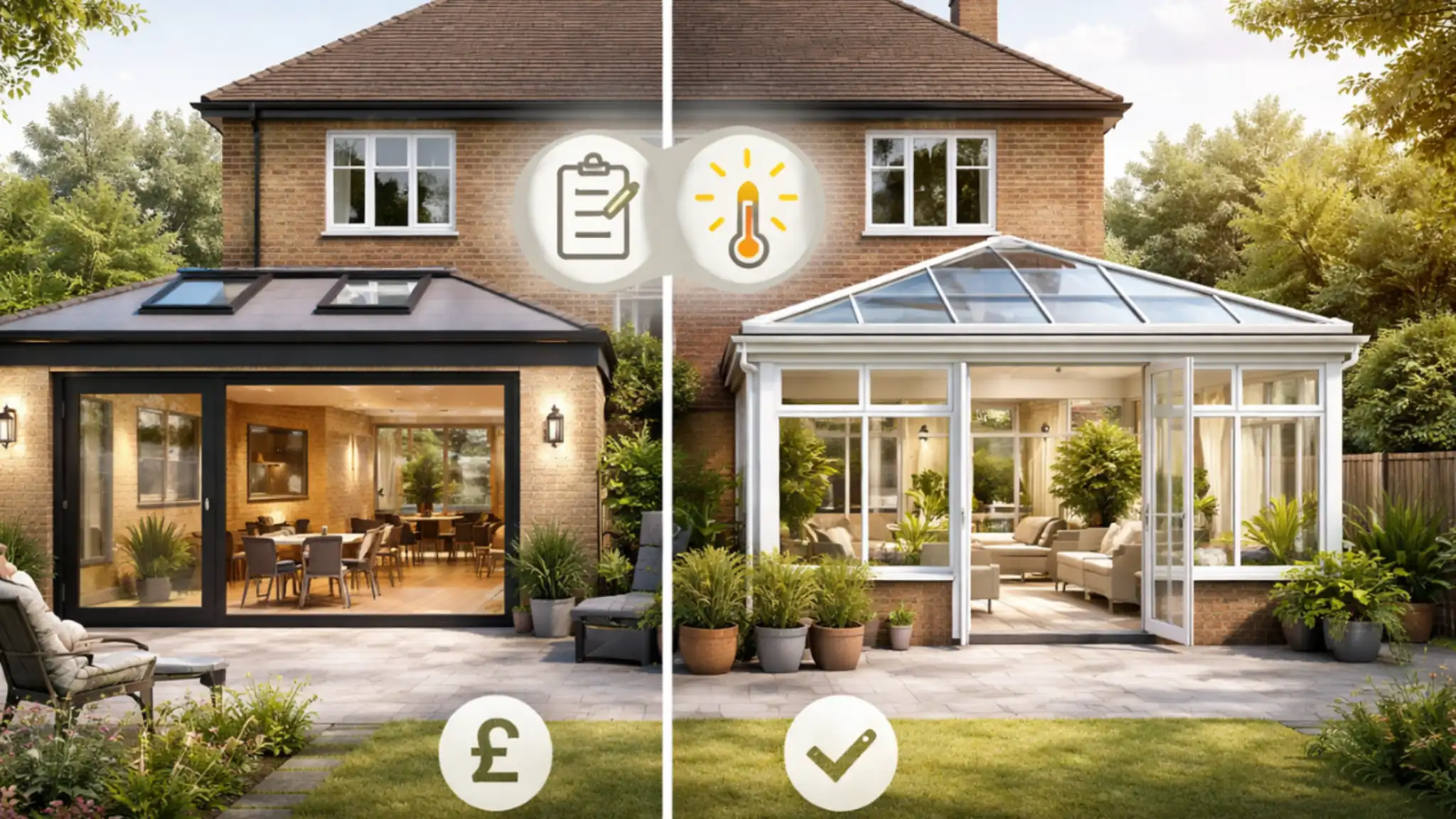
Extensions and Conservatories are often compared as if they’re the same thing — “a bit more space at the back” — but in practice they behave very differently. One is typically designed as a lightweight, glazed room; the other is normally built as a fully insulated part of the home. That difference affects comfort, running costs, and what Building Control will expect.
Note: This guide assumes England. Rules can vary in Wales, Scotland, and Northern Ireland. Also, permitted development rights can be restricted (for example in conservation areas, flats/maisonettes, or where Article 4 directions apply).
Extensions and Conservatories: what’s the real difference?
If you’re deciding between these options, don’t start with the roof style or the amount of glass. Start with how you want to use the room in February and in a heatwave — because that’s where most regrets come from.
1) Comfort and running costs
- Glazed rooms can feel bright and airy, but they’re more prone to overheating in summer and heat loss in winter unless the spec is carefully designed.
- Fully insulated builds generally perform more like the rest of the house, which makes them easier to heat and use year-round.
- Underfloor heating, ventilation, and shading matter more than most homeowners expect — especially with large glazed elevations.
2) Structure and future-proofing
- A lightweight build often uses different foundations/structure than a masonry build (site conditions still matter either way).
- If you plan to open up the back of the house with wide openings, steels and structural design become central to the project.
- Future changes (like removing internal doors or altering heating) can trigger extra Building Control requirements later.
3) Value and “does it count as proper space?”
Estate agents and buyers tend to value space that feels like a seamless part of the home. A bright glazed room can still add value — but it usually needs to feel usable, not seasonal.
Tip: If you want a room you can use every day, focus on insulation, ventilation, and glazing performance early — not as “nice-to-haves” after the design is agreed.
Extensions and Conservatories costs: what you’ll pay (and why it varies)
Costs vary hugely by size, access, ground conditions, specification, and how much structural work is needed to connect the new space to the existing house. However, a few patterns are consistent:
- Glazed-heavy builds can look cheaper at first glance, but high-performance glazing, solar control, and proper foundations can push costs up.
- Fully insulated builds typically cost more overall, but you often get better year-round usability and simpler heating strategies.
- Open-plan layouts usually increase costs because of steels, temporary works, and knock-on requirements for fire safety and ventilation.
What typically moves the price the most
- Roof choice: solid roof vs glazed roof, lanterns, structural glass, and rooflights
- Glazing system: basic frames vs slimline systems, bifolds/sliders, triple glazing, solar control
- Groundworks: drainage moves, deep excavations, poor ground, tree influence
- Internal changes: removing walls, new kitchen layouts, relocating services
- Thermal upgrades: insulation levels, airtightness, heating changes
If you want a clearer breakdown of typical budgets and what’s included, see our cost guide here:cost breakdown for adding space.
Planning permission: when do Extensions and Conservatories need it?
Many homeowners hope this will be a quick “yes/no” answer. In reality, planning permission depends on what you’re building, where it sits, and whether your home still has permitted development rights.
When permitted development is more likely
- The proposal is to the rear and within typical size/height limits.
- You’re not in a restricted area and the property is a single dwellinghouse (not a flat/maisonette).
- Previous additions haven’t already used up the permitted development allowance.
When planning permission is more likely
- You’re in a conservation area, the property is listed, or there are restrictions on the original permission.
- The build is large, tall, close to boundaries, or materially changes the appearance of the home.
- Neighbours are likely to be affected by overlooking, loss of light, or an overbearing impact.
If you’re unsure, start with our planning checklist:how to tell if permission is needed,and our guide to the application process:how the planning system works.
Important: Even if planning permission isn’t required, you may still need Building Control approval. The two systems are separate.
Building regulations: what usually applies to Extensions and Conservatories?
Building regulations are about safety, energy efficiency, structure, ventilation, drainage, and fire precautions. For many projects, this is where the “surprises” happen — especially when homeowners assume a glazed room is automatically exempt.
Common building regulations topics that come up
- Structure: foundations, walls, roof stability, and any steels/openings
- Energy efficiency (Part L): insulation, glazing performance, thermal bridging, and heating changes
- Ventilation (Part F): background ventilation and extraction, especially if it’s connected to a kitchen/dining area
- Fire safety (Part B): escape routes, separation, and how open-plan layouts affect compliance
- Drainage: relocating manholes, new gullies, and building over/near sewers
Helpful reads if you want to understand the Building Control side before you commit:plain-English guide to the regs,what Building Control actually does,andenergy efficiency explained.
Do glazed rooms ever avoid Building Control?
Some setups can be treated more lightly than a full build, but it’s not a blanket “exempt” label you can rely on. The details matter: how it’s separated from the main house, whether it has independent heating, and how it affects the home’s overall thermal performance. If you’re planning to remove doors/walls to make it open-plan, assume Building Control will treat it much more like a permanent habitable room.
Can you put a conservatory on an extension?
Yes — it’s possible to add a glazed room onto an existing rear build, but it needs careful checking. The main issues are:
- Planning history: if the existing build already used permitted development “allowance”, adding more may tip you into a full application.
- Foundations and structure: you need confidence the existing structure can take new loads and connections safely.
- Thermal separation: if you’re keeping it as a more lightly conditioned space, separation details really matter.
- Open-plan intentions: if you want it fully open to the house, you’re likely into a higher level of Building Control compliance.
- Drainage constraints: rear additions often run into inspection chambers or public sewers.
Tip: If the end goal is a year-round family room, it’s usually cheaper long-term to design it as a fully insulated build now, rather than “upgrade” later after you’ve discovered what Building Control requires.
If you suspect drains may be involved, read this before you finalise the footprint:what to know about building near sewers.
Design options for Extensions and Conservatories that work in real life
Option A: Fully insulated build with rooflights/lantern
This is a common “best of both worlds” approach: you get a space that feels like part of the house, plus daylight from above. It can also be easier to control temperature than a fully glazed roof.
Option B: Hybrid approach (more glazing, but built for comfort)
A bright room doesn’t have to be uncomfortable. The key is to design the glazing properly: solar control where needed, thoughtful shading, and enough ventilation to avoid overheating. This is where many budget designs fall short.
Option C: Lightweight glazed room kept separated from the house
If you like the idea of a seasonal sunroom, keep realistic expectations. The “separator” between house and glazed space (often doors) becomes important — and removing it later can trigger significant upgrades.
Option D: Replace an old glazed room with a proper build
Many homeowners inherit an older structure that’s too hot/cold to use. Replacing it with a fully insulated build can be a value-adding project — but it needs proper drawings and Building Control approval.
If you’re in a restricted area, you’ll also want to read:how conservation rules affect home projectsandwhat to consider for listed homes.
A simple step-by-step process (less stress, fewer surprises)
- Clarify the goal: year-round living space, seasonal sunroom, or future-proof resale value?
- Check planning position early: confirm whether permitted development is realistic for your property and location.
- Get the right drawings: accurate existing plans + proposed plans help avoid rework and reduce refusal risk.
- Design the performance: insulation/glazing, ventilation, and heating strategy from day one.
- Confirm Building Control route: Full Plans is often smoother for complex structural changes (especially open-plan).
- Think about neighbours: boundary impacts, party wall responsibilities, and construction access.
Useful next reads:what a good planning drawing set includes,choosing the right Building Control route,andparty wall basics for homeowners.
Want us to sanity-check your options before you spend money?
Tell us what you’re thinking (rough size, location, and photos if you have them). We’ll help you confirm the likely permission route and the best way to approach drawings and compliance.
FAQs: Extensions and Conservatories
Is a glazed room cheaper than a fully insulated build?
Often, yes — but not always. High-performance glazing, proper foundations, and good ventilation can narrow the gap. The real question is whether you want a seasonal room or a year-round room, because the specification (and comfort) can be very different.
Do I always need planning permission?
Not always. Some rear projects can be permitted development, but it depends on your property type, location, and what’s already been added. If you’re in a restricted area or you’ve used up your PD allowance, a full application is more likely.
Do Building Regulations apply if it’s “just glass”?
Building regulations can still apply. Structure, glazing safety, electrics, ventilation, and energy performance all matter. Also, if you intend to open it fully into the house, Building Control will usually expect higher compliance because it affects the main home’s thermal and safety setup.
Can I remove the doors between the house and the glazed room later?
You can sometimes do it, but it’s a common point where Building Control gets involved. Once it becomes open-plan and effectively part of the main house, you may need upgrades (insulation, heating approach, ventilation, and potentially other compliance items).
What paperwork should I keep when it’s finished?
Keep approvals, completion documents, and any certificates for future buyers and solicitors. Our guide here helps you understand what to file safely:what to keep after building work.
Next steps & useful guides
Talk to Plans Made Easy before you commit
If you want peace of mind on the rules, the drawings you’ll need, and the smartest way to get approval, our team can help you plan it properly from the start.

Performance Verified ✅
This page meets PME Optimisation Standards — achieving 95+ Desktop and 85+ Mobile PageSpeed benchmarks. Verified on

