Share this post:
When you start looking into drawings planning permission Not sure if your drawings are good enough? Our team at Plans Made Easy can review what you already have, highlight any gaps, and help you get application-ready drawings without stress.Quick summary – drawings for planning permission
Key facts snapshot – planning drawings
If you’re trying to work out exactly which drawings planning permission applications need, you’re not alone. Councils talk about location plans, block plans, elevations and sections – but rarely show you a simple checklist you can tick through before you submit.
In this guide, our team at Plans Made Easy walks you through the standard drawing requirements for typical UK householder applications, what each drawing must show, and when you can reasonably do them yourself versus when you’re better off using a professional.
We can review your existing planning drawings and tell you whether they’re likely to pass validation before you pay the council fee. If there are gaps, we’ll explain your options in plain English.
Drawings and planning permission – quick overview
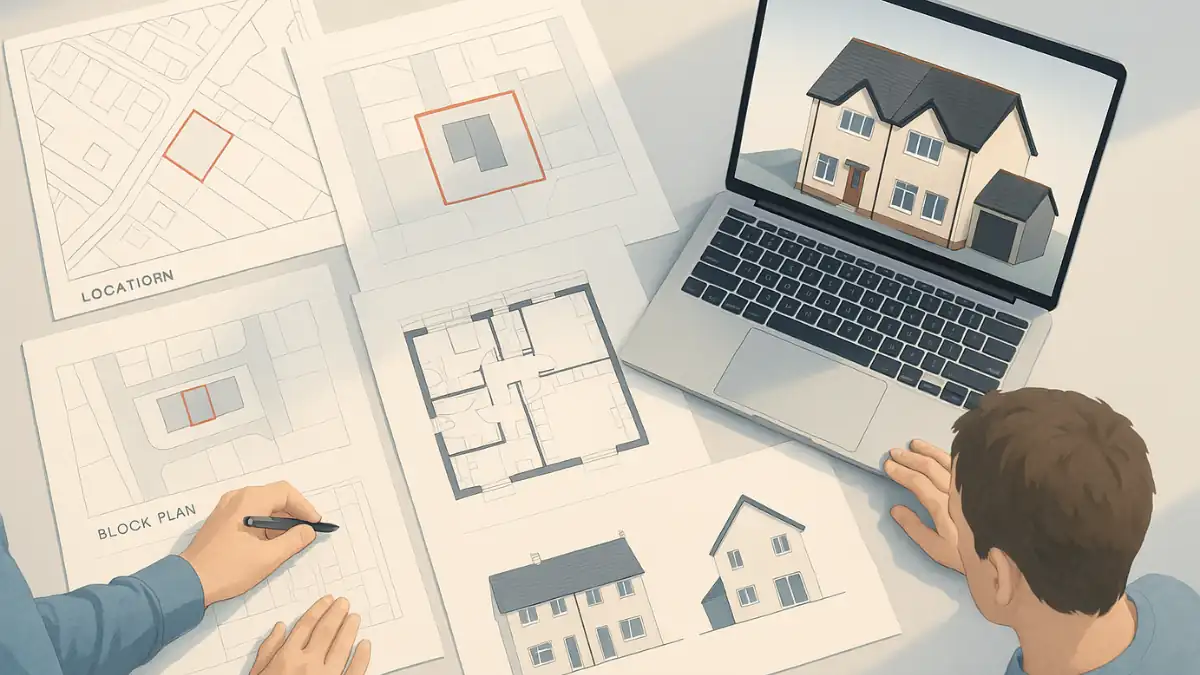
For most residential projects, the council will only validate your application if the drawings clearly show what exists now and what you are proposing. They need to see where the project sits on the site, what it looks like from each side, and how it relates to neighbouring properties.
A typical householder application (for example, an extension or loft conversion) will usually require:
- Location plan – showing your property in the wider area, usually at 1:1250 or 1:2500.
- Block / site plan – showing the plot boundaries, access, and immediate neighbours, usually at 1:200 or 1:500.
- Existing floor plans – current internal layout.
- Proposed floor plans – layout after the work.
- Existing elevations – how the building looks now from each side.
- Proposed elevations – how it will look after the work, including materials and openings.
- Roof plans and sections where relevant – for example for loft conversions or complex roofs.
Different councils have slightly different checklists, but these core drawings appear in almost every set. Ourdetailed guide to planning drawingsgoes into the background in more depth; this article is focused on the practical checklist.
This guide assumes a typical householder application in England. If your property is listed or in a conservation area, or you’re doing something unusual (like a basement extension), your council may ask for extra drawings or heritage information.
Checklist: drawings you usually need for householder planning permission
Use this checklist to see whether your drawings for planning permission are complete and in the right format. If something is missing or unclear, the council can put your application on hold or even refuse to validate it.
1. Location plan and block plan
These drawings show where your property is and how the project sits within the site.
- Location plan at 1:1250 or 1:2500, usually on an up-to-date Ordnance Survey base.
- Red line around the application site; blue line around any other land you own nearby.
- North arrow, road names and surrounding buildings clearly labelled.
- Block/site plan at 1:200 or 1:500 showing:
- Existing and proposed building footprint.
- Site boundaries and garden areas.
- Access, driveways, parking spaces and outbuildings.
- Relevant trees, structures and neighbouring windows close to the boundary.
2. Existing and proposed floor plans (and roof plan where needed)
Floor plans are the core of most drawings planning permission submissions.
- Scale normally 1:100 or 1:50, consistently used on all plans.
- Show each storey on a separate drawing – ground, first, loft, etc.
- Clearly distinguish existing and proposed layouts (separate drawings or bold/hatching).
- Include:
- Room names and main furniture where useful (e.g. kitchen, bathroom, bedroom).
- Overall dimensions and key room sizes, especially where space standards may apply.
- Wall thicknesses, doors, windows and stairs.
- Any changes to levels, such as steps or split floors.
- For lofts and roofs, a roof plan is often required to show dormers, rooflights and ridge/heights.
3. Existing and proposed elevations
Elevation drawings show what the building looks like from each side, both before and after the work.
- Scale normally 1:100 or 1:50.
- Label each elevation (e.g. “Proposed Rear (South) Elevation”).
- Show existing ground levels, proposed changes to levels and finished floor levels if relevant.
- Include:
- Window and door positions and sizes.
- Materials – brick, render, cladding, roof tiles, etc.
- Overall heights (ridge, eaves) and how they compare with neighbours.
- Any boundary treatments (walls, fences) being altered.
4. Sections and additional details (where requested)
Many simple applications don’t strictly need sections, but they’re very helpful where there are level changes, roof alterations or potential overlooking issues.
- Cross-section through key parts of the proposal, showing floor levels, ceiling heights and roof structure.
- Relationship to boundary and neighbouring windows where privacy is a concern.
- Occasional detail drawings for items like balconies, privacy screens or terraces.
Councils appreciate a simple drawing register on your cover sheet – listing each plan, its scale and revision. It reassures case officers that they’re seeing a complete, coordinated set.
What your planning drawings must show to be valid
It’s not just about having the right number of drawings; they also need to include enough information for the planning officer to understand the proposal and assess its impact.
For most councils, valid drawings for planning permission will:
- Use a recognised scale, clearly stated on each sheet.
- Include a scale bar so printed copies can still be checked.
- Show existing and proposed situations clearly, without ambiguity.
- Indicate materials and finishes, especially on external elevations.
- Show boundaries, neighbouring properties and any overlooking windows.
- Include levels and heights where these affect neighbours or street scene.
- Match the written description in your application form and any design statement.
If drawings contradict each other – for example, the plan shows a window that’s missing on the elevation – officers may ask for revisions or treat the application as invalid until it is corrected.
Even if your project might fall under permitted development, you may still decide to apply for a Lawful Development Certificate or full planning permission for peace of mind. The council will usually expect the same standard of drawings as for a normal application.
If you’re unsure whether you need permission at all, ourguide to when planning is requiredis a good starting point.
Can you do your own drawings for planning permission?
Many homeowners wonder whether they can draw the plans themselves instead of paying an architect or technician. In principle, yes – there’s nothing in the rules that says a professional must prepare your plans.
However, drawings planning permission applications rely on must still meet professional standards. That means:
- Accurate measurements taken from a proper survey (not just pacing things out).
- Consistent scales and clear linework.
- Legible text and dimensions.
- Drawings that print clearly on A3 or A1 without becoming unreadable.
For very simple projects – a modest porch or replacing windows in the same openings – a careful DIY set might be fine. For anything involving extensions, roof alterations, or changes close to neighbours, it’s usually safer (and often cheaper overall) to use a professional who produces planning drawings every day.
Our article onpreparing a house drawing plan for permissiongoes into more detail on what’s involved if you’re thinking about trying it yourself.
If the council refuses your application because the drawings are unclear or inaccurate, you’ll usually lose the fee. Getting it right first time is nearly always better value than taking a gamble on rough sketches.
Common mistakes on drawings for planning permission
We regularly see applications delayed or refused because of avoidable issues with the drawings. Some of the most common are:
- No clear distinction between existing and proposed – especially where people draw everything on one plan.
- Missing elevations – for example, only showing the rear of an extension when the side elevation also changes.
- Wrong or missing scale – officers can’t check dimensions, so the application stalls.
- Inconsistent information – roof shape or window positions differ between drawings.
- Not showing neighbours – making it hard for the council to assess impact on privacy or light.
- Lack of levels – particularly on sloping sites or where terraces/balconies are proposed.
If you want a more in-depth breakdown of what councils look for, oursupporting guide on drawings submitted with planning applicationsmay also be useful.
How planning drawings differ from building regulations drawings
Planning drawings focus on what you want to build and how it affects the outside world – appearance, size, overlooking, overshadowing and so on. Building regulations drawings focus on how it will be built and whether it meets Parts A–P (structure, fire, insulation, drainage, etc.).
In practice:
- Planning drawings show layouts, heights, external materials and relationships to neighbours.
- Building regs drawings add construction build-ups, insulation thicknesses, beam sizes (with structural calculations), drainage runs and notes referencing Part L, Part B, and other sections of the regulations.
Sometimes a good set of planning drawings can be developed into building regs drawings later. Other times, you’ll need new technical plans. Ourguide to plans for building regulationsexplains what’s normally required at that stage, and ourbuilding regulations overviewputs it in context.
Costs and timescales for planning drawings
The cost of preparing drawings for planning permission varies with project complexity, location and who you use. As a rule of thumb, you’ll usually see:
- Lower fees for simple, single-storey extensions or straightforward loft conversions.
- Higher fees where a full measured survey is needed, or where there are tricky site constraints.
You can find typical price ranges in ourbreakdown of planning drawing costs.
In terms of time, allow:
- 1–3 weeks for survey and drawings to be prepared, plus your feedback and any tweaks.
- Another few days to pull everything together for submission.
- 8 weeks or so for the council to decide most householder applications, as covered in ourguide to planning permission timelines.
Step-by-step: getting your drawings planning-permission ready
If you want a simple roadmap, here is the process our team works through with most homeowners.
- Clarify what you want to build. Rough sketch ideas, collect photos and note any must-haves or absolute no-gos.
- Check whether you need permission. Use the Planning Portal and our mainplanning permission guideto see whether permitted development might apply.
- Get a measured survey. Either DIY carefully for simple layouts or commission a professional for accuracy.
- Prepare existing drawings. Plans and elevations at agreed scales, clearly labelled.
- Develop proposed drawings. Show the new layout and appearance, including heights, materials and key dimensions.
- Add location and block plans. Purchase an up-to-date OS base map if needed and highlight your site clearly.
- Check against the council’s validation checklist. Most local authorities publish these on their websites.
- Coordinate with any supporting documents. Design and Access Statements, heritage statements or flood risk reports should all describe the same scheme shown on the drawings.
- Final review. Look at everything through the eyes of a planning officer: does each drawing help them understand the proposal quickly?
- Submit your application. Upload PDFs via the Planning Portal or your council’s online system, and keep copies of everything for your records.
FAQs: drawings planning permission
Can I draw my own plans for planning permission?
Yes, you can draw your own plans – there is no legal requirement to use an architect. However, the council will judge the drawings on quality, not on who produced them. They must still be to scale, accurate, clearly labelled and detailed enough for the officer to understand the proposal.
For straightforward projects and if you’re confident with measuring and drawing (perhaps using CAD or a good drawing package), a DIY approach might work. For more complex schemes – particularly extensions close to neighbours, loft conversions or work in conservation areas – professional plans usually save time, stress and re-drawing later.
What scale should drawings be for planning permission?
Most councils expect:
- Location plans at 1:1250 or 1:2500.
- Block / site plans at 1:200 or 1:500.
- Floor plans and elevations at 1:100 or 1:50.
The scale must be clearly stated on each drawing, and it’s good practice to add a scale bar so officers can still check measurements if the plan is printed at a different size.
Do I need drawings for permitted development?
If you build strictly under permitted development rights and never apply to the council, there is technically no requirement to submit drawings. However, most homeowners either apply for a Lawful Development Certificate or seek informal confirmation from their council or a professional.
In these cases, you will still need proper plans and elevations showing how the proposal fits the permitted development rules on size, height and position. Good drawings are also essential for your builder and for future building control checks.
How much do planning drawings usually cost?
Costs vary widely, but for a typical extension or loft conversion you should expect to pay several hundred to a few thousand pounds for survey and drawings, depending on complexity and location. Very simple projects can sometimes be less.
Ourseparate cost guideexplains typical price bands, what tends to push fees up or down, and how to compare quotes fairly.
What drawings are needed for a planning application?
For most domestic householder applications you’ll need a location plan, block/site plan, existing and proposed floor plans, and existing and proposed elevations. Some councils also ask for roof plans, sections, street scene views or additional information in conservation areas.
It’s always worth checking your council’s own validation checklist, and cross-referencing with ourguide to drawings for house extensionsif that’s the type of project you’re planning.
Can I use the same drawings for building regulations?
Sometimes, but not always. Planning drawings focus on size and appearance; building regulations drawings need extra technical detail such as insulation thicknesses, beam sizes (with structural calculations), fire protection, ventilation and drainage layouts.
In many projects we start with the planning drawings and then develop them into a more detailed technical set after approval. Our article onbuilding regulations approvalexplains what’s involved at that stage.
Need help making sure your drawings will pass planning?
Getting drawings planning permission officers are happy with doesn’t have to be stressful. The key is clarity, consistency and giving the council exactly what they need – no more, no less.
At Plans Made Easy, we specialise in helping UK homeowners move smoothly from “idea” to “approved plans”. Whether you need a quick review of drawings you already have, or a full set produced from scratch, we can guide you through each step and liaise with your local authority where needed.
Speak to Plans Made Easy about your planning drawings
We’ll help you avoid the common pitfalls, give your application the best chance of being validated first time, and keep your project moving towards a buildable, compliant design.
Performance Verified ✅
This page meets PME Optimisation Standards — achieving 95+ Desktop and 85+ Mobile PageSpeed benchmarks. Verified on

