
Share this post:
🎥 Watch: Do Garden Rooms Need Planning Permission? 4 STEPS & UK Rules Explained (2025)
Prefer to watch instead of read? Here’s our quick 3-minute guide on Do Garden Rooms Need Planning Permission? 👇Thinking about a garden room?
Find out if you’ll need planning permission before you start building.
Garden Rooms • UK Rules & Local Council Quirks
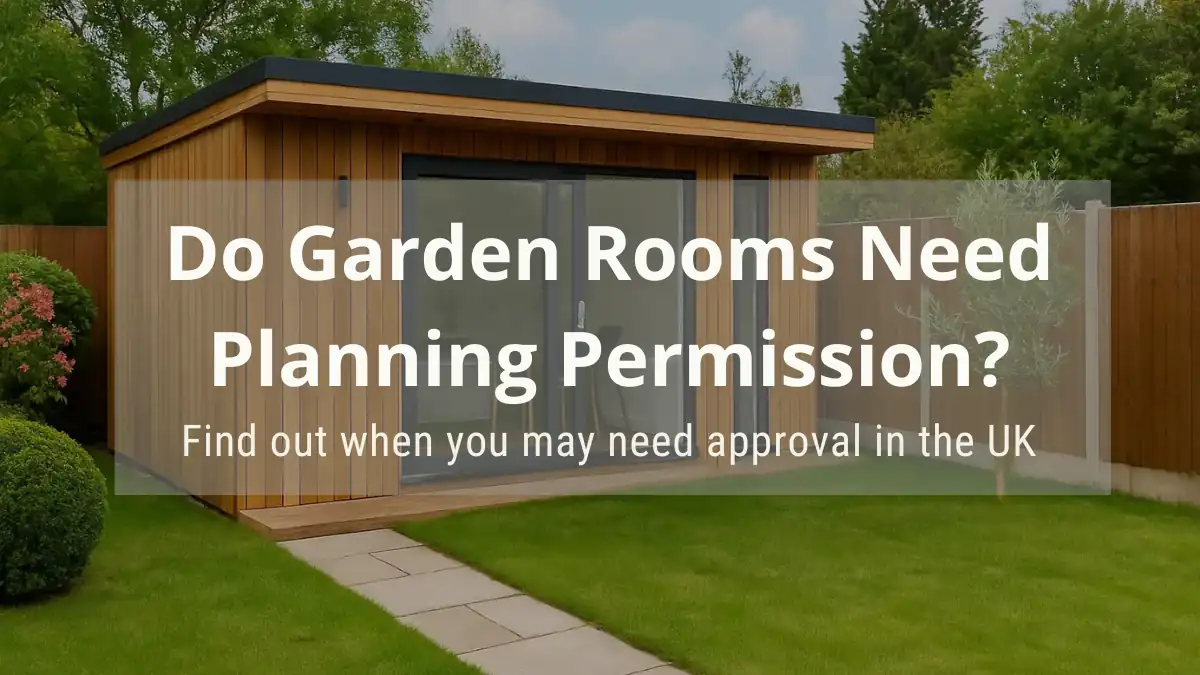
Do Garden Rooms Need Planning Permission?
A clear, homeowner-friendly guide to when a garden room is Permitted Development, when you need planning permission, and how Building Regulations may still apply.
Quick answer: Most garden rooms in the UK do not need planning permission if they meet Permitted Development (PD) rules — typically single-storey, height-limited, and used for activities incidental to the main house (office, gym, studio). If you exceed size/height limits, site it in a restricted location, or plan sleeping accommodation, you’ll likely need planning permission.
What Counts as a “Garden Room”
A garden room is a detached outbuilding within your curtilage. Common uses include home office, gym, studio, or playroom. If the building is designed for self-contained living (bedroom, bathroom, kitchen), it’s no longer an incidental outbuilding and will need full consent.
Note: This guide focuses on England & Wales. Scotland and Northern Ireland have similar but separate systems. Always check your local authority’s pages or the Planning Portal.
When Planning Permission Is Needed
Garden rooms fall under Householder Permitted Development for outbuildings if they comply with specific limits. Key scenarios that typically trigger planning permission:
- Overall height exceeds PD limits (see table below).
- Within 2m of the boundary but taller than 2.5m overall.
- The building sits forward of the principal elevation (front garden).
- Outbuildings together would cover more than 50% of the garden area (measured from the original house).
- Use includes sleeping or self-contained accommodation.
- Location constraints (conservation area, National Park, AONB, the Broads, World Heritage Site) restrict PD rights.
Important: If your garden room includes a bathroom or is intended for overnight stays, expect to need both planning permission and Building Regulations approval.
Key Permitted Development Rules for Garden Rooms
- Single-storey only; max eaves height 2.5m.
- Max overall height: 4.0m (dual-pitched roof) or 3.0m (other roofs).
- If within 2m of any boundary, overall height must not exceed 2.5m.
- Verandas/balconies/raised platforms over 0.3m are not permitted.
- Outbuildings (total) must not cover more than 50% of your garden.
- Not forward of the principal elevation (front garden).
| Rule | Limit |
|---|---|
| Maximum overall height (dual-pitched roof) | 4.0m |
| Maximum overall height (other roofs) | 3.0m |
| Maximum eaves height | 2.5m |
| Height within 2m of boundary | 2.5m overall |
| Raised platforms | Max 0.3m |
| Garden coverage | No more than 50% of land around original house |
| Front garden position | Not allowed under PD |
Tip: Even if you qualify under PD, consider a Lawful Development Certificate for documented proof — helpful for refinancing and when selling.
Building Regulations & Garden Rooms
Planning permission and Building Regulations are separate. You can be exempt from planning and still need Building Regs:
- ≤15m² detached, single-storey, non-habitable: often exempt (subject to fire-safety proximity/materials).
- 15–30m²: exempt only if at least 1m from boundary and built of substantially non-combustible materials. Otherwise, Building Regs apply.
- >30m²: Building Regulations will normally apply.
- Electrics, drainage, insulation, structure and fire safety must meet standards whenever applicable.
Not sure if your idea fits Permitted Development?
We’ll check your project against PD rules and let you know if you need a full planning application.
Local Council Quirks
While national PD rules are consistent, interpretation and enforcement vary:
- Conservation areas: visual impact and location (especially forward of the principal elevation) are scrutinised; many councils resist prominent garden buildings even if sizes meet PD.
- Dense urban plots: tight gardens make the 2.5m height-within-2m rule critical; low “cube” designs are common to comply.
- Article 4 Directions: some streets/areas have PD rights removed — always check with your council.
Warning: If your property has had previous extensions/outbuildings, re-check the 50% garden coverage rule — older structures still count toward the total.
Comparison: Garden Room vs Other Outbuildings
At a glance, here’s how common structures compare:
| Structure | Planning Permission | Building Regulations | Notes |
|---|---|---|---|
| Garden Room | Not usually, if under PD limits | Yes if 15–30m² (near boundary/combustible) or >30m²; services must comply | Best for office/gym/studio; incidental use only |
| Garden Office | Same as garden room | As above; electrics/heating trigger compliance | Heavy business use may raise rates/parking issues |
| Conservatory | Often requires permission if large or prominent | Usually requires Building Regs | Attached to main house; energy standards bite |
| Shed | Generally no, if small/simple and under PD | Rarely, unless very large or near boundary | Storage use; limited services |
Costs & Timelines
- Lawful Development Certificate: typically a few weeks; fee similar to householder application in some councils; gives firm evidence of PD status.
- Householder planning application: decision target ~8 weeks; England fee typically around £258 (plus plan/drawing costs).
- Building Control: plans + inspection fees vary (£200–£500+ depending on route and size).
Tip: Choose factory-built systems with known U-values and structural certification to streamline Building Control sign-off.
FAQs: Do Garden Rooms Need Planning Permission?
Do garden rooms need planning permission UK?
Most don’t if they meet PD limits (height, coverage, location, use). Exceeding these or sleeping use usually requires permission.
What size garden room can I build without planning permission?
Up to 2.5m overall height if within 2m of a boundary; otherwise up to 4.0m (dual-pitched) or 3.0m (other roofs). Keep total outbuildings under 50% of garden area.
Do I need Building Regulations for a garden room?
Often yes where 15–30m² and close to boundary/combustible, and generally for >30m². Services (electrics/plumbing) must comply regardless.
Are garden rooms allowed in conservation areas?
Restrictions tighten. Forward-of-house locations are usually not PD. Visual impact and materials are scrutinised—seek advice early.
Can I use a garden room as a bedroom?
Not under PD. Sleeping or self-contained accommodation normally needs planning permission and full Building Regulations.
Ready to move your project forward?
Plans Made Easy can prepare compliant plans, manage submissions, and guide you from idea to approval.
Next Steps & Useful Guides
- Planning Permission (UK): Complete Homeowner’s Guide
- Building Regulations: Complete Homeowner’s Guide
- Building Control: What It Is & When You Need It
- Planning Permission High Wycombe
- Extension Costs – Complete Homeowner’s Guide (UK)
- Single Storey Extension Costs
- Planning Permission Buckinghamshire
External resources: Planning Portal (UK) | GOV.UK Planning Guidance
Performance Verified ✅
This page meets PME Optimisation Standards — achieving 95+ Desktop and 85+ Mobile PageSpeed benchmarks. Verified on

