
Share this post:
Quick summary: Council Enforcement Notice
A Council Enforcement Notice is a formal planning notice used when your local planning authority believes there has been a breach of planning control — for example, an extension built without the right permission, or not built in line with approved plans.
- Don’t ignore it: missing the deadlines can lead to prosecution and extra costs.
- You may be able to appeal — but the appeal window is usually tight (often 28 days from service).
- Stopping harm matters: some cases involve a Stop Notice or Temporary Stop Notice where works must halt quickly.
- Often fixable: many extension cases are resolved by a retrospective application, plan corrections, or alterations on site.
If the notice relates to an extension, your next step is usually to (1) understand exactly what breach is alleged, (2) get your drawings and dates in order, and (3) decide whether to comply, appeal, or regularise through a planning route.
Worried an extension might trigger planning enforcement?
Share what you’ve built (or plan to build) and we’ll explain your likely options — including whether drawings, a retrospective application, or changes on site make the most sense.
Quick summary: Council Enforcement Notice
A Council Enforcement Notice is a legal planning notice requiring you to put right an alleged planning breach — such as an extension built without the correct permission, built bigger than approved, or used in a way the council says is not allowed.
The notice will usually set out what the breach is, what you must do (for example, remove an element, reduce height, or stop a use), and the compliance timescale. You may be able to appeal, but you normally need to act quickly.
Council Enforcement Notice: what it means for an extension
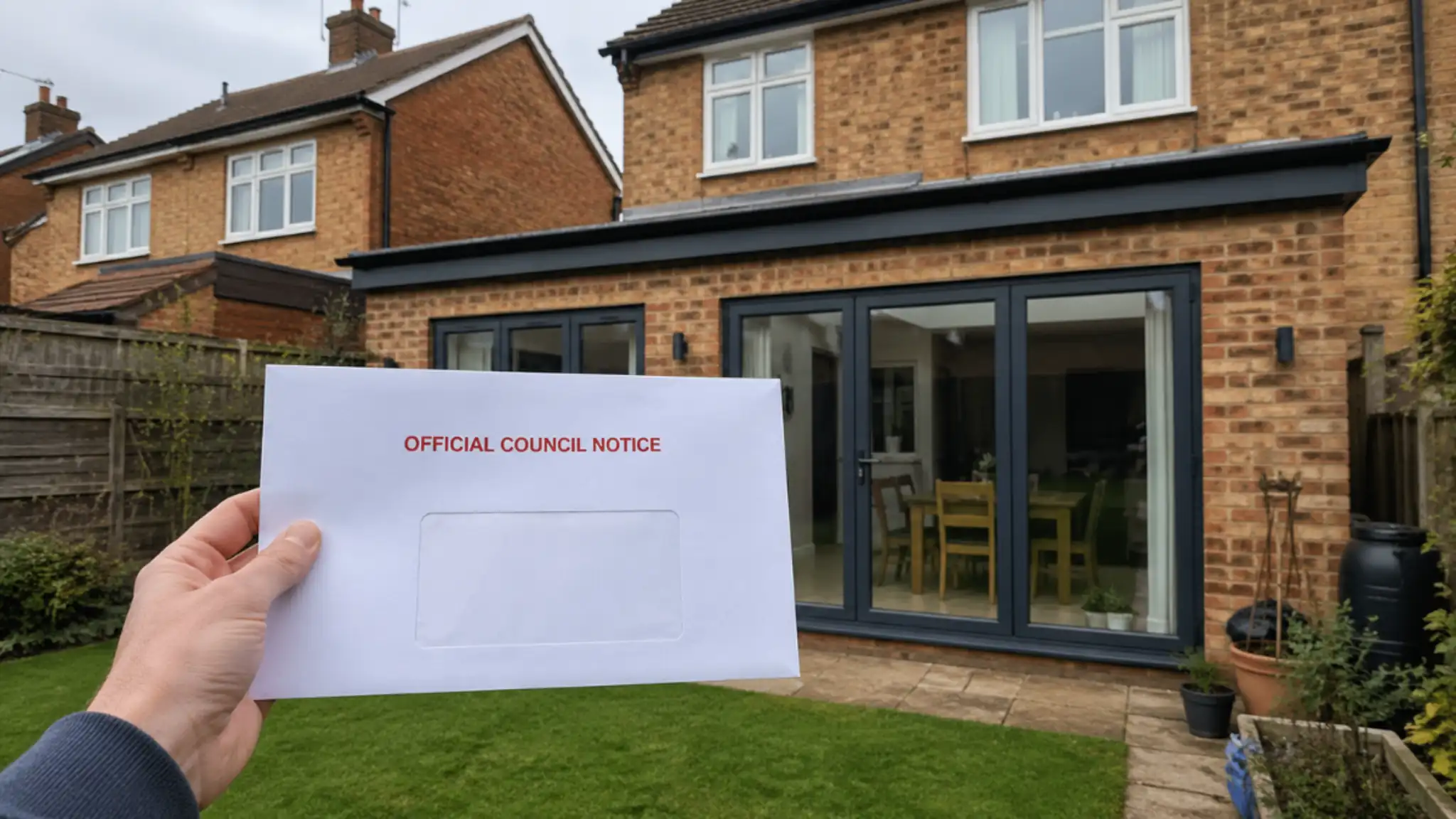
Getting a letter headed “enforcement” can feel alarming, especially if it’s about an extension you’ve invested time and money into. In practice, a Council Enforcement Notice is the council’s formal way of saying:“we believe there’s a planning breach, and we want it resolved by a set date.”
That breach might be as simple as an extension being a little larger than approved, or it could be that the council believes planning permission was required and never granted. Either way, the key is to respond calmly and methodically.
Common extension triggers for enforcement
- No planning permission where it was required (for example, not permitted development).
- Not built to the approved drawings (height, depth, roof form, windows, materials).
- Ignoring planning conditions (obscure glazing, hours of work, approved materials, drainage conditions).
- Neighbour complaints — often about privacy, overshadowing, or noise during works.
- Extensions on constrained sites (conservation areas, listed buildings, Article 4 directions).
Key differences: enforcement notice vs other council powers
“Enforcement” is an umbrella term. A Council Enforcement Notice is one tool, but councils can use other notices depending on the situation. Understanding the difference helps you avoid the wrong response.
Council Enforcement Notice (planning)
- Used for a breach of planning control (unauthorised development or change of use).
- Sets out steps required and a compliance period.
- Usually carries a right of appeal, but you must act within the stated time limits.
Breach of Condition Notice
- Used where planning permission exists, but a condition has not been complied with.
- Often focused on materials, obscure glazing, restricted openings, landscaping, or noise limits.
- Typically no right of appeal in the same way as an enforcement notice — so the strategy is different.
Stop Notice / Temporary Stop Notice
- Used where the council wants works or use to stop quickly to prevent harm.
- Can apply alongside (or before) an enforcement notice.
- Important because it can change what you should do on site immediately.
Ways to regularise an extension (and when each applies)
If a notice relates to an extension, there are usually three broad routes: comply, appeal, or regularise (often via a planning route). Which is best depends on what’s been built, the planning context, and the risk of refusal.
1) Retrospective planning application
This is commonly used where an extension was built without permission (or differs from approved plans), and you want the council to consider granting permission after the fact.
2) Lawful Development Certificate (where appropriate)
If you believe the extension was permitted development or has become lawful over time, a Lawful Development route may be relevant. This is evidence-led and needs careful handling.
3) Compliance / alteration works
Sometimes the quickest route is simply to adjust the extension so it meets what the council considers acceptable — for example, altering a roof height, removing a balcony, changing side windows, or reducing depth.
What a Council Enforcement Notice usually includes
Although formats vary between councils, most enforcement notices contain the same essentials. You should be able to identify the following:
- The alleged breach (what the council says is unauthorised).
- The site/land it relates to (address and land description).
- The steps required (what you must do to remedy the breach).
- When it takes effect (often allowing time for appeal).
- The compliance period (how long you have to carry out the steps).
- Appeal information (how to appeal and by when, where applicable).
Costs & timelines: what homeowners should budget for
Most homeowners worry about two things: “How fast do I need to move?” and “How much is this going to cost?” Costs vary hugely depending on what’s needed — but it helps to think in cost categories rather than a single figure.
Quick costs snapshot (extension enforcement cases)
- Drawings & evidence pack: measured survey, existing/proposed drawings, site plan, and supporting statement (varies by project and complexity).
- Planning application fee: payable to the council if you submit a retrospective householder application.
- Professional support: planning strategy, managing submissions, and negotiating with the case officer.
- Build changes: the cost to alter or remove elements if required (often the biggest cost).
- Specialist reports (if needed): heritage statement, trees/arboricultural input, ecology, or drainage details.
If your extension budget is still being planned (or re-planned), our pillar guide on extension costs for UK homeowners helps you understand where professional fees sit within the overall spend.
Timelines: what usually happens next
- Short term (days): confirm the notice type, record deadlines, gather evidence (plans/photos/dates).
- Medium term (weeks): decide whether to appeal, comply, or submit a planning route to regularise.
- Longer term (months): determination of any application/appeal, plus any agreed build changes and sign-offs.
Step-by-step: what to do after receiving a Council Enforcement Notice
Here’s the process we recommend for homeowners. It’s designed to stop things escalating, while keeping your options open.
Step-by-step checklist (what to do this week)
| Step | What you’re trying to achieve | What to gather |
|---|---|---|
| 1) Read the notice properly | Identify the breach, deadlines, and required steps | Notice pages, service date, maps/site description |
| 2) Stop guessing — check the planning history | Confirm what was approved (if anything) | Decision notice, approved drawings, conditions |
| 3) Document what exists now | Create a clear “as built” picture | Photos, measurements, start/finish dates, contractor info |
| 4) Decide your route | Comply vs appeal vs regularise | Risks, neighbour impacts, planning constraints |
| 5) Prepare the right drawings | Support an application or negotiation | Existing/proposed plans & elevations, site plan, key dimensions |
| 6) Communicate in writing | Avoid misunderstandings and keep an audit trail | Emails/letters, call notes, submission receipts |
Not sure which route is safest: appeal, comply, or retrospective planning?
We’ll review your extension details and explain the realistic options — including what drawings and evidence are usually needed.
Pitfalls & gotchas (the mistakes that make things worse)
Enforcement problems usually escalate for one of three reasons: missed deadlines, unclear information, or changes made in a panic. Here are the biggest “gotchas” we see with extension cases.
Other common mistakes to avoid
- Assuming it’s “just a warning letter”. A formal notice is not the same as an initial enquiry.
- Submitting the wrong drawings. Councils need clear, scaled plans that match what exists (and what is proposed).
- Continuing works without a strategy. In some cases, the council may take the view that harm is increasing.
- Relying on hearsay. Planning enforcement is fact-specific and site-specific.
- Using the wrong anchor for your case. Some households focus on Building Regs when the core issue is planning (and vice versa).
Technical details for extensions (plans, measurements, evidence)
The technical side is often what decides whether an enforcement case becomes manageable or messy. For extensions, the council will usually care about things like height, depth, distance to boundaries, window positions, and how the extension affects neighbours.
What your “evidence pack” should normally include
- Existing & as-built drawings (what’s there now, accurately measured).
- Proposed “regularisation” drawings (what you’re asking to keep, or what changes you’ll make).
- Site plan and location plan at the correct scales.
- Photo set showing key views (rear elevation, boundary relationships, neighbour impacts).
- Timeline of works (start date, key stages, completion date if relevant).
Related comparisons (useful ways homeowners search)
- Enforcement notice vs retrospective planning — what’s the practical difference for an extension?
- Enforcement notice vs stop notice — when do you have to halt works immediately?
- Planning enforcement vs Building Control — who deals with what?
FAQs: Council Enforcement Notice
How long does an enforcement notice last?
An enforcement notice normally remains “live” until the required steps are complied with (or the notice is varied/withdrawn following a formal process). What changes is the compliance period — the timescale you’re given to carry out the steps. If you’re unsure, focus on the dates printed on your notice and get advice quickly.
What is an enforcement notice from the council?
It’s a formal planning notice stating the council believes there has been a breach of planning control. It sets out what the alleged breach is, what you must do to remedy it, and the relevant deadlines. For extension cases, it often relates to building without permission or not building in accordance with approved plans.
Can you appeal a Council Enforcement Notice?
Often, yes — but you must do it within the deadline stated on the notice. Appeals are typically made to the Planning Inspectorate. If you’re considering an appeal, don’t delay, because the time window can be short.
What happens after an enforcement notice?
If you do nothing and the notice takes effect, you may be expected to complete the required steps within the compliance period. If the council believes you haven’t complied, they may escalate — which can include prosecution or other enforcement action. Many homeowners avoid escalation by choosing a clear route: comply, appeal, or regularise through planning (where viable).
When can an enforcement notice be issued?
Councils typically issue enforcement notices when they believe there has been a breach of planning control and it’s considered expedient to act. In extension cases, this is often after investigation and correspondence — but it can move faster where the council believes harm is serious.
Can the council withdraw an enforcement notice?
In some cases, councils can withdraw or vary notices, but it’s not something to assume. Usually, you need a clear reason — for example, evidence shows the notice is incorrect, the alleged breach is not a breach, or a new permission/decision changes the position.
Can council enforcement officers detain you?
Planning enforcement officers are not police. They can investigate planning breaches and may have certain rights to enter land in specific circumstances, but “detaining” someone is not their role. If you’re worried about access or entry rights, get advice based on your specific situation.
Can the council force entry?
Planning enforcement powers around entry are limited and controlled by law. Councils may have powers to enter land at reasonable times for certain purposes, and may require authority (such as a warrant) for forced entry. If this becomes a concern, don’t rely on internet rumours — get proper case-specific advice.
How should an enforcement notice be served?
Service rules are specific and can matter for deadlines. If you believe service was incorrect (for example, wrong party or wrong address), that can be an important detail — especially where appeal timing is tight.
Want a calm second opinion before you respond to the council?
We can review what’s been built, what the notice says, and what evidence usually helps — so you’re not guessing your next move.
Next steps & useful guides
If your enforcement case is linked to an extension, these guides usually help homeowners get the basics right before they take action:
- Extension costs (pillar guide): what to budget for in the UK
- Planning permission guide (UK homeowners)
- Do I need planning permission? (quick checklist)
- Planning fees & typical costs (what you actually pay for)
- Planning application drawings: what councils expect
- Extension drawings explained (what’s included)
- Plans for Building Regulations: what you need & when
- Making plans: from idea to approval
- What it isA formal planning notice requiring you to remedy an alleged breach (often an unauthorised extension or a build that differs from approved plans).
- What it containsThe breach, required steps, effective date, compliance period, and (often) appeal details.
- Common homeowner optionsComply, appeal, or regularise via a planning route (such as a retrospective application) if appropriate.
- Biggest riskMissing deadlines or taking the wrong action without clear drawings and evidence.
- What helps mostAccurate as-built drawings, a clear timeline of works, and a sensible strategy agreed early.
- If it relates to an extensionExpect focus on height, depth, boundary relationship, windows/privacy, and whether it matches any approvals or permitted development limits.
If you want help turning your situation into a clear plan (with the right drawings), contact Plans Made Easy.
Official guidance (useful to bookmark)
For national guidance and the most up-to-date processes, these official resources are worth checking:
- Planning Portal – national guidance on planning and appeals
- GOV.UK – planning permission in England and Wales
- GOV.UK – how to appeal an enforcement notice
- Legislation – enforcement notices (Town and Country Planning Act 1990)
How Plans Made Easy can help
A Council Enforcement Notice doesn’t automatically mean you’ll “lose” your extension — but it does mean you need a clear plan, quickly. In most cases, the best outcomes come fromgetting the facts straight, preparing accurate drawings, and choosing the right route: comply, appeal, or regularise.
Plans Made Easy helps homeowners turn an enforcement situation into a practical next step — whether that’s an “as built” drawing pack, a retrospective planning submission, or a sensible set of design changes to reduce risk and move things forward.
Ready to move your project forward?
Plans Made Easy can prepare compliant plans, manage submissions, and guide you from idea to approval.

Performance Verified ✅
This page meets PME Optimisation Standards — achieving 95+ Desktop and 85+ Mobile PageSpeed benchmarks. Verified on

