
Share this post:
Quick summary: Building Regulations Plans
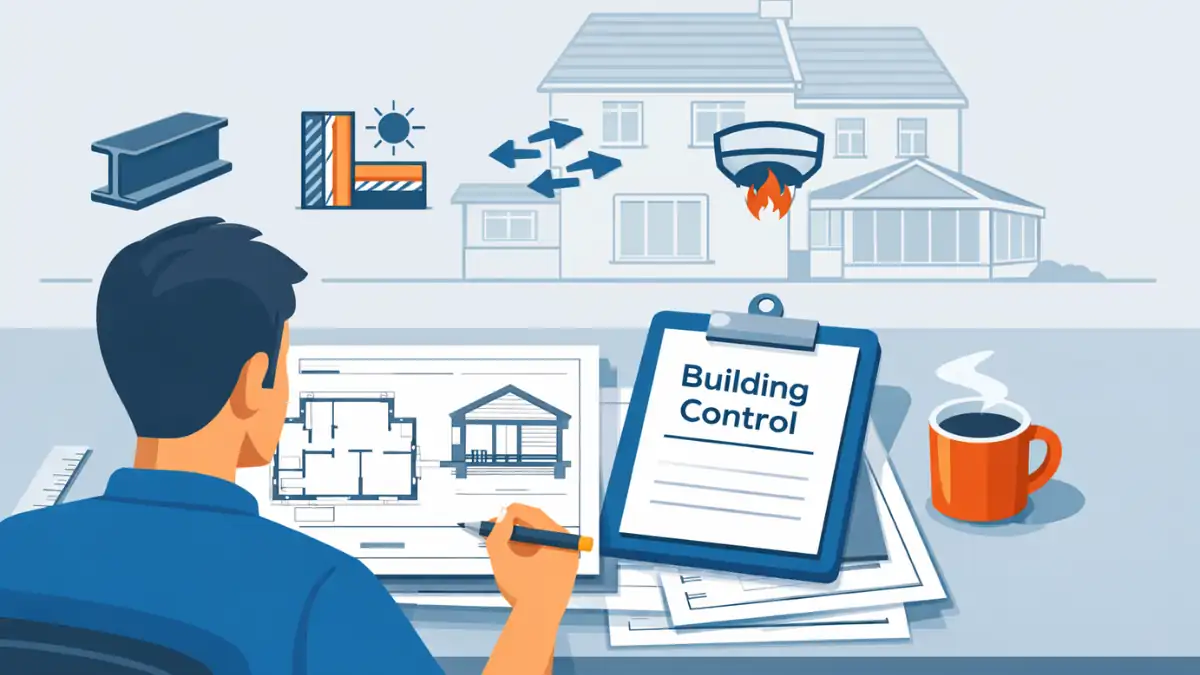
Building Regulations Plans are the detailed drawings and specifications used by Building Control to check that your project meets the Building Regulations (structure, insulation, fire safety, ventilation, drainage and more). In most cases, they’re also what your builder needs to price the job accurately and build it correctly.
- They’re different to planning drawings — Building Regulations Plans are technical construction drawings, not “does it look acceptable?” drawings.
- They reduce delays — clearer information usually means smoother Building Control checks and fewer on-site surprises.
- They protect you later — good paperwork helps you achieve sign-off and keep evidence for future sales and remortgages.
- They’re most useful on the Full Plans route — but they still help even if you use a Building Notice.
If you’re unsure what you need for your specific project (extension, loft conversion, garage conversion, structural alteration, etc), we can quickly sense-check your scope and tell you what drawings and approvals are sensible before you commit.
Not sure what drawings Building Control will actually want?
Tell us what you’re building and we’ll outline the right level of Building Regulations information — so you don’t pay for the wrong thing (or get stuck mid-build).
Quick summary: Building Regulations Plans
Building Regulations Plans are the drawings and construction notes that show how your extension, conversion or alteration will be built to meet Building Regulations. They’re reviewed by Building Control (council or an approved inspector) and they also help your builder price and deliver the work with fewer surprises.
They’re not the same as planning drawings. Planning is about whether the proposal is acceptable in principle; Building Regulations is about whether the construction is safe, energy efficient and compliant.
What are Building Regulations Plans?
Think of Building Regulations Plans as the “buildable” version of your idea. They translate your layout into proper construction information — so Building Control can check compliance and your builder can build what’s intended.
In practice, Building Regulations Plans usually sit somewhere between:
- basic planning drawings (enough to show layout and appearance), and
- a full construction package (enough detail to build, inspect and sign off).
If you want the bigger picture first, our pillar guide explains how Building Regulations work from start to finish:Building Regulations: Complete Homeowner’s Guide.
Building Regulations Plans vs planning drawings
One of the most common homeowner mix-ups is assuming that “plans are plans”. In reality, Building Regulations plans and planning drawings answer different questions.
Planning drawings (planning permission / permitted development paperwork)
- Focus on size, shape, appearance and impact on neighbours / street scene.
- Used by the planning department to decide if the proposal is acceptable.
- Normally show existing and proposed plans/elevations, plus location/site plans.
Building Regulations Plans (technical compliance drawings)
- Focus on how it will be built — structure, insulation, ventilation, drainage, fire safety, stairs and more.
- Used by Building Control to check compliance and inspect works on site.
- Often need coordination with structural calculations and construction specifications.
If you’re still at the “do I need permission?” stage, these two guides help you separate the routes clearly:Planning Permission (UK): The Complete Homeowner’s GuideandDo I Need Planning Permission?
Related comparisons homeowners often search
- Building Regulations vs planning permission — different systems, different tests, often both apply.
- Building Notice vs Full Plans — “start quickly” vs “check properly upfront”.
- Building Regulations vs British Standards — Building Regulations are legal requirements; standards are guidance often used to demonstrate compliance.
When do you need Building Regulations Plans?
Not every project needs the same level of drawings. However, most projects that involve structural work, new thermal elements, new drainage, or changes to fire escape arrangements benefit hugely from proper Building Regulations Plans.
They’re commonly needed (or strongly recommended) for:
- extensions (single-storey, double-storey, rear/side wrap-around),
- loft conversions (new stairs, fire protection upgrades, insulation/ventilation),
- garage conversions (thermal upgrades, damp/ventilation, openings/structure),
- removing walls / adding beams (structural calculations are usually required),
- new openings (bifold doors, enlarged windows, lintels/steelwork), and
- alterations affecting drains (new bathrooms, kitchens, relocation of soil stacks).
If you’re specifically looking for drawing-level detail, you may also find this guide helpful:What Are Building Regulations Drawings and Why Do You Need Them?
What do Building Regulations Plans typically include?
The exact content varies by project, but most Building Regulations Plans packages include a combination of drawings and written notes/specifications. As a minimum, Building Control usually expects enough information to understand the proposed construction.
Typical drawings
- Existing & proposed floor plans (often with key dimensions).
- Elevations (especially where openings, materials or levels matter).
- Building sections showing floor, wall and roof build-ups.
- Detail call-outs (insulation, thermal bridging approach, cavity closures, DPC/DPM).
- Drainage layouts where new connections or runs are proposed.
- Stair details if you’re adding or altering stairs.
Typical notes / specifications
- thermal performance approach (Part L) — insulation thicknesses, U-values where relevant, continuity.
- ventilation strategy (Part F) — background ventilation, extract rates, whole-house approach if needed.
- fire safety approach (Part B) — escape windows/doors, fire doors, detection, protected routes.
- structure strategy (Part A) — often supported by an engineer’s calculations.
For structural elements, you’ll often need input from an engineer. Our guide explains when:Structural Calculations: When Do You Need Them?
Full Plans vs Building Notice: which route suits you?
Building Control work is usually handled via one of two routes. The best one depends on your project complexity, your appetite for risk, and how soon you want to start.
Full Plans
- You submit drawings/specifications for checking before work starts.
- Building Control issues a plan check response (and often an approval) that gives you more certainty.
- Generally best for extensions, loft conversions, structural alterations and anything complex.
Building Notice
- You can start sooner, but there’s less pre-checking up front.
- Decisions can be made on site as work progresses — which can be fine on simple work, but risky on complex builds.
- Builders still need clarity, so proper information is often required anyway.
We break the pros/cons down fully here:Building Notice vs Full Plans – Which Route is Best?
Unsure whether Full Plans or Building Notice is right?
We’ll point you to the safest route for your project type and explain what information Building Control will likely expect — before you start spending on builders.
Costs, timescales and what affects the price
Homeowners often ask about the cost of Building Regulations Plans because it feels like “extra paperwork”. In reality, good plans usually save money by preventing confusion, variations and rework.
Costs vary mainly based on project size and complexity, how much technical detail is needed, and whether you also need engineering input and coordination.
Quick costs snapshot (guide only)
- Simpler work (straightforward internal alterations, modest openings): often lower-cost drawings, depending on what’s needed.
- Typical extensions and loft conversions: usually require a proper technical package plus structural calculations.
- Complex projects (multiple structural changes, awkward sites, basements): often need more design coordination, more details, and sometimes specialist reports.
These are broad guide points because every home is different. Your quote should be based on your exact scope, not a generic online price.
If you want to understand Building Control’s role and inspections, this guide is the best next read:Building Control: What It Is, When You Need It, and How to Pass Inspections First Time(and this one for what happens on site:Building Control Inspections – What to Expect).
Step-by-step: how to get Building Regulations Plans done properly
If you want the smoothest route to compliance (and fewer builder disputes), follow this simple process.
Checklist: getting Building Regulations Plans right
- Confirm your project scope. Extension, loft conversion, garage conversion, structural alterations — list what’s changing.
- Separate planning from Building Regulations early. If planning is needed, deal with that first, then move to technical detailing.
- Decide your Building Control route. Full Plans for certainty; Building Notice only if the project is genuinely simple and your builder is experienced.
- Gather existing info. Photos, rough measurements, past plans, and any known constraints (drains, party walls, conservation area, etc.).
- Commission structural input where needed. Beams, knock-throughs and roof changes almost always need calculations.
- Ask for a clear inclusions list. Confirm what drawings, details and notes are included, plus revision policy.
- Coordinate with the builder before submission. A quick “buildability” sense-check can prevent awkward changes later.
- Submit and keep records. Save your approved plans, notes and any correspondence for your project file.
If your wider project includes an extension, you may also find these useful for overall project planning and sequencing:House Extensions – Complete UK GuideandExtension Regulations UK: Planning Rules, Building Control & Compliance.
Common pitfalls (and how to avoid them)
Most Building Regulations problems we see aren’t “big law issues” — they’re practical issues caused by unclear information and poor coordination.
1) Assuming planning drawings are “enough” for building
Planning drawings are rarely detailed enough for construction. Builders then price based on assumptions, and you get variations later.
2) Missing key details around insulation and ventilation
Parts L and F catch a lot of homeowners out, especially in conversions where you’re improving thermal performance while keeping headroom and ventilation workable.
3) Leaving structural decisions until the builder starts
Structural changes are much easier (and cheaper) to plan on paper. Once steel positions and padstones are being decided on site, you risk delays and redesign.
If your project involves a loft conversion specifically, our wider guide may help you understand typical compliance pinch points:Loft Conversions (UK) — Costs, PD Rules, Process & Council Quirks
FAQs: Building Regulations Plans
What are Building Regulations Plans, in simple terms?
They’re the technical drawings and notes that show how your project will be constructed to comply with Building Regulations. Building Control use them to check compliance, and builders use them to price and build accurately.
Are Building Regulations Plans the same as planning drawings?
No. Planning drawings are mainly about layout, appearance and impact. Building Regulations Plans are about construction detail: structure, insulation, ventilation, drainage, fire safety and other compliance items.
Do I need plans for Building Regulations approval?
For the Full Plans route, yes — you submit plans for checking before work starts. Even on a Building Notice, having proper drawings is still strongly recommended because it reduces uncertainty and helps you avoid costly changes on site.
Is Building Regulations legally required in the UK?
Building Regulations are legally binding for work that falls within the regulations. Exactly what applies depends on what you’re building and where you live, so it’s always worth checking early with Building Control or a professional who deals with compliance daily.
How long are Building Regulations approvals valid for?
It depends on the route and your local Building Control body. More importantly, if you change the design during the build, you may need to update drawings and re-agree details. The safest approach is to keep your plan set aligned with what’s being built.
Do I need an architect for Building Regulations Plans?
Not necessarily. Plans can be prepared by architectural technologists, technicians, and specialist plan providers — the key is that they understand Building Regulations compliance and can coordinate with structural calculations where required.
Who approves Building Regulations — the council or someone else?
Building Regulations can be checked by your local authority Building Control team or by an approved inspector (depending on route and availability). Either way, the drawings and evidence must demonstrate compliance.
How do Building Regulations get enforced?
Enforcement is typically through Building Control inspections, plan checks (if you use Full Plans), and requiring work to be altered if it doesn’t meet requirements. The goal is to achieve compliant construction and the right sign-off at the end.
Want a quick sanity-check before you pay for drawings?
We’ll tell you what level of technical detail is sensible for your project, and what tends to cause delays with Building Control.
Next steps & useful guides
If you want to go deeper (or you’re still unsure which approvals you need), these PME guides can help:
- Building Regulations: Complete Homeowner’s Guide
- Building Control: What It Is, When You Need It, and How to Pass Inspections First Time
- Building Notice vs Full Plans – Which Route is Best?
- Structural Calculations: When Do You Need Them?
- Extension Regulations UK: Planning Rules, Building Control & Compliance
- Planning Permission (UK): The Complete Homeowner’s Guide
- What they areTechnical drawings + notes that explain how your project will comply (structure, insulation, ventilation, drainage, fire safety and more).
- What they’re forTo help Building Control check compliance and to give your builder clear information to price and build accurately.
- Best route for certaintyFull Plans — a plan check before work starts generally reduces surprises later.
- Common add-onStructural calculations are often required where beams, openings or roof structures change.
- Main homeowner benefitFewer delays, fewer disputes, clearer inspections, and stronger paperwork for completion/sign-off.
If you’d like us to confirm what your project needs, message Plans Made Easy and we’ll guide you to the right drawings and approvals.
Official guidance (useful for cross-checking)
For national planning guidance and the government overview of planning permission, these are reliable starting points:
- Planning Portal – national planning guidance and application information
- GOV.UK – planning permission in England and Wales
How Plans Made Easy can help
Building Regulations can feel like a minefield, but it’s much calmer when your project has the right information from the start. The goal is simple: clear drawings, a sensible compliance strategy, and a smooth path to sign-off.
At Plans Made Easy, we help homeowners prepare clear, compliant plan packages and guide you through the Building Control process — so you can build with confidence and avoid nasty surprises mid-project.
Ready to move your project forward?
We can prepare compliant plans and guide you through Building Control so your project stays smooth and stress-free.

Performance Verified ✅
This page meets PME Optimisation Standards — achieving 95+ Desktop and 85+ Mobile PageSpeed benchmarks. Verified on

