
Share this post:
Quick summary: Building Regulations Part M
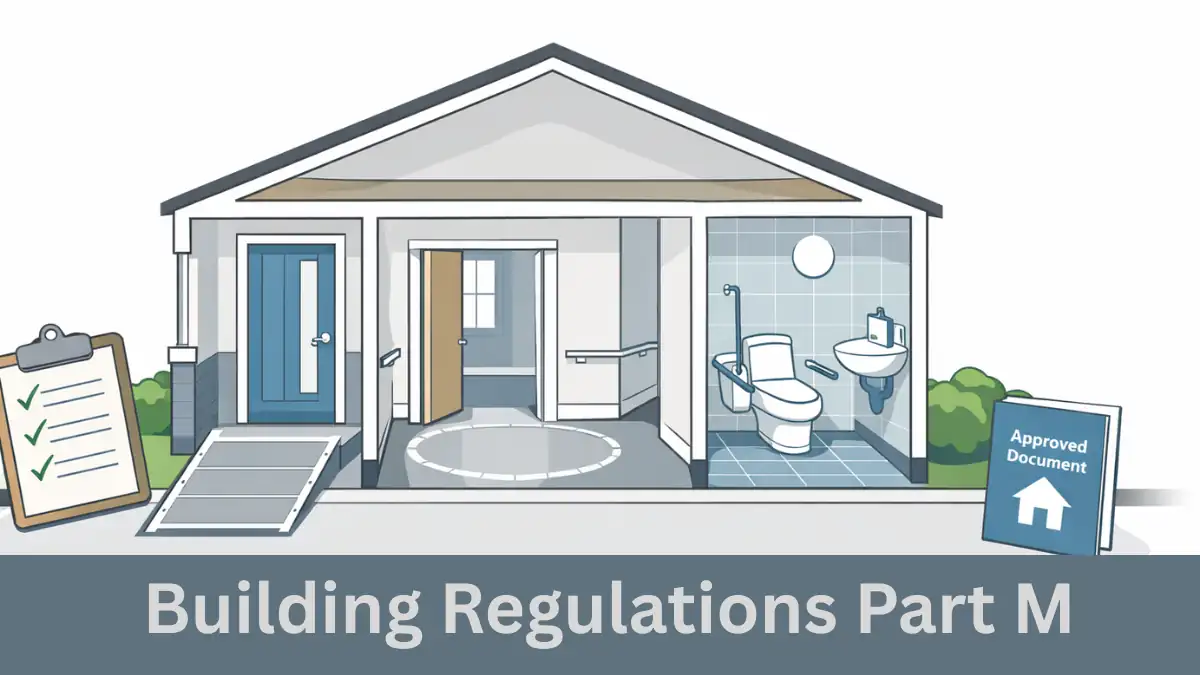
Building Regulations Part M is the UK guidance on access to and use of buildings — in plain terms, it’s about making sure people can get into a building and move around it safely and reasonably easily (including if they’re older, have a disability, or are pushing a pram).
- For most homeowners, Part M matters when you’re building a new home, doing a material change of use, or creating/altering spaces where access and layouts become a Building Control focus.
- It’s not only about wheelchair ramps — it can affect doorways, thresholds, circulation space and WC layouts depending on the project.
- Approved Document M is split into Volume 1 (dwellings) and Volume 2 (buildings other than dwellings).
- The easiest way to avoid stress is to flag Part M early when you’re preparing Building Regulations drawings, so your designer can “design in” compliance rather than fixing it on site.
If you’re unsure whether Part M will bite on your project, our team can sanity-check it alongside the rest of Building Regs and help you avoid expensive last-minute redesigns.
Not sure what Building Control will expect on access?
Tell us what you’re building and we’ll highlight the access points that usually trigger questions — before you spend money on revisions.
What Building Regulations Part M actually covers
Building Regulations Part M is the set of requirements and guidance that deals with access to and use of buildings. In practice, it aims to make sure a building is usable by as many people as reasonably possible — not just “able-bodied” users.
For homeowners, Part M can feel confusing because it sits alongside other rules and real-world constraints:
- Planning permission is about what the council will accept visually and in policy terms (size, impact, neighbours, conservation constraints).
- Building Regulations are about how the work is built (structure, insulation, drainage, fire safety, ventilation — and access under Part M).
- Building Control is the inspection/approval process that checks the Building Regs side is compliant.
If you want a broader overview of how the whole system fits together, start with our guide to Building Regulations for homeowners and our explainer on how Building Control works in practice.
Building Regulations Part M: Volume 1 vs Volume 2 (and the M4 categories)
One reason people Google “Building Regulations Part M volume 1” and “volume 2” is because the guidance is split depending on what you’re building:
Building Regulations Part M Volume 1: dwellings
Volume 1 is used for homes. It includes the well-known M4 categories which describe different accessibility standards that may be required depending on the project and local planning policy:
- M4(1) – “visitable” homes (the baseline for most new homes).
- M4(2) – “accessible and adaptable” homes (a higher standard that supports later adaptation).
- M4(3) – wheelchair user homes (the highest standard, and more demanding in space and layout terms).
Building Regulations Part M Volume 2: buildings other than dwellings
Volume 2 is for non-dwelling buildings (shops, offices, public buildings, communal areas, etc.). Homeowners come across it most often when:
- creating separate accommodation in a way that changes use,
- working on communal areas of blocks, or
- doing projects that blur the line between domestic and non-domestic use.
When Building Regulations Part M applies to home projects
In simple terms, Part M becomes most relevant when your work creates a new “useable environment” or significantly changes circulation and facilities. Typical triggers include:
- New-build homes (Part M is central, especially where M4(2) or M4(3) applies).
- Material change of use (for example, converting a building into a dwelling).
- Major internal reconfiguration where door positions, hall widths, level changes, or WC layouts change.
- Extensions where the new layout introduces access pinch points or creates a “new primary entrance” arrangement.
What matters is not only the theory, but what your Building Control officer will ask to see on drawings and on site. If you’re not sure which route you’re using (Full Plans vs Building Notice), our guide to choosing the right submission route can help.
Common Building Regulations Part M issues in extensions and conversions
For most homeowners, Part M problems appear in a few predictable places. The good news is that these are usually straightforward to design around — as long as you spot them early.
1) The approach to the entrance and “step-free” moments
Part M is sensitive to how someone arrives at and enters a home. That doesn’t mean every existing property must be fully step-free. However, if your design creates awkward new thresholds, steep external steps, or narrow access points, Building Control may ask how you’ve mitigated it.
2) Doorways, corridors, and pinch points
One of the most common Part M headaches is a layout that looks fine on paper, but becomes tight when you account for door swings, furniture, and realistic circulation. This comes up a lot in:
- narrow side returns,
- small WC/shower rooms,
- loft conversions where the stair enclosure steals width, and
- garage conversions where existing structure limits openings.
If your project includes a new staircase or changes around an existing stair, check the interaction with other requirements too. Part M focuses on usability, while stair geometry requirements sit elsewhere — see our plain-English guide to stair requirements for Building Regulations.
3) WC and bathroom layouts
Homeowners often ask about “disabled toilet requirements” under Part M. In domestic projects, the reality is usually about practical layout:
- Can you enter and close the door comfortably?
- Is there sensible access to the WC and basin?
- Will the layout still work if mobility reduces over time?
If you’re building a new home (or creating a new unit), the M4 category can significantly affect bathroom and circulation design — this is where good Building Regulations drawings matter most.
4) Ramps, handrails, and small level changes
Ramps can be useful, but they’re not a magic fix. A poorly planned ramp can create hazards, drainage issues, or awkward landings. Where possible, a thoughtful approach to levels and thresholds usually provides a cleaner outcome.
5) Visual contrast and “easy to use” details
You’ll sometimes see searches for “Part M colour contrast”. That’s more common in public/non-domestic contexts, but the principle is simple: good lighting, clear edges, and sensible design choices make spaces safer and easier to use for everyone.
What your Building Regulations drawings should show for Part M
Building Control can only approve what they can understand. If your drawings are vague, you often get extra questions — or worse, an on-site request to change something after it’s built.
At a minimum, a good Building Regulations package should clearly show:
- door locations, door swings, and key circulation spaces,
- levels and thresholds (especially at entrances and between old/new parts of the house),
- sanitary layouts with sensible clearances,
- stair layouts and guarding/handrail intentions where relevant, and
- any “tight” areas that need careful detailing to work in real life.
If you’re not sure what drawings you actually need, this guide will help: what to include in plans for Building Regulations. It’s also worth reading our overview of how Building Regulations approval works so you understand what Building Control is checking and when.
Want us to review your layout for access risks?
We’ll look at your plans and highlight the spots that commonly trigger Building Control comments — so you can adjust before submission.
Step-by-step Part M checklist for homeowners
If you’re trying to keep things simple, this checklist is a good starting point to discuss with your designer or Building Control.It won’t replace professional assessment, but it helps you spot the “usual suspects”.
| Step | What to check (in plain English) | Why it matters |
|---|---|---|
| 1 | How do you approach and enter the home (or new entrance)? | Awkward steps/thresholds are common late-stage problems. |
| 2 | Are doorways and circulation routes realistic once you include door swings and furniture? | “It fits on the plan” is not the same as “it works in real life”. |
| 3 | Do WC/bathroom layouts allow comfortable access and use? | Small rooms are where Part M issues show up most often. |
| 4 | If there’s a staircase, have you checked the stair design alongside usability? | Stairs can create pinch points and affect circulation. |
| 5 | Have you clearly shown levels, thresholds, and any ramps/landings on the drawings? | Building Control needs clarity to approve and inspect properly. |
| 6 | Have you confirmed what Building Control expects for your type of project and submission route? | It reduces surprises during inspections. |
If your project is an extension or reconfiguration, it also helps to understand the wider compliance picture —see our guide to extension regulations and approvals.
Part M gotchas that cause delays (and how to avoid them)
Designing a layout that only works if everything is “perfect”
Tight door positions, awkward turning space, and over-optimistic WC layouts can all pass unnoticed until you try to use the room. Ask your designer to sanity-check with real-world clearances, not just minimal lines on a plan.
Forgetting the knock-on effects of structure
Sometimes an opening “could” be wider, but only if a beam changes, a column shifts, or a wall is re-engineered. That’s why it helps to line up access thinking with structure early — and, where needed, involve an engineer. (Here’s our guide on when structural calculations are required.)
Assuming Building Control will interpret your intent
Building Control officers are helpful, but they’re not mind readers. Clear drawings save time. If you’re still planning the project, you may also find it useful to read our “big picture” guide to making plans and getting approvals.
FAQs: Building Regulations Part M
What is Building Regulations Part M in simple terms?
It’s the Building Regulations guidance that focuses on access and usability — helping ensure people can enter a building and use key spaces (like circulation routes and sanitary facilities) without unnecessary barriers.
Does Building Regulations Part M apply to extensions?
It can, depending on what you’re building and how the work changes access and layouts. Many small extensions won’t trigger major Part M redesign, but door positions, thresholds, and WC layouts can still become a Building Control discussion. If you want help understanding what applies, start with our Building Control guide.
What’s the difference between Building Regulations Part M and “access for disabled people” rules?
Part M is the Building Regulations route (checked by Building Control). Separate equality duties can apply in other contexts. For typical homeowner projects, the practical focus is: “Will Building Control sign this off as compliant and usable?”
What are Volume 1 and Volume 2 under Part M?
Volume 1 relates to dwellings (homes) and includes the M4 categories. Volume 2 relates to buildings other than dwellings (non-domestic buildings and certain communal/public settings). If your project sits on the boundary, clarify it early.
Do Building Regulations Part M rules set exact door widths and corridor widths?
The Approved Documents contain detailed guidance, but the “right” approach depends on context and layout. Rather than designing to a single number, it’s better to design for realistic usability and then confirm with Building Control that the drawings demonstrate compliance.
How often are Building Regulations updated?
Updates happen periodically, and amendments can be issued without homeowners noticing. For anything you’re building now, always check the latest official guidance and confirm with Building Control which edition they’re working to.
How many “Parts” are there to Building Regulations?
Building Regulations are split into multiple “Parts” (fire safety, insulation, electrics, drainage, access, and more). That’s why a whole-project view is important — one change can affect several Parts at once. Our homeowner guide to Building Regulations explains how they interact.
Will Building Control inspect Part M items on site?
They can do — especially where thresholds, level changes, door sets, bathrooms, or circulation spaces are key to compliance. If you want a clearer idea of how inspections typically run, read what to expect during Building Control inspections.
Next steps & useful guides
If you’re at the “what do I do next?” stage, these guides usually help homeowners move forward with less back-and-forth:
- What drawings you need for Building Regulations
- How Building Regulations approval works (what Building Control checks)
- Insulation and energy efficiency requirements explained
- Electrical safety requirements explained
- How to work out if you need planning permission
Key facts snapshot
External references (official guidance)
- Planning Portal — national guidance hub
- GOV.UK — planning permission overview (England & Wales)
- GOV.UK — official guidance page for access to and use of buildings
Ready to move your project forward?
Plans Made Easy can prepare compliant plans, manage submissions, and guide you from idea to approval — without the usual back-and-forth.
Performance Verified ✅
This page meets PME Optimisation Standards — achieving 95+ Desktop and 85+ Mobile PageSpeed benchmarks. Verified on

