
Share this post:
Exploring a basement conversion?
Tell us your goal (extra bedroom, cinema, home office). We’ll sanity-check feasibility and next steps.
Basement Conversions (UK): clear, practical guidance
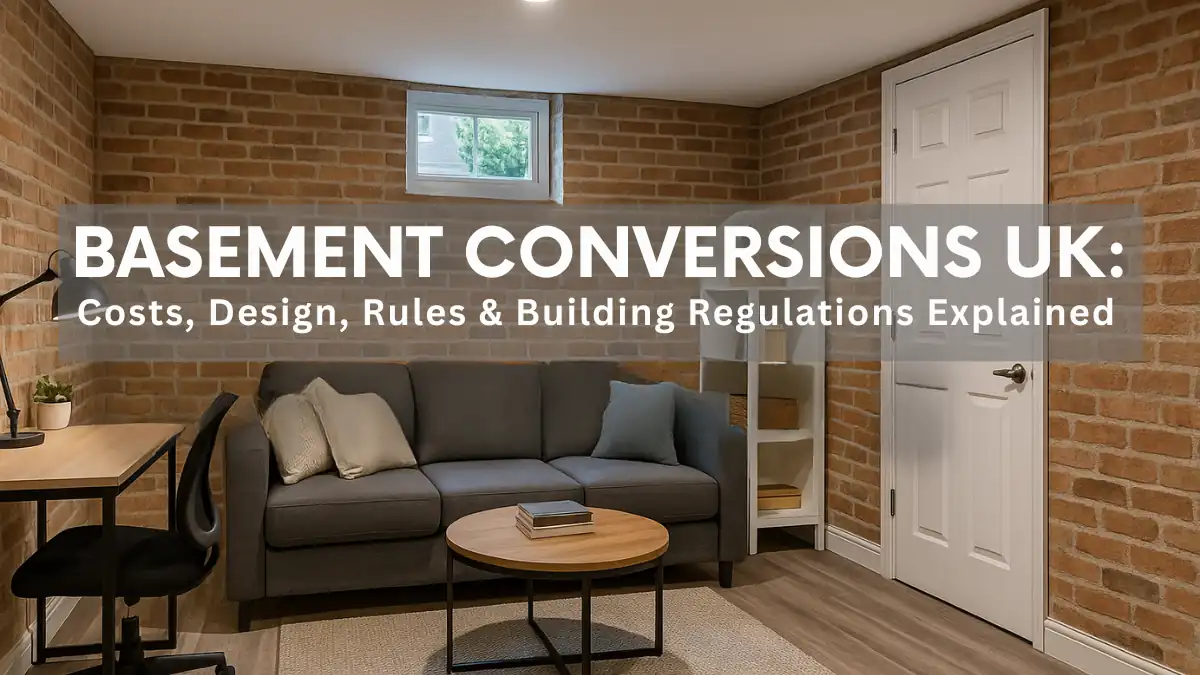
Thinking about unlocking the space under your home? A well-designed basement conversion can create high-quality accommodation without changing your roofline — ideal for dense urban plots or homes in conservation areas. This guide explains when planning permission is needed, what Building Regulations require (waterproofing, structure, fire safety, stairs, ventilation), realistic UK cost ranges, and how to go from idea → drawings → approvals → construction with minimum stress.
Note: This article focuses on England (Planning Portal / GOV.UK rules). Scotland & Northern Ireland differ.
Basement conversions at a glance
- What counts as a “conversion”? Turning an existing cellar or under-croft into habitable space (bedroom, office, playroom, gym, cinema). Digging out to increase headroom is common.
- Why choose a basement? Preserve your garden, keep the street scene unchanged, and add usable floorspace where roof or side extensions aren’t ideal.
- Complexity: Basements demand careful design: waterproofing, structure, drainage, ventilation and fire escape all matter more than in above-ground work.
Do you need planning permission for a basement conversion?
Many internal basement conversions (no change to external appearance) can be done without planning permission. However, situations that often do need permission include:
- Lightwells, grilles or external stairways visible from the street
- New front lightwell covers affecting the façade
- Excavation that alters the building’s footprint or affects neighbouring structures
- Listed buildings and many conservation areas
When in doubt, your safest route is a quick feasibility check and, if needed, a formal application. Start with our main Planning Permission (UK) guide and, for regional flavour, see an example local page like Planning Permission Buckinghamshire.
Useful official references: the Planning Portal and GOV.UK.
Building Regulations for basements: what matters
Basements are governed by the same Building Regulations as the rest of the home, but key Parts bite harder below ground. Expect Building Control to focus on the following:
1) Waterproofing & moisture management
- Type A (barrier/tanking): cementitious or liquid membranes applied to walls/floor.
- Type B (integral): waterproofed concrete structure.
- Type C (drained cavity): cavity drain membranes + perimeter channels to a sump pump.
Note: Many domestic projects combine methods (e.g., Type B + Type C). A specialist design, warranty and maintenance plan is strongly advised.
2) Structure & excavation
- Temporary works/underpinning design to protect your home and neighbours.
- Steel beams, retaining walls, and excavation sequencing require structural calculations.
- Party Wall matters may apply where works affect shared or adjoining walls.
3) Fire safety & safe escape
- Provide a protected escape route to a final exit (often via hallway and ground-floor door).
- Where bedrooms are in the basement, consider secondary means of escape (e.g., egress-size window/lightwell or compliant corridor route).
- Interlinked, mains-powered smoke/heat alarms across storeys.
- Fire-resisting doors and linings as required by the design.
4) Minimum ceiling height & headroom
No single universal minimum is set in the regs, but comfort/liveability typically means ~2.3–2.4m finished height for habitable rooms. Where lower, Building Control will check that rooms still provide reasonable amenity and ventilation; dig-down is common to achieve this.
5) Ventilation & air quality
- Background + extract ventilation sized to room use (e.g., kitchens, baths, utility).
- MVHR or continuous mechanical extract can help in lower-ground spaces.
6) Thermal performance, heating & insulation
- Insulate floors, walls and ceilings to meet Part L targets; avoid interstitial condensation via correct build-ups and vapour control.
- Underfloor heating is popular; check heat-loss calculations and controls.
7) Drainage & foul water
- Fixtures below external manhole levels usually need a lifting station (pump).
- Back-up power/alarms for pumps are advisable.
- If building over or within 3m of a public sewer, see Building Over Sewers.
For the inspection journey, read Building Control Inspections – What to Expect and our overall Building Regulations (Homeowner Guide).
Basement conversion costs & timescales (UK)
Want to compare other routes? See House Extensions (Complete UK Guide), Loft Conversions (UK), and our Extension Costs overview.
Design, waterproofing & finishes
Lightwells, windows & natural light
- Front lightwells may need planning; discreet grilles to pavements require careful detailing and permissions.
- Rear/side lightwells with guarding improve daylight and offer escape options.
Waterproofing strategy
We’ll coordinate a waterproofing design (often Type C drained cavity with pump) and integrate insulation, vapour control and finishes so the whole build-up works as a system.
Stairs, doors & layout
- Compliant stair pitch and headroom; fire-resisting doors where required.
- Sensibly zoned rooms: sleeping spaces near escape routes, noisy rooms isolated.
Finishes & acoustics
Plasterboard lining on battens or independent stud walls can help achieve a flat finish and integrate services. Add acoustic insulation to ceilings if living spaces are above.
Drainage, ventilation, electrics & heating
- Foul drainage: lifting station + backflow protection, with alarms & maintenance access.
- Surface water: perimeter channels to sump (for Type C), with accessible inspection points.
- Ventilation: mechanical extract for wet rooms; background supply air; consider MVHR.
- Electrics: damp-rated fittings where appropriate; RCD protection; careful routing to avoid membranes.
- Heating: underfloor heating or radiators sized via heat-loss calcs.
Step-by-step: how to get a basement conversion approved
| Stage | What happens | Who’s involved | Key outputs |
|---|---|---|---|
| 1) Feasibility | Site check, constraints, budget reality check, lightwell options. | PME designer, homeowner | Feasibility notes, outline sketch, cost range |
| 2) Surveys | Measure, drain/level checks; ground investigation if needed. | Surveyor, ground specialist | Measured survey, ground report (where required) |
| 3) Scheme design | Layouts, stairs, escape routes, lightwells; waterproofing concept. | PME designer, homeowner | Plan/elevation/section drawings |
| 4) Planning (if needed) | Householder/full application or lawful development route. | PME, LPA | Decision notice or certificate |
| 5) Technical design | Structural calculations, details, specification; waterproofing design. | PME, structural engineer, waterproofing specialist | Building Regs drawing set + calcs |
| 6) Building Control | Submit for approval and agree inspection plan. | PME, Building Control | Plans approval or conditional approval |
| 7) Construction | Excavation, structure, membranes, services, finishes. | Main contractor + specialists | Inspections at foundations/structure/waterproofing/drainage & completion |
| 8) Handover | Final snag, O&M/manufacturer warranties, pump maintenance instructions. | Contractor, homeowner | Completion certificate |
Not sure if your idea fits Permitted Development?
We’ll check your project against PD rules and let you know if you need a full planning application.
Pitfalls & gotchas to avoid
- Headroom miscalculations: Finish build-ups (slab membrane + insulation + screed + flooring + ceiling) quickly eat height.
- Under-spec’d pumps/drainage: Fit alarms and battery back-up; plan for maintenance.
- Ignoring neighbouring structures/party walls: Underpinning and sequencing matter. Protect your neighbours and yourself.
- Fire escape assumptions: Bedrooms need robust escape planning; don’t rely on non-compliant windows.
- Lightwell safety: Guarding heights/loads and drainage must be designed.
Read our guides to Planning Permission Timelines and Inspections so you sequence decisions correctly.
Basement vs Extension vs Loft — quick comparison
| Option | Best for | Planning visibility | Complexity | Typical UK cost |
|---|---|---|---|---|
| Basement conversion | Urban plots, keep garden, street scene unchanged | Low external impact (lightwells may need consent) | High (waterproofing, structure, drainage) | £1,500–£4,000+ per m² |
| Rear/side extension | Open-plan living, garden access | Moderate to high (façade massing visible) | Medium | See Extension Costs |
| Loft conversion | Extra bedrooms/bathroom under roof | Moderate (dormers visible) | Medium | See Loft Conversions (UK) |
Local council quirks (England-wide notes)
- Conservation areas & listed buildings: expect tighter controls on front lightwells and façade changes. See Conservation Areas and Listed Buildings.
- Urban centres (e.g., London boroughs, Manchester, Leeds): stricter design guidance for street safety, drainage and heritage settings.
- Flood risk zones: drainage strategy and pump reliability are scrutinised.
- Public sewers: building over/near needs formal approval — read Building Over Sewers.
Basement Conversion FAQs
How much does a basement conversion cost in the UK?
For an existing cellar with minimal dig, allow £1,500–£2,500/m². With dig-down/underpinning or complex waterproofing, expect £2,200–£4,000+/m². Professional fees add ~10–18%. London often carries a premium.
Do basement conversions add value?
Good basements add high-quality, flexible space without losing garden area. Value uplift depends on location, quality, and usability (headroom, light, layout). In dense urban markets they can be very attractive.
Do I need planning permission?
Internal conversions often don’t, but lightwells, external stairs, façade changes, listed buildings, and conservation areas commonly do. Check our Planning Permission Guide or ask us to review your address.
What ceiling height do I need?
A comfortable target is ~2.3–2.4m finished. If lower, Building Control will consider amenity and ventilation; many projects dig down to improve headroom.
Which waterproofing system is best?
Many homes use a Type C drained cavity with sump & pump because it’s maintainable. In new or heavily rebuilt structures, a Type B integral solution may be combined with Type C. Always use a specialist design and keep access for maintenance.
Can I put a bedroom in the basement?
Yes, but you must provide a compliant escape route and consider a secondary means of escape (e.g., egress-size window via a lightwell). Fire doors, alarms, and smoke control are part of the design.
How long does a basement conversion take?
On-site works typically run 8–20+ weeks depending on dig-down and complexity. Add design, approvals and procurement time beforehand.
Can I DIY a basement conversion?
Basements are expert territory. Waterproofing design, structural sequencing and drainage are critical — mistakes are costly. DIY is not advised beyond finishes; use a qualified team.
Will Building Regulations apply even if I don’t need planning?
Yes. All habitable basements must comply with the Building Regulations. We usually recommend the Full Plans route for clarity.
What inspections should I expect?
Typical stages include excavation/structure, waterproofing readiness, drainage/pump installation, insulation/first fix, and completion. See Building Control Inspections.
Want a quick feasibility review?
Share your address and aim. We’ll advise on planning risk, headroom options, and budget fit.
Next steps & useful guides
- Planning Permission (UK): Complete Homeowner’s Guide
- Building Regulations: Complete Homeowner’s Guide
- Building Control: What It Is & When You Need It
- Building Control Inspections – What to Expect
- Structural Calculations: When Do You Need Them?
- Loft Conversions (UK) — Costs, Process & Council Quirks
- House Extensions – Complete UK Guide
- Extension Costs (UK): What to Budget
- Conservation Areas: Rules, Consent & What You Can Do
- Listed Buildings: What You Must Know
- Building Over Sewers (UK) – Permissions & Surveys
- Planning Permission Timelines (UK): Key Stages & Limits
Official references
Ready to move your project forward?
Plans Made Easy can prepare compliant plans, manage submissions, and guide you from idea to approval.
Performance Verified ✅
This page meets PME Optimisation Standards — achieving 95+ Desktop and 85+ Mobile PageSpeed benchmarks. Verified on

