
Share this post:
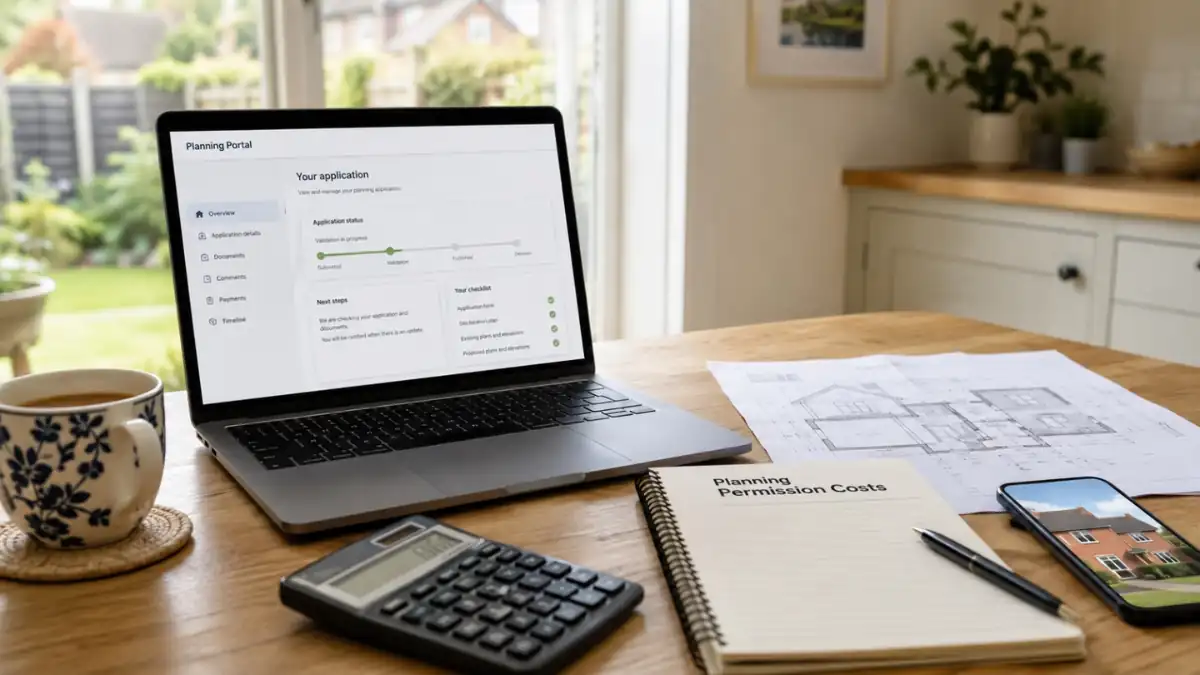
Quick summary: Planning Permission Costs
Most homeowners searching Planning Permission Costs are really trying to budget for the whole “getting approved” stage — not just one fee.In England, the council’s householder planning application fee is nationally set (and depends on what you’re building), but your true budget usually also needs to cover drawings, surveys (sometimes), and Building Regulations.
- Council fee (typical householder): a fixed national fee in England for an extension/alterations to a single home (check the latest fee schedule).
- Planning drawings: often the biggest “hidden” cost for homeowners — especially if you need measured surveys or multiple design revisions.
- Extra reports: only where needed (e.g., trees, heritage, ecology, drainage) — but they can change your budget quickly.
- Building Regulations: separate approval route with its own drawings and checks (usually essential even when planning isn’t).
The safest way to budget is to treat Planning Permission Costs as a stack of costs — and confirm early whether you need full planning, Permitted Development, or a Lawful Development Certificate.
Not sure what you actually need to pay for?
Tell us what you’re planning and we’ll help you map the likely costs — council fees, drawings, and any “extra” reports — before you commit.
Quick summary: Planning Permission Costs
Planning Permission Costs aren’t usually just one fee. For most homeowners, the council’s application fee is only one part of the spend.The bigger budgeting picture often includes drawings, any required surveys/reports, and Building Regulations preparation.
If you budget like a pro from day one, you reduce the chance of delays, redesigns, or paying twice because the first submission wasn’t “validation-ready”.
Planning Permission Costs: what you’re really budgeting for
When homeowners Google Planning Permission Costs, they often want a simple figure.However, in real projects, “planning costs” usually means a bundle of costs that sit around the planning application — and some of them only show up once you’re already underway.
For most householder projects (extensions, loft conversions, garage conversions, outbuildings), your overall Planning Permission Costs budget usually includes:
- Council planning application fee (the statutory fee for the application type).
- Planning drawings (existing + proposed plans/elevations, site/location plans, and sometimes sections).
- Measured survey (often essential for accurate drawings, especially in older homes).
- Optional but common add-ons (design options, 3D visuals, neighbour-friendly adjustments).
- Specialist reports (only where needed: trees, heritage, ecology, drainage, transport, etc.).
- Building Regulations (separate approval route with separate drawings/fees).
Quick costs snapshot: Planning Permission Costs (homeowner view)
- Council fee: varies by application type — use the Planning Portal fee schedule/calculator to confirm your exact fee.
- Planning drawings: commonly a few hundred to a few thousand depending on complexity, survey needs and revisions.
- Specialist reports: only when triggered by your site/context — but can be a meaningful extra line in the budget.
- Building Regulations: usually a separate stage with its own drawings and approval fees.
If you apply online, Planning Portal notes there may be an additional service charge for applications over a threshold — so it’s worth checking what applies to your submission route before you budget. (Also: fees change over time, so always confirm the current figure.)
Planning Permission Costs vs Building Regulations vs Permitted Development
One reason Planning Permission Costs feel confusing is that homeowners lump three different things together.If you separate them early, your budget becomes much easier to control.
Planning permission (the “is it acceptable?” decision)
- Assesses whether the proposal is acceptable in principle (appearance, neighbours, streetscene, policy).
- Usually needs clear existing/proposed drawings and the right plans at the right scales.
- Has a statutory application fee (varies by application type).
Permitted Development (often no planning application — but still rules)
- Some projects don’t require planning permission if they meet Permitted Development limits and conditions.
- You may still want drawings for builder pricing and clarity.
- Many homeowners apply for a Lawful Development Certificate for certainty (it has a fee and evidence requirements).
Building Regulations (the “is it safe and compliant?” approval)
- Checks structure, fire safety, insulation/energy, drainage, ventilation, stairs and more.
- Usually required even when planning isn’t.
- Often needs more detailed drawings/specs than planning.
Application types that affect Planning Permission Costs
The council fee and supporting documents depend on what you’re applying for. Here are the most common homeowner-related routes we see:
Householder planning application
Typically used for extensions and alterations to a single dwelling (not flats). England’s typical householder fee is published by Planning Portal and should be checked against the current fee schedule before submission.
Full planning application (non-householder)
Used for changes that don’t fit “householder” rules (for example, some changes of use, development involving flats, or more complex proposals).Fees can differ substantially from a householder application.
Lawful Development Certificate (LDC)
Often used to confirm a project is lawful under Permitted Development (or that existing works/use are lawful).It’s a separate application route with its own evidence requirements and a fee.
Other common homeowner consents
- Listed Building Consent (if your home is listed) — planning fees and rules behave differently and you may need specialist drawings.
- Works in conservation areas — you may face tighter design expectations and sometimes extra supporting information.
- Discharge of conditions / variation of conditions — can add time and cost after permission is granted.
What’s included (and what’s not) when people quote “planning costs”
When a homeowner hears “it’ll cost £X to do planning,” that quote might mean very different things.To avoid budget surprises, make sure you know what’s included.
Usually included in a planning drawing + submission service
- Existing and proposed floor plans + elevations (and sometimes sections/roof plans).
- Site/block plan and location plan at the correct scales.
- Preparing and submitting the application as your agent.
- Responding to basic planner queries during the process.
Often not included (but commonly needed)
- Multiple design options and major redesign rounds.
- Specialist reports (trees, ecology, heritage statements, drainage, etc.).
- Building Regulations drawings and structural calculations.
- Party wall matters (separate legal process) and neighbour agreements.
Typical cost ranges & timelines for homeowners
While every project is different, most homeowners can budget more confidently by splitting Planning Permission Costs into three buckets:(1) statutory fees, (2) drawings/design, and (3) “only-if-needed” reports.
1) Statutory fees (paid to the council / via the application service)
- Fees are set by application type and are published via Planning Portal and GOV.UK guidance.
- The safest approach is to confirm the exact fee using the Planning Portal fee calculator and/or your council’s planning pages before you submit.
2) Drawings and planning support (paid to your designer/agent)
This is where most homeowner budgets vary. A simple, well-scoped extension on a straightforward house is cheaper to draw and justify than a complex remodel in a sensitive location.
- Lower end: small/simple proposals with minimal design iterations.
- Middle band: typical single-storey extensions, loft conversions and garage conversions.
- Upper end: complex layouts, tricky sites, conservation constraints, or multiple revisions.
3) Specialist reports (only when triggered)
These don’t apply to every home. However, if your site triggers them, they can be a significant part of Planning Permission Costs.
- Ecology: sometimes needed where protected species/habitats may be affected.
- Trees: if there are TPO trees or constraints nearby.
- Heritage: listed buildings or sensitive conservation contexts.
- Drainage/flood: where local risk or policy requires extra detail.
Step-by-step: how to budget before you apply
Here’s a practical process we recommend to homeowners who want to control Planning Permission Costs without cutting corners.
HowTo checklist: budgeting your Planning Permission Costs
- Define the project clearly. What are you building, and what problem are you solving (space, layout, light, bedrooms)?
- Confirm the route. Is it likely to be planning permission, Permitted Development, or PD + Lawful Development Certificate?
- Check constraints early. Conservation area, listed building, TPO trees, Article 4 directions, flood risk — these can change costs.
- Decide what you need drawings for. Planning only, or also Building Regulations and builder pricing?
- Get a measured survey (if needed). Particularly important for older homes or where accuracy matters.
- Price the “full stack”. Council fee + drawings + any likely reports + Building Regulations stage.
- Build in contingency. Allow a buffer for revisions, extra drawings, or a report that becomes necessary.
- Plan the timeline. Validation, consultation, decision period, and any post-permission conditions.
Not sure if your idea fits Permitted Development?
We’ll check your project against PD rules and let you know if you need a full planning application.
Pitfalls & gotchas that make Planning Permission Costs jump
Most “budget blow-ups” happen for predictable reasons. If you know them upfront, you can plan around them.
Common cost triggers
- Starting drawings from guesswork (no measured survey) → revisions later.
- Unclear scope (extensions evolve mid-design) → extra design rounds.
- Constraints discovered late (trees, heritage, neighbours, flood risk) → new documents required.
- Confusing planning with Building Regulations → paying twice for drawings.
- Underestimating post-permission tasks (conditions, Building Control submissions) → more fees later.
Local council quirks (why two similar homes can pay different “real world” costs)
Even with national fee structures, councils differ in what they expect to validate quickly.Some are comfortable with minimal drawings; others expect clearer sections, materials notes, and more context.
This is why a “cheap” plan service can end up costing more — if it doesn’t meet what your local case officer expects first time.
Technical details that affect Planning Permission Costs (but homeowners often miss)
These are the details that don’t sound expensive — until they delay validation or trigger a redesign.
Drawings at the right scale and standard
- Accurate site boundaries, correct scale bars, clear labels and dimensions.
- Existing vs proposed information presented consistently.
- Enough context for neighbours and streetscene where relevant.
Evidence for Lawful Development Certificates
- PD compliance is about meeting the limits and conditions — the evidence needs to be strong.
- If the evidence is weak, the certificate can be refused even if the idea is “probably OK”.
Related comparisons (quick clarity before you spend)
- Planning permission vs Permitted Development: one needs an approval decision; the other needs strict compliance.
- Planning drawings vs Building Regulations drawings: planning is “principle + appearance”; building regs is “how it’s built safely”.
- Householder vs full application: the route affects the fee and the documents required.
FAQs: Planning Permission Costs
How much does planning permission cost in the UK?
The council fee depends on the application type and where you live in the UK. In England, many common fees are nationally set and published via Planning Portal and GOV.UK guidance.For a typical householder application (single dwelling), Planning Portal publishes the current figure and provides a fee calculator to confirm the correct amount for your scenario.
Does applying for planning permission cost money even if it’s refused?
Yes. The application fee is for the council’s assessment process, not a “success fee”.That’s why it’s worth investing in clear drawings and a sensible strategy upfront — it reduces the risk of refusal and costly redesign.
Is planning permission free for any homeowner projects?
Some projects don’t require planning permission because they fall under Permitted Development. However, that doesn’t mean your project is “free” —you may still pay for drawings, and many homeowners choose a Lawful Development Certificate for peace of mind (which has its own fee).There are also certain exemptions/reductions in specific circumstances (set out in the fees regulations/guidance).
How much does planning permission cost for an extension?
Extensions to a single house commonly fall under a householder application (if planning is needed). The council fee is only one part of the budget.Most homeowners should also allow for planning drawings, possible measured surveys, and then Building Regulations drawings/approval once planning is secured.
How much does it cost to object to a planning application?
Submitting an objection or comment to your local council is generally free for members of the public.The key is to focus on valid planning considerations (e.g., overlooking, daylight, parking, design/policy), not private disputes.
What are retrospective planning permission costs?
Retrospective applications can involve the same kinds of fees and drawing requirements as a normal application — and they can become more expensive ifyou need additional evidence, revisions, or professional support to resolve issues raised by enforcement.If you’re in this position, getting advice early can prevent the problem escalating.
Do I need a planning permission fees calculator?
It’s a smart idea. Fees change and depend on application type, so using an official fee calculator helps avoid underpaying (which can delay validation).Planning Portal provides a fee calculator for England, and your council will confirm the fee during validation.
Want us to sense-check your likely costs?
We’ll help you work out what you’ll actually need to budget for — and what you can probably avoid paying for.
Next steps & useful guides
If you’re budgeting the whole project (not just the application stage), these guides are usually the next helpful step:
- Your full extension budget guide (pillar)
- A practical overview of how planning works for homeowners
- A quick checklist to confirm whether you need to apply
- What drawings and documents councils typically expect
- What’s normally included in an extension drawing set
- What you need for Building Regulations approval
- What most homeowners missThe council fee is only one line — drawings, surveys and Building Regulations can be a bigger part of the total budget.
- Best budgeting approachSplit costs into: (1) statutory fees, (2) drawings/agent support, (3) only-if-needed reports.
- Biggest cost driverProject complexity + number of revisions (often affected by late constraint discoveries).
- Common “hidden” extrasMeasured survey, extra drawings/sections, specialist reports, and post-permission conditions/discharge.
- Key risk to avoidSubmitting without a validation-ready pack — delays can cost money and momentum.
- Fastest way to reduce riskConfirm the route (planning vs PD + certificate) and use clear, accurate drawings from the start.
Want a realistic budget for your home? Ask Plans Made Easy to map your likely costs before you apply.
How Plans Made Easy can help
Planning Permission Costs feel stressful when you don’t know what’s essential and what’s optional.The good news is: once you pick the right route and prepare the right submission pack, you can usually keep costs proportionate — and avoid expensive surprises.
Our team helps homeowners prepare clear, compliant drawings, choose the right approval route, and manage submissions smoothly.If you want a calm, honest view on what your project is likely to cost at the planning stage, we’re happy to help.
Official guidance & fee tools
For the latest official rules, fee schedules and calculators, start here:
- Planning Portal – national planning guidance and application information
- GOV.UK – when you need planning permission (England & Wales)
- GOV.UK – official guidance on planning application fees (England)
- Planning Portal – typical costs and the official fee calculator
Ready to move your project forward?
Plans Made Easy can prepare compliant plans, manage submissions, and guide you from idea to approval.
Performance Verified ✅
This page meets PME Optimisation Standards — achieving 95+ Desktop and 85+ Mobile PageSpeed benchmarks. Verified on

