
Share this post:
Quick summary: Extensions for length
If you’re researching extensions for length, what you’re really trying to pin down is: how far your home extension can project before you trigger planning permission or run into practical build limits.
- “Length” usually means projection (how far it sticks out from the original rear wall), not just overall size.
- Permitted Development may apply for some homes, but it depends on your property type, location, and whether your rights are restricted.
- Even when planning isn’t needed, you’ll still need Building Regulations compliance and good-quality drawings for quotes and buildability.
- Small changes can have big impacts — drainage, neighbours, daylight and boundary rules often shape the “maximum” more than you expect.
In this guide, we’ll explain what “length” means in UK home extensions, how councils usually assess it, and how to plan a sensible projection that avoids delays and redesigns.
Not sure how far you can extend without trouble?
Tell us your postcode and a rough sketch, and we’ll sense-check what extension “length” is realistic for your home — and whether Permitted Development is likely to apply.
Extensions for length: what does “length” actually mean for a home extension?
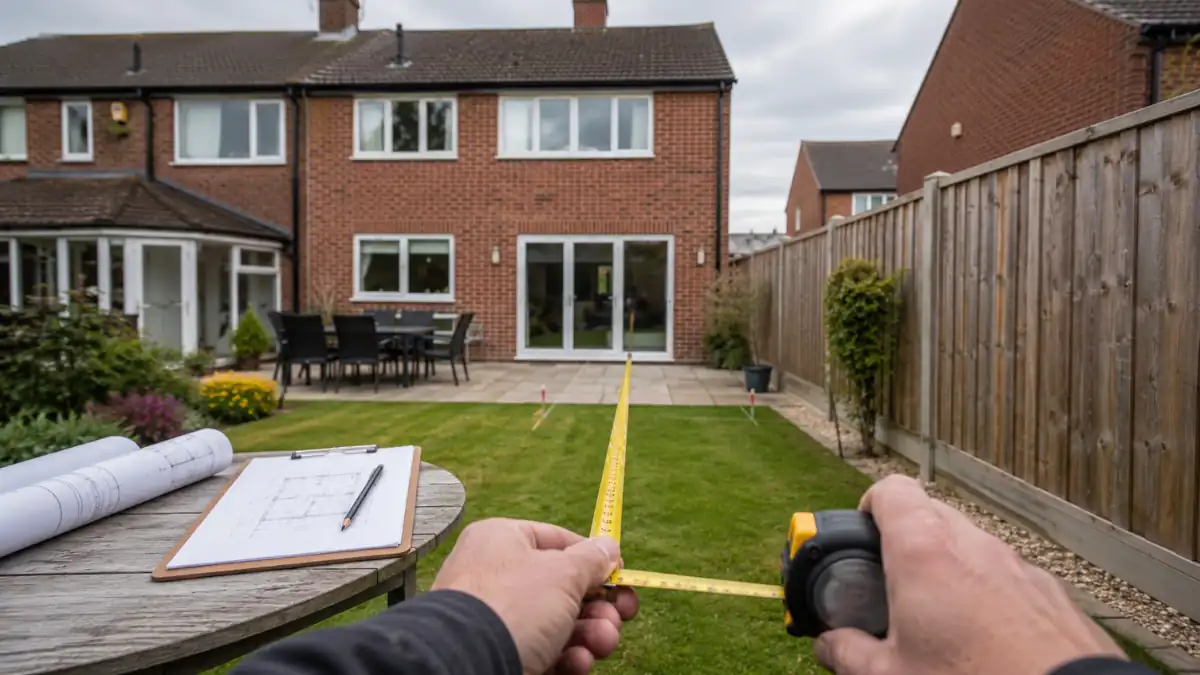
The phrase extensions for length gets searched a lot, but in UK home improvement terms it usually means one thing:how far your extension projects outwards from the “original” house.
Most homeowners are thinking about a rear extension. In that case, “length” is typically the rear projection — the distance from the original rear wall to the new rear wall.However, on side returns and wraparounds, you can end up dealing with multiple projections (rear + side), which is where people get caught out.
Length vs overall size
It’s also worth separating “length” from overall floor area. A shallow extension that is wide can add a lot of space, while a very deep extension may feel dark and awkward unless the layout is planned carefully.In other words, length is only one part of the design.
Extension length vs width vs height: what really limits you?
If you’re trying to maximise space, you’ll usually be balancing three things:projection (length), width, and height. In practice, your “maximum” is often set by constraints, not ambition.
1) Neighbours and daylight
- Longer projections can increase overshadowing risk.
- Side extensions can affect light to windows and boundary relationships.
- Even if planning isn’t required, a poor layout can still lead to neighbour disputes.
2) Drainage, manholes and buildability
A common practical limit is what’s under the ground. If a longer extension crosses drains, manholes, or shared sewers, you may need redesign, build-over agreements, or structural changes.This is one reason we always recommend getting a proper measured survey and checking services early.
3) Roof form and internal layout
The longer the extension, the more careful you need to be with roof design (especially at junctions), structure, and ventilation.This is where your designer earns their keep — a long extension can be brilliant, but it has to be coherent.
Do you need planning permission for extension length, or can Permitted Development apply?
For many homeowners, the main question behind extensions for length is: “Can I do this without planning permission?”The honest answer is: sometimes — but it depends on your property and constraints.
When Permitted Development may apply
Many houses (not flats) can carry out certain extensions under Permitted Development (PD), provided you meet the relevant limits and conditions.If you’re unsure, start with our homeowner guides on:planning permission andwhether you need planning permission.
When planning permission is more likely
- Your home is a flat/maisonette (PD rules are different and far more limited).
- You’re in a conservation area or have restrictions that affect external works.
- You want a very long projection or a wraparound that significantly changes the appearance.
- Your proposal raises neighbour impact concerns (loss of light/overbearing).
If your goal is a longer extension but you’re near the edge of what’s acceptable, it often helps to align your design with local expectations and policy.That’s one reason our main pillar guide exists:House Extensions – Complete UK Guide (Planning, Costs, Council Quirks).
What you’ll need to prove extension length (drawings, measurements and details)
Whether you pursue planning permission or rely on PD, you still need to be clear about the extension length on paper.At a minimum, most successful projects use a consistent drawing pack showing existing and proposed layouts and elevations.
Typical drawing “must-haves”
- Existing and proposed floor plans with key dimensions (so projection is unambiguous).
- Existing and proposed elevations (to show how the new rear wall sits).
- Site/block plan (boundaries, distances, and relationship to neighbours).
- Sections where needed (especially when depth + roof form could affect height/appearance).
If you want a deeper explanation of what a good set looks like, these guides help:extension drawings explained andplans for Building Regulations.
Costs & timelines: how extension length affects the real-world project
Longer extensions can increase cost, but not always in a straight line. The main drivers are usually:foundations, structure, glazing strategy, roof complexity, and services.
Quick costs snapshot: what changes when you increase the length?
- Foundations & structure: deeper extensions often mean more groundworks and steelwork (especially in open-plan rear layouts).
- Roof and drainage: longer runs can require more complex falls, gutters, and downpipe locations.
- Services relocation: boilers, radiators, soil stacks, and drains often need moving.
- Design time: the closer you push limits, the more iterations are needed to keep it compliant and buildable.
For a fuller budget picture (beyond “length”), see our guide to planning permission costs.
Timelines: where length adds time
- Pre-design checks: drains, boundaries, and existing constraints can add survey time.
- Planning route: if you need planning permission, the decision process can add weeks/months to your programme.
- Build phase: longer extensions typically mean more trades, longer lead times, and more snagging.
Not sure if your idea fits Permitted Development?
We’ll check your project against PD rules and let you know if you need a full planning application.
Step-by-step: choosing an extension length that’s realistic (and approvable)
If you want extensions for length that genuinely improve your home (rather than creating a dark space and planning stress),follow a simple, sensible process.
HowTo checklist: decide your extension “length” with confidence
- Define the purpose first. Dining? Family room? Bigger kitchen? The “right” projection depends on the layout you need.
- Mark your constraints. Boundaries, neighbour windows, drains/manholes, and any trees/levels that affect buildability.
- Decide your comfort zone. A shorter projection with better design can outperform a longer, awkward footprint.
- Check your likely consent route. Read our planning permission guide and confirm whether PD might apply for your home.
- Get a measured survey. Accurate existing drawings prevent costly redesign later.
- Draft two options. One “ideal” and one “safer” option — so you can adjust if planning/constraints bite.
- Plan the daylight strategy. Rooflights, glazing proportions, and internal zoning make or break longer extensions.
- Think ahead to Building Regs. Longer extensions often need structural detail and insulation upgrades; see Building Regulations plans.
Pitfalls & gotchas with extension length (what homeowners commonly miss)
Other common issues
- Over-deep, under-lit layouts: a long extension can feel like a corridor unless you plan light and zoning.
- Ignoring side impacts: longer projections near a boundary can increase neighbour sensitivity.
- Drainage surprises: building over drains or moving inspection chambers late in the project can be expensive.
- Missing the “paper trail”: skipping a lawful development check can cause headaches at sale time.
Technical details that can limit how far you can extend
Even before you hit planning constraints, “how far” can be capped by construction realities.In longer extensions, we commonly see:
- Structure: steel beams for open-plan rear walls and larger openings.
- Thermal performance: insulation targets (Part L) and detailing at junctions.
- Fire safety: means of escape and any impacts to open-plan arrangements (Part B).
- Ventilation: longer footprints can need better extract strategy (kitchens/living zones).
Related comparisons: is “more length” always the best way to add space?
Often, homeowners assume more projection is the only solution. In reality, you may get a better outcome by balancing:
- Length vs width: a slightly shorter but wider extension can feel more generous.
- Length vs layout: better zoning (kitchen/dining/living) can outperform a deep, single-use room.
- Length vs light: rooflights and glazing proportions are crucial for longer footprints.
Local council quirks: why “maximum length” isn’t universal
Councils vary in how they interpret impact, design, and neighbour relationships. Two streets can receive different outcomes depending on:
- the pattern of development (what’s already been approved nearby),
- whether your home is in a constrained area (conservation/heritage),
- and how close your proposal is to boundaries and neighbour windows.
If you want a joined-up view of these issues, our main extension guide is the best starting point:House Extensions – Complete UK Guide (Planning, Costs, Council Quirks).
FAQs: Extensions for length
What does “extensions for length” mean in home improvement terms?
For UK homeowners, it usually means the projection of an extension — how far it extends out from the original rear (or side) wall.It’s often discussed alongside width and height, because those three dimensions together shape both planning impact and buildability.
Can I do an extension “length” increase without planning permission?
Sometimes. Many houses can extend under Permitted Development, but eligibility depends on your property type (houses vs flats),location (for example conservation areas), and whether your PD rights have been restricted. If you’re unsure, use our guides onwhether you need planning permission andhow planning permission works.
How is the “length” measured — from my current wall or the original house?
In many cases, rules and assessments reference the original house. That’s why previous extensions can reduce what’s possible next.A measured survey and clear existing/proposed drawings are the safest way to avoid confusion.
Do I still need Building Regulations if planning permission isn’t needed?
Yes, in most cases. Planning and Building Regulations are separate. Longer extensions often involve structure, insulation, ventilation and drainage considerations.Our guide to Building Regulations plans explains what’s typically required.
What’s the safest way to avoid problems when pushing extension length?
Start with a measured survey, confirm constraints (drains, boundaries, neighbour windows), and develop two options: an ideal layout and a “safer” fallback.If you’re staying within PD, many homeowners also apply for a Lawful Development Certificate for peace of mind.
Want a quick yes/no on your extension length?
We’ll review your rough measurements and constraints and tell you the most sensible route — PD, lawful development, or a planning application.
Next steps & useful guides
If you’re refining how far to extend, these guides will help you plan the whole project (not just the “length”):
- House extensions: planning, costs, and common council issues
- Planning permission explained for homeowners
- Do I need planning permission? (homeowner checklist)
- Extension drawings: what’s included and why they matter
- Plans for Building Regulations: what you need and when
- Planning permission costs: what to budget for
- What “length” usually meansThe projection of the extension from the original wall line (often the rear wall).
- Planning vs PDSome homes can extend under Permitted Development, but it depends on property type, location, and restrictions.
- Biggest practical constraintsDrainage/manholes, neighbour daylight impact, boundary relationships, and roof/structure complexity.
- What helps avoid disputesClear drawings, a measured survey, and considering a Lawful Development Certificate where appropriate.
- Common mistakeMeasuring from the current wall, when rules/assessments may reference the original house.
- Non-negotiableBuilding Regulations often still apply even when planning permission doesn’t.
If you want a calm, clear answer on your project’s “length” limits, message Plans Made Easy here.
Official guidance (recommended)
For the safest, most up-to-date rules and application guidance, check:
- Planning Portal – national guidance on planning and home extensions
- GOV.UK – planning permission in England & Wales
- GOV.UK – Approved Documents (Building Regulations guidance)
- RICS – property and building guidance (costs and professional standards)
How Plans Made Easy can help
Getting extensions for length right isn’t about chasing a magic number — it’s about balancing projection, daylight, neighbour impact,and buildability so your extension feels great and stays on the right side of planning and Building Regulations.
Our team can prepare the drawings, advise on the best approval route, and manage submissions so your project moves forward smoothly — with fewer surprises.
Ready to move your project forward?
Plans Made Easy can prepare compliant plans, manage submissions, and guide you from idea to approval.

Performance Verified ✅
This page meets PME Optimisation Standards — achieving 95+ Desktop and 85+ Mobile PageSpeed benchmarks. Verified on

