
Share this post:
Quick summary: Building regulations on loft conversions
Building regulations on loft conversions apply to almost every loft conversion in the UK — even if you don’t need planning permission.In plain terms, Building Control will want to see that your new loft room is safe (fire escape, stairs, structure),warm (insulation and ventilation), and usable (headroom, doors and access).
- Yes, you usually need Building Regs for a loft conversion (and often for significant loft work).
- Fire safety + escape route is a big one: doors, alarms and protected stairway are common requirements.
- Stairs and head height can make-or-break whether a loft works as a compliant room.
- Insulation thickness matters — but it’s not just “stuff in more insulation”; you also need correct build-up and ventilation.
- Costs: you’ll pay for plans/technical detail and Building Control fees (plus structural calculations in many cases).
If you’re unsure what route you need (Full Plans vs Building Notice), we can sense-check your project and advise what Building Control will expect.
Not sure what Building Control will ask for on your loft?
Tell us what you’re planning and we’ll outline the typical Building Regs requirements (and the easiest way to get approval).
Quick summary: Building regulations on loft conversions
Building regulations on loft conversions are mainly about safety, structure and energy performance.In practice, that means a compliant stair, a safe escape route, the right fire protection, suitable insulation/ventilation,and structural design that Building Control can sign off.
Overview: Building regulations on loft conversions (what homeowners actually need to know)
A loft conversion feels like “just adding a room”, but from a Building Control point of view you’re creating a new storey that people will sleep in,escape from in an emergency, and heat all winter. That is why Building Regulations apply.
The goal is simple: your loft conversion should be safe to use, safe to escape from, and built properly.If you get the basics right early, approvals are usually straightforward. If you leave them until the build has started, costs and stress tend to rise.
Key differences: planning permission vs Building Control for a loft conversion
We regularly see homeowners mix these up. They are different systems, run by different teams, and they look at different things.
Planning is about whether you’re allowed to build it
- Looks at size/shape, external appearance, neighbours and local policy.
- Some lofts fall under Permitted Development (especially simple rear dormers), but not always.
- Conservation areas, flats/maisonettes, and previous restrictions can change the answer.
Building Control is about whether it’s safe and compliant
- Looks at structure, insulation, ventilation, fire safety, stairs, electrics and more.
- Applies even when planning permission isn’t needed.
- Ends with a completion certificate (which matters for future sale and peace of mind).
Application types: Full Plans vs Building Notice for loft conversions
Most loft conversions go to Building Control using one of two routes. The best choice depends on complexity, build method, and how much certainty you want before work begins.
Full Plans (most common for loft conversions)
- You submit detailed drawings/specification before starting.
- Building Control reviews and comments upfront.
- You get clearer written approval, which reduces “surprise changes” on site.
Building Notice (sometimes used for simpler work)
- Less detail submitted at the start, with compliance checked as you build.
- Can work for straightforward jobs, but lofts often have too many moving parts (stairs, structure, fire upgrades).
- Risk: you only discover issues once work is underway.
What they include: the main loft conversion Building Regs requirements
While every house is different, Building Control tends to focus on a few core areas for loft conversions.Below is a homeowner-friendly overview of what usually matters most.
Structure (floors, beams and roof changes)
- Loft floors usually need strengthening (joists designed for storage are rarely enough for a room).
- Steel beams or engineered solutions are common, and calculations are often required.
- Openings for stairs affect structural layout, so they must be designed properly.
Fire safety and escape
- A safe escape route is often required from the new loft down to an external door.
- Fire protection upgrades may be needed on the stair enclosure and ceilings/walls.
- Smoke alarms (and sometimes heat alarms) are usually expected on each storey.
Thermal performance and ventilation
- Insulation upgrades are typically needed to meet modern standards.
- Ventilation must be designed alongside insulation to reduce condensation risk.
- Windows/rooflights can trigger safety glazing and means-of-escape considerations.
Stairs, headroom and safe access
- Stairs must be safe to use day-to-day (rise/going, handrails, guarding).
- Head height is a common pinch point — especially near the top/bottom of the stair.
- Landing space and door swings need careful thought for usability and compliance.
Quick costs snapshot (what homeowners usually budget for)
- Technical drawings/spec: commonly needed for a smooth Full Plans submission.
- Structural calculations: often required where beams/new floor structure are involved.
- Building Control fees: paid to the council or an approved inspector (varies by area and project size).
- Fire safety upgrades: can add cost if existing doors/alarms/linings need improvements.
If you want the “full picture” (beyond Building Control), our guide onoverall project costshelps you map out professional fees and approvals from start to finish.
Technical details: stairs, head height, fire doors and insulation (the big questions)
Building regulations loft conversion stairs (what typically catches people out)
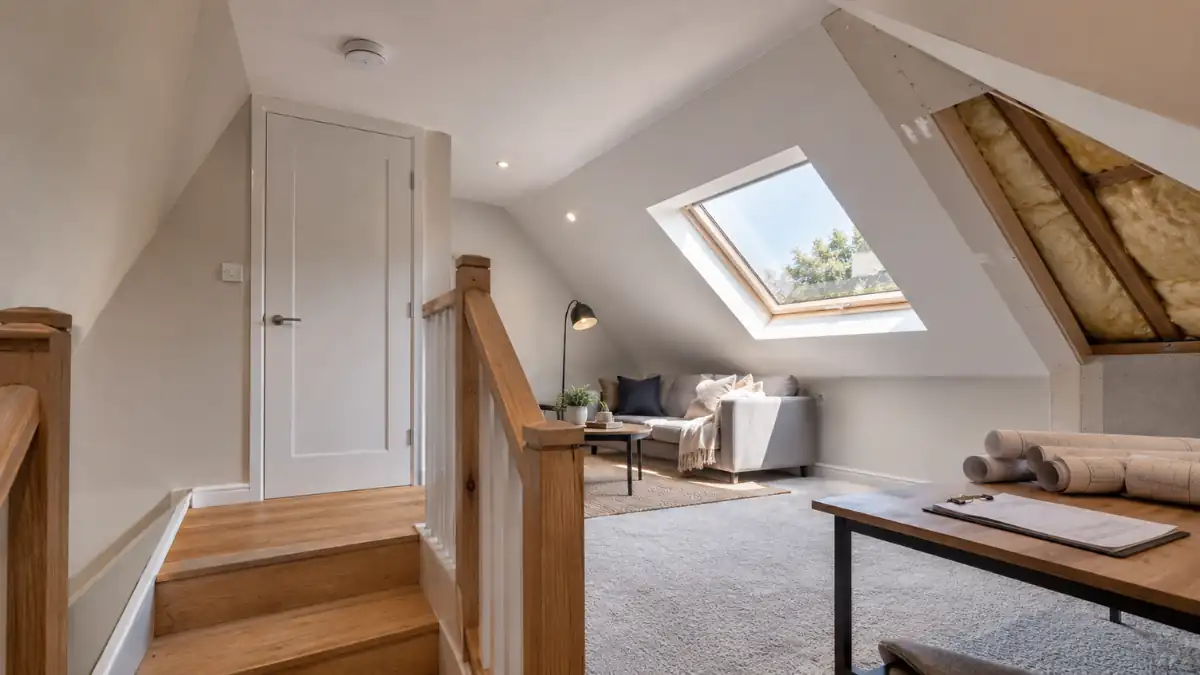
Stairs are often the hardest part to “make work” because they affect layout on the floor below as well as the new loft.A compliant stair normally needs good headroom, sensible pitch, and safe handrails/guarding.
- Where the stair starts can remove a surprising amount of space from a bedroom or landing below.
- Switching to a space-saver stair is not always acceptable for a main habitable room.
- Open-plan ground floors can complicate the protected escape route approach.
Building regulations loft conversion head height (what’s “enough”?)
Headroom rules are one of the most searched topics, and it’s easy to see why: older roofs, dormers, and stair openings can all reduce usable height.In practice, Building Control will focus heavily on headroom over the stairs and safe movement areas.
Building regulations loft conversion fire doors (do you need them?)
Fire doors are a common requirement, but not every home is identical. The usual principle is that the escape route down to the final exit is protected,which can mean upgrading certain existing doors (and sometimes adding self-closers, depending on the design approach).
- Some projects involve replacing a set of internal doors to improve fire resistance on the escape route.
- Interlinked alarms across storeys are typically part of the package.
- Existing layouts (especially open-plan arrangements) can change what’s needed.
Building regs loft conversion insulation thickness (why “thicker” isn’t the whole story)
Insulation is essential, but the correct build-up depends on your roof type (rafters, warm roof, cold roof), ventilation strategy,and how you’re finishing internally. If you only focus on “insulation thickness”, you can accidentally create condensation risk.
- Roof insulation usually needs a coordinated approach: insulation + ventilation + vapour control layers where appropriate.
- Dormer cheeks/roof and party walls (where relevant) should also be detailed properly.
- Windows/rooflights can trigger thermal and safety glazing considerations.
Want us to sense-check your loft layout for compliance?
We’ll review your stair position, escape route and insulation approach and tell you what Building Control is likely to expect.
Costs & timelines: how long Building Control takes (and what delays it)
Timelines vary by council and by how prepared your submission is, but the pattern is fairly consistent:clear drawings and a sensible technical approach reduce back-and-forth.
- Full Plans route: time upfront for drawings, then plan check and comments before you start.
- On-site inspections: staged visits during the build (structure, insulation, fire protection, completion).
- Completion certificate: issued when Building Control is satisfied the work complies.
Step-by-step: how to get Building Regs approval for a loft conversion
Here’s the process we recommend homeowners follow. It keeps things calm, avoids rework, and gives your builder clarity.
HowTo checklist (simple homeowner sequence)
- Confirm whether planning applies (especially if you’re adding a dormer or changing the roofline).If you’re unsure, start with this checklist.
- Measure the existing loft properly (head heights, roof shape, chimney positions, water tank locations).
- Fix the stair position early and test headroom/landing space on drawings.
- Agree a fire safety strategy (escape route, alarms, and any door upgrades) before construction starts.
- Design insulation + ventilation together to reduce condensation risk.
- Choose your submission route (Full Plans is usually best for loft conversions).
- Book inspections at the right stages so you don’t have to open up finished work later.
- Keep evidence (product specs, photos of hidden work, certificates) to support sign-off.
Pitfalls & gotchas: what causes loft conversions to fail Building Control
- Stairs squeezed in too late (leading to poor headroom or unsafe pitch).
- No clear escape route strategy (especially in open-plan layouts).
- Insulation added without ventilation detail (condensation and mould risk).
- Structural assumptions (existing joists/rafters not designed for a room).
- Missing certificates (electrical works, smoke alarm upgrades, glazing specs, etc.).
Related comparisons (common homeowner questions)
- Loft conversion under Permitted Development vs needing planning permission (rule-of-thumb: external changes and constraints matter most).
- Full Plans vs Building Notice (rule-of-thumb: loft conversions usually benefit from Full Plans).
- Basic storage loft vs a habitable loft room (the second triggers far more compliance requirements).
FAQs: Building regulations on loft conversions
Do loft conversions need building regulations?
In most cases, yes. Creating a habitable loft room nearly always brings Building Regulations into play, covering structure, fire safety,stairs, insulation and ventilation. Even where planning permission isn’t required, Building Control approval usually is.
Is it illegal to convert a loft without building regulations?
Carrying out notifiable building work without Building Control involvement can create serious problems later — especially when you sell,remortgage, or if there’s a safety incident. If work has already been done, speak to Building Control early about the options(often discussed as a regularisation process), because “hoping it’s fine” tends to backfire.
Converting loft without building control — what are the risks?
The biggest risks are hidden: inadequate structure, unsafe stairs, poor fire protection, and condensation problems from incorrect insulation.On the practical side, a missing completion certificate can delay or derail a sale and may reduce buyer confidence.
Building regulations loft conversion stairs: what does Building Control focus on?
Building Control will usually focus on safe access (stair geometry, handrails/guarding), headroom over key parts of the stair,and how the stair ties into the escape route. Stairs are also linked to layout below, so they need early design, not a last-minute squeeze.
Building regulations loft conversion head height: how do you know if your loft is workable?
The best way is to test it on a drawn section and stair layout early. Building Control tends to focus on safe movement on the stairsand practical usability. If height is tight, a dormer layout adjustment or stair position change can sometimes make the difference.
Building regulations loft conversion fire doors: are they always required?
Not every home is identical, but fire safety upgrades are very common. The typical aim is a protected escape route,which can involve upgrading certain doors and improving alarms. Layout matters a lot (for example, open-plan ground floors can need a different approach).
Building regs loft conversion insulation thickness: is there a single “right” thickness?
There isn’t one universal thickness, because compliance depends on the full build-up (roof type, insulation type, ventilation strategy,and vapour control). What matters is achieving the required performance without creating condensation risk.That’s why insulation is best designed as part of the Building Regs drawings/specification.
How much is Building Control for a loft conversion?
Fees vary by local authority/approved inspector and the scale of the work. You’ll typically budget for Building Control fees,plus drawings/specification and structural calculations (where required). If you want, we can help you map out the likely approvals and fees for your project.
Building regulations for loft conversion Scotland: is it the same?
Scotland has a different system and standards (and a different approvals process) compared to England/Wales.If you’re in Scotland, treat this guide as general context and get local, Scotland-specific advice before committing to a design.
Worried your loft won’t meet the rules?
We can review your layout and explain what Building Control will likely require — before you spend money on the wrong design.
Next steps & useful guides
If you’re moving beyond “what are the rules?” and into planning your project, these guides help most homeowners:
- Our complete homeowner guide (this is the pillar page this article supports)
- This guide explains the drawings and details Building Control typically expects
- A quick checklist to confirm whether planning permission applies
- A straightforward overview of the planning process
- How to plan a project sensibly (costs, drawings and approvals)
- Do you usually need approval?Yes — most loft conversions require Building Control sign-off, even when planning permission isn’t needed.
- Most common “problem areas”Stair layout/headroom, protected escape route, fire protection upgrades, and insulation/ventilation design.
- What Building Control is aiming forA safe structure, safe access, safe escape, and suitable thermal performance with low condensation risk.
- Best submission route (typical)Full Plans is often the calmest route for loft conversions because issues are resolved before the build starts.
- What to keep for your recordsApproved plans/spec, structural calculations, product details, photos of hidden work, and completion certificate.
- Key homeowner takeawayDesign the stair, fire strategy and insulation early — that’s where most delays and cost overruns come from.
Want a quick sense-check? Send us your loft idea and we’ll explain the likely compliance route.
Official guidance and helpful references
For the latest official rules and background reading, it’s worth checking:
- Planning Portal – national planning guidance and application information
- GOV.UK – planning permission in England and Wales
- GOV.UK – Approved Documents (official Building Regulations guidance)
- LABC – practical Building Control guidance and articles
How Plans Made Easy can help with your loft conversion
The fastest way to a smooth loft conversion is a clear, compliant plan that your builder can follow and Building Control can approve without drama.We help homeowners design loft layouts that work in the real world — especially around stairs, escape routes and insulation build-ups.
If you’d like, our team can prepare the drawings/specification for Building Control, coordinate the compliance approach,and guide you through the approval process so you can start your build with confidence.
Ready to move your project forward?
Plans Made Easy can prepare compliant plans, manage submissions, and guide you from idea to approval.
Performance Verified ✅
This page meets PME Optimisation Standards — achieving 95+ Desktop and 85+ Mobile PageSpeed benchmarks. Verified on

