
Share this post:
Quick summary: Building Regulations for Garage Conversion
If you’re turning a garage into a habitable room, Building Regulations for Garage Conversion will almost always apply — even when planning permission doesn’t.In simple terms, Building Control want to see that the new space is safe, warm, well ventilated, and built properly (structure, fire safety, insulation, drainage, electrics and more).
- You usually need Building Control sign-off (either a Building Notice or Full Plans route).
- Insulation upgrades are nearly always required (floor, walls, roof/ceiling, and openings).
- Fire safety can affect doors, escape windows, smoke alarms and separation to the house.
- Paperwork matters — you want a completion certificate for future sale and peace of mind.
Below, we explain what Building Control typically check for a garage conversion, common “gotchas”, and a step-by-step route to approval.
Not sure what Building Control will want for your garage conversion?
Tell us what you’re planning and we’ll outline the typical Building Regulations checks — plus the simplest route to sign-off.
Quick summary: Building Regulations for Garage Conversion
Building Regulations for Garage Conversion are about making sure the new room is compliant — structurally sound, energy efficient, properly ventilated and safe to use.Most garages start life as “non-habitable” spaces, so a conversion nearly always triggers upgrades to insulation, fire safety, electrics, and sometimes drainage.
If you want to avoid delays (and protect your future sale), treat Building Control sign-off as non-negotiable — and plan it in from day one.
Building Regulations for Garage Conversion: the homeowner overview
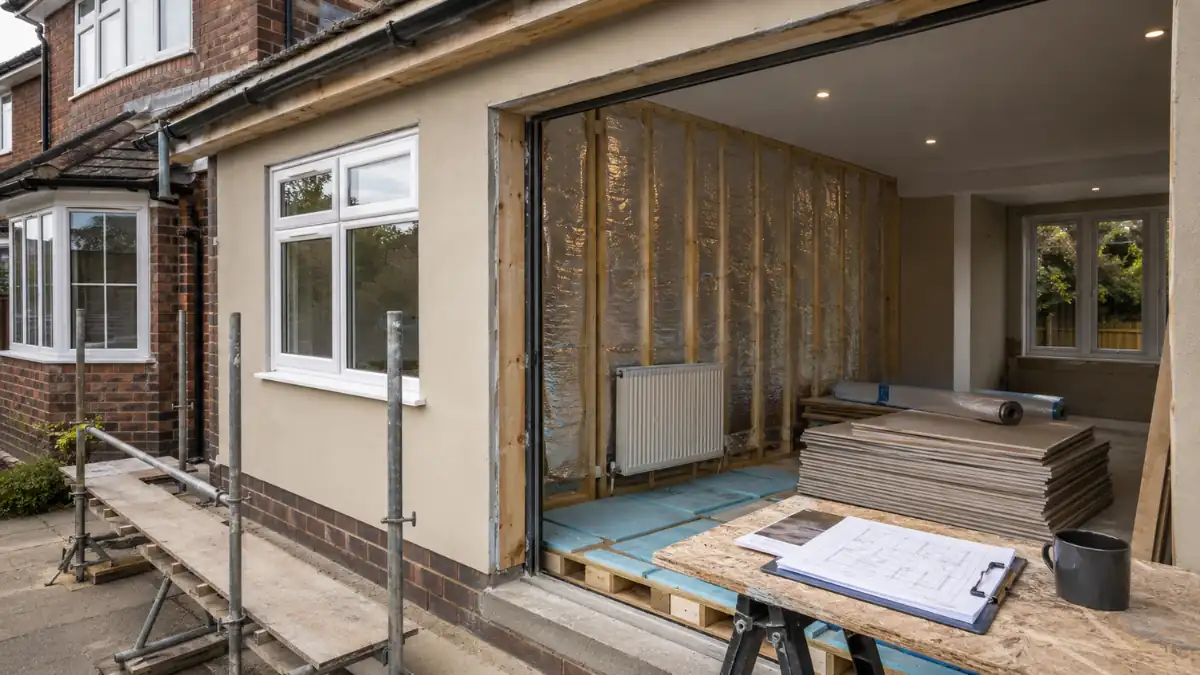
A garage conversion looks simple on paper — close the door opening, insulate, add heating, and you’ve got a new room.However, garages are typically built to a lower standard than the rest of the house, so Building Control will want proof that your finished space is suitable as a habitable room.
As a rule, you’ll need a compliant approach for:
- Part L (energy efficiency) — insulation and thermal performance.
- Part B (fire safety) — escape, alarms, separation and linings where needed.
- Part F (ventilation) — background ventilation and extract where relevant.
- Part P (electrics) — safe installation and certification.
- Structure (Part A) — especially if you remove walls, alter openings or add beams.
- Drainage (Part H) — if you add a WC, utility or new waste connections.
If you want the bigger picture beyond garage-specific issues, our main hub explains how the system works end-to-end:Building Regulations: Complete Homeowner’s Guide.
Planning permission vs Building Control for a garage conversion
One of the most common misunderstandings we see is assuming that “no planning needed” means “no approvals needed”.In reality, planning and Building Control do different jobs.
Planning permission (often not needed)
- Planning focuses on use, appearance and impact (neighbours, street scene, parking, policy).
- Many internal-only garage conversions won’t need a full application, although changes to the front elevation can trigger it.
- Your council may care about loss of parking in certain areas, or where conditions restrict garage use.
Building Control (usually needed)
- Building Control focuses on safety, structure and performance.
- They’ll inspect key stages and want evidence of compliant materials and details.
- You’ll ideally finish with a completion certificate.
Building Control routes: Building Notice vs Full Plans
For Building Regulations for Garage Conversion, you’ll typically choose between Full Plans or a Building Notice.Both can work — but they suit different risk levels.
Full Plans (best for clarity and “paper trail”)
- You submit drawings/specification and (where needed) structural information.
- Building Control check it and issue an approval (or comments) before work progresses too far.
- Generally a calmer route if you’re changing structure, adding drainage, or want fewer surprises.
Building Notice (faster start, but less certainty)
- Less design information is submitted up front.
- Compliance is assessed mainly via site inspections as you build.
- It can be fine for straightforward work — but it increases the risk of being asked to open up work later.
What Building Control check for a garage conversion
Building Regulations for Garage Conversion usually come down to a few predictable pressure points. Below are the areas that most commonly cause delays — and how to plan for them.
1) Insulation and heat loss (Part L)
Garages are often single-skin, uninsulated, and draughty. Once it becomes a habitable room, Building Control typically expect upgraded thermal performance to walls, floor and roof/ceiling, plus decent windows/doors.
- Walls: internal lining systems or new insulated construction where required.
- Floor: insulation is commonly needed — especially if the slab is cold or the floor level must be raised.
- Openings: new glazing/doors should meet suitable energy standards.
2) Fire safety and escape (Part B)
Fire safety requirements depend on layout and how the conversion connects to the house. Typical considerations include:
- Means of escape: sometimes an escape window is required (depending on room type and storey).
- Smoke alarms: interlinked alarms are commonly expected when you alter the dwelling.
- Internal doors/linings: may need upgrading in certain layouts.
3) Ventilation and moisture control (Part F)
Conversions can suffer from condensation if ventilation is an afterthought. Building Control will usually look for a sensible strategy:
- Background ventilation (e.g., trickle vents) and controllable openings.
- Mechanical extract if you add a WC, shower room or utility.
- Damp proofing — especially around floors, external walls and thresholds.
4) Structure and openings (Part A)
Even if you’re not doing a big extension, there may be structural changes:
- forming a new opening where the garage door was,
- removing/altering internal walls between house and garage,
- adding beams or supports, especially in integral garages.
5) Electrics (Part P) and heating
Garage electrics are often basic. Once the room is habitable, you usually need properly designed circuits, safe consumer unit capacity, and certification by a competent installer.Heating also matters — Building Control will want the room to be reasonably heatable and comfortable.
6) Drainage (Part H) if you add plumbing
Adding a cloakroom, shower room or utility increases the complexity. You’ll need sensible waste runs, ventilation/air admittance where required, and correct connection to existing drainage.
Quick costs snapshot – Building Control for a garage conversion
- Building Control fees: vary by council/approved inspector and scope (often a few hundred pounds for straightforward work).
- Plans/drawings: if you use the Full Plans route, expect design/drawing costs depending on complexity.
- Structural input: may be required if beams/openings change.
- Compliance upgrades: insulation and glazing are often the biggest “hidden” costs in a garage conversion.
Exact figures vary by area and specification — but budgeting early helps you avoid redesign and rework once Building Control are involved.
Costs & timelines: drawings, inspections and approval
Most delays happen for one reason: the build starts without a clear compliance plan, then Building Control request details after work is already hidden behind plasterboard.A simple way to avoid this is to think in stages:
- Before you start: pick your route (Full Plans or Building Notice) and agree the inspection schedule.
- During the build: keep evidence (insulation spec, photos of DPM, structural works, certificates).
- At the end: make sure you receive your completion paperwork.
Want to avoid surprises from Building Control?
We’ll help you choose the right submission route and prepare the drawings/spec so your garage conversion can be signed off smoothly.
Step-by-step HowTo: getting Building Regs sign-off for a garage conversion
Here’s the straightforward, low-stress path we recommend for most homeowners dealing with Building Regulations for Garage Conversion.
HowTo checklist: garage conversion Building Regulations (simple route)
- Confirm the room use. Office? Bedroom? Playroom? Utility? (Fire, ventilation and drainage can change.)
- Check the existing garage build. Single-skin walls? Low floor? No DPC/DPM? (This drives insulation and damp strategy.)
- Decide the Building Control route. Full Plans if there’s any structure/drainage uncertainty; Building Notice for simple work.
- Prepare compliant drawings/spec. Show insulation build-ups, openings, ventilation, and key construction notes.
- Book inspections early. Ask what stages they want to see before anything is covered up.
- Keep evidence. Photos of insulation/DPM and keep electrical/plumbing certificates.
- Final sign-off. Arrange the completion inspection and request your completion certificate for your records.
Step-by-step process (what typically happens on site)
- Initial visit / submission: Building Control confirm what they’ll expect for your type of garage conversion.
- Opening-up (if needed): sometimes they’ll want to see foundations/floor/walls before you line them.
- Insulation stage: walls/floor/ceiling insulation checked before plasterboard.
- Services stage: electrics and any plumbing/drainage checked and certified.
- Completion: final inspection, then completion certificate issued once everything is in order.
Pitfalls & gotchas (including “no building regs” situations)
“No building regulations for garage conversion” — when people get caught out
You’ll see searches like “no building regulations for garage conversion” or “do I need building regulations for a garage”.In practice, if you’re creating habitable space, Building Control sign-off is the safe assumption.
- If the work was done without approval, it can cause issues when you sell or remortgage.
- It can also hide defects (cold bridging, damp, unsafe electrics) that become expensive later.
Local council quirks (worth knowing)
Even though Building Regulations are national, local practice varies. Some Building Control teams prefer more detail up front; others are comfortable inspecting on a Building Notice.Either way, a clear drawing package and a sensible inspection plan makes everything smoother.
Related comparisons (helpful when planning a conversion)
- Garage conversion vs extension: conversions can be cheaper, but insulation/damp upgrades are often underestimated.
- Building Notice vs Full Plans: Full Plans tends to reduce surprises when structure/drainage is involved.
- Integral vs detached garage conversion: integral garages often involve more fire/door/interface considerations with the house.
FAQs: Building Regulations for Garage Conversion
Is Building Regulations approval needed for a garage conversion?
In most cases, yes. If you’re converting a garage into a habitable room (office, bedroom, playroom, snug), Building Control will typically expect compliance and inspections. The conversion usually requires upgrades to insulation, ventilation, electrics and sometimes structure or drainage.
What are the Building Regulations for a garage conversion (in plain English)?
Building Control want the new room to be safe and comfortable. That usually means: better insulation (walls/floor/roof), sensible ventilation, safe electrics, appropriate fire safety measures, and confirmation that any structural changes are properly designed.
How do I get Building Regs for a garage conversion?
You choose a submission route (Full Plans or Building Notice), notify Building Control, and agree inspection stages. For Full Plans, you submit drawings/specification up front; for Building Notice, the focus is on site inspections. Either way, keep evidence and request your completion certificate at the end.
How much is Building Control for a garage conversion?
Fees vary by local authority/approved inspector and project complexity. For straightforward domestic work, Building Control fees are often in the low hundreds, but can be higher if the scope includes structural changes or added drainage. It’s worth getting the fee quote early so it’s built into your budget.
Buying a house with no building regs for a garage conversion — what should I do?
Ask the seller for paperwork first (completion certificate, plans, electrical certificates). If nothing exists, get advice before you exchange contracts. You may need further checks to understand whether the work is compliant, and what your options are to reduce risk going forward.
Selling a house without building regs for a garage conversion — will it be a problem?
It can be. Buyers and solicitors commonly ask for Building Regulations sign-off for conversions. Missing paperwork can cause delays, renegotiation, or requests for further evidence. If you’re in this situation, get advice early so you can present the best possible file for the sale.
Do I need Building Regulations if I’m only replacing the garage door with a wall and window?
Often, yes — especially if the change forms part of creating habitable space or affects thermal performance. If the garage becomes a “proper room”, insulation and performance upgrades are typically expected, and Building Control may want to inspect the build-up before it’s covered.
Want us to sense-check your compliance plan before you build?
We can review your layout, insulation approach and submission route so you’re not relying on guesswork.
Next steps & useful guides
If you’re planning a garage conversion and want to avoid costly mistakes, these guides are a good next step:
- Our Building Regulations hub (how Building Control works, start to finish)
- What drawings you typically need for Building Control (and when)
- Planning permission basics (helpful if your conversion changes the frontage)
- A simple “do I need planning permission?” checklist
- Speak to our team about plans, submissions and approvals
- Do you usually need approval?Yes — converting a garage into habitable space typically requires Building Control involvement and sign-off.
- Most common upgradeInsulation to walls/floor/roof plus suitable windows/doors (energy efficiency requirements).
- Other key checksFire safety, ventilation, electrics certification, structure (openings/beams), and drainage if you add plumbing.
- Submission routesFull Plans (more certainty) or Building Notice (faster start, but more risk of surprises).
- Best “stress saver”Agree inspection stages early and keep evidence (photos/spec sheets/certificates) before work is covered up.
- Why paperwork mattersA completion certificate helps protect you when selling, remortgaging, or dealing with future alterations.
Want to get it right first time? Ask Plans Made Easy to guide your garage conversion through Building Control.
How Plans Made Easy can help
Building Regulations for Garage Conversion are rarely complicated once they’re planned properly — the stress comes from discovering requirements late, after work is already hidden.The simplest approach is to agree your route (Full Plans or Building Notice), set out a clear insulation/fire/ventilation strategy, and keep the paperwork tidy from day one.
If you’d like a calm, practical steer, our team can prepare compliant drawings, coordinate structural input where needed, and help you navigate Building Control inspections without the usual back-and-forth.
Official guidance & trusted resources
For the most up-to-date official information, these sources are worth bookmarking:
- Planning Portal – guidance on approvals and home projects
- GOV.UK – planning permission (England & Wales)
- GOV.UK – Building Regulations approval process
- GOV.UK – Approved Documents index (technical guidance by topic)
Ready to move your project forward?
Plans Made Easy can prepare compliant plans, manage submissions, and guide you from idea to approval.
Performance Verified ✅
This page meets PME Optimisation Standards — achieving 95+ Desktop and 85+ Mobile PageSpeed benchmarks. Verified on

