
Share this post:
Quick summary: Enforcement Notice
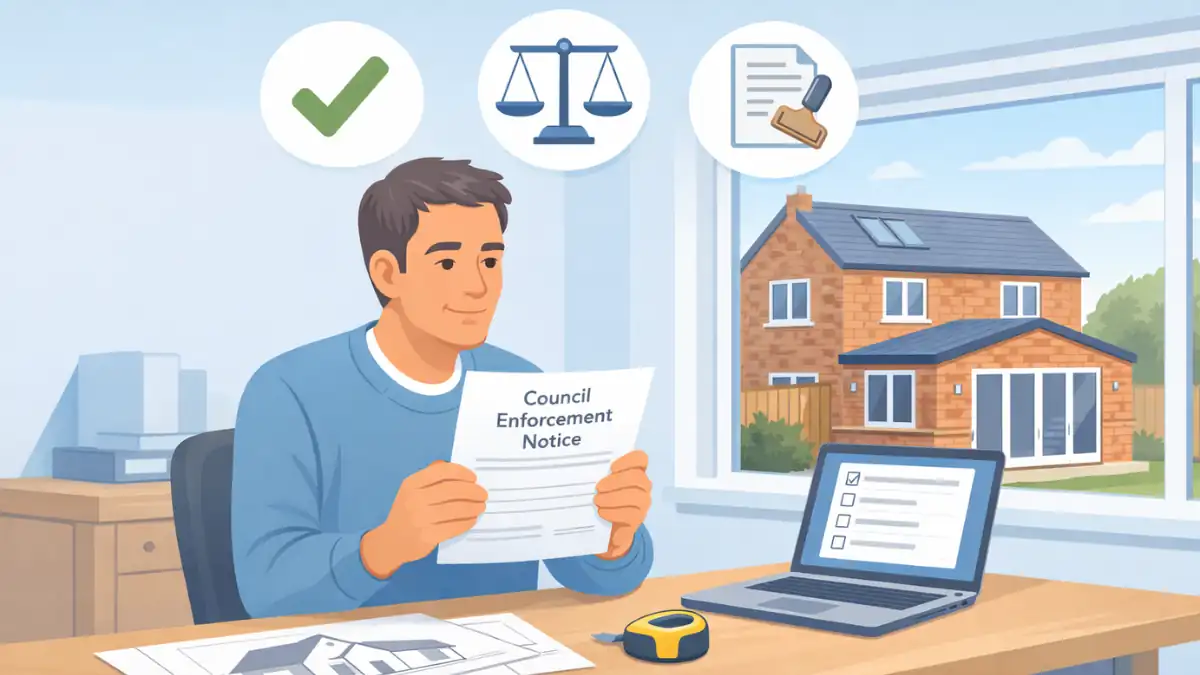
If you’ve received an Enforcement Notice for an extension, it usually means the council believes there’s been a breach of planning control (for example: building without permission, building bigger than approved, or not following a planning condition). The notice will set out what the breach is, what you must do to fix it, and the deadlines.
- Don’t ignore it. Once it “takes effect”, failing to comply can become a criminal offence.
- You may be able to appeal (usually within tight time limits) or apply to regularise the works.
- Get clarity fast: check the notice wording, the plans you built to, and what the council says is wrong.
The best next step is usually to pause and assess: what exactly is being alleged, what evidence the council has, and whether the extension could be made acceptable with changes or a revised permission.
Worried about an Enforcement Notice on your extension?
Send us the notice (and a few photos). We’ll explain what it means, what your options are, and what usually works with councils.
Quick summary: Enforcement Notice
An Enforcement Notice for an extension is a formal council notice that alleges a planning breach and requires specific steps to put things right.You normally have a limited window to appeal, and the notice will include dates for when it takes effect and when you must comply.
In most cases, the quickest way to reduce stress is to get the facts in writing, understand whether the extension could be made acceptable, and then choose the right route:compliance, an appeal, or a regularising application (where appropriate).
Enforcement Notice for an extension: what it is and why it happens
If you’ve received an Enforcement Notice relating to an extension, it can feel like everything has suddenly become urgent (and expensive).The key thing to know is this: councils don’t issue these casually. A notice usually follows an investigation where the council believes there is a breach of planning control.
Typical reasons an Enforcement Notice is issued on an extension
- No planning permission where the extension is not permitted development (or PD rights are restricted).
- Built larger / higher / closer than the approved plans (even small differences can matter).
- Materials or windows not matching conditions (for example obscure glazing, openings, cladding types).
- Work in a conservation area or on/near a listed building without the right consents.
- Neighbour impact complaints (overlooking, daylight loss, bulk, boundary issues).
If you’re unsure whether your extension needed permission in the first place, it’s worth revisiting your basics first:the quick homeowner checklist on whether permission is neededandthe specific extension guide.
What happens next after you receive an Enforcement Notice
An Enforcement Notice is a legal document. The wording matters. In plain English, it usually sets out:
- The alleged breach (what the council says is unauthorised).
- The reasons (why the council considers it harmful or unacceptable).
- The steps required (what you must do to remedy it).
- The dates: when it takes effect and how long you have to comply.
- Appeal information (how and when you can challenge it).
Will the council stop the work immediately?
Not always. An Enforcement Notice typically gives a period before it takes effect, and then a further period to comply.However, councils can also use other tools (like temporary stop notices) where they believe immediate harm is happening.
If you’re mid-project, it’s sensible to avoid doing anything that makes the alleged breach worse until you’ve got professional guidance.If your builder is waiting, share a written summary with them so everyone is working from the same facts.
Your options after an Enforcement Notice for an extension
Most homeowners have three realistic routes. Which one fits depends on what the notice says and what’s actually been built.
Option 1: Comply with the notice (full or partial)
Compliance means doing the steps the notice requires, within the time allowed. Sometimes that’s removal of the extension.However, in many extension cases, the steps can involve alterations rather than total demolition (for example reducing height, moving a balcony, changing windows, or removing roof lights).
Option 2: Appeal the Enforcement Notice
You may be able to appeal if you think the notice is wrong, unreasonable, or asks for more than is necessary.Appeals have strict time limits, so this is rarely a “think about it for a month” decision.
In practice, an appeal can argue things like:
- planning permission should be granted (in effect, the development is acceptable),
- there is no breach (for example, it is permitted development or matches the permission),
- the steps required are excessive, or
- the compliance time is too short.
If you’re heading towards any kind of appeal route, it helps to understand the wider planning system and timescales:how planning timelines workandhow appeals are approached in practice.
Option 3: Try to regularise the extension (where appropriate)
Sometimes the extension could be acceptable with the right design and supporting information.That might mean a retrospective planning application, or a revised application that reflects what’s built (or what you propose to alter it to).
If you’re unsure how to get your documents in order, these guides help you map the process:how to prepare plans properlyandwhat costs sit around a planning application.
Want a clear plan before you respond to the council?
We can review your Enforcement Notice, compare it to what’s built, and outline the most sensible “next move” (including drawings, submissions, and likely council expectations).
Costs and timelines to expect
Costs vary massively because an Enforcement Notice can range from a simple paperwork fix to major building changes.Instead of focusing on one number, it’s better to break it into what you might have to pay for.
Quick costs snapshot (typical areas where costs appear)
- Drawings & measured survey: often needed to clarify what’s built vs what was approved.
- Planning application / regularising submission: may involve an application fee and professional time.
- Professional support: planning consultant / designer input to negotiate changes or prepare an appeal case.
- Build alterations: if compliance means changes, this can be the biggest cost area.
- Building Control / certification: if the extension also has Building Regulations gaps, you may need extra inspections or evidence.
If you’re also worried about Building Regulations evidence (especially for older works), it’s worth readingwhat compliance documents you should keepandhow Building Control fits into home projects.
How long does an Enforcement Notice last?
The notice will set key dates (when it takes effect and when compliance is required). Separately, councils can keep enforcement records, and notices can continue to matter later (for example when selling).That’s why it’s important to get the outcome documented once the issue is resolved.
Step-by-step: what to do in the first 7 days
If you act quickly and calmly, you can usually reduce the risk of missed deadlines and rushed decisions.Here’s the process we recommend homeowners follow.
First 7 days checklist (Enforcement Notice for an extension)
| Day | What to do | Why it matters |
|---|---|---|
| 1 | Read the notice twice and highlight the alleged breach, steps required, and dates. | Most mistakes happen because homeowners respond to the “headline”, not the wording. |
| 1–2 | Pull all documents: approval decision notice, approved drawings, conditions, correspondence. | You need to know whether this is “no permission” or “not built to permission”. |
| 2–3 | Photograph the extension clearly (all sides, boundaries, windows, roof, heights if possible). | Helps you (and any advisor) assess harm, overlooking, massing and compliance options. |
| 3–4 | Check whether any PD limits or restrictions apply (conservation areas, Article 4, past conditions). | This can change the entire strategy. |
| 4–5 | Get measured drawings if there’s any dispute on sizes/heights or “built bigger”. | Accurate drawings reduce argument and support appeals or regularising submissions. |
| 5–7 | Decide the route: comply, appeal, or regularise — and set a timeline around the notice dates. | Avoids missing the appeal window or drifting into non-compliance. |
Common pitfalls (and how to avoid making it worse)
Pitfall 1: Assuming “it’s only a small difference”
Planning is often about impact. A small increase in height near a boundary, or a new side window that introduces overlooking,can be enough to shift the council’s view from “acceptable” to “harmful”.
Pitfall 2: Confusing planning with Building Regulations
Even if your builder says “it’s structurally fine”, planning is about use, scale, appearance and neighbour impact.If you also have Building Regs concerns, start here:the homeowner Building Regulations overview.
Pitfall 3: Not thinking about selling the house
Unresolved planning enforcement can cause delays, price reductions, or failed sales because buyers and solicitors want certainty.If your extension was built without permission, this guide may also be relevant:what to do if an extension was built without permission.
Technical details councils often focus on (extensions)
While every council is different, extension enforcement cases often come down to a few repeat themes:
- Height and massing near boundaries or neighbouring windows.
- Overlooking from upper windows, roof terraces, balconies, or raised decks.
- Overbearing impact where the extension dominates a neighbour’s outlook.
- Materials (particularly in conservation areas or on prominent elevations).
- Condition breaches (obscure glazing, opening restrictions, privacy screens).
Enforcement notice vs other council notices (quick comparisons)
Homeowners often see several similar-sounding terms. Here’s the simple difference.
Common comparisons
- Enforcement notice vs stop notice: an enforcement notice sets out the breach and remedy steps; a stop notice (or temporary stop notice) is used to halt activity quickly in certain situations.
- Enforcement notice vs breach of condition notice: a breach of condition notice focuses on not following a planning condition; it has its own rules and can be used alongside other action.
- Enforcement notice on a property: typically served on owners/occupiers and can continue to matter later, which is why proper resolution paperwork is important.
Local council “quirks” that can affect outcomes
Councils broadly follow the same legal framework, but the practical approach can differ:
- Some councils favour an early “invite to regularise” approach where harm is limited.
- Others focus heavily on neighbour impact and privacy, especially for two-storey or raised elements.
- Evidence expectations vary: some will want a full measured survey; others accept simpler plans if clear.
FAQs: Enforcement Notice
What is an Enforcement Notice from the council?
It’s a formal notice alleging a planning breach and requiring steps to fix it (for example altering or removing unauthorised work, or stopping an unauthorised use).It will also include key dates and appeal information.
What happens if you ignore a planning Enforcement Notice?
If the notice takes effect and you do not comply, it can become a criminal offence and the council can take further action.In real terms, ignoring it often makes the situation more expensive and harder to resolve later (including when selling).
Can you appeal an Enforcement Notice?
Yes, in many cases you can appeal — but the deadline is usually tight and must be met. Appeals are typically handled through the Planning Inspectorate process,and the appeal must be lodged before the notice takes effect.
How long do you have to appeal an Enforcement Notice?
The notice will state when it takes effect, and your appeal must be received before that date. Because deadlines can be short,it’s wise to get advice immediately if you’re considering an appeal route.
Is an Enforcement Notice public?
Many councils publish enforcement notices or keep them on public registers. Even where publication varies, the practical point is thatunresolved enforcement can show up during conveyancing checks, so it’s better to resolve it properly and keep paperwork.
Can I submit a retrospective planning application after receiving an Enforcement Notice?
Sometimes, yes — especially if the council believes there’s a reasonable prospect the development could be acceptable (possibly with changes).However, it depends on the facts and timing, and it’s important not to rely on this without a clear strategy.
What if my extension matches the approved drawings?
This is where evidence matters. If you can show it matches (approved plans, measured survey, dated photos), the council may reconsider or refine their position.Get your documents in order quickly so your response is clear and credible.
Want us to sense-check your notice wording?
We’ll explain what the notice is really asking for, what deadlines matter, and what a realistic compliance or regularising plan looks like.
Next steps & useful guides
If you want to stabilise the situation and move forward calmly, these homeowner guides help:
- Extension costs and budgeting (pillar guide)
- A step-by-step guide to the extension planning process
- What to do if permission is refused (and what happens next)
- How appeals work (and what improves your chances)
- What drawings you need for an extension (and why they matter)
- Building Regulations basics for extensions and conversions
- The key certificates and compliance documents to keep
- What it isA formal council notice alleging a planning breach and requiring steps to remedy it, with set dates.
- Why it happensMost commonly: built without permission, not built to approved plans, or breach of a planning condition.
- What matters mostThe exact wording, the “take effect” date, compliance deadlines, and whether you have grounds to appeal or regularise.
- Ignoring itOnce it takes effect, failure to comply can become a criminal offence and can create major issues on sale.
- Best first moveGather all approvals and drawings, photograph what’s built, and get measured plans if anything is disputed.
- When to get helpImmediately if deadlines are tight, if neighbours are impacted, or if you’re considering appeal/regularisation.
If you want a calm, practical plan, send Plans Made Easy your notice and a few details and we’ll outline the quickest route to resolution.
Official guidance (useful references)
For the most up-to-date national guidance and official appeal routes, these sources are worth checking:
- Planning Portal – national planning guidance and application information
- GOV.UK – planning permission in England and Wales
- GOV.UK – how to appeal an enforcement notice
- GOV.UK – national guidance on effective planning enforcement
How Plans Made Easy can help
An Enforcement Notice on an extension is stressful, but it’s usually manageable with a clear, evidence-led plan.The goal is to protect you from missed deadlines, reduce the risk of escalation, and get you to a documented outcome the council accepts.
Plans Made Easy can prepare accurate drawings, help you respond to the notice, and guide you through a regularising route or appeal strategy where appropriate.We keep it practical, homeowner-friendly, and proportionate to your project.
Ready to move your project forward?
Plans Made Easy can prepare compliant plans, manage submissions, and guide you from idea to approval.

Performance Verified ✅
This page meets PME Optimisation Standards — achieving 95+ Desktop and 85+ Mobile PageSpeed benchmarks. Verified on

