
Share this post:
Quick summary: Building Regulations Approved Documents
Building Regulations Approved Documents are the government’s “how-to” guidance notes for meeting the legal requirements in the Building Regulations (England). They don’t replace the law — instead, they show common, accepted ways to comply when you’re doing building work at home (extensions, loft conversions, garage conversions, renovations, new bathrooms, structural changes and so on). :contentReference[oaicite:0]{index=0}
- They’re guidance, not the regulations themselves — you can comply in other ways if you can prove you meet the requirements. :contentReference[oaicite:1]{index=1}
- They’re split into “Parts” (e.g. fire safety, structure, ventilation, drainage, energy efficiency, access). :contentReference[oaicite:2]{index=2}
- You must use the right version — Approved Documents are updated over time, so “old PDF” advice can trip you up. :contentReference[oaicite:3]{index=3}
- England vs Wales can differ — always check which nation’s guidance applies to your property. :contentReference[oaicite:4]{index=4}
In this guide we’ll explain what Approved Documents are, how many there are, which ones homeowners use most, and how to use them sensibly alongside Building Control so you avoid delays, rework, and awkward questions when you sell.
Not sure which Approved Document applies to your project?
Tell us what you’re building and we’ll point you to the right guidance and the usual Building Control route — before you spend money on drawings or a builder.
Quick summary: Building Regulations Approved Documents
Building Regulations Approved Documents are official guidance notes that explain practical ways to meet the Building Regulations requirements in England. They’re used by designers, builders and Building Control to check whether work is likely to comply — but they are not the regulations themselves.
For homeowners, they’re most useful when you’re planning drawings, agreeing details with a builder, and getting through inspections without surprises.
What Building Regulations Approved Documents are (and what they aren’t)
When you search online, it’s easy to end up with a mix of PDFs, forum advice, and half-remembered rules. A calmer way to approach it is this:the Building Regulations are the law, and the Approved Documents are guidance that show common ways to meet that law.
So what do Approved Documents actually cover?
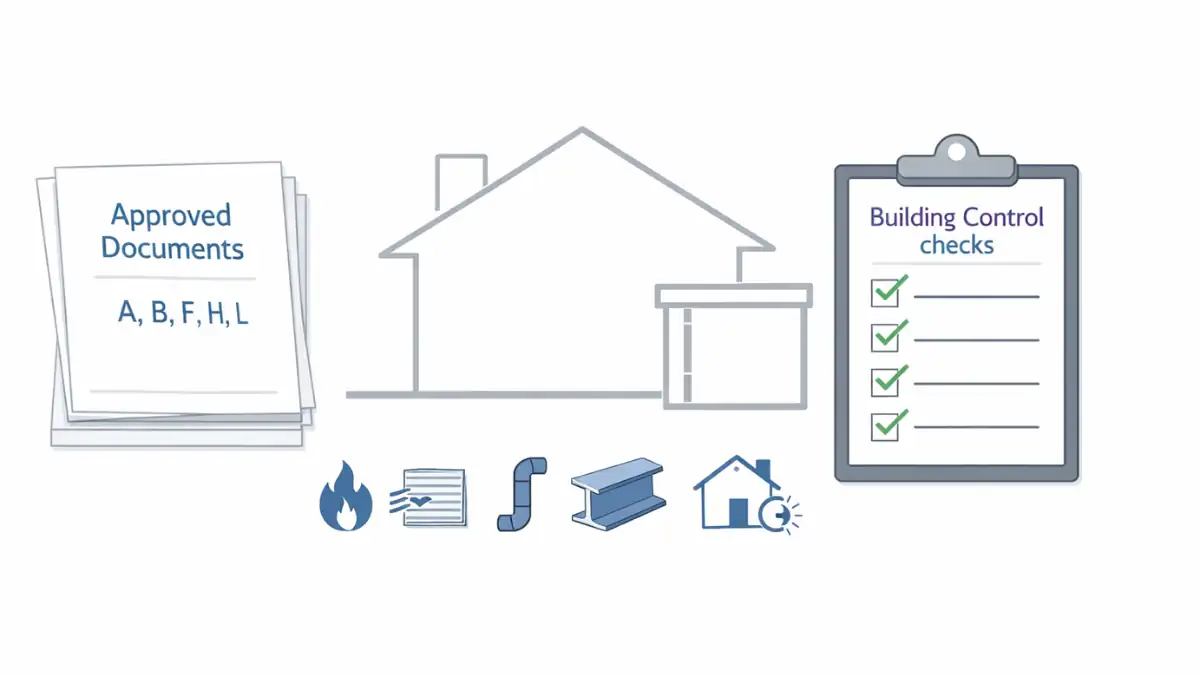
Approved Documents are organised by “Parts” (A, B, C and so on). Each Part deals with an area of building performance, such as structure, fire safety, ventilation, drainage, access, and energy efficiency.
They typically include:
- plain-English explanations of the performance standard you must meet,
- common design approaches that Building Control are used to seeing,
- tables, diagrams and “rules of thumb” (where relevant),
- references to British Standards and test methods (where needed).
Approved Documents vs the regulations: what’s the difference?
Think of it like this:
- The Regulations set out the legal requirements and define what counts as “building work”.
- The Approved Documents explain practical ways to satisfy those requirements in common situations.
How many Approved Documents are there?
There isn’t a single “one-page” answer because the set evolves as guidance is updated and reorganised.GOV.UK publishes the official collection, and Planning Portal also links to the most recent versions.
As a homeowner, the practical point is this: you don’t need to memorise the entire list.You need to identify which Parts your project touches — then make sure you’re using the correct edition (and any amendments).
Approved Documents list: the ones homeowners meet most
Below is a homeowner-friendly way to think about the Approved Documents — focused on the Parts that commonly come up in domestic projects.(This is not a complete technical list, and your project may involve other Parts too.)
Structure, fire safety, moisture and sound (the “big ones”)
- Part A (Structure) — beams, lintels, foundations, load-bearing walls, and structural alterations.
- Part B (Fire safety) — escape routes, fire doors, smoke alarms, fire separation, and higher-risk layouts (often relevant to loft conversions).
- Part C (Moisture and contaminants) — damp proofing, ground moisture, site preparation, and basic resistance to contaminants.
- Part E (Sound) — sound insulation, especially if you’re doing certain conversions or separating dwellings.
Ventilation, drainage and waste (where lots of jobs fail inspections)
- Part F (Ventilation) — bathrooms, kitchens, extract fans, background ventilation, and air-tightness considerations. (Often overlooked in “pretty” refurb jobs.)
- Part H (Drainage and waste disposal) — foul drainage, rainwater disposal, and principles for compliant drainage layouts.
Stairs, guarding, access and electrics (common trip points)
- Part K (Protection from falling / collision) — stairs geometry, guarding, handrails, and safety glazing principles.
- Part M (Access) — access and usability standards (important on some extensions and certain ground-floor work).
- Part P (Electrical safety) — notifiable electrical work and safe installation practices.
Energy efficiency (nearly always relevant)
- Part L (Conservation of fuel and power) — insulation, thermal performance, glazing standards, and energy-related upgrades triggered by building work.
Quick “costs” snapshot: what homeowners usually pay for (and what’s free)
- Approved Documents are typically available to view/download online via official sources (no need to buy expensive “bundles”).
- What costs money is turning guidance into a buildable, inspectable design: measured surveys, drawings, structural calculations, and specialist details.
- What costs even more is rework when items are missed (common examples: ventilation, insulation continuity, and drainage).
If you want a clear route through this, it often helps to start with proper drawings and a sensible inspection plan.For a plain-English explanation of inspections, see our guide to how inspections typically work from start to finish:read the inspections walkthrough.
How to use Approved Documents on a real home project
Homeowners often ask for a “Building Regulations Approved Documents list” because they want certainty.The better approach is to treat Approved Documents as a toolkit — and use them alongside Building Control and proper drawings.
Step-by-step: a simple way to use Approved Documents (without getting overwhelmed)
- Write down what you’re doing. Extension? Loft conversion? Knocking through a wall? New bathroom? Drainage changes?
- List the likely “Parts” you’ll touch. For most projects: structure + fire safety + ventilation + energy efficiency are a starting point.
- Check the latest editions. Use the official collection as your source of truth.
- Decide your Building Control route early. If you need good detail before you build, the “full plans” path is often calmer than guessing. (We explain the routes here:compare the two common routes.)
- Turn guidance into drawings/details. That usually means proper plans and notes — plus structural calculations where structure changes (see:when calculations are typically needed).
- Confirm tricky items early. Ventilation strategy, insulation upgrades, fire protection, drainage connections, and stair geometry are common “inspection pinch points”.
- Keep evidence. Take photos during the build and keep certificates — it helps with sign-off and helps when you sell (see:what documents to keep).
Homeowner checklist table: match your project to the most relevant Parts
| Typical home project | Parts that commonly apply | Common “missed” items |
|---|---|---|
| Single-storey extension | A, B, F, L (plus others depending on work) | Insulation continuity, ventilation rates, structural bearings |
| Loft conversion | A, B, K, L, F | Stair design, escape route protection, fire doors, ventilation |
| Garage conversion | L, F, A (often), B (often), P | Floor/wall upgrades, ventilation, electrics, damp treatment |
| New bathroom / WC | F, H, P (and sometimes M) | Extract fan sizing/controls, drainage falls/vents, electrics zones |
| Knocking through walls / structural changes | A (and often B) | Beam sizing, supports, padstones, temporary works planning |
This table is a practical starting point. Your Building Control surveyor (or an Approved Inspector/Registered Building Control Approver) will confirm what applies for your exact layout and scope.
Want to avoid Building Control “snags” and rework?
We can help you translate the guidance into clear drawings and a compliance plan that your builder can actually follow.
How Approved Documents link to Building Control, drawings and certificates
Approved Documents become most valuable when they’re tied to your Building Control process — because that’s where compliance gets checked in the real world.Planning Portal summarises how Approved Documents support the technical “Parts” and links to the current versions.
Drawings: “planning drawings” vs “buildable details”
Many homeowners start with planning drawings (if planning permission is needed). Those drawings are about the shape and appearance of what you want to build.Building Control, however, needs enough technical detail to confirm compliance.
- For planning drawings, see:our guide to what planning drawings usually include.
- For technical drawings, see:what a compliant technical package normally covers.
- If you’re not sure where your project sits, start here:a simple explainer of what Building Control actually does.
Certificates: why they matter more than people realise
Even if the build “looks fine”, you usually need paperwork to prove compliance — particularly for electrics, structural items, and final completion.This becomes important when you sell, remortgage, or if an insurer asks questions later.
We cover what to keep (and why) here:what the completion certificate is foranda simple checklist of documents homeowners should keep.
Common pitfalls (and “gotchas” that cause delays)
In our experience, Building Control problems rarely happen because a homeowner “didn’t care”.They happen because key details were assumed, skipped, or taken from an outdated source.
Other common issues we see on domestic projects
- Ventilation is designed as an afterthought (then fails inspection or creates condensation problems).
- Insulation is “nearly right” — but continuity and junctions aren’t considered, so performance and compliance suffer.
- Drainage changes aren’t mapped clearly — especially when existing runs are unknown or altered over the years.
- Stair/headroom and guarding are left to “builder standard”, which can be risky in loft conversions.
- Structural alterations are under-specified (beam bearings, padstones, lateral restraint, and temporary works assumptions).
Related comparisons homeowners often search for
- Approved Documents vs Building Regulations: guidance vs the legal requirements.
- Full plans vs building notice route: which is calmer for your type of project (see:a plain-English comparison).
- Planning permission vs Building Control: you may need one, the other, or both — depending on the work (start here:a simple “do I need permission?” checklist).
FAQs: Building Regulations Approved Documents
What are Building Regulations Approved Documents?
They are official government guidance documents that explain common ways to meet the requirements of the Building Regulations in England.They help designers, builders and Building Control understand what “compliance” looks like in typical building situations.
How many Approved Documents are there?
The set is organised around the technical “Parts” of the Building Regulations and is updated over time.The safest way to confirm what’s current is to use the official GOV.UK collection (and then open the specific documents relevant to your project).
Where can I find a Building Regulations Approved Documents list (official)?
Use the official collection on GOV.UK and the links on Planning Portal, which both point to the most recent versions.Avoid relying on random PDF downloads that don’t clearly show the edition and amendment history.
Are Approved Documents the same as the Building Regulations?
No. The Building Regulations are the legal requirements. Approved Documents are guidance showing common ways to comply.You can comply in other ways, but you may need to provide evidence to Building Control if you deviate from typical solutions.
Which Approved Document covers fire safety in homes?
Fire safety guidance is covered under Part B. For domestic projects, this often becomes most important in loft conversions, open-plan layouts, and works that affect escape routes.If you want a homeowner-friendly explainer, we also cover the key domestic issues here:read the fire safety guide.
Which Approved Document covers ventilation?
Ventilation guidance sits under Part F. This matters for bathrooms, kitchens, airtight upgrades, and many refurb projects where moisture control is overlooked.We also break it down simply here:see the ventilation explainer.
Which Approved Document covers drainage and waste disposal?
Drainage and waste disposal guidance is covered under Part H. It often comes up when adding bathrooms, moving kitchens, converting garages, or extending where existing drainage routes are unknown.If your project is near existing drains, you may also find this helpful:what to know before building near drains.
How often are Building Regulations / Approved Documents updated?
There isn’t one fixed schedule — updates happen when government changes policy, clarifies guidance, or introduces new requirements.That’s why it’s worth using the official collection pages and update notices rather than assuming the PDF you downloaded years ago is still current.
Want a second pair of eyes before you build?
We can sense-check the Parts likely to apply, flag the usual domestic “snags”, and help you line up drawings and inspection steps.
Next steps & useful guides
If you’re moving from “research” to “getting it done”, these guides tend to help homeowners most:
- Start with the complete homeowner guide to the rules (big picture)
- Understand what Building Control checks (and when)
- Learn what “approval” really means in practice
- See what an application typically involves
- Understand what drawings usually need to show for compliance
- Understand completion sign-off and why it matters
- Energy efficiency explained simply (common homeowner pain point)
- Access requirements explained in plain English
- What they areOfficial guidance showing common ways to meet the Building Regulations requirements in England.
- What they aren’tThey aren’t the law — the Building Regulations are the legal requirements.
- How to use them (best practice)Identify the Parts that apply, confirm you’re using the latest edition, and translate guidance into drawings/details that Building Control can approve.
- Most common homeowner PartsStructure, fire safety, ventilation, drainage, stairs/guarding, access, electrics and energy efficiency (depending on your scope).
- Top “gotcha”Using an outdated PDF or the wrong nation’s guidance — always cross-check official sources.
- What to keepPhotos during the build + certificates and completion sign-off paperwork (helps with selling and reduces disputes).
If you want help matching the guidance to your project and getting the details right first time,message our team and we’ll point you in the right direction.
Official guidance (recommended starting points)
For the most reliable, up-to-date references, use:
For the official Approved Documents collection and current editions, use the GOV.UK collection page:Approved Documents (official collection).
How Plans Made Easy can help
For most homeowners, the tricky bit isn’t finding the PDFs — it’s knowing which Parts apply to your specific layout, then turning the guidance into drawings and details that your builder can follow and Building Control can sign off.
If you tell us what you’re planning (even at sketch stage), we can help you map out the right compliance route, prepare the drawings, and guide you through Building Control without unnecessary delays.
Ready to move your project forward?
Plans Made Easy can prepare compliant plans, manage submissions, and guide you from idea to approval.
Performance Verified ✅
This page meets PME Optimisation Standards — achieving 95+ Desktop and 85+ Mobile PageSpeed benchmarks. Verified on

