
Share this post:
Quick summary: Planning Permission Refused
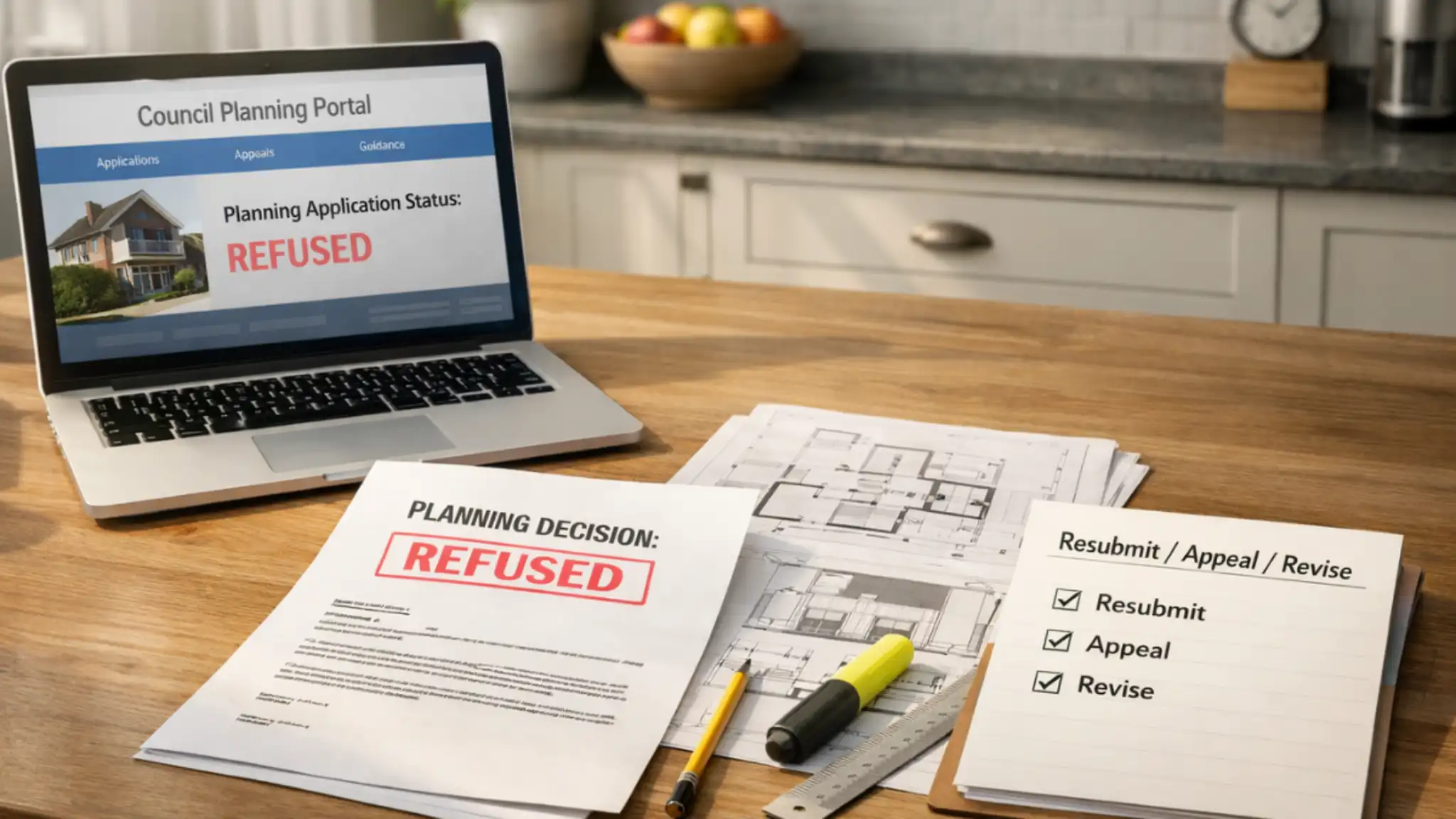
If you’ve had Planning Permission Refused, it doesn’t automatically mean “game over”. In most cases, the refusal notice is simply the council telling you what didn’t work (and why) — so you can fix it, submit again, or appeal if the decision feels unreasonable.
- First step: read the refusal reasons carefully and identify what evidence the case officer relied on.
- Most common fixes: design tweaks (height, depth, roof form), better neighbour impact, better drawings, or supporting documents.
- Your main options: resubmit a revised application, appeal, or withdraw and rethink (sometimes with pre-app advice).
- If you’ve already built: a refused retrospective application needs fast, careful action to reduce enforcement risk.
Below, we explain what “refused” really means, what to do next, and how to give your next submission the best chance of approval — without wasting months (or money).
Not sure why your application was refused?
Share your refusal notice and drawings — we’ll explain the reasons in plain English and tell you the quickest route to a stronger re-submission or appeal.
Planning Permission Refused — what it really means
Getting a refusal letter is frustrating — especially if you’ve spent money on drawings and waited weeks for a decision.However, Planning Permission Refused usually means the council believes the proposal conflicts with one or more planning policies(for example, neighbour amenity, design, highways, or heritage constraints).
The good news is this: most refusals are fixable. Often, it’s not the entire idea that’s the problem —it’s the scale, the positioning, the design details, or a missing piece of information.
If you want the bigger picture of how the system works (and what councils look for), see our Pillar guide:Planning Permission (UK): The Complete Homeowner’s Guide.
Common reasons planning permission is refused
Councils word refusal reasons in “planner-speak”, but most fall into a few familiar buckets. Here are the typicalplanning permission refusal reasons we see on householder applications.
1) Overbearing impact, loss of light, or loss of privacy
This is one of the most common refusal grounds. If an extension feels too deep, too tall, or too close to a boundary,the council may say it harms neighbouring amenity (overshadowing, overbearing presence, or direct overlooking).
- Two-storey side extensions close to boundaries
- Deep rear extensions near small gardens
- Upper-floor windows with clear views into neighbours’ rooms/gardens
2) Design, appearance, or “out of keeping”
Councils often refuse proposals that look awkward on the host house or street scene — for example,mismatched materials, bulky roof forms, or poor proportions.
3) Highways, parking, access, and visibility
Even if you’re not changing the road layout, issues can crop up around dropped kerbs, loss of parking spaces,turning circles, or poor visibility at the access point.
4) Heritage constraints and protected areas
If you’re in a conservation area, near a listed building, or the house itself is listed,councils expect a higher design standard and more supporting information.(This is where many “reasonable” projects become difficult without the right approach.)
Helpful reading:Conservation Areas (UK): Rules, Consent & What You Can Do andListed Buildings: Thinking about works on your listed property?.
5) Missing information or unclear drawings
Sometimes the council can’t properly assess what you’re proposing because key details are missing — levels, heights,neighbour relationship sections, or accurate elevations.
If you’re unsure whether your drawings are up to scratch, these guides help:Planning Permission Drawings andDrawings for Planning Application.
What to do if planning permission is refused (first 72 hours)
When planning permission is refused, the smartest next step is rarely “rush an appeal”.Instead, you want to understand exactly what the council objected to and what evidence would address it.
- Read each refusal reason slowly. Highlight what policy issue is being claimed (amenity, design, highways, heritage, etc.).
- Pull up the officer report. This often includes the real detail — neighbour relationship, photos, and the reasoning behind the decision.
- Check if the council suggested changes. Some refusals subtly indicate what would be acceptable (reduced depth, set back, obscure glazing, etc.).
- Ask for a follow-up call (if offered). Some councils will discuss how to make it acceptable; others won’t — but it’s worth trying quickly.
- Don’t start building (or keep building). If the project isn’t lawful, you risk enforcement action and higher stress later.
Your options after a refusal: revise, resubmit, appeal
After Planning Permission Refused, most homeowners fall into one of these routes. The right choice depends onthe refusal reasons, your site constraints, and whether the council’s decision feels reasonable.
Option A: Revise the design and resubmit (often the fastest win)
If the council’s objections are practical (too deep, too tall, too close, too much overlooking), a revised scheme can be the quickest route.Your new application should clearly show you’ve responded to each refusal reason.
- Reduce depth/height or set the extension in from the boundary
- Adjust roof form (hipped roof, lower ridge, smaller dormer)
- Add obscure glazing / high-level windows where privacy is the issue
- Provide proper sections, levels and neighbour relationship drawings
Option B: Appeal the refusal (useful when the decision feels “off”)
Appeals can work — but they are not always the quickest route, and they need a strong planning argument.If your scheme genuinely meets policy and the refusal reasons are weak, an appeal may be sensible.
If you’re considering this route, read:Planning Permission Appeal: How to Win When Your Application Is Refused.
Option C: Withdraw, rethink, and de-risk (especially on tricky sites)
Where the refusal is tied to heritage constraints, highways issues, or tight neighbour impacts, it may be worthre-working the design properly rather than “tinkering”.This is also where a planning consultant approach can save you months.
Related:Planning Permission Consultants: How to Get Approval Fast.
Want to know whether to appeal or resubmit?
We’ll review your refusal reasons and tell you which route is most likely to work — and what changes usually unlock approval.
Retrospective planning permission refused — what next?
This is where things feel more urgent. If you’ve already built (or started building) and the council hasrefused retrospective planning permission, you need a calm plan — quickly.
- Read the reasons carefully: is it the scale, the design, neighbour impact, or a policy restriction (like conservation area controls)?
- Stop non-essential work: continuing can make resolution harder and more expensive.
- Work out what change would make it acceptable: reduce, alter, re-clad, obscure glazing, change roof form, etc.
- Get professional input fast: you want a clear strategy to reduce enforcement risk.
Can planning permission be refused if neighbours object?
Yes — but not simply because neighbours object. Councils must decide applications against planning policies,so objections matter most when they identify a planning issue (loss of light, privacy, parking, noise, character of the area, etc.).
In practice, neighbours’ comments can influence how closely the officer looks at impacts, and whether they request more information.So, if your project is borderline, a strong set of objections can make refusal more likely.
Step-by-step: how to turn a refusal into an approval
If you’re asking, “planning permission refused — what can I do?”, this is the practical process we use to get clarityand move forward without guesswork.
Step-by-step checklist (homeowner-friendly)
- Map each refusal reason to a fix. Write “Reason 1 → Fix”, “Reason 2 → Fix” (design, drawings, documents, evidence).
- Decide: appeal vs re-submit. If the council’s concerns are valid, re-submit is often faster than appeal.
- Upgrade the drawing pack. Add sections, levels, accurate heights, and neighbour relationships where needed.
- Write a short planning statement. Address each refusal reason directly, with references to policy where possible.
- Consider pre-app advice for tricky sites. Not always necessary, but it can de-risk heritage/highways cases.
- Submit a revised scheme with clear changes. Make it obvious what has been improved (include a “response to refusal” note).
- Stay responsive during determination. Quick answers to queries can prevent another refusal.
If you need a baseline on timing (so you can plan builders and budgets sensibly), see:Planning Permission Timelines (UK Guide).
Common pitfalls after a planning refusal
- Resubmitting without meaningful change: the council rarely reverses itself without a clear reason.
- Ignoring the officer report: it often contains the real detail behind the refusal.
- Underpowered drawings: missing heights, levels, or sections can lead to “unable to assess” refusals.
- Appealing when a tweak would win: appeals can take time; a smart revision can be quicker.
- Starting work after refusal: it adds stress and risk if permission isn’t in place.
FAQs: Planning Permission Refused
If planning permission is refused, can I apply again?
Yes — you can submit a new application, and many homeowners do. The key is to make sure the re-submission responds clearlyto the refusal reasons (design changes, better drawings, additional supporting information). If you re-submit the same schemewith minimal changes, another refusal is more likely.
What are the most common reasons planning permission is refused?
For householder projects, the usual reasons are neighbour impact (loss of light/privacy/overbearing), design “out of keeping”,highways/parking issues, heritage constraints (conservation area/listed buildings), or missing/unclear information in the drawings.
What do I do if planning permission is refused?
Start by reading the refusal notice and the officer report. Then decide whether the best route is a revised re-submission(often fastest) or an appeal (more suitable when the refusal reasons are weak). Either way, your next step should be a clear“response to refusal” plan that addresses each point directly.
How to appeal a planning permission refusal?
An appeal argues that the council’s decision was wrong based on policy and evidence. To do well, you typically need a clear planning argument,accurate drawings, and responses to each refusal reason. If you want guidance on whether an appeal is worth it, our guide here can help:Planning Permission Appeal.
What happens if retrospective planning permission is refused?
A refused retrospective application can increase enforcement risk, so it’s important to act promptly and sensibly.Often the solution is a revised scheme (changes to what’s built) that addresses the council’s concerns, followed by a fresh application.If you’re in this situation, getting professional advice quickly can reduce stress and avoid costly missteps.
Can planning permission be refused if neighbours object?
Neighbours’ objections can influence the process, but the decision must be based on planning policies.Objections matter most when they point to genuine planning issues like privacy, light, parking, noise, or character of the area.
How many times can a planning application be rejected?
There isn’t a simple “maximum”. However, repeated re-submissions without addressing the core issues tend to lead to repeated refusals.The practical aim is to identify the real policy problem and solve it, rather than hoping for a different outcome with the same scheme.
Want a clear plan for your next move?
We can tell you, quickly, whether your refusal is best fixed by design changes, stronger drawings, a planning statement — or an appeal.
Next steps & useful guides
If your planning permission was refused and you want to strengthen your next submission, these PME guides are a good next read:
- Planning Permission Refusal: What It Means and What to Do Next
- Planning Permission Appeal: How to Win When Your Application Is Refused
- Planning Permission Drawings: A Complete Guide for Homeowners
- Planning Permission Cost (UK): Complete Guide for Homeowners
- Planning Permission Timelines (UK Guide)
- Planning Permission Consultants: What They Do & When You Actually Need One
- Most common refusal groundsNeighbour amenity (light/privacy/overbearing), design/character, highways/parking, heritage constraints, or missing information.
- Best “first move”Read the refusal notice and the officer report, then map each reason to a practical fix.
- Fastest typical routeA revised re-submission is often quicker than appeal when the council’s concerns are reasonable.
- When appeal makes senseWhen the refusal reasons are weak and the proposal aligns with policy (needs a strong, evidence-based argument).
- Retrospective refusalTreat as time-sensitive: stop non-essential work and get a strategy to reduce enforcement risk.
If you want a calm, practical route forward, send us your refusal notice and we’ll outline your best next step.
Official guidance
For national guidance and the latest process information, it’s worth checking:
- Planning Portal – national guidance and application information
- GOV.UK – planning permission in England and Wales
How Plans Made Easy can help after a planning refusal
A refusal is upsetting, but it can also be useful — because it pinpoints what the council needs to see for a “yes”.The key is not to guess. Instead, respond directly to the refusal reasons with the right design tweaks, the right drawings,and the right supporting information.
Plans Made Easy helps homeowners interpret refusal notices, strengthen drawings, and choose the most effective route —whether that’s a revised re-submission or an appeal strategy.
Ready to move your project forward?
We can review your refusal and show you a clear, sensible route to a stronger outcome.

Performance Verified ✅
This page meets PME Optimisation Standards — achieving 95+ Desktop and 85+ Mobile PageSpeed benchmarks. Verified on

