
Share this post:
Quick summary: Building Regulations Drawings
Building Regulations Drawings are the detailed technical plans used by Building Control (or an Approved Inspector) to check your project meets UK Building Regulations before and during construction. They go beyond “planning drawings” and show how the work will actually be built — things like insulation build-ups, structural details, fire safety measures, drainage runs and ventilation.
- Best for most extensions and conversions: a “Full Plans” submission with Building Regulations drawings reduces surprises and helps you pass inspections first time.
- They protect you: clearer drawings usually mean fewer site queries, fewer builder “extras”, and fewer delays when Building Control visits.
- They’re often required for: extensions, loft conversions, garage conversions, structural knock-throughs, new drains, steel beams and significant thermal upgrades.
- They usually sit alongside: structural calculations (engineer) and specifications (materials / performance) — especially for steels, openings and foundations.
If you’re unsure what you need for your project (or whether Building Notice is a risk), our team can sense-check it quickly and explain the safest route to approval.
Not sure what drawings you actually need for Building Control?
Tell us what you’re building and we’ll explain whether you need a Full Plans submission, what Building Control will expect, and what’s sensible for your budget.
Quick summary: Building Regulations Drawings
Building Regulations Drawings are the technical drawings and notes that show Building Control how your extension, conversion or alteration will be constructed to comply with Building Regulations. They are typically used for a Full Plans submission and help you avoid delays, failed inspections, and expensive “re-work” once the builder is on site.
In many cases, these drawings are prepared after you’ve agreed the layout (often following planning), and they’re usually supported by structural calculations where steel beams, openings or significant structural changes are involved.
What are Building Regulations drawings?
Homeowners often hear the phrase “Building Regulations drawings” and assume it’s just another name for plans. However, they’re a very specific thing: drawings that show how the building work will meet the technical standards set out in Building Regulations.
In plain English, planning drawings show what you want to build. Building Regulations drawings show how you’re going to build it safely, efficiently, and to a standard Building Control can sign off.
Building Regulations drawings vs planning drawings
A simple way to think about it:
- Planning drawings focus on appearance, size, impact on neighbours and the street scene.
- Building Regulations drawings focus on construction detail — structure, insulation, ventilation, drainage, fire safety, stairs, glazing, and more.
If you want a deeper overview of how Building Control works, see our guide onBuilding Control: what it is, when you need it, and how to pass inspections first time.
Why you need Building Regulations drawings (in real life)
Technically, some projects can be done without a detailed drawing pack if you use the Building Notice route. In practice, most homeowners benefit from proper Building Regulations drawings because they remove guesswork.
1) They help you avoid “on-site surprises”
Without clear details, Building Control may ask questions mid-build — and your builder may have to stop while you get answers. A good drawing pack deals with typical queries up front: insulation type and thickness, ventilation strategy, lintel or beam sizes, and drainage connections.
2) They help your builder price accurately
Vague information often leads to vague quotes. Then variations creep in (“That wasn’t included…”) once the project starts. Building Regulations drawings usually reduce this risk, because the scope is clearer.
3) They support your completion certificate
The end goal is a Building Regulations completion certificate — essential for peace of mind and often important when you sell. If you want to understand that document and why it matters, seeBuilding Regulations Completion Certificate – what it is and why you need one.
Quick costs snapshot – Building Regulations drawings
- Typical householder range: often £800–£2,000+ depending on project size, complexity and what’s included.
- Structural calculations: commonly an additional cost where steels / openings / foundations are involved.
- More complexity = more detail: loft conversions, multi-room extensions and projects with drainage changes usually need more drawings and coordination.
Costs vary by region and scope. The best way to compare quotes is to confirm exactly what drawings and support are included (and how many revisions you get).
What Building Regulations drawings include
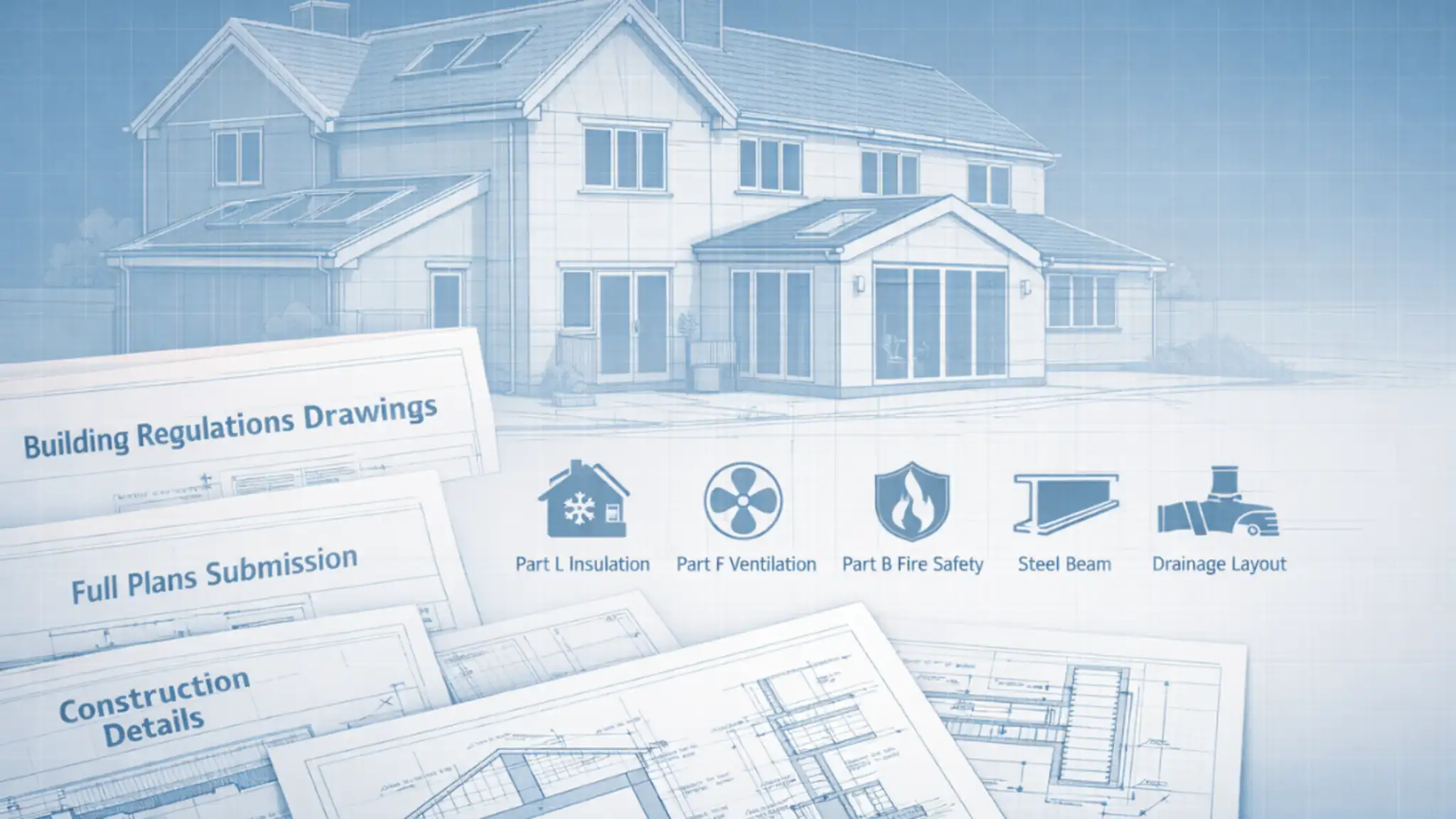
Every designer has their own approach, but a solid Building Regulations drawing set typically includes:
- Existing and proposed plans (with enough detail for Building Control, not just layout).
- Sections showing floor/roof build-ups, ceiling heights, insulation, and structural formation.
- Construction details (e.g., lintels, cavity closers, damp proofing, junctions, roof edges).
- Thermal/energy notes (commonly referencing Part L — insulation and energy efficiency).
- Ventilation strategy (often Part F: trickle vents, extract rates, background ventilation).
- Fire safety considerations where relevant (Part B — particularly important for loft conversions and escape routes).
- Drainage layouts if you’re adding bathrooms/kitchens or altering underground drainage.
- Specification notes that clarify products/performance where drawings alone can’t.
If you want a dedicated breakdown of what’s required, our guidePlans for Building Regulations – what drawings you need and whengoes into more depth.
Full Plans vs Building Notice: which is safer?
When homeowners ask, “Do I need Building Regulations drawings?”, what they’re often really asking is: should I use Full Plans or Building Notice?
Full Plans (recommended for most homeowners)
With Full Plans, you submit your drawings and details before work starts. Building Control checks them and (if acceptable) issues an approval. It’s generally the calmer route because problems are found early, on paper — not on site.
Building Notice (faster to start, but higher risk)
Building Notice can be fine for smaller, straightforward work, but you’re effectively relying on inspections and on-site agreement. If something isn’t compliant, you may only find out when it’s already built.
We explain the pros and cons in plain English here:Building Notice vs Full Plans – which route is best?
Unsure whether Full Plans is worth it for your project?
We’ll help you choose the right Building Control route and outline what drawings and calculations you’ll realistically need.
Who does Building Regulations drawings?
You don’t have to use a registered architect. Building Regulations drawings are commonly prepared by:
- Architectural technologists / technicians (often very cost-effective for householder work).
- Architects (particularly where design development is still evolving).
- Design-and-build firms (sometimes bundled into the build cost — check what you get).
- Specialist plan-drawing practices (often focused on compliant packs and submissions).
The key is not the job title — it’s whether they regularly produce drawings that Building Control accepts, and whether they can coordinate with a structural engineer when needed.
If your project includes steels, beams, or structural openings, you’ll likely need an engineer’s input too. Our guide toStructural calculations: when do you need them?explains the typical triggers.
Costs and timescales
Costs for Building Regulations drawings vary, but the biggest drivers tend to be:
- Project type: a simple single-storey extension is different to a loft conversion with stairs and escape considerations.
- How much detail is needed: drainage changes and thermal upgrades usually increase the drawing workload.
- Engineer coordination: steels/openings/foundations require calculations and sometimes revisions.
- How finalised your design is: more design changes = more drawing revisions.
Timescales also depend on workload, complexity, and how quickly you can answer queries (e.g., confirming finishes, heating approach, glazing, drainage points). A well-briefed project usually moves faster.
Step-by-step: how to get Building Regulations drawings
If you want a smooth run to approval, this simple process helps.
Step-by-step checklist for Building Regulations drawings
- Confirm your scope. Extension, loft conversion, garage conversion, internal knock-through, new bathroom, etc.
- Check planning status. If you’re not sure whether you need planning, start here:Do I Need Planning Permission?
- Freeze the layout. Agree the key design decisions (openings, roof shape, room positions) before detailing.
- Arrange a measured survey (if needed). Accurate existing information makes compliant details easier.
- Produce the Building Regulations drawings pack. Include sections, details, notes and specs — not just plans.
- Coordinate structural calculations. Especially for steels, openings, lintels, and structural alterations.
- Submit via Full Plans (usually best). Get plan checking done before work begins.
- Keep the pack on site. Your builder and Building Control should be working to the same information.
- Track changes properly. If anything changes on site, record it and check it stays compliant.
Common pitfalls (and how to avoid them)
“We’ll figure it out on site” (expensive phrase)
Some builders are excellent — but Building Control still needs compliance. If key details aren’t agreed up front (insulation thickness, ventilation approach, steel sizes, drainage falls), the “figure it out later” approach often becomes delays and variations.
Not allowing for ventilation and energy requirements early
Parts L and F commonly affect details like insulation thickness, airtightness approach, trickle vents, extract fan rates and duct runs. If these aren’t designed in early, you can end up with awkward bulkheads, reduced ceiling heights, or rework.
Forgetting drainage and “building over sewers” constraints
If your extension affects manholes, drains or public sewers, you may need extra checks and approvals. This can influence design and build method. See:Building Over Sewers – what you must know.
Related comparisons homeowners often search
If you’ve been Googling around this topic, these are the “comparison” questions we hear most often — and they’re worth getting clear before you commit:
- Building Regulations drawings vs planning drawings: planning is “is it acceptable?”, regs are “is it compliant and buildable?”.
- Building Notice vs Full Plans: faster start vs lower risk (especially for complex work).
- Building Regulations approval vs completion certificate: approval is the check up front; the certificate is the sign-off at the end.
For the bigger picture, this support stone ties into our pillar guide:Building Regulations: Complete Homeowner’s Guide.
FAQs: Building Regulations drawings
What are Building Regulations drawings?
They’re the technical plans and notes used by Building Control to check that your project meets Building Regulations. They include construction details (not just layouts) such as insulation build-ups, structural formation, fire safety considerations, ventilation and drainage where relevant.
Do I need Building Regulations drawings for an extension?
In most cases, yes — especially if you want a calmer, lower-risk Full Plans approval before work starts. Some extensions can use Building Notice, but it tends to be riskier when the design is complex, structural work is involved, or drainage is changing.
What drawings do you need for Building Regulations approval?
Typically: existing and proposed plans, key sections, and construction details showing how the work meets relevant parts of the regulations. Many projects also need specification notes and structural calculations (for beams, openings, foundations, etc.).
Who does Building Regulations drawings — do I have to use an architect?
No. Many Building Regulations packs are produced by architectural technologists, technicians or specialist plan-drawing practices. What matters most is experience producing Building Control-ready drawing sets and coordinating with a structural engineer when needed.
How much do Building Regulations drawings cost in the UK?
It varies by project type and complexity. A typical householder range is often around £800–£2,000+, with structural calculations commonly charged separately where needed. The easiest way to compare is to confirm what’s included (details, notes/specs, revisions, submission support).
Are Building Regulations drawings the same as “building control drawings”?
Homeowners use the phrases interchangeably. In practice, both usually mean a technical drawing pack suitable for Building Control — typically submitted under Full Plans so the details are checked before you build.
Can I do Building Regulations drawings myself?
Technically yes, but it’s uncommon unless you have construction detailing experience. The risk is missing key details (especially around thermal performance, ventilation, structure and fire safety), which can cause failed inspections or expensive revisions mid-build.
Want a quick sense-check before you pay for drawings?
We’ll tell you what Building Control is likely to expect for your type of project and where homeowners often overspend (or under-spec) their drawing pack.
Next steps & useful guides
If you’re moving from “idea” to “ready to build”, these guides usually help homeowners next:
- Plans for Building Regulations (UK Guide) – What Drawings You Need & When
- Building Control: What It Is, When You Need It, and How to Pass Inspections First Time
- Building Notice vs Full Plans – Which Route is Best?
- Structural Calculations: When Do You Need Them?
- Planning Permission Drawings: A Complete Guide for Homeowners
- Extension Drawings Explained – What’s Included and Why You Need Them
- What they areTechnical drawings and notes used by Building Control to check compliance before and during construction.
- Best route for most projectsFull Plans (pre-check) is usually calmer and lower risk than relying on Building Notice for complex work.
- Typically includePlans, key sections, construction details, and specification notes (plus drainage/fire/ventilation details where relevant).
- Often required alongsideStructural calculations for beams, openings, foundations and other structural changes.
- Why they matterThey reduce delays, reduce on-site disputes, and make passing inspections (and getting a completion certificate) much easier.
- Common homeowner mistakeStarting work without enough detail — then paying for redesigns and remedial work mid-build.
Want to avoid “surprises” later? Send us your project details and we’ll recommend the right drawings and approval route.
Official guidance
For national guidance and up-to-date information, it’s always worth checking:
- Planning Portal – national planning guidance and application information
- GOV.UK – planning permission in England and Wales
How Plans Made Easy can help
Building Regulations drawings are one of those things that feel “optional” right up until they aren’t. If your builder is on site and Building Control asks for missing details, it’s usually stressful and expensive.
Our team helps homeowners prepare clear, compliant drawing packs, coordinate structural information, and choose the right Building Control route — so you can build with fewer surprises and get your completion certificate without drama.
Ready to move your project forward?
Plans Made Easy can prepare compliant plans, manage submissions, and guide you from idea to approval.

Performance Verified ✅
This page meets PME Optimisation Standards — achieving 95+ Desktop and 85+ Mobile PageSpeed benchmarks. Verified on

