
Share this post:
Quick summary: Planning Permission Garden Building
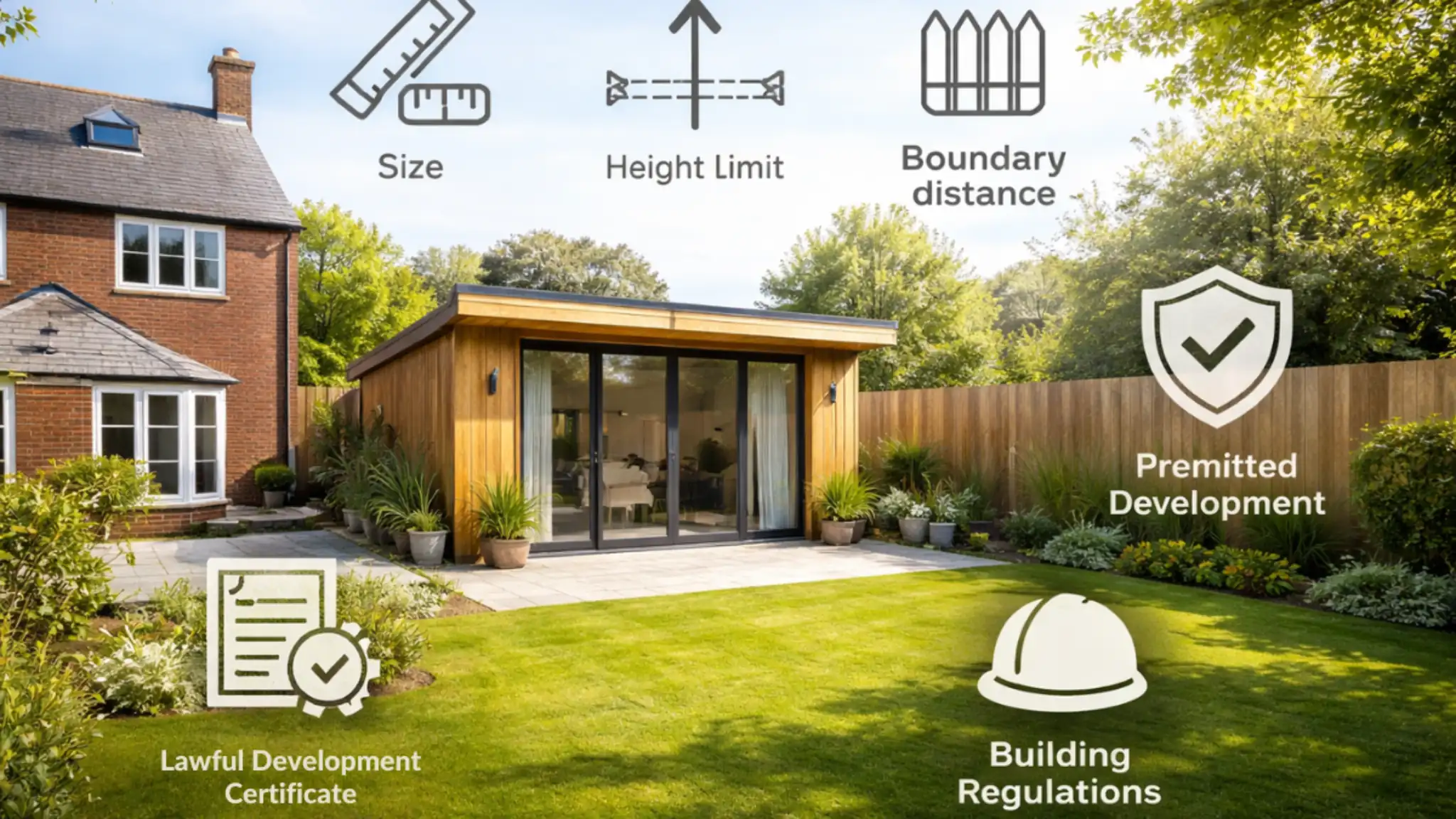
If you’re looking up Planning Permission Garden Building, the good news is that many garden buildings (sheds, studios, garden offices and small outbuildings) can be built under Permitted Development — as long as you stay within size, height and location limits.
- Most “everyday” garden buildings don’t need a full planning application if they are ancillary to the house (not a separate home) and meet PD limits.
- Height and boundary position are two of the biggest “caught out” areas — especially for garden offices and studios.
- Conservation areas, listed buildings and Article 4 areas often have tighter rules (or remove PD rights).
- Building Regulations can still apply even if planning permission doesn’t — particularly if you’re creating a habitable space with electrics, insulation and heating.
In this guide, we explain the practical checks homeowners should do before building, plus when it’s sensible to apply for a Lawful Development Certificate for peace of mind.
Not sure if your garden building needs permission?
Share your rough size, position and use — we’ll sense-check it against Permitted Development rules and flag any common risks before you commit.
Quick summary: Planning Permission Garden Building
A Planning Permission Garden Building question usually comes down to four things: use (what it’s for), size, height, and where it sits in the garden. Many garden buildings are allowed under Permitted Development, but it’s easy to break the rules by accident — particularly near boundaries, in conservation areas, or when the building becomes a “real room” with electrics, insulation and heating.
If you want the lowest-stress route, consider getting clear drawings and applying for a Lawful Development Certificate (LDC) where appropriate — it’s often the easiest way to prove it was lawful if you sell or if a neighbour complains later.
Planning Permission Garden Building: what most homeowners need to know
Garden buildings have exploded in popularity — offices, gyms, studios, teenage dens, and “a quiet room” away from the main house.However, councils don’t look at a garden building based on what you call it. They look at what it is, how it’s used, and whether it meets the relevant rules.
For most UK homeowners, the main question isn’t “can I build it?” — it’s “can I build it without a full planning application?”That’s why Planning Permission Garden Building searches usually lead to Permitted Development (PD).
Before you think about numbers and measurements, get one thing clear: your garden building must normally be incidental/ancillary to the enjoyment of the dwellinghouse (in plain English: it supports the main home, not a separate home).
- Usually OK: home office, gym, hobby room, storage, garden studio, occasional guest space (without creating a separate dwelling).
- Higher risk: self-contained living accommodation (kitchen + bathroom + sleeping as an independent unit), or a space used as a separate rental/annexe without the right consents.
Do you need planning permission for a garden building?
The honest answer is: sometimes. Plenty of garden buildings fall under PD, but you need to check against a short list of “deal-breakers”.If any of these apply, you are much more likely to need a formal application.
Common reasons a garden building needs a planning application
- You live in a flat/maisonette (PD rights are more limited than for houses).
- Your home is listed (you may need Listed Building Consent, even for works that feel “minor”).
- You’re in a conservation area, National Park, AONB, or similar designated land (restrictions can be tighter).
- There’s an Article 4 Direction removing PD rights in your area.
- The building is too tall, too close to the boundary at a tall height, or takes up too much of the plot.
- It becomes a separate unit (kitchen/bathroom + independent living can shift the planning balance quickly).
If you want a bigger-picture view of how councils assess applications and what “permission” actually means, link to our main permissions guide here:our complete homeowner guide.
Permitted Development rules for a garden building (size, height, boundaries)
Most “do I need planning” confusion comes from height and location rules. Homeowners often design a garden office, then later discover it’s too tall at the boundary, or it sits forward of a line the council considers the “front” of the house.
1) Height limits are the big one
In many typical PD scenarios, you’ll need to keep a close eye on:
- Overall height (especially with pitched roofs and raised bases).
- Eaves height (often overlooked when roof overhangs are included).
- Distance to the boundary (the closer it is, the more careful you need to be).
2) Where it sits in the garden matters
Garden buildings under PD are generally expected to be to the side or rear of the house, not positioned in a way that effectively creates a new “front” structure.This matters most on corner plots, long gardens, or properties with unusual access/drive arrangements.
3) Plot coverage and “how big can a garden building be without planning?”
Councils and PD rules typically limit how much of the land around your original house can be covered by outbuildings and extensions.Practically, this means your garden building should be sized sensibly, leaving a reasonable amount of garden space.
4) Use: shed vs garden office vs garden room
A shed used for storage is rarely controversial. A garden office or studio is still often fine under PD, but it tends to:
- be larger and closer to boundaries,
- have more glazing and a stronger visual impact, and
- include electrics, heating, insulation (which can trigger Building Regulations considerations).
If you want a focused read for those project types, these are useful next steps:shed rules guide andgarden room rules guide.
Planning permission vs Building Regulations for garden buildings
One of the most important homeowner misunderstandings is assuming:“No planning permission needed” = “no rules”.In reality, planning permission and Building Regulations do different jobs.
Planning permission is about impact
- How the building looks and sits in the plot.
- Neighbour impact (privacy, overshadowing, noise, overlooking).
- Local policies (design, character, conservation constraints).
Building Regulations are about safety and performance
- Structure, insulation and energy efficiency.
- Electrical safety, ventilation, drainage (where relevant).
- Fire safety provisions and safe access/escape.
If you’re building something that feels like a “real room”, you should assume Building Regulations may be in play — and get clarity before you build.You can read our overview here: Building Regulations guide.
Not sure if your idea fits Permitted Development?
We’ll check your garden building against PD rules and tell you if you need a full planning application.
Step-by-step: how to check your garden building properly
If you want to avoid delays (and avoid building something you later have to change), follow this practical process.It’s the same approach we use to sense-check homeowners’ ideas quickly.
Step-by-step: Planning Permission Garden Building checklist
- Define the use clearly. Storage? Office? Gym? Guest room? If it’s edging towards a self-contained unit, pause and get advice early.
- Measure your garden and boundaries. Know the true distance to fences/walls, and note any slope that could affect “height”.
- Sketch the size and roof type. Pitched roofs often add height quicker than you expect.
- Check constraints on the property. Listed building, conservation area, Article 4, or restrictive conditions from earlier approvals.
- Check Permitted Development limits. Focus on height, boundary position, and overall plot coverage.
- Decide whether to apply for an LDC. If you want proof it’s lawful (especially for larger garden rooms/offices), an LDC can be a sensible “paper shield”.
- Confirm Building Regulations requirements. Particularly if you’re adding insulation, heating, electrics, drainage or creating a year-round habitable room.
- Get drawings that match reality. Good drawings help planning, help Building Control, and stop builders quoting “blind”.
If you want a quick yes/no style starting point, you can also use:our permission checklist.
Pitfalls & gotchas that trigger council problems
“No planning needed” isn’t the same as “no neighbour impact”
Even where PD applies, neighbours can still complain — and if your building breaches PD limits, the council can ask you to alter it or remove it.That’s why accuracy matters: it’s not the idea that causes pain, it’s the detail.
Electrics, heating and year-round use can change the conversation
A basic shed is simple. A garden building that’s insulated, heated and used daily as a workspace is still often fine — but it’s more likely to trigger Building Regulations considerations, and it’s more likely to be scrutinised if it looks out of scale.
Local council “quirks” and designated land
Some councils are stricter on design, overlooking, or garden development impact — and designated land (conservation areas etc.) can tighten what’s allowed under PD.If anything about your site feels non-standard, it’s usually worth getting a quick professional check before you spend money on the build.
Related comparisons homeowners often Google
When you research a garden building, these comparisons often come up — and they’re worth understanding before you decide how to proceed:
- Planning permission vs Building Regulations — different systems, different triggers, both can apply.
- Garden office vs garden room — the more “habitable” it becomes, the more careful you need to be.
- Garden building in England vs Scotland — similar concepts, different rulebooks.
- Permitted Development vs full planning — PD is a set of limits; full planning is a formal approval route.
FAQs: Planning Permission Garden Building
Do you need planning permission for a garden office?
Often, no — many garden offices are allowed under Permitted Development. However, you must stay within the relevant limits on height, position (especially near boundaries), and plot coverage, and it must remain ancillary to the main house (not a separate dwelling). If you’re close to the limits, an LDC can provide peace of mind.
Is planning permission required for a garden shed?
A typical small shed is commonly fine under Permitted Development, but problems arise when sheds are unusually large, too tall, or positioned in a sensitive spot (for example, in front of the house, or within restricted areas). Also check whether your property has constraints such as conservation status or Article 4 restrictions.
How big can a garden building be without planning permission?
There isn’t one single “safe” size for every home because the answer depends on height, boundary distance, how much of the plot is already covered by extensions/outbuildings, and whether PD rights apply to your property at all. If you’re designing something substantial, it’s worth a quick check before build costs ramp up.
How tall can a garden building be without planning permission?
Height is one of the most common reasons a garden building accidentally breaks PD rules. Roof type, ground slope, and raised bases can all affect the final height. If you’re near a boundary or using a pitched roof, measure carefully and consider drawings that show heights clearly.
Do garden buildings need Building Regulations even if planning permission isn’t required?
Sometimes, yes. Planning and Building Regulations are separate systems. If your garden building is becoming a “real room” (insulated, heated, electrics, potentially plumbing), Building Regulations questions come up more often. It’s smart to confirm the position early so you don’t end up redoing work or struggling to evidence compliance later.
Do the rules change for a garden building in Scotland?
Yes — Scotland has its own planning framework and permitted development rules. The general principles (size, height, location, use) are still relevant, but the specific limits can differ. If you’re in Scotland, treat any PD guidance as a prompt to check your local council’s rules before you build.
Want a quick, clear answer before you build?
We can review your proposed size and position and tell you the most likely route — PD, LDC, or a full application.
Next steps & useful guides
If you want to go one level deeper, these guides are usually the most helpful alongside a garden building project:
- Outbuildings explained
- Outbuildings permissions checklist
- Garden room rules guide
- Shed rules guide
- Building Control explained
- Most common routeMany garden buildings can be built under Permitted Development, but only if you stay within the limits on use, height, and location.
- Biggest risk areasHeight near boundaries, raised bases, sloping gardens, and properties with restricted PD rights (conservation areas, listed buildings, Article 4).
- Planning vs Building RegsThey’re separate. You can be “OK on planning” but still need to address Building Regulations for a habitable garden room/office.
- Peace-of-mind optionA Lawful Development Certificate can be a smart move if you’re close to the limits or want clear proof for future sale.
- Best homeowner habitGet accurate measurements and drawings early — it reduces redesign, neighbour complaints, and enforcement risk.
If you want us to sense-check your proposal, message the Plans Made Easy team with your rough dimensions and a photo of the garden.
Official guidance
For the most up-to-date official guidance, it’s always worth checking:
- Planning Portal – national guidance and application information
- GOV.UK – planning permission in England and Wales
How Plans Made Easy can help
Getting a garden building right is usually about avoiding the “small detail” mistakes — heights, boundaries, constraints on the property, and whether the space becomes a habitable room.With the right checks up front, you can avoid expensive changes later and keep the project moving smoothly.
Our team can prepare clear drawings, advise on the most sensible permission route (PD, LDC or full planning), and help you avoid the common pitfalls that trigger council delays.
Ready to move your project forward?
Plans Made Easy can prepare compliant plans, manage submissions, and guide you from idea to approval.
Performance Verified ✅
This page meets PME Optimisation Standards — achieving 95+ Desktop and 85+ Mobile PageSpeed benchmarks. Verified on

