
Share this post:
Planning Permission Garden Room rules usually fall under permitted development (PD) in England — which means many garden rooms can be built without a planning application. However, the detail matters: size, height, boundary distance, conservation area restrictions, and whether the use is “incidental” to the house.
Quick summary: Planning Permission Garden Room
- Many garden rooms don’t need planning permission if they meet PD rules (typically under GPDO Class E).
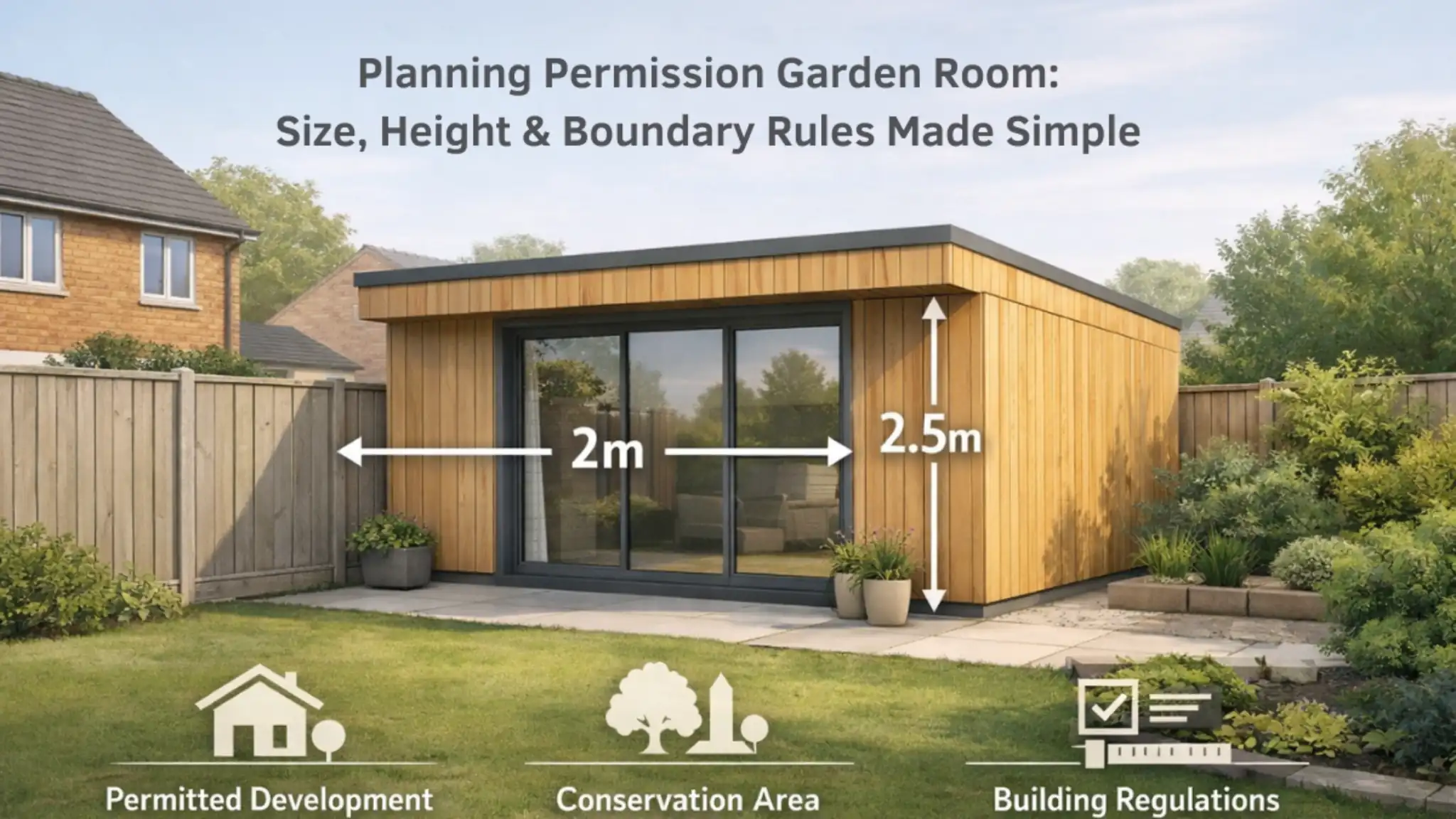
- Height is the biggest “gotcha”: within 2m of a boundary, the overall height is usually limited to 2.5m.
- It must be incidental to the main home (not a separate dwelling or self-contained accommodation).
- Conservation areas and Article 4 directions can tighten the rules — always double-check locally.
- Building Regulations can still apply even when planning permission isn’t needed (especially if it’s heated/insulated and used as a proper room).
Key Facts Snapshot
- Typical PD route: Outbuildings under Class E (incidental use)
- Common height limit near boundaries: 2.5m within 2m of the boundary
- Common planning triggers: Conservation areas/Article 4, listed buildings, forward-of-house positioning, unusual scale, neighbour impact
- Timeframe if you do apply: Often 8 weeks for a householder application (longer if extra reports are needed)
- Best next step: Get a PD check + simple drawings so you don’t build “blind” and run into problems later
This guide is written for homeowners in England. Rules can differ in Scotland, Wales and Northern Ireland, and your local council may also have specific restrictions (for example, Article 4 directions).
What this guide covers
- Do I need planning permission for a garden room?
- Permitted development rules for a garden room (Class E)
- Garden room size limits without planning permission
- Garden room height rules (including the 2m boundary rule)
- Garden room near boundary rules (what councils look for)
- “Incidental use” explained: office vs living space vs annexe
- Conservation areas, listed buildings & Article 4 directions
- Building Regulations for garden rooms (often misunderstood)
- Cost & timeline if you do need planning permission
- How to get a quick, confident yes/no before you start
- FAQs
Planning Permission Garden Room questions normally come down to one thing: does it qualify as permitted development (PD)? If it does, you may not need a planning application — but you still need to get the basics right (especially height, boundary distance, and the intended use).
Note: This article supports our pillar guide: Planning Permission (UK): The Complete Homeowner’s Guide. If you’re unsure how PD works in general, that guide is the best place to start.
Permitted development rules for a garden room (Class E)
Most garden rooms are treated as outbuildings. In England, the usual PD route is under Class E (outbuildings incidental to the enjoyment of the dwellinghouse). In plain English, that means the building must be:
- Within your property’s “curtilage” (your house and the surrounding land that forms the domestic garden area), and
- Not forward of the principal elevation (so, typically not in your front garden), and
- Used for something incidental to the home (more on this below), and
- Within size/height/coverage limits.
Important: PD rights can be restricted or removed — for example by Article 4 directions, planning conditions on newer estates, or if the property is listed. If any of these apply, you may need permission even for a modest garden room.
If you want a deeper PD overview, our team also covers outbuildings more broadly here: Outbuildings Explained – What You Can (and Can’t) Build Without Permission.
Garden room size limits without planning permission
There isn’t a single “maximum square metre” rule that applies in all cases. Instead, councils and PD rules usually focus on:
- How much of your garden is covered by buildings (including sheds and other outbuildings), and
- Whether the scale looks reasonable compared to the house and plot.
Garden coverage rule (the one most people miss)
A common PD restriction is that buildings (including outbuildings) shouldn’t cover more than roughly half of the curtilage. That doesn’t mean “half of the lawn” — it means half of the total garden/land area around the original house. If you already have a large shed, garage, extension, or previous outbuildings, this can become the limiting factor.
Tip: If your garden room is close to the limit, a simple site plan and footprint check can save you a lot of grief later — especially if you plan to sell and your solicitor asks for evidence it was lawful.
“Largest garden room without planning permission” — what’s realistic?
In practice, the “largest” garden room you can build under PD is usually controlled by height and boundary distance, not a headline floor area number. That’s why many big garden rooms end up needing a planning application — not because they’re huge inside, but because they’re too tall, too close to a boundary, or feel dominant for the plot.
If you’re specifically cost-led, you may also find this helpful: Our complete cost guide for planning applications.
Garden room height rules (including the 2m boundary rule)
Height is where many homeowners accidentally fall outside PD. For outbuildings, the typical PD height rules are:
- Within 2 metres of a boundary: maximum overall height is usually 2.5 metres
- More than 2 metres from a boundary: maximum overall height is typically 4 metres for a dual-pitched roof, or 3 metres for other roof types
- Eaves height: often limited (commonly 2.5 metres)
Important: “Height” is measured to the highest point of the roof. If you’re adding a thick warm roof build-up, parapet details, roof lanterns, or a shallow pitch, those can push you over the limit even when the design looks low.
Garden room height vs internal ceiling height
If you’re aiming for a comfortable internal ceiling height, it’s very easy to exceed 2.5m overall — especially if you want:
- proper insulation and a warm roof build-up
- fall for drainage on a flat roof
- ceiling downlights and services voids
That doesn’t mean you can’t do it. It just means you should design it properly from the start so you’re not forced into compromises halfway through the build.
For homeowners who want to understand the drawing requirements before committing, this is a good next read: Planning Permission Drawings: A Complete Guide for Homeowners.
Garden room near boundary rules (what councils look for)
Even when your garden room meets the basic PD measurements, councils can still get involved if a neighbour complains and the build looks out of character or creates clear harm. The most common pressure points are:
- Overlooking (especially if you’ve raised floor levels or have large glazed doors facing a neighbour)
- Overshadowing (a tall wall close to the boundary can block light)
- Noise (home gym, music room, workshop use)
- Boundary fire risk (particularly with timber cladding and close separation)
Note: PD is not a “free pass” to ignore neighbours. You can be within PD and still end up with an enforcement-style headache if the development is materially different from what PD allows (for example, too tall, used as accommodation, or sited illegally).
Garden room with toilet or bathroom — is that allowed?
A toilet doesn’t automatically trigger planning permission. However, it does raise a sensible question: is the building still “incidental”, or is it becoming a separate unit of accommodation?
As a rule of thumb:
- WC for an office / studio use: often fine (planning-wise) if everything else is compliant
- Shower room + kitchenette + sleeping space: much more likely to be treated as an annexe or separate accommodation, which may require planning permission and Building Regulations compliance
“Incidental use” explained: office vs living space vs annexe
“Incidental” is one of those planning terms that causes confusion. It doesn’t mean “minor” or “small”. It means the use is secondary to the main house.
Examples that are typically incidental
- home office
- gym / hobby room
- studio (art/music) used by the household
- garden storage combined with a workspace
Examples that can trigger planning permission
- self-contained accommodation (sleeping + cooking + living as a separate household)
- primary living space that effectively replaces the main home’s living areas
- business use that materially changes the character of the property (clients visiting, deliveries, noise, staff)
Important: If your aim is an annexe-style building, you’re no longer in “simple PD garden room” territory. You may need planning permission, Building Regulations approval, and sometimes extra considerations like parking, access, and amenity space.
Conservation areas, listed buildings & Article 4 directions
If your property is in a conservation area, PD rights can still exist — but there are often extra sensitivities around design, siting and visibility. Even more importantly, some areas have Article 4 directions that remove certain PD rights entirely.
For a clear homeowner explanation, see: Conservation Areas (UK): Rules, Consent & What You Can Do.
Listed buildings (and curtilage listed buildings)
If your home is listed — or you have structures within the curtilage that are treated as listed — you should assume a garden room will need careful advice. In many cases, PD is restricted and you may need Listed Building Consent in addition to any planning decision.
More detail here: Listed Buildings: Thinking about works on your listed property?.
Building Regulations for garden rooms (often misunderstood)
Planning permission and Building Regulations are separate systems. So even if you don’t need planning permission, you may still need to consider Building Regulations — especially if the garden room is a proper, heated, insulated space.
Our dedicated guide is here: Building Regulations for Garden Rooms – What You Need to Know Before You Build.
When garden rooms are often exempt (typical scenarios)
Some detached, single-storey garden buildings can be exempt from Building Regulations depending on size, use, and boundary proximity. Common exemption-style scenarios include:
- Very small buildings used for storage, or
- Detached buildings with no sleeping accommodation where fire separation to the boundary is appropriate, or construction addresses fire risk.
Note: Even where the structure is exempt, electrical work is still safety-critical, and certain electrical work is notifiable (Part P). If you’re running power, lighting, heaters, or data, do it properly and keep your paperwork.
If it’s heated and insulated, Part L often matters
If you’re creating a comfortable year-round room (especially with fixed heating), Building Control may expect the build-up to meet energy efficiency standards. That affects wall thickness, roof build-up, glazing spec, and ventilation — which then feeds back into the overall height and PD compliance.
If you’d like a broader Building Regs overview, start here: Building Regulations: Complete Homeowner’s Guide.
Cost & timeline if you do need planning permission
If your design falls outside PD (often because of height near a boundary, scale, or intended use), you’re into a householder planning application. As a very general guide:
- Decision timeframe: commonly around 8 weeks (but it can be longer if there are constraints or amendments)
- Main costs: application fee, drawings, and sometimes supporting information (for example, heritage statements in sensitive areas)
Two useful reads if you’re planning an application:
- Planning Permission Timelines (UK Guide)
- Planning Permission Cost (UK): Complete Guide for Homeowners
Important: If you’ve already built a garden room and you’re worried it isn’t compliant, don’t panic — but don’t ignore it either. Retrospective applications are possible in some situations, yet they carry risk. The safest route is to get the facts checked against PD rules and your site conditions.
How to get a quick, confident yes/no before you start
If you want certainty before spending money, here’s what we recommend:
- Confirm constraints: conservation area, listed status, Article 4 direction, planning conditions on the property.
- Sketch the siting properly: where it sits, distance to boundaries, and what else is already in the garden.
- Check heights from the right reference point: include roof build-up, falls, and any raised decking/platforms.
- Be clear on use: office/studio/gym vs anything that looks like accommodation.
- Keep evidence: drawings, emails, and confirmations for your records (it helps during sale and avoids disputes later).
Want us to sanity-check your garden room design?
Our team can review your proposed size, height and siting against permitted development rules, flag risks early, and tell you the cleanest route to approval if planning permission is needed.
FAQs: Planning Permission Garden Room
Do I need planning permission for a garden room?
Often, no — many garden rooms in England can be built under permitted development (Class E). However, you may need planning permission if the garden room is too tall (especially near the boundary), covers too much of the garden, is sited in front of the house, is used as accommodation, or if your PD rights are restricted (for example, conservation area Article 4 or planning conditions).
What size garden room can I build without planning permission in the UK?
There isn’t one single “maximum size” number that applies everywhere. In practice, PD compliance is usually limited by height rules, boundary distance, and how much of your garden is already covered by buildings. A properly designed garden room can be generous, but it must still feel proportionate for the plot and meet the PD limits.
How big can a garden room be without planning permission if it’s near a boundary?
When the building is within 2 metres of a boundary, the key restriction is usually the maximum height (commonly 2.5m overall). That height limit often dictates the design and usable internal space more than the footprint does.
What is the maximum garden room height without planning permission?
Height limits depend on roof type and boundary distance. A common rule is 2.5m overall height within 2m of a boundary. Further away from the boundary, taller roofs may be possible (for example, dual-pitched roofs are often allowed higher than flat roofs). Always measure height properly, including roof build-ups and any raised platforms.
Can I build a garden room with a toilet without planning permission?
Sometimes, yes — a WC doesn’t automatically mean planning permission is required. The bigger question is whether the building becomes self-contained accommodation. If you add facilities that make it feel like a separate living unit (sleeping/cooking/living independently), you’re much more likely to need planning permission and full Building Regulations compliance.
Do conservation areas change garden room planning rules?
They can. You may still have permitted development rights in a conservation area, but there can be extra restrictions and greater sensitivity around siting and appearance — plus some areas have Article 4 directions that remove certain PD rights. If your home is listed, the approach is different again and you may need Listed Building Consent.
Does Scotland / Northern Ireland have the same garden room rules?
No — the detailed permitted development rules differ across the UK. This guide is written for England. If you’re in Scotland, Wales, or Northern Ireland, you should check the relevant local rules and guidance (and your local authority’s requirements) before committing to a design.
Do I need Building Regulations approval for a garden room?
Possibly. Planning and Building Regulations are separate. Some small detached garden buildings can be exempt depending on size, use, and boundary separation, but heated/insulated garden rooms often raise Building Control expectations (especially around energy efficiency, electrical safety, ventilation and fire separation). If in doubt, get advice before you build.
Next step: avoid problems before they start
If you want a stress-free project, the best time to check planning and building regs is before you order the garden room or pour foundations. We can confirm the likely route (PD vs planning), flag site constraints, and help you prepare the right drawings if you need an application.

Performance Verified ✅
This page meets PME Optimisation Standards — achieving 95+ Desktop and 85+ Mobile PageSpeed benchmarks. Verified on

