
Share this post:
Quick summary: planning permission dorset
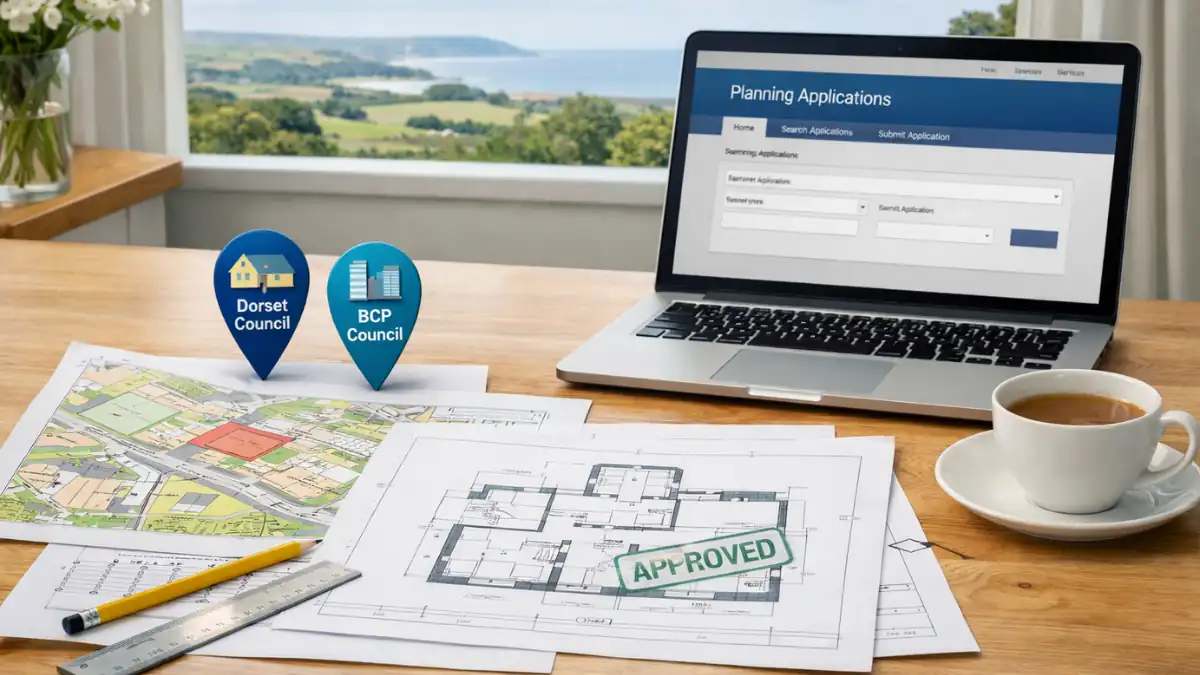
If you’re researching planning permission dorset, the first thing to know is that “Dorset” can mean two different planning authorities: Dorset Council (most of the county) and BCP Council (Bournemouth, Christchurch and Poole). The rules are broadly the same nationally, but the local policies, constraints and validation checklists can differ.
- Step 1: confirm which council area your home sits in (Dorset Council vs BCP).
- Step 2: check whether your project might be Permitted Development (no full application needed) or if you should apply.
- Step 3: prepare the right drawings and documents so the application is validated first time.
- Step 4: remember that Building Regulations is a separate approval route (many projects need both).
In this guide, we’ll walk you through how homeowners typically apply locally, what you’ll need, common Dorset-specific “gotchas”, and how to avoid delays.
Not sure which Dorset council handles your application?
Tell us your postcode and a sentence about your project — we’ll point you to the right local authority and explain what you’re likely to need before you submit.
Planning permission Dorset: what it really means (and who decides)
Homeowners often search for planning permission dorset when they’re thinking about an extension, loft conversion, garage conversion, a garden room, or even buying a plot. Dorset is a big county with a mix of coastal towns, historic centres and rural villages — and that means your project can be affected by local character, neighbour impact, and sometimes heritage or landscape constraints.
The most important practical point is that Dorset has two local planning authorities. Your application must go to the right one, otherwise you lose time before you even start.
If you want a plain-English overview of how the planning system works nationally, we recommend starting withour complete UK guide(then come back here for the Dorset-specific bits).
Dorset Council vs BCP: Christchurch, Poole, Dorchester and beyond
Dorset homeowners commonly get caught out by council boundaries — especially around Christchurch, Poole and Bournemouth. In simple terms:
- Dorset Council covers most of the county (including places like Dorchester, Weymouth, Bridport, Sherborne, Gillingham and many villages).
- BCP Council covers Bournemouth, Christchurch and Poole.
Each council publishes its own planning pages (how to submit, how to comment, what to upload, and local validation requirements). If you’re looking for a “Dorset planning contact” page, go via the official council site for your authority rather than relying on old directory results.
You’ll also see search terms like “planning permission Christchurch Dorset” or “planning permission Poole Dorset”. The key thing is simply this:Christchurch and Poole fall under BCP Council, not Dorset Council.
Do you need permission in Dorset, or is it Permitted Development?
Many home projects in Dorset are possible under Permitted Development (PD) — especially straightforward rear extensions, some loft conversions, and certain outbuildings. However, PD has strict limits, and the details matter (height, depth, materials, roof shape, proximity to boundaries, and whether the property has had rights removed).
If you want a quick “yes/no” starting point, our guidehelps you check the common scenarios.It’s a good first read before you spend money on drawings.
If you’re unsure, many homeowners choose to apply for a Lawful Development Certificate (LDC) when using PD. It’s optional, but it gives you written confirmation that your proposal is lawful — which can really help when you sell.
Planning application types you’ll see in Dorset
For most homeowners, the application route falls into one of these buckets:
- Householder application — typical for extensions, dormers, porches and external alterations to a single home.
- Lawful Development Certificate (proposed) — to confirm PD status before you build.
- Prior approval — used for certain PD rights where the council must assess specific impacts (for example, neighbour impact on larger rear extensions).
- Listed building consent — if your home is listed (this is separate to the main application process).
Dorset Council specifically encourages homeowners to consider pre-application advice for trickier schemes, so you can identify issues early and avoid submitting the wrong information.
What you need to submit (drawings + documents)
Whether you apply through Dorset Council or BCP, the quality and completeness of your submission is what gets you validated quickly. For a typical householder project, you’ll usually need:
- Location plan and block/site plan at the correct scale.
- Existing and proposed floor plans.
- Existing and proposed elevations (and sometimes sections/roof plan depending on the proposal).
- Ownership certificate and the correct application form.
- Supporting statements where relevant (for example, heritage statements in sensitive areas).
If you want a detailed breakdown of what “acceptable” drawings look like (and what councils commonly reject), these guides help:
Costs and timescales in Dorset
For most homeowners, the “headline” cost is the council fee — but in reality you also need to budget for drawings, surveys (if needed), and sometimes reports (heritage, trees, ecology, drainage).
Quick costs snapshot (homeowner projects in Dorset)
- Council application fee: in England, a typical householder application is £528.
- Drawings + submission support: varies by complexity, but this is often the main “project setup” cost (separate to the council fee).
- Extra reports: may apply in conservation areas, for listed buildings, for trees, or where there are environmental constraints.
If you want a clearer sense of what’s normal, seeour guide to typical costs.
In terms of time, most straightforward applications are decided within around eight weeks once they are validated, although larger or more complex cases can take longer.The key phrase there is once validated — which is why getting the submission right matters so much.
For a fuller timeline (including design, survey, drawings, consultation and decision), seeour timeline guide.
Want to avoid delays and resubmissions?
We can review your proposal, prepare compliant drawings, and help you submit the right documents to the right Dorset planning authority first time.
How to apply in Dorset: step-by-step checklist
If you’re thinking “how to apply for planning permission in Dorset”, this is the homeowner-friendly order we recommend. It keeps things calm and reduces the risk of expensive redesign later.
Step-by-step process (Dorset homeowners)
| Step | What you do | Why it matters |
|---|---|---|
| 1 | Confirm your local authority (Dorset Council vs BCP) | Stops misdirected submissions and lost time |
| 2 | Check constraints (conservation area, listed, trees, flooding) | Constraints often change what’s achievable |
| 3 | Decide your route: PD, LDC, prior approval, or full application | Choosing the wrong route is a classic delay |
| 4 | Get accurate existing + proposed drawings | Validation depends on clarity, scales and completeness |
| 5 | Submit via Planning Portal (most common) and pay the fee | The council can’t start until it’s submitted and valid |
| 6 | Respond quickly to any council queries during validation/assessment | Fast replies keep your application moving |
| 7 | If approved, read conditions carefully and plan Building Regs next | Conditions can affect timing, materials and build method |
Planning Portal explains the general submission route and how applications are passed to the relevant authority after payment.
Common Dorset pitfalls (and how to avoid them)
Dorset applications tend to go smoothly when the design is sensible, neighbours aren’t heavily impacted, and the submission pack is solid. Problems usually come from a handful of predictable issues:
- Boundary confusion (red line doesn’t match the title plan or doesn’t include the full curtilage).
- Overlooking local character (materials, window proportions, roof forms — especially in sensitive villages and historic streets).
- Underestimating neighbour impact (overlooking, overbearing massing, loss of light).
- Trees and hedges (TPOs and conservation area controls can affect what you can remove or alter).
- Starting too early (work beginning before you’ve got the right approvals in place).
One more Dorset-specific practical point: because homeowners often want to “check what others have done”, it’s worth learning how to view local decisions properly (and how to read conditions).Our guideshows you how to check applications in your area.
FAQs: planning permission Dorset
Which council do I apply to in Dorset?
It depends on your location. Many areas fall under Dorset Council, while Bournemouth, Christchurch and Poole are handled by BCP Council.Start from your council’s official planning pages to make sure you’re using the right portal and checklist.
How do I apply for planning permission in Dorset?
Most homeowners apply online via the Planning Portal, uploading plans and supporting documents and paying the fee at the same time. The Portal then passes the application to the relevant local authority for validation and assessment.
How long does planning permission take in Dorset?
For many householder applications, a decision is often made in around eight weeks from the point the application is validated. Larger or more complex schemes can take longer, and any validation issues can add extra time.
What are the Dorset planning rules I need to follow?
National planning rules apply everywhere, but local policies and constraints vary by area. Your proposal will be assessed against the relevant local plan policies, plus issues like design, neighbour impact, highways, trees, heritage and flood risk where applicable.If your home is in a conservation area or is listed, you should expect additional checks.For a plain-English national overview, see our UK guide.
Can I build an extension in Dorset without a full planning application?
Sometimes, yes — many extensions can fall under Permitted Development. However, the limits are strict and there are exceptions (for example, certain protected areas, or where PD rights have been removed).If you want to sanity-check your route, start with our quick checker.
How much does a Dorset planning application cost?
The council fee depends on the application type. In England, a typical householder application fee is £528, but certificates, prior approvals and other application types have different fees.Use official fee guidance for the latest figures.
I’m buying land with planning permission in Dorset — what should I check?
Ask for the full decision notice, approved drawings and all conditions. Check whether conditions have been discharged, whether time limits are still valid, and whether there are any restrictions that affect design, materials, access or drainage.Also keep all compliance documents safe — they matter later if you sell.Our guide on what paperwork to keep is a helpful checklist.
Key facts snapshot
Next steps & useful guides
If you want to keep moving without guesswork, these guides are the most useful next reads:
- typical end-to-end timelines
- what drawings councils expect
- Building Regulations explained
- what Building Control will check
- extra rules in conservation areas
- what to do if refused
External links (official guidance)
- Planning Portal guidance and online applications
- GOV.UK overview guidance
- Dorset Council planning hub
- BCP Council application guidance
Wrapping up: a calmer way to get approval in Dorset
The fastest route through planning permission dorset is usually the simplest one: confirm your local authority, choose the right application route, and submit a clean, complete set of drawings. If your home sits in a sensitive area (heritage, conservation, special landscapes), plan for an extra layer of checks and make the design feel “of its place”.
If you’d like a second pair of eyes before you submit — or you want us to handle the drawings and submission — our team can help you move forward with confidence.
Ready to move your project forward?
Plans Made Easy can prepare compliant plans, help you submit to the correct Dorset authority, and guide you from idea to approval.
Performance Verified ✅
This page meets PME Optimisation Standards — achieving 95+ Desktop and 85+ Mobile PageSpeed benchmarks. Verified on

