
Share this post:
Quick summary: How Much Does a Cellar Conversion Cost
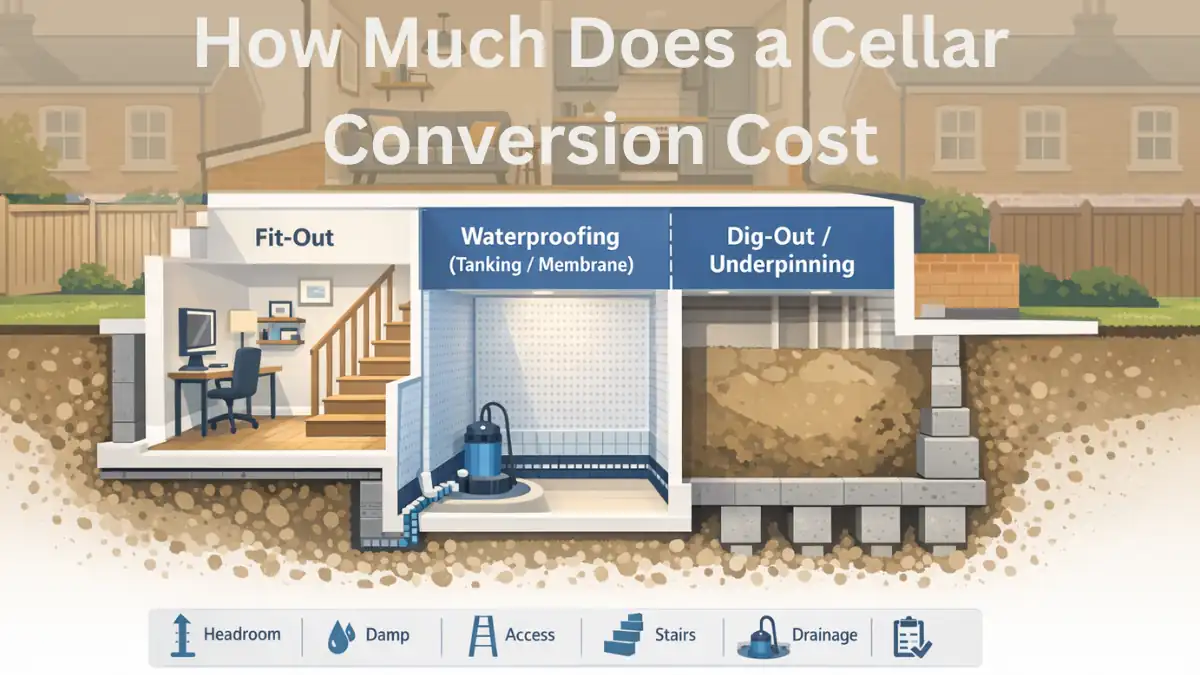
If you’re asking How Much Does a Cellar Conversion Cost, the honest answer is: it depends on whether you’re fitting out existing space, solving damp properly, or doing a full dig-out with underpinning. Those three routes sit in very different price bands.
- Fit-out of an existing cellar (best-case scenario): often £25,000–£60,000 for a typical room, depending on size and spec.
- Waterproofing + fit-out (common in older homes): frequently £40,000–£90,000+, because damp control, drainage and detailing matter.
- Dig-out / increase headroom (highest-risk, highest-cost): typically £80,000–£200,000+, especially if underpinning, restricted access, or complex temporary works are involved.
- Best budgeting rule: include a 10–15% contingency for below-ground work (sometimes more if access is tight or the structure is unknown).
In the guide below, we break down typical UK cost drivers (dig-out, tanking/waterproofing, fit-out), what building control will care about, and the “hidden extras” that catch homeowners out.
Trying to sanity-check a cellar conversion quote?
Send us the rough size, headroom, and what you want to use the space for — we’ll tell you what usually drives the cost (and what’s often missing from early quotes).
Quick summary: How Much Does a Cellar Conversion Cost
For most homeowners, the biggest swing in cost comes down to one question: are you converting an existing cellar, or creating new space?A straightforward fit-out can be manageable, but a dig-out with underpinning can move into “major build” territory very quickly.
If you’re still deciding whether the project is feasible (structure, headroom, damp risk), our team also has a deeper step-by-step guide you can read here:our underpinning and conversion process guide.
How Much Does a Cellar Conversion Cost in the UK?
If you’ve typed How Much Does a Cellar Conversion Cost into Google, you’re not looking for a sales pitch — you want a realistic range and a clear explanation of what changes the price.That’s exactly what we’ll do here.
Cellar conversion average cost: the three common routes
- Fit-out of existing space (headroom is OK, structure is sound): often £25,000–£60,000.
- Waterproofing + fit-out (very common in older properties): often £40,000–£90,000+.
- Dig-out / create more headroom (with structural work): commonly £80,000–£200,000+.
You’ll also see some companies quote per square metre.As a broad guide, a simple fit-out might sit around £1,500–£3,000 per m², while dig-outs can be £3,000–£5,000+ per m².However, per-m² pricing can be misleading if the staircase, drainage, or structural work is the real cost driver.
Quick costs snapshot: How Much Does a Cellar Conversion Cost at a glance
- Design + surveys: allow £1,500–£6,000+ (more if structural design is complex).
- Waterproofing (tanking / membrane / drainage): often £4,000–£20,000+ depending on system and size.
- New staircase / access changes: commonly £2,500–£10,000+ depending on layout and fire-safety requirements.
- Electrics + lighting: often £2,000–£8,000+ depending on spec.
- Heating + ventilation: commonly £2,000–£10,000+ depending on whether you add UFH, radiators, MVHR, etc.
- Bathroom / utility room add-on: often £5,000–£20,000+ depending on drainage complexity and finish level.
- Contingency: aim for 10–15% minimum for below-ground work.
Tip: If a quote looks “too tidy” and doesn’t mention waterproofing detail, ventilation, or building control sign-off, it’s worth slowing down and checking what’s excluded.
Cellar conversion costs UK: what actually drives the price
When we review quotes, the price differences usually come from risk and complexity, not just floor area.In other words, a smaller cellar can cost more than a bigger one if it’s damp, awkward to access, or needs major structural work.
1) Headroom: the difference between a conversion and a “new build underground”
If you already have usable head height, you’re often looking at a fit-out.If you don’t, you may need excavation (sometimes alongside underpinning) — and that’s where costs escalate.
2) Damp risk and waterproofing approach
Below-ground spaces want to be damp. The job is to manage water safely and reliably, not just hide it.Waterproofing is one of the biggest cost variables — and it’s also one of the biggest failure points if done cheaply.
3) Access and spoil removal
Terraced houses with narrow passages can add significant labour and waste handling costs.Likewise, if you need a conveyor, chute, road permits, or restricted working hours, expect your quote to reflect it.
4) Layout changes and building regs complexity
A simple “one room” arrangement is easier than multiple rooms, bathrooms, utility spaces, or a new stair position.Building Regulations commonly involve Parts A (Structure), B (Fire safety), C (Moisture), F (Ventilation), L (Energy efficiency) and P (Electrical safety).The more your design touches, the more coordination is required.(If you want a plain-English overview of how inspections and sign-off work, seeour guide to inspections and approvals.)
Dig-out and underpinning costs (when headroom is the issue)
Dig-outs are where homeowners get the biggest quote shock — because you’re no longer “renovating a room”, you’re changing how the house is supported.That normally means temporary works, structural design, careful sequencing, and close building control involvement.
What pushes dig-out costs up?
- Older properties (unknown foundations, variable walls, historic movement).
- Party wall implications if you share walls with neighbours (common in terraces/semi-detached).
- Restricted access for spoil removal and materials.
- Drainage or sewer constraints (for example, if you’re near shared drains or need permissions).
- Complex geometry (split levels, multiple rooms, tricky stair positions).
If your home adjoins neighbours, you’ll often need to consider the Party Wall etc. Act.For a simple overview of notices and typical timing, seeour guide to notices and neighbour process.
Cost of converting a cellar UK: tanking/waterproofing costs and choices
Waterproofing is one of those topics where the cheapest quote can become the most expensive mistake.The “right” system depends on ground conditions, how the space will be used, and how much risk you’re comfortable with.
Tanking vs cavity drain membrane: what’s the difference in cost?
You’ll often hear “tanking” used as a catch-all term, but in practice there are different approaches.Broadly, some systems try to block water, while others accept that water may arrive and instead manage it behind a membrane with drainage and a sump/pump.
- Basic cementitious tanking can look cheaper upfront, but it’s very sensitive to preparation and movement.
- Cavity drain membrane systems can cost more, yet they’re often chosen because they manage water rather than fighting it.
- Sump/pump and drainage adds cost, but it can be the difference between a dry room and a recurring problem.
Cellar conversion costs: fit-out (stairs, electrics, heating, bathroom spec)
Once the structure is stable and the space is reliably dry, the job becomes much more like a high-quality internal renovation.This is where your finish level makes a big difference: a simple hobby room costs far less than a guest suite with a bathroom and bespoke joinery.
Typical fit-out items that move the price
- Stairs and access (position, headroom, enclosure, fire safety detailing).
- Electrics and lighting design (downlights, feature lighting, additional circuits, data points).
- Heating (radiators vs underfloor heating, boiler upgrades, zoning).
- Ventilation (especially important below ground to control humidity and condensation).
- Bathrooms and pumping (if gravity drainage isn’t possible, you may need pumped solutions).
- Soundproofing (home cinema, music room, or noisy plant equipment).
- Insulation and energy performance (Part L considerations and comfort year-round).
Not sure what scope you actually need: fit-out, waterproofing, or dig-out?
We can help you map the right route for your house, then prepare drawings and a clear scope so quotes are comparable.
How Much Does a Cellar Conversion Cost: how to budget step-by-step (and avoid surprises)
The easiest way to avoid budget stress is to treat this like a staged process.Each stage reduces uncertainty, which means quotes become more accurate and you’re less likely to pay for “unknowns” later.
Step-by-step budgeting checklist (simple table)
| Stage | What you’re checking | What to budget for |
|---|---|---|
| 1) Feasibility | Headroom, access, damp history, intended use | Initial advice + basic surveys |
| 2) Design | Layout, stairs, ventilation, drainage, fire safety strategy | Measured survey + drawings + structural input |
| 3) Approvals | Building control route, party wall process, planning risk if external changes | Fees, notices, and time allowance |
| 4) Construction | Waterproofing installation, structural works, first-fix services | Main contract + contingency |
| 5) Fit-out | Plastering, joinery, flooring, bathroom/kitchen, decorating | Finish-spec allowance (don’t under-budget) |
If you want a big-picture refresher on compliance, see our plain-English guide to Building Regulations.It helps you understand what building control will check and why it matters.
Pitfalls and hidden extras that increase cellar conversion costs
Even well-planned projects can drift on budget if the scope isn’t clear.Here are the most common “extras” we see homeowners hit unexpectedly.
Hidden cost #1: planning permission (when there are external changes)
Many cellar projects are largely internal, but planning permission can come into play if you add or change external elements (for example light wells, external doors, major excavation that changes the appearance, or works in sensitive areas).Listed buildings and conservation areas can also change what’s allowed.If you want a straightforward starting point, see our guide to the permission process.
Hidden cost #2: drainage constraints
Bathrooms, utility rooms and kitchens below ground can trigger extra costs if you need pumps, ejectors, or major drainage alterations.It’s also worth understanding sewer constraints early (especially if your property has shared drains).(If it’s relevant to your home, our guide here helps: what to check before building near drains.)
Hidden cost #3: fire safety and escape strategy
Fire safety is not just a “paper exercise”. Depending on layout, you may need protected routes, upgraded doors, compliant stairs, smoke alarms, and (in some cases) escape windows.If you want a homeowner-friendly overview, see our Part B explainer.
Hidden cost #4: specification creep
It’s very easy to start with “a simple room” and end up designing a premium snug, cinema room, or guest suite.That’s not a bad thing — as long as you budget for it from the start.
Related comparisons: is a cellar conversion cheaper than an extension or loft?
Homeowners often ask us how below-ground space compares to other ways of gaining room.While every home is different, the general pattern looks like this:
- Loft conversions can be cost-effective if your roof shape and headroom work well, because you’re building “into” existing structure.
- Single-storey extensions can be simpler to price, but they depend on garden space and planning constraints.
- Below-ground projects can unlock space where you can’t extend outwards, yet they carry higher risk and therefore a bigger contingency.
FAQs: How Much Does a Cellar Conversion Cost
How much does a basement conversion cost?
People often use “basement” and “cellar” interchangeably. Cost is mainly driven by whether the space already exists and is structurally sound.If it’s a straightforward fit-out, budgets can be lower. If you need waterproofing or excavation, the cost rises quickly.
How much to convert a cellar UK?
In the UK, a typical conversion ranges from a modest fit-out (if headroom and damp risk are favourable) through to a full dig-out with underpinning.The best way to pin this down is to confirm: (1) headroom, (2) damp/waterproofing approach, (3) access, and (4) the finish you want.
How much does a basement conversion cost UK?
UK pricing varies by region and by complexity.A quote that looks “high” may actually be including the correct structural sequencing, waterproofing detail, and building control compliance — which is usually where long-term value is created.
How much value does a cellar conversion add?
Value uplift depends heavily on location, ceiling height, natural light, and whether the space feels like “proper living space”.A bright, dry, well-ventilated room that integrates nicely with the house can add meaningful value, while a gloomy or damp-prone space may add far less.For a realistic view, we usually suggest speaking to a local estate agent once you have a clear layout and spec.
Do I need planning permission for a cellar conversion?
Many conversions are largely internal, so planning permission isn’t always required.However, it can be needed if you change the outside appearance (for example, adding light wells, external doors, altering levels, or substantial excavation), and it’s more likely to be sensitive in conservation areas or for listed buildings.When in doubt, check with your local planning authority or ask a planning professional to review your proposal.
Is tanking always required?
Not always — but some form of moisture strategy almost always is.The right approach depends on how dry the space is currently, ground conditions, and how you’ll use the room.A good design is about reliable performance over time, not just “looking dry” on day one.
Want a clear scope so builders’ quotes are comparable?
We can help you define the right route (fit-out vs waterproofing vs dig-out), then produce compliant drawings that make pricing much clearer.
Next steps & useful guides
If you want to go deeper than How Much Does a Cellar Conversion Cost alone, these guides will help you plan properly and avoid compliance headaches:
- Read our underpinning and conversion process guide (step-by-step overview of how these projects usually run)
- Understand inspections and sign-off (what building control will check and when)
- Get a plain-English Building Regulations overview (key parts that typically apply to conversions)
- Learn how notices and neighbour process works (particularly relevant for terraces and semis)
- When structural calculations are needed (and why they protect you during build and resale)
- A homeowner’s guide to planning (helpful if you’re adding light wells/externals)
- Lowest-cost routeA straightforward fit-out of existing space (good headroom, minimal damp risk) is usually the most affordable approach.
- Most common cost driverWaterproofing and moisture control — because a below-ground room is only valuable if it stays reliably dry and comfortable.
- Highest-cost routeDig-out / underpinning to gain headroom can move into major-build territory, especially with restricted access or party wall complexity.
- Planning risk triggersExternal changes (light wells/doors), sensitive areas (listed/conservation), and substantial excavation can increase planning complexity.
- Budget protectionInclude a 10–15% contingency minimum for below-ground projects, and insist on a clear scope before comparing quotes.
External references (official guidance)
Ready to move your project forward?
Plans Made Easy can help you clarify feasibility, prepare compliant drawings, and guide you through building control so your conversion is done properly — and signed off cleanly.

Performance Verified ✅
This page meets PME Optimisation Standards — achieving 95+ Desktop and 85+ Mobile PageSpeed benchmarks. Verified on

