
Share this post:
Quick summary: Drawing Extension Plans
If you’re preparing Drawing Extension Plans for planning permission, your goal is simple: make it easy for the planning officer to understand what exists now, what you’re proposing, and how it affects neighbours and the street.
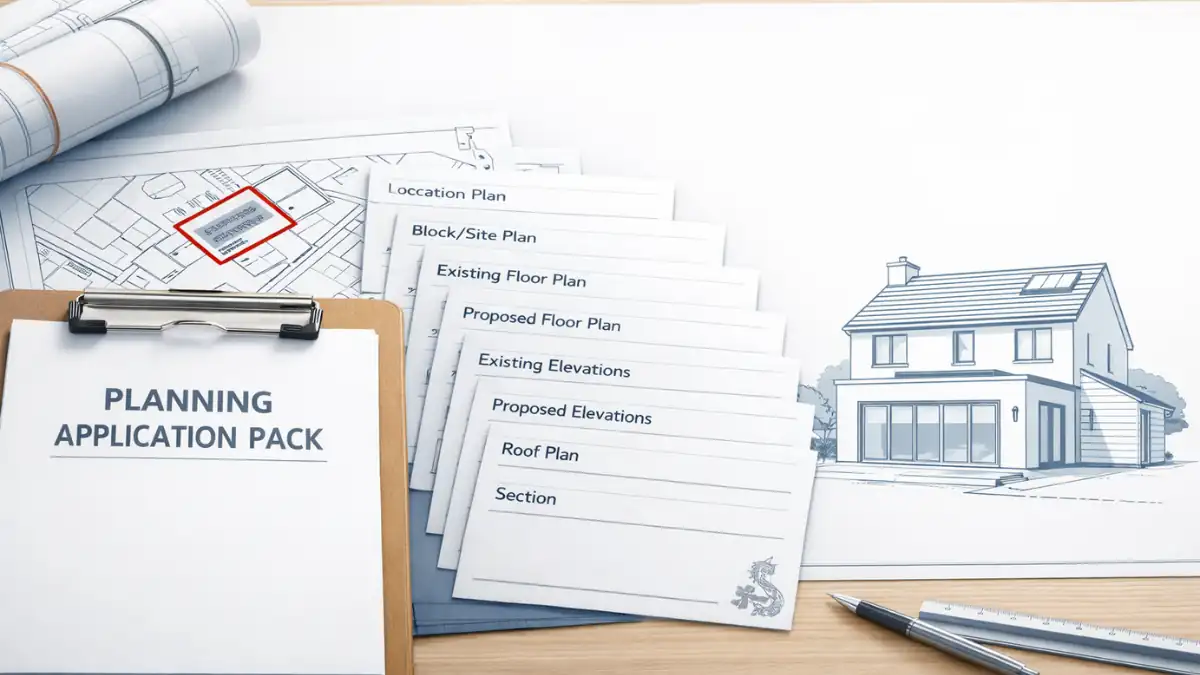
- Minimum pack (most householder applications): location plan, block/site plan, existing + proposed floor plans, existing + proposed elevations.
- Often needed as well: roof plan, sections (especially where levels change), materials notes, boundary treatments.
- Accuracy matters: scaled drawings with clear dimensions reduce delays and “invalid” applications.
- Planning vs Building Regulations: planning drawings show the design and appearance; Building Regs drawings go into construction detail (structure, insulation, fire safety, drainage etc).
- What the council wantsClear, scaled “existing vs proposed” drawings that show size, position, height and external appearance.
- Most common missing itemsIncorrect scales, unclear boundary lines, missing roof information, or elevations that don’t match the floor plans.
- Best way to avoid delaysStart with a measured survey (or reliable measurements), then keep every drawing consistent and clearly labelled.
Not sure what your council expects in your application pack?
Share a rough sketch and a couple of photos — our team will tell you what documents you’ll likely need and what usually causes delays.
Drawing Extension Plans: what “good” looks like for planning
When homeowners talk about Drawing Extension Plans, they’re usually trying to do one (or more) of these things:get planning permission, confirm Permitted Development with a Lawful Development Certificate, or give a builder enough information to price accurately.
For planning permission, “good” drawings are not about fancy graphics. Instead, they’re about clarity.A planning officer should be able to answer these questions quickly:
- What is currently there?
- What are you proposing to build?
- How big is it, and where does it sit on the plot?
- How will it look from outside?
- Will it affect neighbours (light, privacy, outlook) or the street scene?
If you want the wider context of how drawings fit into a full householder submission, our pillar guide is a good companion read:our complete application checklist.
Planning drawings vs Building Regulations drawings
One of the biggest stress-points we see is homeowners assuming “drawings are drawings”.In reality, planning and Building Regulations serve different purposes, so the information level is different.
Planning drawings (what the planning department uses)
- Focus on size, siting and appearance.
- Show how the proposal relates to boundaries, neighbours and the street.
- Typically include existing/proposed plans and elevations, plus a site/location plan.
Building Regulations drawings (what Building Control uses)
- Go into construction detail (structure, insulation, fire safety, ventilation, drainage, etc).
- Often coordinated with structural calculations (Part A) and energy requirements (Part L).
- Used for inspections and compliance sign-off.
If you’re unsure what you’ll need for Building Control, this guide explains it in plain English:what’s required for Building Regulations approval.It’s also worth understanding how inspections work in practice viaour Building Control overview.
Want us to sanity-check your draft drawings before you submit?
We’ll check the essentials (scales, consistency, missing sheets) so you avoid the most common validation delays.
What to include in Drawing Extension Plans for planning permission
Although councils vary slightly, most householder submissions in England expect a familiar “core set” of drawings.Below is the checklist we use when helping homeowners prepare a clean, easy-to-assess pack.
1) Location plan (usually OS-based)
- Shows your property in context (nearby roads/landmarks).
- Typically includes a red line around the application site.
2) Block / site plan
- Shows the plot boundary, the proposed extension position, and key site features.
- Usually includes adjacent buildings, access points, and sometimes trees, sheds or hardstanding.
3) Existing and proposed floor plans
- Clear “before and after” layouts, labelled as Existing and Proposed.
- Walls removed/added should be obvious, and room uses should be labelled.
- Where helpful, add key dimensions so the proposal can be understood at a glance.
4) Existing and proposed elevations
- Usually the most important drawings for neighbour impact and appearance.
- Show window/door positions, external finishes, and ridge/eaves heights where relevant.
- Make sure the elevations match the floor plans (openings line up, projection depth is consistent, etc).
5) Roof plan (often needed)
- Helpful where roof forms change (flat roof lanterns, parapets, pitched roofs, dormers).
- Can prevent “back and forth” questions about drainage falls and roof shape.
6) Sections and levels (when your site isn’t flat)
- Particularly useful for sloping gardens, stepped floor levels, or where neighbour relationships are tight.
- Shows floor-to-ceiling heights, roof build-up intent, and how the extension sits relative to ground level.
7) Notes that quietly improve approval chances
Planning officers are assessing impact, not construction detailing. However, a few short notes can make your proposal easier to support:
- Materials: a short note like “brick to match existing” / “grey aluminium bi-folds” / “roof tiles to match”.
- Obscure glazing: if a side window could affect privacy, specify it early.
- Boundary treatment: if you’re adding screening or a new fence, show it on the site plan.
If your project is specifically a house extension, this deeper guide is helpful for the pre-submission stage:how the extension permission process usually works.
Who can produce your drawings (and when DIY is risky)
Homeowners often ask us: “Can I draw my own extension plans?” In many cases, yes — councils don’t require you to use an architect.That said, “can” and “should” aren’t always the same thing.
When DIY drawings can work
- Your proposal is simple (for example a straightforward single-storey rear extension).
- You can measure accurately and draw to scale.
- You understand that the planning officer needs consistent drawings, not just a sketch.
When DIY becomes a false economy
- You’re close to boundaries or neighbours’ windows.
- The design includes unusual roof shapes, level changes or large glazing.
- Your home is in a conservation area or is listed (or near a listed building).
- You expect to move windows/doors multiple times during design.
If you want a quick sense-check of what’s normally included for a typical householder pack, this PME guide is useful:what most homeowners include for house extension submissions.
How to draw extension plans step-by-step (practical checklist)
If you’re trying to work out how to draw extension plans (including “how to draw extension plans free” or “draw extension plans online free UK” searches),the process below is the safest way to avoid inconsistencies.
Step-by-step process (what we recommend)
- Start with a measured survey. Measure external walls, window positions, and key internal walls. Take photos of every elevation.
- Choose a scale and stick to it. Most floor plans/elevations are produced at a consistent scale so they can be compared easily.
- Draw the “existing” first. Don’t design the new extension until the existing baseline is accurate.
- Overlay the proposal clearly. Create separate proposed sheets, labelled properly, and keep line weights readable.
- Cross-check every drawing. Projection depth, window sizes and heights should match across plans and elevations.
- Create a clean site plan. Plot boundaries, distances to boundaries where helpful, and the extension footprint.
- Add a short notes panel. Materials, privacy measures (if needed), and any relevant constraints.
- Do a final “validation pass”. Check the council’s list and ensure every required sheet is included before submission.
Common mistakes that delay approval
Even when the design is perfectly acceptable, small document issues can slow things down.Here are the problems we see most often with extension submissions.
Mistake 1: Drawings that don’t agree with each other
- Plans show one window position, elevations show another.
- Extension depth differs between plan and elevation.
- Roof height is unclear or inconsistent.
Mistake 2: Missing context for neighbours
- No clear boundary lines or neighbour windows shown where relevant.
- No section drawing where level changes create uncertainty.
- Side windows that could affect privacy, but no note about glazing type.
Mistake 3: Treating planning drawings like construction drawings (or the other way round)
Planning officers don’t need every insulation layer or steel beam location.Meanwhile, your builder and Building Control often do.If you try to use one pack for everything, it can create gaps in the next stage.This guide explains the “next stage” documents clearly:how councils typically assess an application pack.
Related homeowner searches (and what they usually mean)
If you’re searching phrases like “drawing for extension”, “drawing house extension plans”, or “free software for drawing extension plans”, you’re normally trying to solve one of these problems:
- Speed: you want something you can submit quickly.
- Cost control: you want to avoid paying twice for rework.
- Confidence: you want to know you’re including what the council expects.
A quick rule of thumb: the cheaper or faster the method, the more you must personally manage the risk (accuracy, revisions, and “missing sheet” issues).If you want us to take that stress off your plate, we can help you package everything properly first time.
FAQs: Drawing Extension Plans
How to draw extension plans?
Start by measuring the existing house accurately, then create clear existing and proposed drawings at a consistent scale.Finally, add the site/location plans and cross-check that every elevation matches the floor plan (openings, projection depth, heights).
Can I draw my own extension plans?
In many cases, yes — councils don’t require an architect. However, your drawings still need to be scaled, consistent and complete.If your site is tight, your design is complex, or your home is in a sensitive area (like a conservation area), professional help usually saves time overall.
How to draw plans for house extension?
For a house extension, focus on the items that help planning assess impact: existing and proposed floor plans, elevations, and a clear site plan.If levels or roof forms are complicated, include a section drawing so the proposal is easy to understand.
How to draw extension plans free?
Free tools can help you draft layouts, but planning success depends on output quality: correct scale, clear labels, and consistent measurements.If you’re using a free app, build in extra time for checking and revisions — that’s where most DIY submissions stumble.
Who can draw plans for an extension?
A homeowner can, but many people use an architectural technician, designer, or architect.The right choice depends on complexity: simple extensions can be straightforward, while larger or neighbour-sensitive projects benefit from experienced design input.
Who draws up extension plans?
Typically an architectural technician, designer or architect prepares the drawings, often after a measured survey.Some firms also act as your agent and handle the submission, which can reduce back-and-forth with the council.
Next steps & useful PME guides
If you’re moving from “rough idea” to a real submission, these PME guides usually help homeowners avoid expensive detours:
- How to check if you need permission at all
- The typical extension permission journey
- A plain-English overview of compliance requirements
- What Building Control does (and what they’ll look for)
- What timelines tend to look like in real life
Key facts snapshot: Drawing Extension Plans
- Core drawings (most councils)Location plan, site/block plan, existing + proposed floor plans, existing + proposed elevations.
- Often required “extras”Roof plan and/or sections where levels/roof forms are unclear; brief materials notes.
- Most common delayInconsistent measurements between drawings, or missing required sheets at validation stage.
- Best homeowner moveDo a final “validation pass” against your council’s list before hitting submit.
External references
Final thought
The best extension submissions are the ones that remove uncertainty.If your drawings are consistent, properly labelled, and show neighbour relationships clearly, you give your application the smoothest possible run.That’s exactly what good Drawing Extension Plans should do.
Ready to move your project forward?
Plans Made Easy can prepare a clean, council-friendly drawing pack and guide you from idea to submission — without the usual stress.

Performance Verified ✅
This page meets PME Optimisation Standards — achieving 95+ Desktop and 85+ Mobile PageSpeed benchmarks. Verified on

