
Share this post:
If you’re Googling How Long to Renovate a House, you’re probably trying to plan life around builders, budgets, and a bit of chaos. The honest answer is: it depends on the scope — but you can estimate a realistic timeline once you understand the stages (design, approvals, strip-out, first fix, second fix, finishes, and sign-off).
Quick summary: typical renovation timelines
- One room refurb (non-structural): often 1–4 weeks
- Kitchen or bathroom: commonly 3–8 weeks (longer if layout changes)
- Partial house refurb: often 8–16+ weeks
- Full renovation / “back to brick”: typically 4–9+ months
- Major structural changes + approvals: can reach 9–15+ months
These are broad UK ranges for England. Your property type, access, approvals, and hidden issues can move the schedule.
Key facts snapshot (timeline drivers)
- Design + surveys often take longer than homeowners expect (especially if scope keeps changing).
- Planning permission (if needed) adds weeks, and sometimes months if revisions are required.
- Building Control inspections are staged — you can’t “skip ahead” without sign-offs.
- Supply lead times (kitchens, windows, steels, bespoke items) frequently drive delays.
- Hidden problems (damp, asbestos, rotten timbers, wonky drains) are common in older homes.
Important: A “fast” programme only works if the paperwork and drawings are right. Rushing the early stages can cause bigger delays later (variations, rework, inspection failures, and budget creep).
When you ask How Long to Renovate a House, what you’re really asking is: “How long until we can live normally again?” The most reliable way to answer that is to break a renovation into stages, then add the time (and risk) where projects usually slip: approvals, structural surprises, and long lead-time items.
In this guide, we’ll walk you through a typical UK (England) renovation timeline from start to finish — including common scenarios like a room refurb, a flat renovation, and “gut and renovate” projects. We’ll also share practical ways to reduce delays without cutting corners.
How long to renovate a house in the UK? Typical ranges
Most homeowners don’t need an “exact” number on day one — they need a sensible range they can plan around. As a starting point (and assuming decent access, a competent builder, and no major surprises), these are typical timelines we see for England:
| Project scope | Typical on-site time | Common reasons it extends |
|---|---|---|
| Single room refurb (decor, flooring, minor electrics) | 1–4 weeks | Drying times, hidden repairs, late material choices |
| Kitchen / bathroom (like-for-like layout) | 3–6 weeks | Out-of-plumb walls, plumbing changes, product lead times |
| Kitchen / bathroom (layout changes) | 5–8+ weeks | Re-routing services, extra Building Control stages, rework |
| Partial house refurb (multiple rooms, some services) | 8–16+ weeks | Electrical rewires, heating changes, damp issues, access |
| Full renovation / “back to brick” | 4–9+ months | Structural alterations, steels, insulation upgrades, sequencing |
| Major alterations + approvals (or listed / conservation) | 9–15+ months | Planning revisions, specialist methods, restricted working |
Note: These ranges are “on-site” time. The full timeline (including design, surveys, approvals, and ordering) is usually longer — and that’s where many programmes go off track.
Want a timeline that matches your home (not an internet average)?
Our team can sanity-check your scope, flag approval risks, and help you plan the right drawings so your builder can price and programme properly.
Speak to Plans Made EasyFull renovation timeline: stages from start to finish
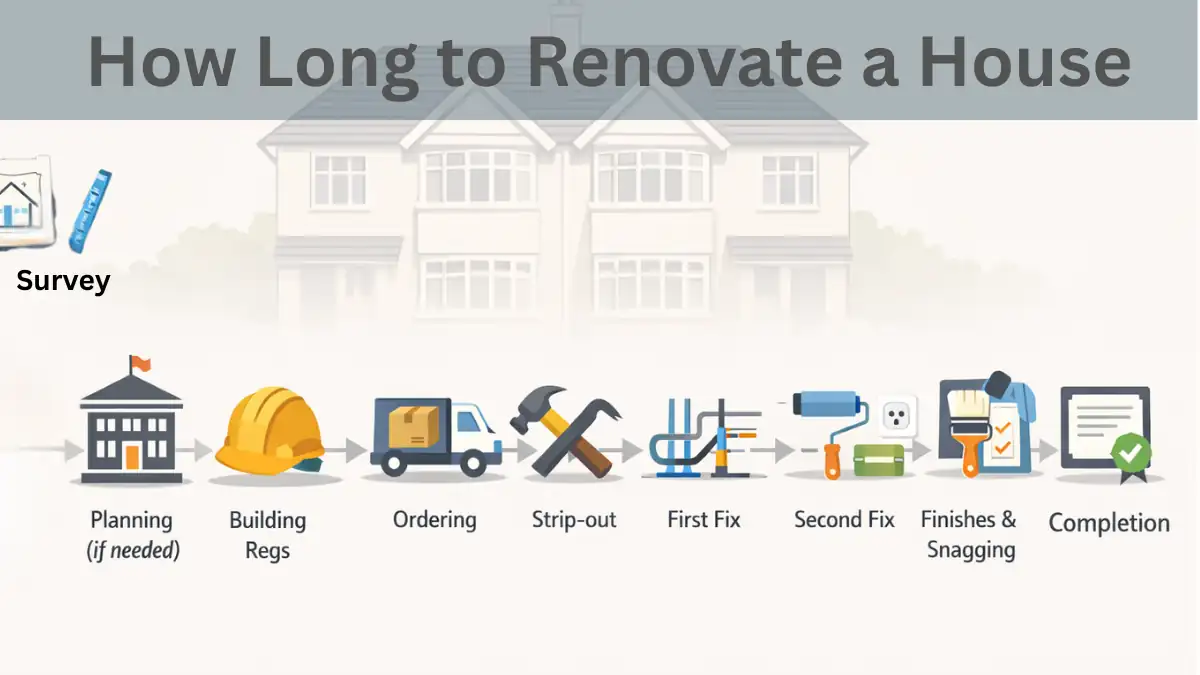
A renovation that runs smoothly isn’t “fast” — it’s well sequenced. Here’s a practical stage-by-stage timeline you can use to plan. Your builder may label phases differently, but the order is broadly the same.
Stage 1: Scope, surveys, and budget (often 1–4 weeks)
- Decide what you’re changing (and what you’re not).
- Do the right surveys (especially for older homes): damp, drainage, structural checks, asbestos where relevant.
- Sketch your priorities: layout, insulation upgrades, heating, storage, finishes.
Tip: The fastest programmes start with a tight scope. If you’re still changing layouts during the build, you’ll almost always lose time and spend more.
Stage 2: Design and drawings (often 2–8+ weeks)
Even if you’re “not moving walls”, drawings help you and your builder stay aligned. If you are changing structure, moving drainage, adding rooflights, or altering fire escape routes, good drawings matter even more.
- Measured survey (if needed)
- Layout options / design development
- Planning drawings (if you need planning permission)
- Building Regulations drawings (and structural calculations where required)
Stage 3: Approvals and permissions (variable — see below)
Some renovations are permitted development or don’t need planning at all. Others do. Either way, Building Regulations often apply to structural work, insulation upgrades, electrics, plumbing, and fire safety.
Stage 4: Pricing, builder selection, and lead times (often 2–6+ weeks)
This stage is where timelines are won or lost. If items like kitchens, windows, doors, steels, tiles, or bespoke joinery have long lead times, they need ordering early — otherwise the site sits idle waiting for deliveries.
Stage 5: Pre-start preparation (about 1–2 weeks)
- Site setup, protection, welfare, skips
- Neighbour liaison (especially in terraces and flats)
- Party wall process if applicable
- Finalise programme and payment schedule
Stage 6: Strip-out and first fix (often 2–6+ weeks)
“First fix” is the hidden work: electrics, plumbing, heating pipework, stud walls, floor strengthening, insulation prep, and any structural openings.
Stage 7: Plastering, second fix, and finishes (often 3–8+ weeks)
- Plastering (and drying time)
- Second fix electrics & plumbing
- Kitchens/bathrooms install
- Joinery, flooring, decorating
Stage 8: Snagging, testing, and sign-off (often 1–3 weeks)
Final inspections, certificates, and the Building Control completion process can take a little time — especially if any items need rework. It’s also the stage where missing paperwork can cause stress when you come to sell later.
Timelines by project type (room, flat, full house, back-to-brick)
How long to renovate a room?
A single room can be quick — but only if it’s genuinely cosmetic. Painting, flooring, and basic electrical work might fit into 1–2 weeks. If you’re chasing in new electrics, replastering, fixing floors, or addressing damp, it’s often 2–4 weeks.
How long to renovate a flat?
Flats often take longer than people expect because there’s more to coordinate:
- Leaseholder approvals or freeholder consent for certain works
- Access restrictions (working hours, loading, parking, noisy works windows)
- Communal considerations (fire doors, shared services, sound insulation expectations)
A straightforward flat refurb might still be 6–12 weeks, while a more involved programme can push beyond that.
How long to gut and renovate a house?
“Gut and renovate” (often called “back to brick”) usually means stripping out walls, floors, services, kitchens and bathrooms — then rebuilding properly. Timelines commonly land around 4–9+ months, depending on:
- How much structural work is involved (steel beams, opening up, underpinning)
- Whether you’re upgrading insulation and ventilation to meet Building Regulations
- How quickly decisions are made on finishes and fixtures
- Lead times for key items (kitchens, windows, bespoke joinery)
How long to repair a house after fire or flood?
Fire and flood repairs are a different category because they involve drying out, investigations, and often insurance processes. A small, contained incident might be resolved in 6–12 weeks, while more extensive damage can take several months.
Important: After a flood, drying time is not optional. If finishes go on too early, you can lock in moisture and create bigger problems later (mould, blown plaster, warped joinery).
Planning permission, Building Regulations, and inspections: what they add
A lot of timeline advice online ignores approvals — and that’s where homeowners get caught out. Some renovation work doesn’t require planning permission, but still needs Building Regulations compliance, inspections, and completion paperwork.
Planning permission: when it affects the schedule
If your project changes the outside of the house, affects neighbours, or falls outside permitted development (or you’re in a conservation area / listed building context), you may need a planning application. That introduces a formal timetable and the possibility of amendments.
- Useful reference: Planning Portal guidance
- PME guide: council timescales and what happens at each stage
Building Regulations: what it adds (and why it matters)
Building Regulations are about safety and performance — structure, fire safety, ventilation, electrics, drainage, insulation (Part L), and more. Even without planning permission, Building Regulations can still apply.
- PME guide: what Building Regulations cover for home projects
- PME guide: how Building Control works and how inspections are staged
(Internal links chosen from your provided list.) :contentReference[oaicite:0]{index=0}
Why renovations take so long (and what you can control)
If you’ve ever wondered “why do renovations take so long?”, it’s usually not one big thing — it’s lots of small ones that stack up. The good news is that many of them are preventable.
1) The scope grows during the build
Changing your mind is normal. However, every change has a knock-on effect: redesign, re-pricing, re-ordering materials, and re-sequencing trades.
2) Hidden issues appear once things are opened up
Until strip-out happens, you don’t truly know what’s behind plaster and under floors. Common discoveries include damp, rotten joists, outdated wiring, and drainage problems — especially in older UK housing stock.
3) Lead times and late selections
Kitchens, tiles, windows, doors, and bespoke items often dictate the programme. If selections are late, the site can’t progress logically, so you lose weeks in “dead time”.
4) Sequencing and drying time
Even with a great builder, some tasks can’t overlap. Plaster needs to dry. Screeds need to cure. Waterproofing needs time. Rushing these steps can cause failures later.
5) Inspections and compliance
Building Control inspections happen at key points. If work isn’t ready, you wait. If it fails, you rework — and that’s a programme hit.
How to keep your renovation on schedule
You don’t need to “rush” a renovation to keep it moving. Instead, focus on reducing uncertainty and making decisions early.
Do these before work starts
- Lock the scope (what’s included, what’s excluded, and what’s provisional).
- Get proper drawings where needed — especially if the layout or structure changes.
- Write a clear scope of work so your builder can price accurately and plan labour.
- Order long lead-time items early (kitchen, windows/doors, steels, bespoke joinery).
- Plan your living arrangements (can you stay put, or is it better to move out for phases?).
PME guide: what to include in a scope of work (so your programme doesn’t unravel) :contentReference[oaicite:1]{index=1}
Tip: Build a buffer into your plan. Even well-run renovations often need contingency time for inspections, drying, and the odd surprise behind the walls.
Not sure if you need approvals before you start?
We can quickly tell you what drawings you’re likely to need, whether planning permission is in play, and the safest route through Building Control.
(Internal link from your provided list.) :contentReference[oaicite:2]{index=2}
FAQs: How Long to Renovate a House
How long does it take to renovate a house in the UK?
How long does it take to renovate a room?
How long does it take to gut and renovate a house?
How long does it take to renovate a flat?
How long does it take to repair a house after fire or flood?
Why do renovations take so long?
Next steps and useful PME guides
- What to expect from Building Control during your project
- What inspectors look for at each stage
- Council planning timescales (and where delays happen)
- Common unseen challenges that slow projects down
(Internal links chosen from your provided list.) :contentReference[oaicite:3]{index=3}
Ready to plan your renovation properly?
If you’d like help setting a realistic programme, confirming which approvals apply, and producing the drawings your builder and Building Control actually need, our team at Plans Made Easy can help.
Contact Plans Made Easy
Performance Verified ✅
This page meets PME Optimisation Standards — achieving 95+ Desktop and 85+ Mobile PageSpeed benchmarks. Verified on

