
Share this post:
Quick Summary: Planning Permission for Extension
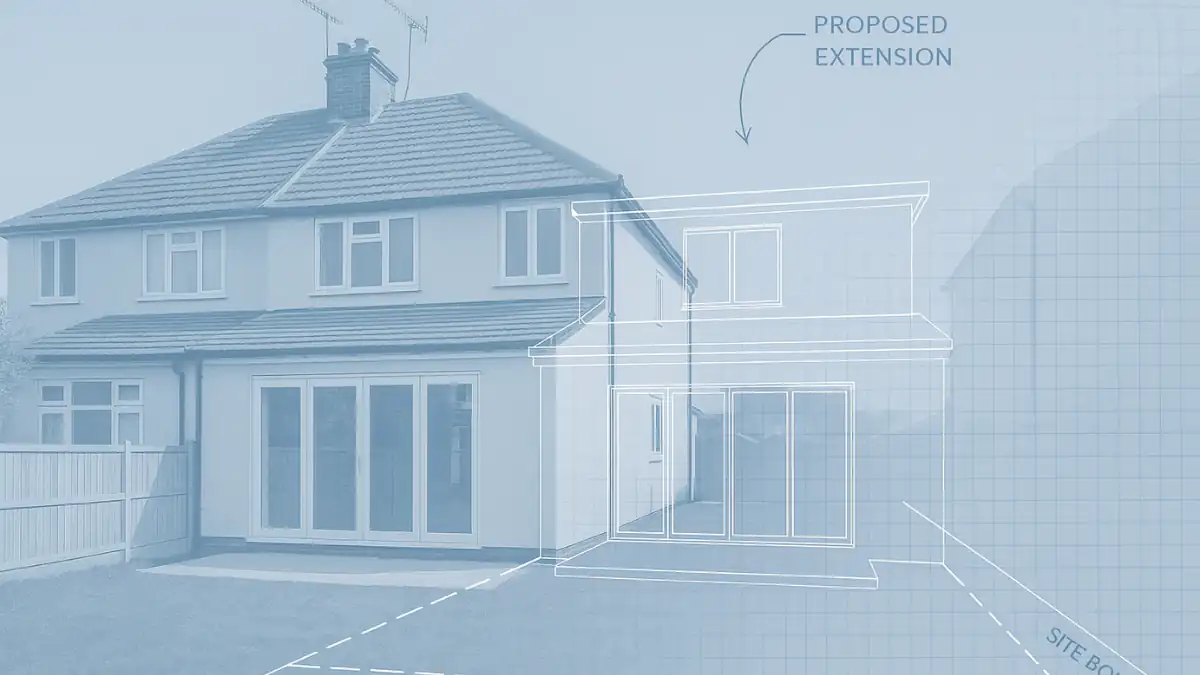
If you’re thinking about extending your home, understanding planning permission for an extension is one of the most important early steps. This guide explains when permission is required, how the rules work under Permitted Development, and what to expect when applying to your local council in England.
- Most extensions are allowed under Permitted Development — but not all.
- Council rules vary, especially in conservation areas, Article 4 areas and near boundaries.
- Good plans make approvals smoother and reduce delays.
This article is part of our wider Planning Permission series and supports our main guide, Planning Permission (UK): The Complete Homeowner’s Guide.
Unsure if your extension needs planning permission?
Tell us what you want to build and we’ll check the rules for your area.
What Planning Permission for an Extension Really Means
When you extend your home, the local council needs to decide whether your new space fits the character of the area and follows national planning rules. This process is known as planning permission for an extension. Although many extensions fall under Permitted Development, others require a full application to the council.
Our team always encourages homeowners to get clarity early. It avoids costly redesigns, delays, or — worst case — being told to take work down.
When You Need Planning Permission for an Extension
Although many household extensions can be completed under Permitted Development, planning permission is required when the design exceeds certain size, height or placement limits. You will also need permission if the property is in a restricted area or already has extensions that used up its PD allowance.
Common triggers that require planning permission
- The extension is higher than the existing roof.
- Your home is in a conservation area, national park or AONB.
- You live in an Article 4 Direction area.
- The extension sits too close to a boundary.
- The project includes balconies, terraces or raised platforms.
- You have already extended under PD and exceeded your allowance.
For specific advice on whether your idea is permitted, see: Do I Need Planning Permission for a Kitchen Extension?
Permitted Development Rules for Extensions (Quick Breakdown)
Permitted Development rights allow many rear and side extensions without formal planning permission. However, the rules are precise and must be followed carefully.
Rear extension PD limits
- Single-storey: Maximum projection of 3m (terraced/semi) or 4m (detached).
- Height: Must not exceed 4m.
- Materials: Must be similar to the main house.
Larger Home Extension Scheme (prior approval)
- Up to 6m on semis/terraced, or 8m on detached homes.
- Requires neighbour consultation but not full planning permission.
Side extension PD limits
- Maximum height of 4m.
- Width must not exceed half the width of the original house.
Not sure if your idea fits Permitted Development?
We’ll check your project against PD rules and let you know if you need a full planning application.
How the Planning Application Process Works
If your extension requires full planning permission, the application process is straightforward but must be done carefully. Poor drawings or missing documents are among the most common causes of refusal or delay.
What your application normally includes
- Existing & proposed floor plans
- Existing & proposed elevations
- Block plan & site location plan (OS map)
- Roof plans (if relevant)
- Access statement (rare for houses but sometimes needed)
- Design & Access Statement (if required)
For a breakdown of drawing requirements, see: Planning Permission Drawings: Complete Guide
Planning Permission Costs & Council Timelines
Most councils charge the standard national fee for a householder planning application. In 2025, this is typically around £265–£300 depending on the authority.
Typical planning permission costs for extensions
- Application fee: £265–£300
- Plans & drawings: £650–£1,500+ depending on complexity
- Specialist reports: £0–£800 (heritage, trees, flood risk)
Expected timeline
- 8 weeks is the standard target for councils.
- Can extend to 10–12 weeks in busy areas.
Common Pitfalls When Applying for Extension Planning Permission
Many homeowners are caught out by small details that could have been avoided. Here are the most common issues our team sees:
- Incorrect boundary assumptions.
- Designs breaching PD size limits by a few centimetres.
- Low-quality drawings that do not match each other.
- Missing scale bars or north arrows.
- Ignoring drainage, especially when building over a sewer.
FAQs: Planning Permission for Extension
Do all extensions need planning permission?
No. Many rear and side extensions fall under Permitted Development, as long as they stay within the size, height and placement rules. If you are unsure, we can review your project for clarity.
How long does planning permission take for an extension?
Councils aim for an 8-week decision, although it can take longer during busy periods or where extra documents are needed.
Can I build a two-storey extension under Permitted Development?
In some cases yes, but the rules are strict. Two-storey rear extensions under PD are allowed only for specific conditions and distances. They are not permitted in conservation areas.
Does an extension always need Building Regulations approval?
Yes — almost every extension requires Building Control sign-off, even if planning permission isn’t needed. See: Building Control Guide.
Can my neighbour stop my extension?
Neighbours cannot directly “veto” your extension, but their comments may influence the council’s decision, especially on issues like overshadowing or privacy.
Key Facts Snapshot
- Most extensions under PD?Yes — but only if you meet the detailed rules on size and placement.
- Planning application fee:£265–£300 depending on council.
- Typical council decision time:8–10 weeks on average.
- Building Regulations needed?Yes, almost always. Planning and Building Regulations are separate systems.
Next Steps & Useful Guides
Here are the most helpful related guides from Plans Made Easy:
- Do I Need Planning Permission?
- Planning Permission Drawings Guide
- Extension Costs – Full Breakdown
- House Extensions – Complete UK Guide
- Rear & Side Extensions
Ready to move your project forward?
Plans Made Easy can prepare compliant plans, manage submissions, and guide you from idea to approval.
Planning Portal — National Planning Guidance
GOV.UK — Planning Permission in England & Wales

Performance Verified ✅
This page meets PME Optimisation Standards — achieving 95+ Desktop and 85+ Mobile PageSpeed benchmarks. Verified on

