
Share this post:
Outbuildings are a really flexible way to add space to your home — from simple sheds and home offices to garden rooms, studios and small stores. However, the rules for outbuildings can be confusing: some fall under permitted development, others need full planning permission, and many still have to comply with building regulations even if planning isn’t required.
In this guide, we’ll explain what an outbuilding actually is, how it compares with sheds, garages and extensions, and what you can and can’t do without planning permission. We’ll also look at building control, costs, timescales and the main traps that catch homeowners out.
Thinking about adding an outbuilding?
Our team can review your sketch ideas and tell you, in plain English, whether you’re likely to need planning permission or just building regulations approval.
What is an outbuilding?
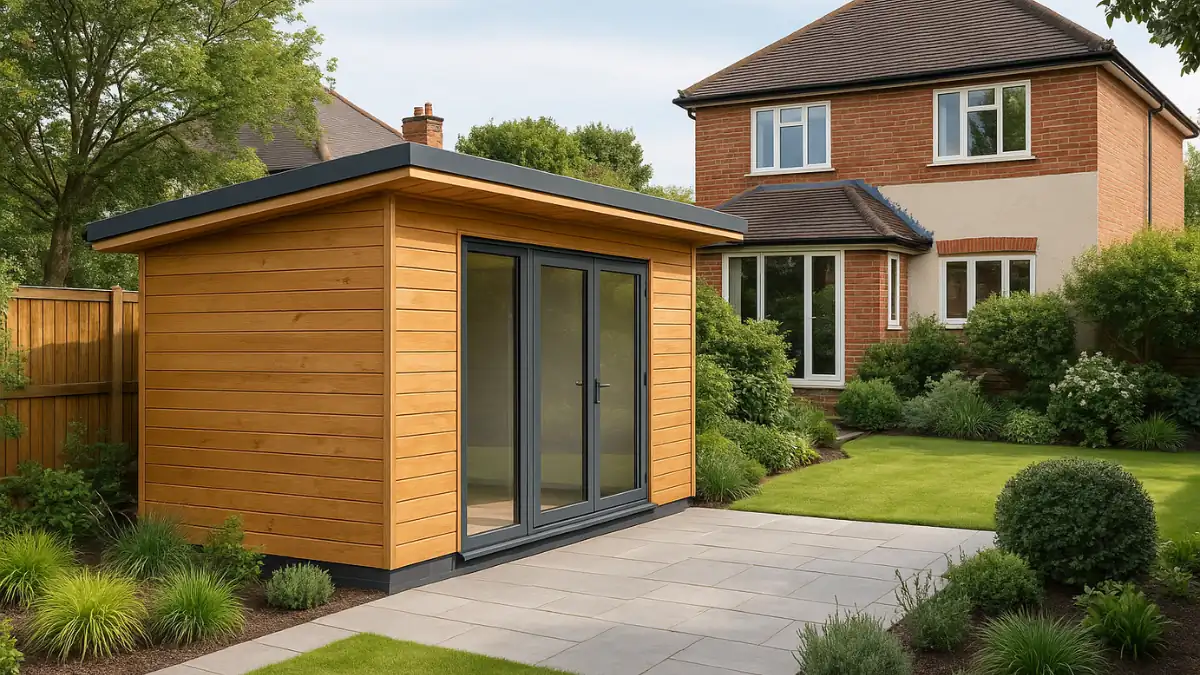
In planning terms, outbuildings are separate structures within the curtilage of your house — usually in the garden — that are incidental to the main dwelling. They aren’t normally physically attached to the house and they shouldn’t function as a self-contained home.
Typical outbuildings include:
- Garden sheds and storage buildings
- Home offices or studios in the garden
- Workshops, hobby rooms and garden gyms
- Detached garages and car barns
- Summerhouses and non-sleeping garden rooms
Outbuildings vs extensions, garages and sheds
Homeowners often mix up outbuildings with other types of development. As a quick comparison:
- Outbuilding vs extension: extensions are physically attached to the house and enlarge the main dwelling. Outbuildings are detached.
- Outbuilding vs garage: a detached garage is one type of outbuilding, but many garages are built as part of the main house or extension.
- Outbuilding vs shed: a shed is usually a small, simple outbuilding used only for storage or light hobbies.
If you’re unsure whether your idea counts as an outbuilding or an extension, it’s worth cross-checking with our wider guides on house extensions and extension drawings.
When do outbuildings need planning permission?
Many smaller outbuildings can be built using the householder permitted development rights that apply to most houses in England. But as soon as you go beyond those limits — or you live in a more sensitive area — a full planning application may be needed.
Situations where you’re likely to need planning permission
- The outbuilding is in front of the principal elevation facing the highway.
- It’s more than one storey, or the eaves height is over 2.5m.
- The overall height exceeds 4m with a pitched roof, or 3m with a flat roof.
- It covers more than half the garden area (including existing outbuildings).
- You live in a listed building, conservation area or other designated land where rights have been removed.
- The outbuilding will be used as a separate dwelling or self-contained annexe.
For a deeper look at how the system works, you might find our main planning permission guide and “Do I need planning permission?” article helpful.
Outbuildings and permitted development rules
Where permitted development (PD) rights apply, you can build certain outbuildings without submitting a formal planning application, provided you stay within the PD size and position limits. This is often the case for modest garden offices, workshops and sheds behind the house.
Key permitted development limits for outbuildings
In broad terms, you usually stay within PD for outbuildings if:
- The outbuilding is single storey only.
- The eaves height is no more than 2.5m.
- The overall height is no more than 4m with a dual-pitched roof, or 3m with any other roof.
- Any part of the outbuilding within 2m of the boundary is no more than 2.5m high.
- Total outbuildings and other extensions do not cover more than 50% of the garden area.
- The use is incidental to the main dwelling (for example hobby space, office, gym or storage), not a separate home.
For garden rooms in particular, we’ve broken PD rules down in more detail in our dedicated guides on garden rooms, planning permission for a garden room and planning rules for sheds.
Do outbuildings need building regulations approval?
Planning permission and building regulations are separate. Even if your outbuilding is permitted development, it may still need to comply with building regulations, or at least parts of them.
When small outbuildings are usually exempt
Many simple outbuildings are exempt from full building regulations where:
- The floor area is under 15 m², and
- They’re single storey, detached and contain no sleeping accommodation.
Some slightly larger outbuildings up to 30 m² can also be exempt if they’re at least 1m from the boundary or built of non-combustible materials, again without sleeping accommodation.
When building control is normally required
You are likely to need building regulations approval where an outbuilding:
- Exceeds the 15–30 m² size thresholds above.
- Includes a bathroom, kitchenette or sleeping area.
- Is attached to the house or linked via a covered structure.
- Is heavily insulated and heated for regular occupation as a home office or studio.
In those cases, Parts A (structure), B (fire safety), L (energy efficiency), P (electrics) and other sections may apply. Our dedicated guides on building regulations, plans for building regulations and building control inspections explain how the process works.
Using outbuildings: office, gym, studio or annexe?
The intended use of your outbuilding is just as important as its size. Outbuildings are meant to be incidental to the main dwelling, so there are limits on how far you can go without extra permissions.
Typical “incidental” uses
These are usually acceptable under PD (subject to size/position rules):
- Home office, art studio or hobby workshop
- Garden gym or games room
- Summerhouse used for relaxing in the garden
- General storage, bikes or garden tools
When an outbuilding becomes an annexe or separate dwelling
If you add a shower room, full kitchen and dedicated sleeping area, the council may view the outbuilding as an annexe or separate dwelling. At that point you would normally need:
- Planning permission for a change of use, and possibly for the building itself; and
- Full building regulations approval, including fire escape routes and insulation standards.
If you’re specifically looking at a larger garden room or annexe, our guide on garden room extensions and our article on planning permissions for extensions are worth a read alongside this one.
Typical costs and timelines for outbuildings
Costs vary a lot depending on size, specification and whether you’re buying a modular garden building or commissioning a bespoke structure. As a very broad guide for UK projects:
- Simple timber shed or small store (DIY kit): from £800–£3,000.
- Mid-range insulated garden office (10–15 m²): often £12,000–£25,000 including electrics.
- Bespoke studio or gym with high-spec finishes: £25,000–£45,000+.
- Large annexe-type outbuilding with bathroom and kitchen: similar to a small extension – easily £2,000–£3,000+ per m².
These figures are ballpark only. Local labour rates, access to the garden and ground conditions can move costs up or down significantly.
How long do outbuildings take?
- Design and drawings: 2–6 weeks, depending on how clear your brief is.
- Planning or Lawful Development Certificate: usually 8 weeks plus time for validation.
- Building regulations approval: 2–6 weeks for Full Plans, quicker for a Building Notice.
- Construction on site: from a few days for a small shed to several weeks for a large insulated garden room or annexe.
Not sure if your idea fits Permitted Development?
We’ll check your project against PD rules and let you know if you need a full planning application.
Step-by-step: check if your outbuilding needs permission
Here’s a simple checklist to help you work out where you stand before you spend money on detailed drawings or orders.
| Step | What to check | Why it matters |
|---|---|---|
| 1 | Confirm your property type and any restrictions (listed building, conservation area, Article 4 Direction). | These can remove permitted development rights completely or partially. |
| 2 | Measure your garden and existing extensions/outbuildings. | PD only allows up to 50% of the garden to be built over. |
| 3 | Sketch the outbuilding footprint, height and distance to boundaries. | Height and boundary distances are key PD tests. |
| 4 | Decide how it will be used (storage only, office, gym, occasional guest space, full annexe). | “Incidental” use is easier than sleeping or separate living accommodation. |
| 5 | Check the PD rules on the Planning Portal and compare them to your measurements. | This tells you if a planning application is likely to be needed. |
| 6 | Consider whether building regulations are triggered (size, insulation, plumbing, electrics). | This affects whether you need a Full Plans application or Building Notice for building regulations approval. |
Common pitfalls, council quirks and “gotchas” with outbuildings
Outbuildings look simple, but they sit at the crossroads of planning, building control, insurance and even council tax. Here are some of the issues we see most often.
Boundary distances and neighbour concerns
The 2.5m height limit within 2m of the boundary catches many people out. Taller outbuildings right on the boundary can feel overbearing to neighbours and attract complaints, even if they technically comply.
Local council quirks
Each council interprets the national rules slightly differently. Some are relaxed about home offices in outbuildings; others worry about traffic, noise or whether the space could turn into a separate dwelling. On sloping sites, some councils measure height from the lowest ground level, which can reduce what’s possible without planning.
It’s always worth looking at recent decisions near you using our guide to viewing planning applications. This shows how your council has treated similar outbuildings locally.
Future sale and compliance documents
Buyers and their surveyors increasingly ask for proof that outbuildings were built lawfully and safely. Keep copies of:
- Any planning permission or Lawful Development Certificate.
- Building control sign-off and completion certificates.
- Electrical certificates and other compliance documents.
Our guide to certificates and compliance documents explains what’s worth keeping in your house-file.
Outbuildings – frequently asked questions
What counts as an outbuilding?
In simple terms, an outbuilding is a separate structure within your garden that’s incidental to the main house. Think of sheds, home offices, workshops, detached garages and non-sleeping garden rooms. It shouldn’t function as a fully self-contained dwelling in its own right.
Do outbuildings always need planning permission?
No. Many smaller outbuildings fall under householder permitted development rights, so you don’t need to submit a planning application if you stay within the national size, height and location limits and your property still has PD rights. However, if you live in a conservation area or listed building, or if the use is more like an annexe, planning permission is much more likely to be required.
Can I sleep in an outbuilding or use it as guest accommodation?
Occasional daytime naps in a garden room are one thing; setting it up as a regular bedroom is another. Once an outbuilding is used for sleeping, councils tend to treat it as an annexe or separate dwelling, which normally needs planning permission and full building regulations approval. It can also have council tax, fire safety and insurance implications.
How close to the boundary can I build an outbuilding?
Permitted development rules allow outbuildings near boundaries, but if any part is within 2m, the whole structure must be no more than 2.5m high. Taller buildings typically need to be set further in from the boundary or go through planning. You must also avoid encroaching over the boundary itself and be mindful of any tree roots, sewers or shared structures.
Do outbuildings need building regulations approval?
Very small, simple outbuildings used only for storage are often exempt from building regulations. But as soon as they are larger, heavily insulated, heated or contain a bathroom or sleeping space, building regs usually apply. Building control will look at structure (Part A), fire safety (Part B), insulation (Part L), ventilation, drainage and electrics.
Are outbuildings covered by home insurance?
Most home insurance policies include some cover for sheds and outbuildings, but limits can be lower than for the main house and high-value items like bikes or tools may need extra cover. If you’re using an outbuilding as a home office or for business, always speak to your insurer so you’re properly protected.
How many outbuildings can I have in my garden?
There’s no fixed national limit on the number of outbuildings, but under permitted development the total area of all outbuildings and other extensions must not cover more than half the garden. If your plot becomes very built up, the council may also have design or amenity concerns even if each building is modest in size.
Want a second opinion on your outbuilding plans?
Share your sketch, photos and measurements and we’ll advise whether you’re better with permitted development, a Lawful Development Certificate or a full planning application.
- Typical examples Garden sheds, home offices, studios, detached garages, summerhouses and small garden gyms.
- Planning permission needed? Often not, if the outbuilding falls within householder permitted development limits and is used for incidental purposes only.
- Building regulations Small storage-only buildings may be exempt, but larger or heated outbuildings – especially with bathrooms or sleeping space – usually need building regs approval.
- Common pitfalls Too tall near boundaries, over-development of the garden, using “offices” as annexes, and lack of paperwork when selling.
- Where to check the rules Use national guidance on the Planning Portal, your local council’s planning pages and our detailed articles on planning permission and building regulations.
Unsure if your idea is exempt, permitted development or full planning? Plans Made Easy can review your proposal and prepare the drawings you’ll need for approvals.
Next steps & useful guides
If you’re serious about adding an outbuilding, these related guides on Plans Made Easy will help you go deeper into the rules, drawings and approvals:
- Planning permission for a garden room – detailed homeowner guide
- Planning permission for a shed – rules, sizes & council quirks
- Garden rooms – do you need planning permission?
- Building regulations for garden rooms – what you need to know before you build
- Building regulations approval explained – what every homeowner must know
- Certificates & compliance documents you must keep
- Do I need planning permission? – step-by-step UK guide
Official guidance and next checks
For the latest national rules and technical guidance on outbuildings, it’s always sensible to double-check:
Ready to move your project forward?
Plans Made Easy can prepare compliant plans, manage submissions, and guide you from idea to approval.
Performance Verified ✅
This page meets PME Optimisation Standards — achieving 95+ Desktop and 85+ Mobile PageSpeed benchmarks. Verified on

