
Share this post:
🎥 Watch: Rear and Side Extensions – Which Adds More Value? 4 Tips To Give you a Head Start
Prefer to watch instead of read? Here’s our quick 3-minute guide on Rear and Side Extensions rules 👇Thinking about a rear and side extension?
Get clear on what’s allowed under Permitted Development and when you’ll need full planning permission.
Home Extensions • UK Rules & Local Quirks
Rear and Side Extensions: Rules, Design Tips & Local Council Quirks
A practical guide for homeowners planning to extend out to the rear and along the side return — what’s possible, when you need permission, and how to design it right first time.
Quick answer
Yes — rear and side extensions are often possible. Many smaller schemes can proceed under Permitted Development (PD), provided you stay within limits on depth, height, width, eaves line and materials, and avoid wrap-around forms that merge side and rear elements into a single mass. If your proposal exceeds PD limits, is in a constrained area (e.g., conservation area) or involves a wrap-around footprint, you’ll likely need full planning permission. Either way, you’ll still need Building Regulations approval and (usually) structural calculations.
What counts as a rear & side extension?
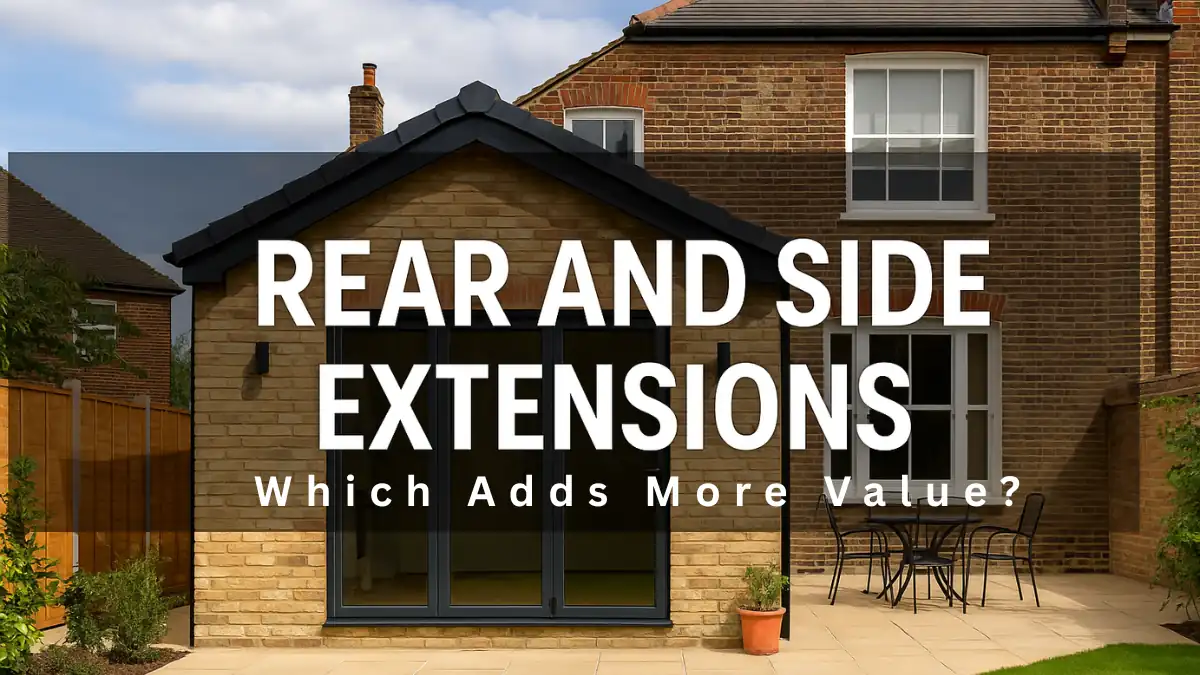
A rear extension projects out into the back garden from the main rear wall. A side extension infills space along the side of your house — commonly the narrow side return on Victorian/Edwardian terraces and semis. Combined proposals are popular because they can transform a dark kitchen into a bright family space with a better room layout and access to the garden.
Permitted Development rules (when planning isn’t needed)
Under PD, you may be able to add a modest rear extension and a single-storey side extension, so long as each element meets the General Permitted Development Order (GPDO) limits. Highlights include:
- Single-storey rear extension depth: commonly up to 3 m for attached houses and 4 m for detached (or more via Prior Approval for Larger Home Extensions, subject to neighbour consultation).
- Side extension width: usually no more than half the width of the original dwelling.
- Height: max eaves 3 m; max overall height 4 m with a pitched roof (flat roofs typically judged at 3 m next to boundaries).
- Materials: “similar appearance” to the existing house (finish/colour/texture).
- Boundaries: no eaves higher than 3 m within 2 m of a boundary.
- No wrap-around under PD: side + rear combined into a single mass usually falls outside PD.
Always confirm constraints like previous extensions (PD is measured from the “original” house), Article 4 Directions, or whether your home is in a Conservation Area or is a Listed Building where PD rights may be restricted or removed.
Not sure if your idea fits Permitted Development?
We’ll check your project against PD rules and let you know if you need a full planning application.
When full planning permission is required
You’ll likely need a planning application if any of the following apply:
- Wrap-around form (combined rear + side as a continuous volume).
- Depth/height/width exceed PD tolerances, or you’re proposing a two-storey side/rear element near a boundary.
- Your property is listed, in a conservation area, or under an Article 4 restriction.
- Balconies/raised terraces creating overlooking or noise concerns.
Well-composed design and a clear Planning Statement improve your chances. We’ll reference local policies and demonstrate how the scheme respects neighbours’ light (often using the 45°/25° rules), scale and street character. See our guide to House Extensions and planning costs for budgets and fees.
Design ideas, layouts & daylight
Rear + side projects work best when the extra footprint unlocks a better plan rather than just “more space.” Consider:
- Side return infill to widen the kitchen and form a sociable family room.
- Glazing strategy: rooflights over the side infill; a modest roof lantern or slot glazing to bring daylight deep into the plan.
- Thermal line continuity: minimise cold bridges; align insulation at the junction of old and new.
- Structural simplicity: where openings are large, a goalpost or steel frame may be cleaner than multiple point loads. See Structural Calculations.
- Kitchen utility zones: use the former side passage for pantry/utility/WC so the main area stays bright and uncluttered.
Party Wall & neighbour impacts
If you’re building along the boundary or excavating for new foundations, Party Wall procedures may apply. Good neighbour relations help planning too:
- Show how your design avoids overbearing height near fences and manages overshadowing.
- Place tall elements away from their main windows; consider a set-in or stepped elevation.
- Use high-level rooflights on the side infill to admit daylight while protecting privacy.
Costs, timings & inspections
Budgets vary by location and specification, but as a very rough homeowner guide:
- Single-storey rear/side infill: from ~£2,000–£3,000+ per m² for sensible, insulated construction with compliant glazing and a basic kitchen fit (higher for premium finishes/complex structure).
- Professional fees: measured survey & drawings, planning submission (if required), Building Control inspections, and structural design.
- Programme: allow 2–3 months design/permissions; 6–12 weeks for construction depending on size and complexity.
For route choices, see Building Notice vs Full Plans. If you’re early in planning, these planning timelines help set expectations.
Local quirks & council nuances
Policies are national, but interpretation varies. Some councils are stricter about wrap-around bulk and side streetscape. Others cap eaves height and push for matching brickwork, bond and mortar colour. In places like High Wycombe and Milton Keynes, expect careful review of rear depth near boundaries on terraces and semis; in Conservation Areas, glazing proportions, roof form and materials may need to echo the host house. If you’re in Buckinghamshire, start with our guide to planning in Buckinghamshire and check your specific ward’s guidance.
Conclusion: add space that works, not just square metres
A rear and side extension can transform how you live — brighter, better-connected rooms and smarter storage. Keep within PD where sensible, or plan a strong, neighbour-friendly case if you need permission. Get drawings, structure and Building Regulations right at the start to avoid delays on site. If you’d like a sanity check, we’re here to help.
Rear & Side Extensions — FAQs
What is a side return extension?
A side return extension infills the narrow strip along the side of your house — common on Victorian/Edwardian layouts. It widens the kitchen/living area and pairs well with rooflights to keep the centre of the plan bright.
Can I join a rear and side extension together (wrap-around) under Permitted Development?
Generally no. The GPDO doesn’t allow wrap-around under PD. You can often do a compliant rear element and a compliant separate side element, but when they visually merge, councils usually require a full planning application.
How much does a rear and side extension cost?
Very broad guide: from ~£2,000–£3,000+ per m² for single-storey, rising with structure, glazing and finishes. Allow for design, planning (if needed), Building Control and structural engineer fees.
Can I build a rear extension with no side access?
Often yes, but the builder will need a logistics plan for waste removal and deliveries via the front door or through the house. Protect finishes and schedule works to minimise disruption.
Do I need planning permission for a side return extension?
If the side element is single-storey, no wider than half the width of the original house, and within PD height/material limits, it may be PD. Check conservation status and Article 4 restrictions. When in doubt, apply for a Lawful Development Certificate.
Why are side return extensions sometimes refused?
Common reasons include loss of neighbour daylight, overbearing height on boundaries, wrap-around bulk, and poor material match. A stepped or set-back design with sensitive eaves height usually performs better.
Ready to move your project forward?
Plans Made Easy can prepare compliant plans, manage submissions, and guide you from idea to approval.
Next steps & useful guides
- House Extensions: Complete UK Guide
- Do I Need Planning Permission for an Extension?
- Building Regulations: Complete Homeowner’s Guide
- Structural Calculations: When Do You Need Them?
- Building Control Inspections – What to Expect
- Building Notice vs Full Plans – Which Route is Best?
- Planning Permission Timelines – Key Stages & Timescales
- Planning Permission Costs – Application & Design Fees
- Planning Portal — National guidance
- GOV.UK — Planning permission in England & Wales

Performance Verified ✅
This page meets PME Optimisation Standards — achieving 95+ Desktop and 85+ Mobile PageSpeed benchmarks. Verified on

