
Share this post:
Quick summary: Planning Permission Reading
If you are planning an extension, loft conversion, garage conversion or other alterations to your home, understanding planning permission Reading requirements is an important first step. Reading Borough Council is responsible for deciding planning applications within its administrative boundary, and the rules affecting your property will depend on the proposed work, its location and any planning restrictions already in place.
- Local planning authority: Reading Borough Council deals with applications for properties within Reading Borough.
- Planning permission requirements: Some home improvements need a formal application, while others may qualify as permitted development.
- Planning decision times: Standard householder applications normally have an eight-week determination period, although delays or agreed extensions can occur.
- Local planning restrictions: Conservation areas, listed buildings, Article 4 Directions and previous planning conditions can affect what you are allowed to do.
- Planning application searches: You can check previous applications, approved drawings, decisions and planning conditions using Reading Borough Council's online planning register.
- Building Regulations: Planning permission and Building Regulations approval are separate requirements. Many home improvement projects must comply with both.
Our advice: Before commissioning drawings or starting building work, check your property's planning history, confirm which development rights apply and make sure your proposed design meets Reading's planning policies. A little preparation can help prevent unnecessary delays, redesign costs and problems with the council.
Planning a home improvement project in Reading?
Not sure whether you need planning permission? Our team can review your ideas, explain the likely requirements and help you prepare the right plans before applying.
Planning permission in Reading: What homeowners need to know
Planning permission Reading requirements can sometimes feel confusing, particularly when you are trying to establish whether a proposed extension or conversion needs council approval.
The good news is that many straightforward home improvements can be assessed using established national planning rules. However, Reading also has local planning policies, conservation areas and restrictions that may affect your property.
Reading Borough Council is the local planning authority for properties within its boundary. It assesses planning applications against the adopted development plan, national planning policy and other relevant planning considerations.
Reading's Local Plan was adopted in November 2019, and a partial update has been progressing through examination. Therefore, homeowners should check the policies in force when their application is considered.
What does Reading Borough Council consider?
For a typical house extension or alteration, the planning officer may consider:
- The size, height and overall appearance of the proposed development.
- How the extension relates to the existing property.
- Any loss of daylight, sunlight or privacy affecting neighbouring homes.
- Whether the design fits the character of the street.
- Potential effects on trees, heritage features and conservation areas.
- Parking, access and other relevant site considerations.
A well-prepared application explains how your proposal responds to these matters. Clear drawings also make it easier for the council to understand what you want to build.
When do you need planning permission in Reading?
Not every improvement requires a full planning application. The important distinction is between development that requires express planning permission and work that is already permitted under national legislation.
Planning permission for rear extensions in Reading
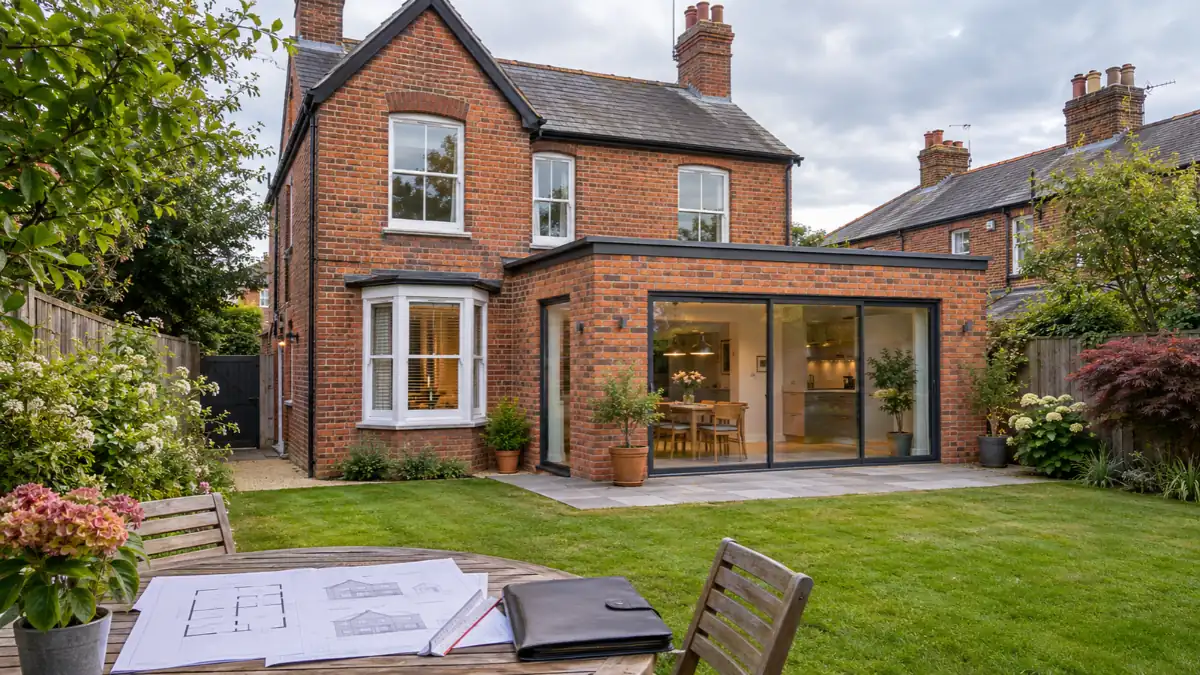
Rear extensions are among the most common projects undertaken by homeowners. Some single-storey extensions qualify as permitted development, subject to rules covering depth, height, boundaries and other limitations.
However, a larger extension, a property with restricted development rights or a proposal affecting a protected building may require a formal application.
For a detailed explanation, see our guide to checking whether your extension needs council approval.
Planning permission for loft conversions
Certain roof alterations and loft conversions can also fall within permitted development. Nevertheless, restrictions may apply to roof enlargement, external appearance and properties within designated areas.
If you are adding a substantial dormer or changing the roof profile, it is important to establish whether your design meets the relevant limits before committing to construction.
Garage conversions and garden buildings
Converting an existing garage into habitable accommodation does not always require planning permission. However, restrictions can arise where the garage is subject to a planning condition, where external alterations amount to development or where the proposed use is not incidental or ancillary to the dwelling.
Likewise, garden offices and outbuildings may qualify as permitted development when they meet the applicable requirements. Sleeping accommodation or use as a separate dwelling raises different planning considerations.
Reading permitted development: Can you build without applying?
Permitted development rights allow certain building works and changes of use to proceed without submitting a conventional planning application, provided every relevant condition and limitation is met.
These rights are national in origin, but they do not apply equally to every property. For example, flats generally do not benefit from the same householder permitted development rights as dwellinghouses.
What can restrict permitted development in Reading?
- Conservation areas: Additional restrictions apply to certain external alterations.
- Article 4 Directions: The council may remove specified permitted development rights within defined areas.
- Planning conditions: Previous permissions may limit particular alterations.
- Listed buildings: Separate listed building consent requirements may apply.
- Previous extensions: Earlier additions can affect the remaining permitted development allowance.
- Type of property: Flats and other buildings may have fewer available rights than houses.
Reading Borough Council specifically advises homeowners to check whether their property retains its permitted development rights before relying on them.
Our homeowner planning permission checklist explains the main questions to consider before progressing a project.
Reading Borough Council planning rules and local restrictions
National planning rules are only part of the picture. Reading's local policies and designated areas can influence whether an application is acceptable.
Conservation areas in Reading
Reading has a number of conservation areas where particular importance is placed on preserving or enhancing architectural and historic character.
These include parts of Caversham, Redlands, Kendrick and other established neighbourhoods. Exact conservation area boundaries must be checked against the council's published maps.
If your home is within a conservation area, restrictions may affect extensions, roof alterations, cladding and other visible changes.
Our separate guide to understanding conservation area restrictions explains why ordinary permitted development assumptions may not apply.
Article 4 Directions in Reading
An Article 4 Direction removes specified permitted development rights within a defined area. It does not automatically prohibit building work, but it means planning permission may be needed for development that would otherwise be permitted.
Reading has Article 4 controls covering matters including certain architectural features and changes of use to houses in multiple occupation.
Therefore, always check the council's current Article 4 maps rather than assuming that neighbouring houses have identical development rights.
Planning conditions on older properties
Previous planning approvals can contain conditions that continue to affect a property. These might control the use of a garage, restrict further alterations or require particular materials.
How to check planning permission in Reading
Reading Borough Council provides a public planning register where you can search planning applications and examine published decisions.
This is especially useful if you are buying a property, considering an extension or looking at applications submitted by neighbours.
Step-by-step: Reading planning application search
How to use the Reading planning permission search
- Open the council's planning search. Visit the official Reading Borough Council planning applications search page.
- Search using the address. Enter the property address or use a known planning reference number.
- Review previous applications. Check whether extensions, conversions or other alterations have been approved or refused.
- Open the planning documents. Where available, compare the submitted drawings with the approved plans.
- Read the decision notice. Look carefully at the decision, approved drawing references and planning conditions.
- Check the property's history. Identify any earlier permissions that could affect your proposed development.
- Seek clarification where necessary. If records are missing or unclear, contact the council rather than assuming approval exists.
Open Reading Borough Council's official planning application search.
The council's online register includes applications dating from October 1988 and associated documents dating from December 2005. However, the records are not complete and do not replace a formal Local Land Charges search.
How to apply for planning permission through Reading Borough Council
Once you have established that a planning application is necessary, the next step is preparing the information required for a valid submission.
Step 1: Establish the correct application type
Most ordinary extensions to a single dwellinghouse are handled through a householder planning application. However, creating a separate dwelling or undertaking a different form of development may require another application type.
Step 2: Prepare accurate planning drawings
A typical householder application may require:
- A location plan identifying the application site.
- Existing and proposed floor plans.
- Existing and proposed elevations.
- Site or block plans showing the proposal.
- Roof plans, sections or other supporting drawings where relevant.
- Additional reports or information required for the particular site.
Our guide to preparing the correct planning drawings explains what should normally be included.
Step 3: Submit the application
Reading Borough Council accepts online applications through the national Planning Portal. Applications can also be submitted by post in accordance with the council's published procedures.
Step 4: Validation and consultation
The council checks the application documents and fees before confirming that the application is valid. It will then undertake the relevant consultation and assessment procedures.
Where required, neighbours are notified through the council's notification arrangements. Reading currently uses site notices for planning application publicity.
Step 5: Receive and review the decision
Your application may be approved, approved subject to conditions or refused. Before starting work, check the decision notice carefully and confirm whether any conditions need to be discharged first.
Planning permission Reading costs and timescales
Planning costs consist of more than the council application fee. Homeowners may also need to budget for drawings, surveys, professional advice and Building Regulations documentation.
Quick costs snapshot: What should you budget for?
- Council application fee: Set nationally according to the type of development.
- Planning drawings: Depends on the size and complexity of the property and proposal.
- Additional surveys: May be required for trees, heritage, drainage or other relevant matters.
- Planning consultant fees: Optional for some straightforward applications, but useful where planning issues are complex.
- Building Regulations drawings: Normally a separate professional service and cost.
- Planning Portal service charge: May apply to online submissions.
Planning application fees can change. National fee revisions are scheduled to take effect on 8 December 2026. Always check the applicable fee when submitting your application.
How long does Reading planning permission take?
The normal statutory decision period for a householder application is eight weeks. This applies to a valid application, subject to any agreed extension of time.
More complex applications can take longer, particularly where additional information is needed or the proposal requires committee consideration.
Remember that preparing plans and validating an application can add time before a decision is issued.
For further information, see our guide to planning application timescales and delays.
Need help preparing your Reading planning application?
We can help you understand the likely planning requirements, prepare accurate drawings and organise the information needed for your application.
Common mistakes when applying for planning permission in Reading
Many planning problems can be avoided by checking the relevant restrictions and documents before submitting an application.
Assuming permitted development applies automatically
The national rules contain conditions and exclusions. In addition, Reading's Article 4 Directions and previous planning conditions can remove some of the rights that homeowners expect to have.
Submitting incomplete or inconsistent drawings
Drawings should clearly show the dimensions, height and appearance of the proposed works. Missing or contradictory information may prevent validation or lead to further questions from the planning officer.
Ignoring neighbouring properties
Overshadowing, loss of privacy and the relationship between a proposed extension and nearby buildings can influence the planning assessment.
Confusing planning approval with Building Regulations
Planning permission does not confirm that the construction complies with structural, fire safety, insulation or ventilation requirements.
Our homeowner guide to Building Regulations explains these separate responsibilities.
What if Reading Borough Council refuses planning permission?
A refusal does not necessarily mean your project cannot proceed. First, read the decision notice and identify the specific planning concerns.
Depending on the reasons for refusal, it may be possible to amend the design, submit a revised application or appeal the decision.
However, there is no fixed limit on the number of times a proposal can be refused. Repeatedly submitting the same unacceptable scheme is unlikely to help, and the council may have powers to decline certain repeat applications.
Conclusion: Getting your Reading planning application right
The most effective way to approach a home improvement project is to establish the planning position before making major financial commitments.
Start by checking your property's planning history, identifying any conservation area or Article 4 restrictions and confirming whether the proposed work requires permission.
Next, prepare clear drawings and supporting information that address Reading's relevant planning policies. This can make the application easier to assess and reduce avoidable complications.
At Plans Made Easy, we help homeowners understand the process and prepare the documentation needed to move their projects forward with greater confidence.
FAQs: Planning permission Reading
How do I check planning permission in Reading?
Use Reading Borough Council's online planning register to search by address or planning reference. You can review application details, decisions and available drawings. However, the online records are incomplete and should not replace a formal property search where one is required.
Do I need planning permission for a rear extension in Reading?
Not always. Some rear extensions fall within permitted development, provided they satisfy the relevant limits and conditions. Planning permission may still be required for larger proposals or where development rights have been restricted.
How long does planning permission take in Reading?
The normal statutory determination period for a householder planning application is eight weeks. Nevertheless, validation delays, additional information or an agreed extension can lengthen the overall process.
How many times can planning permission be refused?
There is no general numerical limit on refusals. However, repeated applications for substantially the same development can be subject to restrictions. It is usually better to address the reasons for refusal before submitting again.
How long are planning permission records kept in Reading?
Reading's online register provides application records from October 1988 and associated documents from December 2005. This does not mean older records have necessarily been destroyed. Contact the council if you need historical information that is not available online.
Does Reading Borough Council allow permitted development?
Yes. National permitted development rights apply to qualifying properties and projects within Reading. However, conservation area restrictions, Article 4 Directions, planning conditions and the type of property may affect those rights.
Can I buy land with planning permission in Reading?
Yes, land may be marketed with an existing planning permission. However, you should verify that the permission relates to the correct site, remains capable of lawful implementation and has any relevant conditions or obligations properly understood before purchasing.
Do I need planning permission to convert my house into an HMO in Reading?
The answer depends on the proposed number of occupants, the existing lawful use and the property's location. Reading has Article 4 restrictions affecting certain changes from dwellinghouses to small houses in multiple occupation. Larger HMOs generally require planning permission, and separate licensing rules may also apply.
How long does planning permission last in Reading?
Full planning permissions commonly require development to begin within three years, unless the decision specifies a different lawful period. The exact commencement condition must be checked on the decision notice. Different rules can apply to other consent types.
Is building control approval required after planning permission?
Many extensions, loft conversions and structural alterations require Building Regulations compliance even when planning permission has already been granted. The two systems assess different matters, so approval under one does not automatically satisfy the other.
Next steps and useful planning guides
If you are preparing a home improvement project in Reading, the following Plans Made Easy articles explain related stages in greater detail.
- Complete UK homeowner planning guide – Our main Pillar article covering the wider planning system.
- How to find and inspect previous planning applications – Useful when researching your property's planning history.
- Understanding council fees and other planning expenses – Helps you budget before applying.
- Understanding refusals and your available options – Explains possible next steps after an unsuccessful application.
- Local authority Reading Borough Council, for properties within its administrative boundary.
- Planning policies Reading Local Plan and other applicable national and local planning policies.
- Householder timescale Normally eight weeks for a valid application, subject to agreed extensions.
- Application fees Nationally prescribed fees; check the current schedule when applying.
- Permitted development Available for qualifying developments, subject to applicable restrictions and conditions.
- Local restrictions Conservation areas, Article 4 Directions, listed buildings and planning conditions.
- Planning records Online register includes applications from October 1988 and documents from December 2005.
- Building Regulations Separate from planning permission; additional approval or compliance may be required.
Official planning information and further reading
For the latest planning rules, application procedures and fees, consult these authoritative resources:
- Reading Borough Council – Planning applications and local procedures
- GOV.UK – Current and forthcoming planning application fees in England
- GOV.UK – Official planning application decision statistics
- Planning Portal – Practical guidance for homeowners and online applications
Ready to move your Reading home improvement project forward?
Plans Made Easy can help you understand your planning requirements, prepare accurate plans and organise your application documents. Get in touch to discuss your project.

Performance Verified ✅
This page meets PME Optimisation Standards — achieving 95+ Desktop and 85+ Mobile PageSpeed benchmarks. Verified on

