
Share this post:
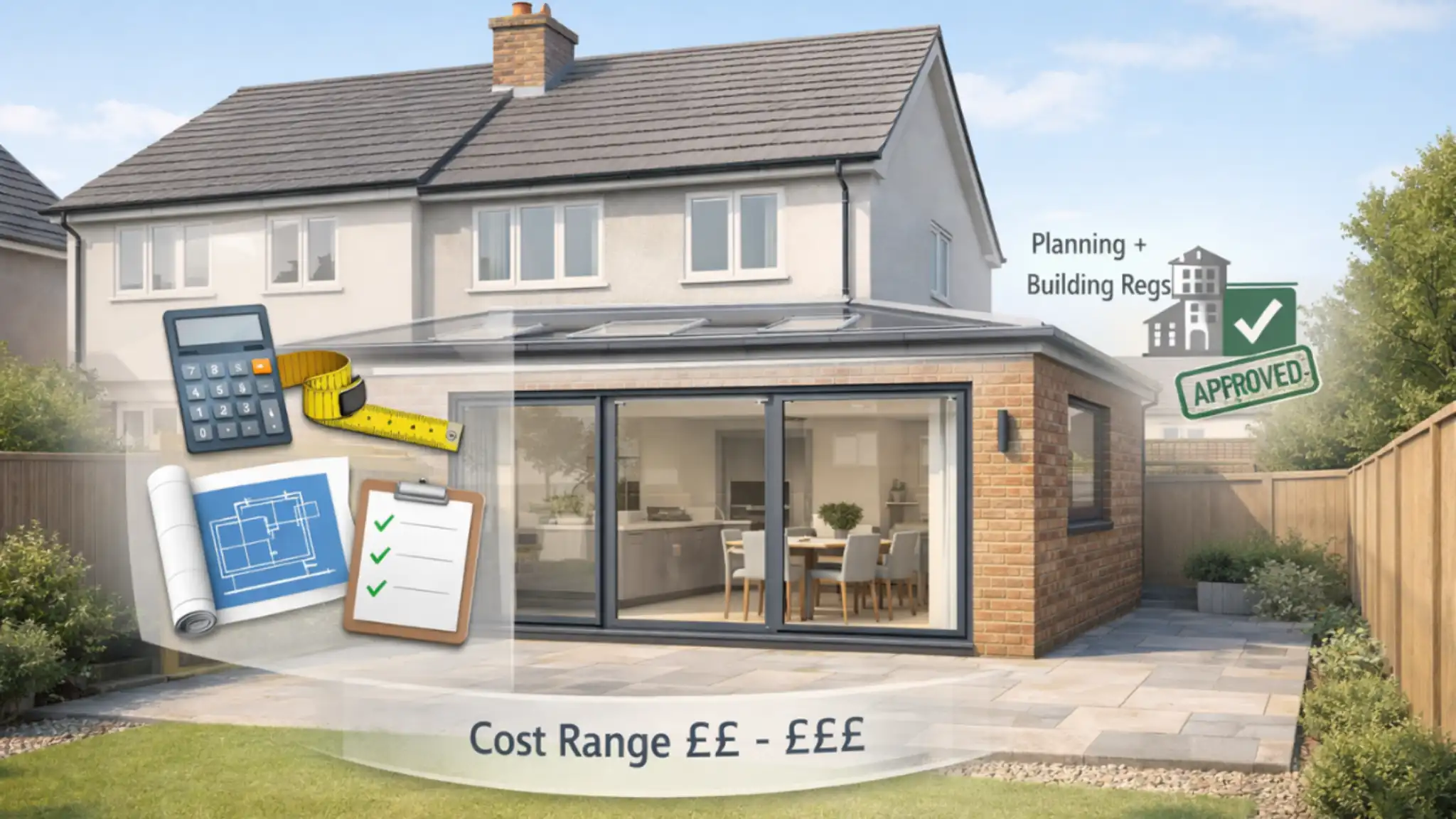
Quick summary: how much are extensions UK
If you’re Googling how much are extensions UK, the honest answer is: it depends on the size, specification and how complex your house is — but most homeowners can still get to a realistic budget quickly with a few sensible assumptions.
- Typical build cost range: many extensions land somewhere around £2,000–£3,500+ per m² depending on area, access and finish.
- Small single-storey extensions: often start from the tens of thousands, but costs jump fast with steels, drainage moves and high-spec glazing.
- Two-storey extensions: usually offer better “£ per m² value” than single-storey, but they can trigger more structural work and design detail.
- Don’t forget “non-build” costs: drawings, surveys, structural calculations, planning (if needed) and Building Control all sit outside the builder’s quote.
In the guide below, we break down the costs you should expect, what drives the price up, and how to budget safely so you’re not caught out halfway through.
Want a realistic budget before you book builders?
Share your rough size, location and extension type — we’ll sense-check your numbers and flag the common “hidden extras” that push quotes up.
So… how much are extensions in the UK?
When homeowners ask how much are extensions UK, they usually want a number they can trust — not a vague “it depends”.The practical way to approach it is to split your budget into:
- Build cost (what the builder does on site), and
- Project cost (everything else you must pay for to do it properly and keep it compliant).
As a broad rule of thumb, many UK extensions land around £2,000–£3,500+ per m² for the build element, depending on location and finish.However, the range is wide because a “simple box” is very different from a rear extension with bifolds, underfloor heating, roof lanterns and a full kitchen refit.
Quick costs snapshot – a sensible way to estimate
If you want a quick starting point, try this:
- Step 1: Estimate internal floor area being created (m²).
- Step 2: Multiply by a realistic build range (often £2,000–£3,500+ per m²).
- Step 3: Add a separate allowance for “non-build” costs (drawings, engineer, Building Control, surveys, permissions).
- Step 4: Add contingency — typically 10–15% for older houses or complex sites.
The goal isn’t to predict the final penny — it’s to avoid starting a project that can’t be finished comfortably.
Extension cost per m²: how to use it properly
“Cost per square metre” is useful, but only if you treat it as a guide — not a quote.It works best when you compare like-for-like (similar extension type, similar finish, similar region).
Why £/m² can mislead homeowners
- Small extensions often cost more per m² because kitchens, steels, foundations and connections don’t scale down neatly.
- Complexity beats size — awkward access, drainage moves, split levels and tight party wall conditions can add cost quickly.
- Finishes change everything — a basic shell is very different from a “kitchen-diner with skylights and UFH”.
What actually drives extension costs up (and down)?
Most extension budgets are shaped by a handful of predictable factors. If you understand these, you can make design choices that keep costs under controlwithout sacrificing the parts that matter to you.
1) Structure and groundworks
Groundworks are one of the biggest “swing costs”. Depth of foundations, drainage runs, existing manholes, and soil conditions can all change the price.Steelwork (RSJs) and propping also add cost, especially where you want large open-plan openings.
For projects involving structural openings or major alterations, you’ll usually need an engineer.See our guide on structural calculations for what’s typically involved.
2) Design complexity and constraints
- Terraces and semis often have tighter boundaries and neighbour constraints.
- Conservation areas and listed buildings can add design and approval work.
- Rear access (or lack of it) can push labour time and waste handling up.
If your home has restrictions, it’s worth reading our plain-English overview ofconservation area rules (and the extra care needed for sensitive locations).
3) The specification (windows, insulation, heating, finishes)
The moment you choose premium glazing, roof lanterns, underfloor heating, smart ventilation, bespoke joinery or stone worktops,your cost band moves. None of this is “wrong” — it just needs to be budgeted honestly from the start.
4) Kitchen and services moves
Many homeowners extend to create a bigger kitchen-diner. Kitchens are often one of the most expensive parts of the overall project,and moving water, soil pipes, and electrics can add more than people expect.If your project centres on a kitchen space, our guide on kitchen extension planning and costs will help you plan properly.
Not sure what your quote really includes?
We can help you spot the missing items that cause overruns — and suggest what to ask before you sign.
What’s included in a quote — and what’s usually missing
A clear quote isn’t just about the final number — it’s about certainty.For a typical extension, you should expect clarity on:
- Demolition / strip-out and waste removal,
- Groundworks including drainage and foundations,
- Structure (walls, steels, roof),
- Thermal upgrades (insulation and airtightness to meet Part L expectations),
- Windows/doors (spec, U-values, trickle vents where needed),
- Electrics/plumbing/heating scope, and
- Finishes (plastering, flooring, decorations) — or clearly excluded.
If you’re at the “what drawings do I need?” stage, these two guides are useful:what planning drawings typically include andwhat Building Regulations plans cover.
Planning permission and Building Regulations: cost impact
Two homeowners can build a similar-sized extension for very different total project costs depending on permissions and compliance work.This is where many budgets go off track — not because the build changed, but because the “paperwork and proof” wasn’t allowed for.
Planning permission: when it affects your budget
Some extensions fall under permitted development. Others need a full planning application — especially where you’re close to boundaries,in sensitive areas, or the design pushes typical limits.If you’re unsure, start with our extension permission checklist.
Even where planning permission isn’t needed, many homeowners still apply for a Lawful Development Certificate for certainty (particularly before selling).That can add a modest cost, but it often reduces stress later.
Building Regulations and Building Control
Almost all extensions need Building Regulations compliance, and Building Control involvement.Costs vary by council/approved inspector and project scope, but it’s important to budget for:
- Building Control application/inspection fees,
- construction detail drawings (if you take the Full Plans route), and
- any supporting calculations or product evidence needed to demonstrate compliance.
If you want a simple explanation of how inspections work, see:what Building Control actually does andwhat to expect at inspections.
Step-by-step: budgeting for your extension (without nasty surprises)
If you want to keep control of costs, a simple process beats guesswork every time.Here’s the approach we recommend to most homeowners.
Step-by-step: a safer way to budget
- Define the outcome. Extra bedroom? Bigger kitchen-diner? Utility? Know what “success” looks like.
- Measure the likely floor area (m²). Even a rough sketch helps early budgeting.
- Use a realistic build band. Apply a range, not a single number, and be honest about your finish level.
- Add the “non-build” costs. Drawings, surveys, engineer, Building Control, permissions if needed.
- Ask for like-for-like quotes. Use a written scope so you’re comparing the same thing.
- Check constraints early. Boundaries, neighbours, drainage, and access are common cost drivers.
- Hold a contingency. 10–15% is common; older houses often justify the upper end.
If you’re still at the idea stage, our pillar guideHouse Extensions – Complete UK Guideexplains the bigger picture: planning, process, common council issues and how to avoid delays.
FAQs: how much are extensions UK
What is the cheapest type of extension to build?
A simple, small, single-storey rear extension with straightforward foundations, standard windows and minimal services moves is often the “cheapest” route.Costs rise quickly when you add complex roof forms, large openings, premium glazing or drainage diversions.
Is a two-storey extension better value than a single-storey extension?
Often, yes — because you’re paying for foundations and a roof once, while gaining extra floor area.However, two-storey work can add structural complexity, more design detailing, and sometimes greater planning sensitivity depending on overlooking and bulk.
Do extension quotes usually include VAT?
Not always. Some quotes are shown ex-VAT, others inc-VAT, and it can vary depending on the builder’s VAT registration and how they present pricing.Ask the question directly and get it confirmed in writing before you compare quotes.
How much should I allow for drawings and approvals?
You typically need to budget separately for measured survey, drawings, any structural input, and Building Control.If planning permission is required, you’ll also have the planning application fee and potentially extra supporting documents depending on your site.Our guide to planning-related costs explains what normally sits outside the build quote.
Can I save money by doing my own drawings?
For straightforward projects, some homeowners do produce their own sketches, but councils and Building Control usually expect properly scaled plans.In practice, professional drawings often save money by reducing misunderstandings, avoiding redesign, and helping you get accurate builder pricing.
Why do extension costs vary so much between regions?
Labour rates, access constraints, parking/waste logistics, and local market demand all affect build costs.London and the South East often price higher, but even within the same town, tight sites and awkward access can push prices up.
Want a clearer budget range for your exact house?
Send us your rough dimensions and a couple of photos — we’ll help you sanity-check your expected costs and the likely approval route.
Next steps & useful guides
If you want to go beyond rough numbers and get your project set up properly, these guides will help:
- Planning Permission for Extension: a step-by-step guide
- Planning drawings: what you need for approval
- Building Regulations: what applies to extensions
- Building Control: routes, fees and inspections
- Party wall notices explained (if you share a wall/boundary)
- Extension plans: what to include before pricing
- Best quick estimatorArea (m²) × a realistic build band, then add “non-build” costs and a 10–15% contingency.
- Main cost driversGroundworks/drainage, steelwork and openings, access, glazing/spec level, and how much you’re refitting internally.
- Common budget mistakeComparing quotes that include different things (VAT, finishes, drainage moves, Building Control, kitchen supply).
- Approval realityEven when planning isn’t required, Building Regulations compliance usually is — budget for it from day one.
If you want a clearer budget range and the likely permission route for your home, contact Plans Made Easy and we’ll guide you through the sensible next steps.
Official guidance
For current national guidance, it’s worth checking:
- Planning Portal – national planning guidance and application information
- GOV.UK – planning permission in England and Wales
How Plans Made Easy can help
Working out “how much are extensions UK” is much easier when your scope is clear, your drawings are right, and you’ve budgeted for the real-world extras(permissions, compliance, and the bits builders often exclude).
Our team helps homeowners prepare compliant plans, coordinate Building Regulations information, and navigate planning submissions in a calm, practical way —so your project moves forward without expensive delays.
Ready to move your project forward?
Plans Made Easy can prepare compliant plans, manage submissions, and guide you from idea to approval.

Performance Verified ✅
This page meets PME Optimisation Standards — achieving 95+ Desktop and 85+ Mobile PageSpeed benchmarks. Verified on

