
Share this post:
Quick summary: Extension Regulations
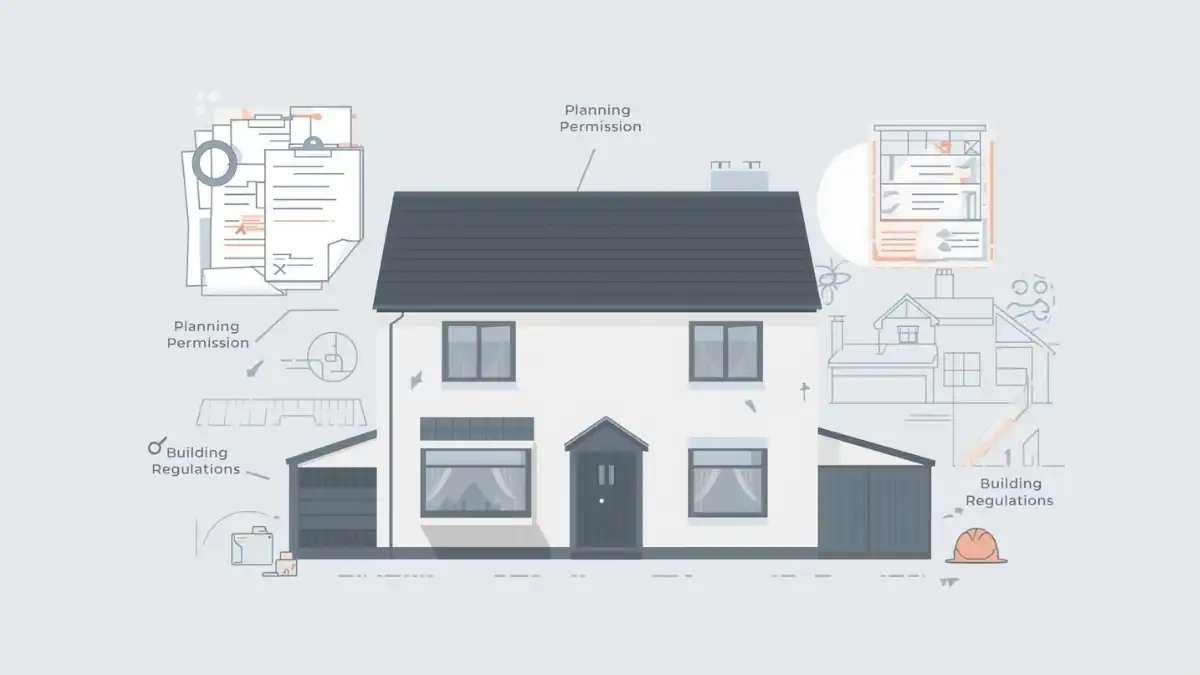
Extension regulations in the UK are made up of two separate systems: planning rules (whether you’re allowed to build it) and Building Regulations (how it must be built safely and legally).
- You may be able to build an extension without planning permission under Permitted Development.
- Building Regulations approval is still required for almost all extensions.
- Different rules apply depending on size, location, and type of extension.
- Getting this wrong can cause problems when selling, remortgaging, or insuring your home.
Unsure which extension regulations apply to your home?
We’ll explain whether you need planning permission, Building Control approval, or both — before you commit.
What do “extension regulations” actually cover?
Homeowners often use the term extension regulations to describe all the rules around extending a house. In reality, those rules come from two different places.
In simple terms:
- Planning permission controls what you can build and how it affects neighbours and the street.
- Building Regulations control how it is built, covering structure, insulation, fire safety and drainage.
You can read a full breakdown in our main guide toBuilding Regulations,but below we focus specifically on how these rules apply to extensions.
Planning permission vs Building Regulations for extensions
Planning permission rules for extensions
Planning rules look at the impact of your extension on the outside world — neighbours, streetscape, and local character.
- Height, depth and overall size
- Position relative to boundaries
- Overlooking and loss of light
- Design and external appearance
Many house extensions fall under Permitted Development. Our guideDo I Need Planning Permission for an Extension?explains this in detail.
Building Regulations rules for extensions
Building Regulations apply to almost every extension, regardless of whether planning permission is needed.
- Foundations and structure (Part A)
- Fire safety and escape routes (Part B)
- Insulation and energy efficiency (Part L)
- Drainage and ventilation
Extension regulations without planning permission
Many homeowners search for extension rules without planning permission. In England, this usually means building under Permitted Development (PD).
Typical PD limits include:
- Single-storey rear extensions within depth limits
- Height limits (usually 4m max)
- No extensions forward of the principal elevation
- Special restrictions in conservation areas
Even under PD, you should strongly consider applying for aLawful Development Certificateto prove the extension is legal.
Building Regulations for house extensions
Whether your extension is small or large, Building Regulations approval is usually required.
You’ll normally need:
- Building Regulations drawings
- Structural calculations (where applicable)
- Site inspections by Building Control
- A Building Regulations Completion Certificate
Learn more in our guide toBuilding ControlandPlans for Building Regulations.
Not sure if your extension complies?
We’ll sense-check your proposal against planning rules and Building Regulations before problems arise.
Extension regulations by extension type
Single-storey and rear extensions
These are often permitted development but must still meet Building Regulations. Seerear and side extensions.
Double-storey extensions
Usually require planning permission and full Building Regulations approval due to structural complexity.
Kitchen extensions
Kitchens trigger extra rules around ventilation, drainage and insulation. Readkitchen extension regulations.
Loft and side extensions
Often constrained by height limits, roof design and fire escape rules. Seeloft conversions.
Step-by-step: how to check extension regulations
- Confirm if planning permission is required
- Check for conservation area or listed building restrictions
- Prepare planning drawings if needed
- Arrange Building Regulations drawings
- Submit to Building Control (Full Plans or Building Notice)
- Keep certificates for future sale
Common extension regulation mistakes
- Assuming “small” means no regulations apply
- Building before approvals are in place
- Missing completion certificates
- Relying on builder advice alone
FAQs: Extension regulations UK
Do all extensions need Building Regulations?
Yes, almost all house extensions require Building Regulations approval, even if planning permission is not needed.
Can I extend an existing extension?
Sometimes, but cumulative size limits and planning history matter. Always re-check regulations.
Can I build an extension without Building Regulations?
No. Doing so can make the work unlawful and difficult to sell later.
Need reassurance before you build?
A quick review now can save months of stress later.
- Planning permissionMay be required depending on size, location and history.
- Building RegulationsRequired for almost all extensions.
- Permitted DevelopmentNot automatic — conditions apply.
- CertificatesKeep planning approvals and completion certificates safe.
Official guidance
Ready to move your extension forward?
Plans Made Easy can prepare compliant plans and guide you through approval.

Performance Verified ✅
This page meets PME Optimisation Standards — achieving 95+ Desktop and 85+ Mobile PageSpeed benchmarks. Verified on

