Share this post:
Quick Summary: Elevation Drawings for Planning Permission
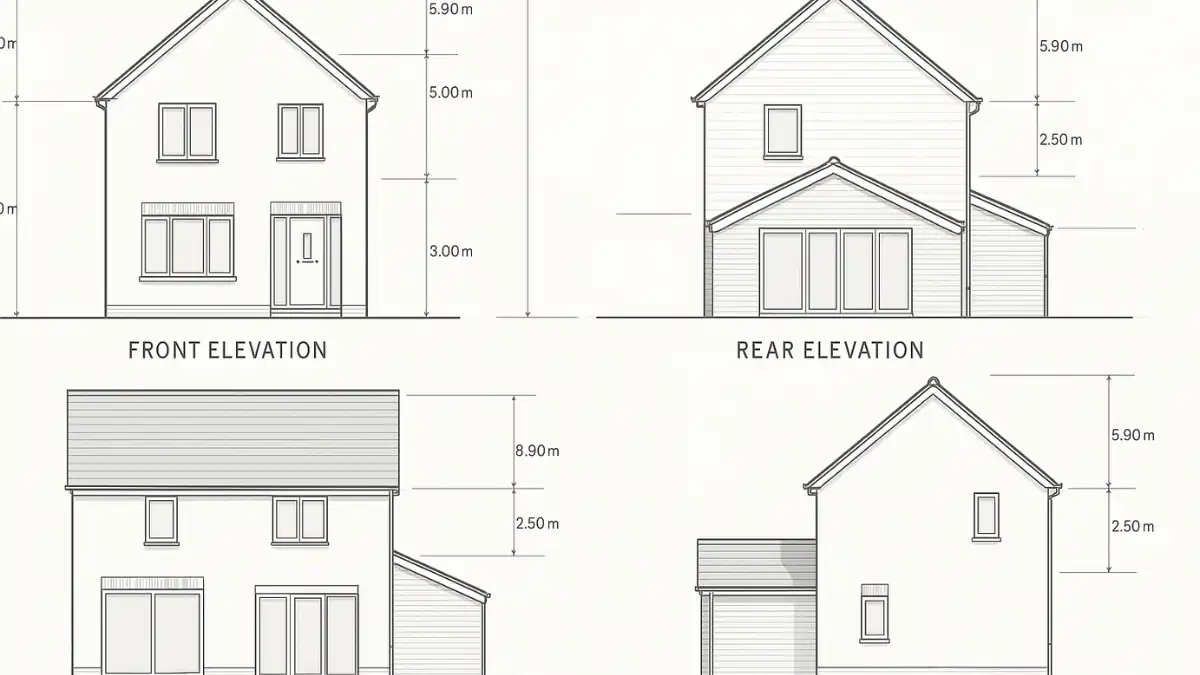
Elevation drawings for planning permission show your home from every visible side — front, rear, left, and right — so the council can understand the appearance, scale, and external changes you’re proposing. They’re a mandatory part of almost all planning applications in England.
- Required for: Extensions, loft conversions with dormers, garden rooms, porches, outbuildings, garage conversions (if external changes).
- Shows: Heights, roof form, windows, doors, materials, boundaries & adjoining properties.
- Prepared by: Architectural technicians, architects, or specialist planning-drawing services.
- Cost range: £250–£600+ depending on project size and detail level.
This guide explains everything you need, including what they show, what the council checks, and how to avoid the common refusal triggers.
Need elevation drawings for your planning application?
Our team produces council-ready drawings for extensions, conversions and outbuildings.
What Are Elevation Drawings for Planning Permission?
Elevation drawings for planning permission are scaled architectural drawings that show the exterior sides of your proposed development. When you submit a planning application in England, the council uses these drawings to judge how your project will look from the street, from neighbours’ gardens and from public viewpoints.
They must be drawn to scale, usually 1:50 or 1:100, and include both the existing elevations and the proposed elevations. This lets the planning officer directly compare what is changing and assess the impact on appearance, character and amenity.
This Support Stone article sits underneath our main Pillar guide on Planning Permission Drawings, offering a deeper breakdown specifically on elevations.
Why Councils Require Elevation Drawings
Local authorities rely on elevation drawings because they answer the key planning questions such as:
- Does the extension fit the character of the area?
- Are the materials appropriate?
- Will the height or massing harm neighbour amenity?
- Does the roof form match or work with the existing house?
- Are new windows overlooking neighbouring homes?
Without elevation drawings, the planning officer simply cannot assess impact. Missing or unclear elevations are one of the most common reasons applications are made invalid before they even reach an officer.
What Elevation Drawings Must Include
To be accepted for planning permission, elevation drawings must include certain information. Councils vary in how strict they are, but most require the following as standard.
1. All Visible Sides of the Building
Typically:
- Front (street-facing)
- Rear
- Left side
- Right side
2. Existing and Proposed Versions
You must show both:
- Existing elevations – what your house looks like today.
- Proposed elevations – your future extension, conversion, or alteration.
3. Dimensions & Heights
These normally include ridge height, eaves height, window positions, and overall footprint width.
4. External Materials
Such as brick, render, cladding, roof tiles, fascias, and doors. Councils want consistency with the existing house unless a design-led exception is justified.
5. Boundaries & Adjoining Properties
Shows the relationship with nearby buildings — critical for impact and overlooking assessments.
Not sure what your council expects?
We prepare elevation drawings that meet local requirements and match Planning Portal guidance.
Who Can Prepare Elevation Drawings?
You do not need an architect for elevation drawings, although you can use one if you prefer. Most UK homeowners choose:
- Architectural technicians – skilled, accurate, cost-effective.
- Architects – useful for design-led projects.
- Specialist planning-drawing services – often cheapest and fastest.
We cover the full process in our broader guide on Drawings for Planning Applications.
How Much Do Elevation Drawings Cost?
The cost varies depending on complexity and detail level. However, most homeowners fall into fairly predictable ranges.
Typical Elevation Drawing Costs (UK):
- Small extension: £250–£350
- Large extension or loft conversion: £350–£500
- Complex or multi-storey projects: £450–£650+
If you are preparing drawings for a full application, consider reading the wider guide on Planning Permission Drawings Costs for a complete breakdown.
Step-by-Step: How To Get Your Elevation Drawings Prepared
| Step | What Happens |
|---|---|
| 1. Home Survey | A technician measures the exterior and interior layout. |
| 2. Existing Drawings Created | Your home is drawn in its current form. |
| 3. Proposed Design Added | The proposed changes (extensions, roof, windows) are drawn over the existing. |
| 4. Elevations Rendered | Front, rear and side elevations are produced. |
| 5. Final Pack Issued | Drawings prepared for submission through the Planning Portal. |
Common Mistakes That Hold Up Applications
- Incorrect scale (must show 1:50 or 1:100).
- Missing materials or unlabelled details.
- No comparison between existing and proposed.
- Inaccurate heights leading to neighbour objections.
- Not showing boundaries or nearby windows.
If you’re submitting for the first time, our guide on Planning Permission explains how drawings fit into the wider application.
FAQs – Elevation Drawings for Planning Permission
What are elevation drawings?
Elevation drawings show each external side of a building in accurate scale. They display height, materials, roof shape, windows and doors so the council can assess the external impact of your proposal.
How much do elevation drawings cost?
Most UK homeowners pay between £250 and £600 depending on the size of the project, detail level, and whether both existing and proposed drawings are required.
Do I need elevation drawings for permitted development?
Yes, in many cases you do. Even under permitted development, drawings are required for a lawful development certificate to prove your project meets PD limits. See our guide on when planning permission is required.
Are elevation drawings needed for a loft conversion?
If you are adding a dormer, rooflight or altering the ridge/eaves height, elevation drawings are mandatory for planning permission or a lawful development certificate.
Can I draw elevations myself?
Councils require professional-quality scaled drawings. Hand-drawn or inaccurate elevations are almost always rejected. Most homeowners use an architectural technician.
How long do they take to produce?
Typically 5–10 working days depending on survey availability and complexity.
Key Facts Snapshot
- Required For: Extensions, loft conversions, outbuildings with changes, porches, garage conversions
- Scale: 1:50 or 1:100
- Includes: Heights, materials, windows, doors, roof form, boundaries
- Cost Range: £250–£600+
- Needed For Validation: Yes — and missing elevations cause most invalidations
Ready to move your project forward?
Plans Made Easy prepares elevation drawings, manages submissions, and guides you from idea to approval.
Useful external guidance:
Performance Verified ✅
This page meets PME Optimisation Standards — achieving 95+ Desktop and 85+ Mobile PageSpeed benchmarks. Verified on

