
Share this post:
Quick summary: Drawings for Planning Permission
If you’re asking whether you need Drawings for Planning Permission, the honest answer is: for most householder projects in England, yes — you’ll need clear, scaled plans to either submit a planning application, apply for a Lawful Development Certificate (for Permitted Development), or simply avoid delays when the council validates your paperwork.
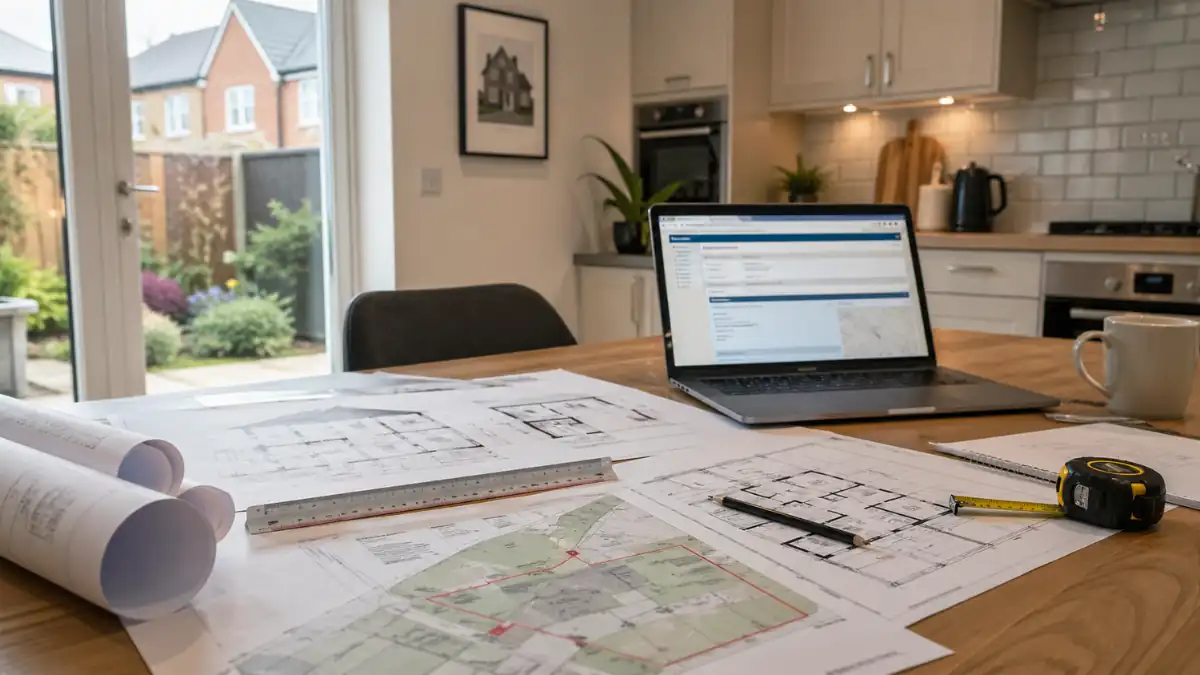
- Most planning applications need (as a minimum) a location plan and site/block plan, plus existing & proposed floor plans and elevations.
- Permitted Development doesn’t always mean “no drawings” — you usually still want them for an LDC, builder quotes, and peace of mind.
- DIY drawings can be accepted if they are accurate, to scale, properly labelled, and match council validation requirements.
- Most delays happen because drawings are missing, unclear, not to scale, or the red line boundary/site plans are wrong.
Below, we’ll explain what drawings councils typically expect, when DIY is realistic, and when it’s better to get a measured survey and a professional set prepared.
Not sure what drawings your council will accept?
Tell us what you’re planning and we’ll point you to the right drawing set — so your application is valid first time.
Do I need drawings for planning permission?
In most cases, yes — if you’re making a planning application, you’ll need a set of Drawings for Planning Permission that clearly show what exists now and what you want to build. The council can’t assess impact on neighbours, appearance, or scale based on a description alone.
Even where you don’t need full planning permission (for example, if your project is Permitted Development), drawings are still often the “boring but important” part that keeps everything smooth — especially if you want a Lawful Development Certificate, accurate builder quotes, or to avoid disputes later.
What drawings are needed for planning permission?
For a typical householder application (extensions, loft changes, dormers, outbuildings), councils usually expect a core set of drawings that explain the proposal clearly and to a recognised scale.
Core drawings councils usually want
- Location plan (shows the site in context — often based on OS mapping).
- Site / block plan (shows boundaries, neighbouring buildings, access, and the proposed works on the plot).
- Existing floor plans (current layout).
- Proposed floor plans (what changes).
- Existing elevations (current external appearance).
- Proposed elevations (what the house will look like after).
Common “extras” that are often required
- Roof plan (helpful where roof form changes, dormers, or PV arrays are involved).
- Sections (useful for split levels, tricky foundations, or where height needs to be unambiguous).
- Street scene / context elevation (sometimes requested on terraces or where matching neighbours matters).
- Materials notes (especially if appearance is sensitive or you’re in a protected area).
Planning application vs Permitted Development: do you still need drawings?
This is where homeowners often get caught out. “Permitted Development” can remove the need for a full planning application, but it doesn’t remove the need for clear drawings in real life.
When you usually need drawings even under Permitted Development
- Lawful Development Certificate (LDC) — you’ll normally need a proper drawing set to prove the proposal meets PD rules.
- Builder pricing — builders can’t quote accurately from a sketch.
- Party Wall matters — drawings help neighbours understand what’s proposed.
- Future sale — paperwork is easier if you have a clear record of what was built and why it was lawful.
Can I do my own planning drawings?
Yes — you can submit DIY drawings, and many councils will accept them, as long as they meet the same standards as professional drawings: clear, accurate, and to scale. Planning Portal is explicit that drawings need to meet quality standards to validate an application.
DIY drawings are more realistic when…
- the project is simple (for example, a straightforward single-storey rear extension)
- you can take accurate measurements
- you understand scale and can produce consistent plans/elevations
- your site isn’t awkward (levels, unusual boundaries, shared access, etc.)
DIY drawings get risky when…
- the design affects roof form, height, or neighbour outlook/privacy
- you’re in a conservation area or dealing with heritage constraints
- you need sections/levels to explain the proposal
- you’re not confident your measurements are right
Quick costs snapshot (typical UK ranges)
- Measured survey: often a few hundred pounds depending on size and complexity.
- Planning drawing set: commonly a few hundred to low thousands depending on scope.
- Building Regulations drawings (if needed): often similar again, because they require more technical detail.
Costs vary by region, property complexity, and how many revisions you need. If you want ballpark bands, our cost guides break this down in more detail.
Not sure if your idea fits Permitted Development?
We’ll check your project against PD rules and let you know if you need a full planning application.
How to draw plans for planning permission (step-by-step)
If you’re going down the DIY route, the goal is simple: make your Drawings for Planning Permission clear enough that the council can validate them quickly and assess the impact without guessing.
Step-by-step HowTo checklist (DIY drawings)
| Step | What to do | What councils look for |
|---|---|---|
| 1. Measure accurately | Measure walls, openings, floor-to-ceiling heights, and key external dimensions. | Consistency between plans and elevations; believable dimensions. |
| 2. Choose a scale | Use a recognised metric scale (commonly 1:50 or 1:100 for plans/elevations). | Drawings that are readable and properly scaled. |
| 3. Draw existing first | Produce existing floor plans and elevations before proposed. | A clear “before vs after”. |
| 4. Draw proposed changes | Show the new layout and what changes externally. | Impact on neighbours, massing, windows, and appearance. |
| 5. Add site & location plans | Use correct boundaries (red line) and show access, parking, and adjacent context. | Correct site boundary and enough context to validate. |
| 6. Label clearly | Include drawing titles, scales, revision letters, and north point where relevant. | Clarity and professionalism (even for DIY). |
Submitting drawings: how to avoid validation delays
Many planning delays aren’t “planning decisions” — they’re admin problems. If your application isn’t valid, the council won’t start the assessment clock.
Common validation issues we see
- missing location/site plans
- site boundary not clearly marked
- plans not labelled “existing” vs “proposed”
- inconsistent dimensions (plans don’t match elevations)
- poor image quality or unreadable PDFs
Costs & timelines for getting drawings done
If you decide not to DIY, you’re usually paying for (1) someone to measure properly and (2) someone to turn that into a clear, compliant drawing set. For many homeowners, the value is less stress and fewer back-and-forth emails with the council.
Typical timescales
- Measured survey: often completed in a single visit.
- First draft drawings: commonly 1–3 weeks depending on workload and complexity.
- Revisions: allow a bit of time if you’re comparing options or tweaking layouts.
FAQs: Drawings for Planning Permission
What drawings are needed for planning permission?
Most householder applications need a location plan and site/block plan, plus existing and proposed floor plans and existing and proposed elevations. Some projects also need roof plans, sections, or street scene drawings depending on complexity and local requirements.
Can I draw my own plans for planning permission?
Yes — councils can accept DIY drawings if they are accurate, clearly labelled, and to a recognised scale. The risk is that unclear or inconsistent drawings can lead to validation delays (or requests for rework), which often removes any time saved by doing it yourself.
Do I need drawings for Permitted Development?
Often, yes. Even if you don’t need a full planning application, you’ll usually want proper drawings for an LDC (to prove the work is lawful), and for builder quotes. Planning Portal’s guidance is a useful starting point for understanding whether permission or Building Regulations approval applies.
What scale should drawings be for planning permission?
Scales vary by drawing type, but councils generally expect a recognised metric scale that’s easy to read. Planning Portal explains common plan types and expects drawings to meet quality standards for validation.
Who can prepare drawings — do I need an architect?
You don’t have to use a registered architect. Many homeowners use architectural technologists, technicians, or specialist plan-drawing services. What matters is that the drawings are clear, accurate, and meet local validation requirements.
What’s the biggest mistake homeowners make with planning drawings?
The most common issue is incomplete or inconsistent information — for example, missing site plans, incorrect boundaries, or elevations that don’t match the floor plan. That can trigger validation problems and slow everything down.
Want to avoid delays and redraws?
We can sense-check what you’re planning and confirm the drawing set your council is likely to expect.
Next steps & useful guides
If you want to go a level deeper (or you’re comparing DIY vs professional help), these guides are a helpful next step:
- Our main guide to the UK planning permission process
- A deeper explanation of what councils expect from drawings
- How to put together a strong planning submission pack
- Typical drawing costs (and what affects quotes)
- Cost guide: budgeting for surveys and plans
- When it’s worth using an architect vs a technician
- If your project is an extension: planning and plan basics
- What drawings you’ll typically need for an extension (permission, PD, and sign-off)
- Most common required drawings Location plan + site/block plan + existing/proposed floor plans + existing/proposed elevations.
- DIY drawings allowed? Yes, if they are accurate, to scale, and meet validation standards — otherwise expect delays.
- Permitted Development You may not need a full application, but drawings are still useful (especially for an LDC and builder pricing).
- Most common delay Applications being marked invalid due to missing/unclear plans, wrong boundaries, or inconsistent drawings.
- Best homeowner move Check your council’s validation checklist, then build a drawing pack that leaves no ambiguity.
If you want a quick sanity check before you submit, message Plans Made Easy and we’ll point you in the right direction.
Official guidance and trusted resources
For up-to-date national guidance, these are worth bookmarking:
- Planning Portal – plans and drawings (what’s commonly required)
- Planning Portal – householder planning consent (information required)
- GOV.UK – planning permission in England and Wales
- RIBA – homeowner guidance on planning a house extension
Conclusion: the simplest way to avoid planning delays
If you take one thing away, let it be this: councils need drawings that make your proposal obvious. Whether you DIY or go professional, your Drawings for Planning Permission should be clear, consistent, and properly labelled — because that’s what keeps validation smooth and helps the case officer assess your project without guesswork.
If you’re unsure which drawings your project needs, or you want to avoid rework, our team can help you plan the right pack and submit with confidence.
Ready to move your project forward?
Plans Made Easy can prepare compliant plans, manage submissions, and guide you from idea to approval.
Performance Verified ✅
This page meets PME Optimisation Standards — achieving 95+ Desktop and 85+ Mobile PageSpeed benchmarks. Verified on

