
Share this post:
Drawing Plan For House for planning permission doesn’t have to be complicated — but it does need to be clear, accurate, and in the right format for your council. If the plans are missing key information (or drawn to the wrong scale), it can slow your application down or trigger “invalid” checks.
Quick summary
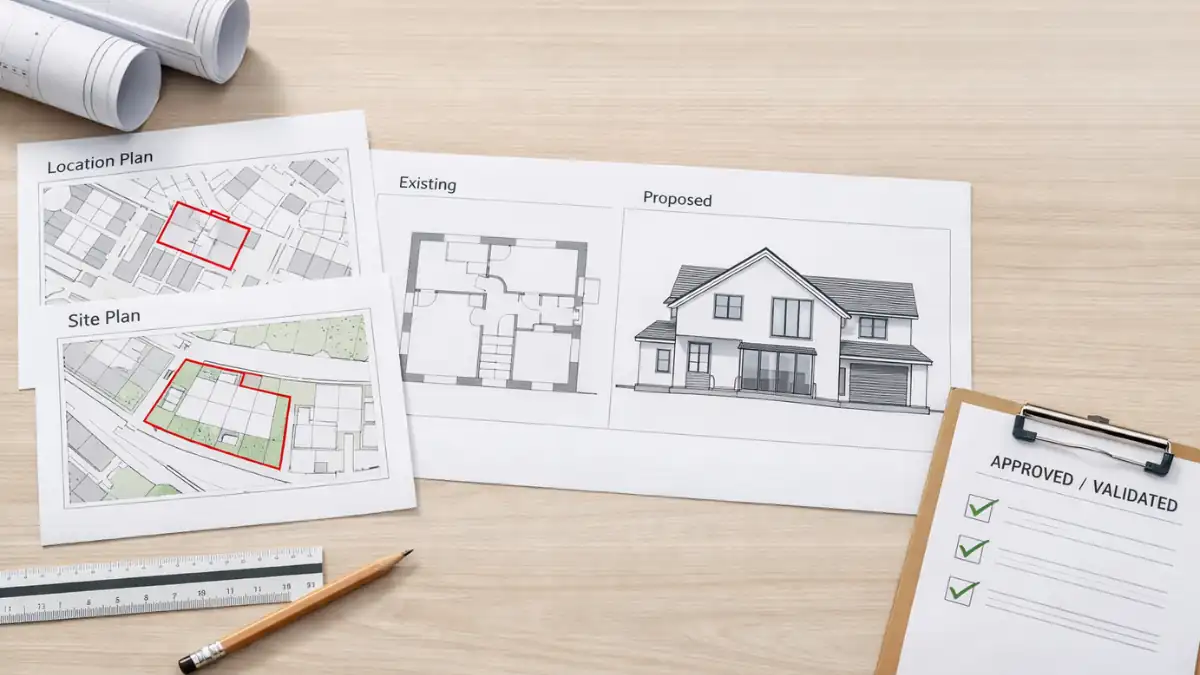
- Your council usually needs a location plan, site/block plan, and existing + proposed drawings (typically floor plans and elevations).
- Drawings should be to a recognised scale (often 1:50 or 1:100) with key dimensions.
- Even if your project is “permitted development”, you may still want proper plans (and you might need a Lawful Development Certificate).
- Planning drawings are not the same as Building Regulations drawings — you may need both.
Key facts snapshot
- Most common reason for delay: missing plans (or the wrong scale / no red line boundary).
- Best way to avoid stress: start with a measured survey and work from accurate dimensions.
- Good to know: your local authority can ask for extra info depending on the site and constraints.
Note: This guide is written for homeowners in England. Your council (Local Planning Authority) can have its own validation checklist, especially in conservation areas, near listed buildings, or where trees / highways are involved.
If you’re preparing a planning application, the “drawing plan” part is often what worries homeowners most — especially if you’re trying to keep costs sensible. The good news is this: councils aren’t looking for fancy artwork. They want clear, accurate drawings that show what exists now, what you’re proposing, and how it sits on the site.
In this guide, we’ll walk you through what to include in a Drawing Plan For House for planning permission, what format usually works best, and how to avoid the common mistakes that cause delays.
On this page
Drawing Plan For House: what your council usually needs for planning permission
Most planning applications are validated against a checklist. The exact list can vary by council, but for a typical householder application you’ll usually need:
- Location plan (shows the site in context, with the boundary edged in red)
- Site / block plan (shows the property, boundaries, nearby buildings, and where the work sits)
- Existing drawings (what’s there now)
- Proposed drawings (what you want to build)
- Supporting documents (design statement, heritage statement, flood risk info etc — only when relevant)
Important: Planning drawings and Building Regulations drawings are different. Planning is mainly about how it looks, how it affects neighbours, and how it fits policy. Building Regs is about structure, insulation, fire safety, drainage, and more.
If you want a broader view of what “valid” application sets look like, our guide to planning application drawing requirements is a helpful next step.
Drawing Plan For House drawings: scales, dimensions, and formatting that work
Councils don’t accept “rough sketches” for most applications. Your drawings should be clear, consistent, and to a recognised scale. In practice, these are common:
- 1:50 (great for detail, often used for floor plans and elevations)
- 1:100 (common for general layouts)
- 1:200 or 1:500 (common for site/block plans, depending on the plot)
- 1:1250 (often used for location plans)
What must be shown clearly on your planning drawings
- A scale bar (useful if drawings get printed at a different size)
- North point (especially on site and location plans)
- Key dimensions (so the case officer can understand size and change)
- Labels (e.g., “Existing” vs “Proposed”, room names where helpful)
- Enough line weight / clarity to be readable on-screen
Tip: If you’re measuring yourself, don’t rely on “estate agent” plans. They’re rarely accurate enough for submissions. A measured survey is usually the calmest place to start.
Drawing Plan For House checklist: what to include (with plain-English explanations)
1) Location plan (the “red line boundary” plan)
This is the plan that shows where your property sits in the wider area. It normally includes:
- The application site edged in red
- Any other land in your ownership edged in blue (when relevant)
- Road names and surrounding buildings so the site is easy to identify
Many homeowners buy this as a mapping product (rather than drawing it from scratch). Your council will often specify the exact format they expect.
2) Site / block plan (how the work sits on your plot)
A site plan zooms in and shows your house, garden, boundaries, and nearby context. For planning permission, it should usually show:
- Boundary lines, fences, walls, and access points
- Where the proposed work sits (extension outline, outbuilding position, etc.)
- Distances to boundaries and nearby buildings where relevant
- Parking / access arrangements if they’re changing
- Important trees (and sometimes root protection areas, depending on the site)
3) Existing floor plans
These show the current layout and footprint. Councils use them to understand what’s changing — and whether the proposal is proportionate.
- Show wall thicknesses and internal layout clearly
- Label key spaces (kitchen, lounge, hallway, etc.)
- Include overall dimensions where helpful
4) Proposed floor plans
This is where the planning officer can see the new layout, new openings, and the scale of the change. Good proposed plans will:
- Show the new footprint and how it connects to the existing house
- Include key dimensions (overall and critical elements)
- Clearly mark new doors, windows, rooflights, and openings
5) Existing and proposed elevations (front / rear / side)
Elevations are essential for showing appearance — which is a big part of planning decisions. Elevations should typically include:
- All sides affected (and often the full set of elevations for context)
- Window and door positions
- Overall heights and ridge/eaves heights where relevant
- Material notes (e.g., “brick to match existing”, “render finish”, “tile type”)
If you’re unsure what “good” elevations look like for councils, you may find our explainer on what elevations are and why they matter useful.
6) Sections (only when needed, but often very helpful)
A section is like a slice through the building. Not every project needs one, but councils often ask for sections when:
- The site slopes
- Heights are sensitive (near boundaries or neighbours)
- Roof changes are complex
- You need to show relationship to neighbouring windows or ground levels
7) Roof plan (useful for roof alterations and many extensions)
Roof plans can clarify ridge lines, hips/valleys, rooflights, dormers, and drainage direction. They’re especially useful when the proposal changes the roof shape or adds roof openings.
Note: If your project touches highways (new or altered access, dropped kerb, visibility splays), the council may ask for extra drawings or highways information.
Who can create a Drawing Plan For House for planning permission?
In the UK, there’s no rule saying your plans must be drawn by an architect. However, the drawings must still meet planning validation standards — and that’s where DIY plans can sometimes cause headaches.
DIY plans: when it can work
Doing your own drawings can work when the project is simple, you’re comfortable with scale drawing, and you can produce clean, readable PDFs.You’ll need to be confident with:
- Measuring accurately (including heights where relevant)
- Drawing to scale consistently
- Showing the right set of existing + proposed drawings
- Producing clear site/location plans in the council’s preferred format
When it’s smarter to get professional help
In our experience, professional drawings are usually worth it when any of the following apply:
- You’re in a conservation area or the house is listed
- You’ve had a refusal before (or neighbours are likely to object)
- The design is tight to boundaries, height limits, or overlooking concerns
- You want to move quickly and reduce “back and forth” with the council
If you’re weighing up whether you need specialist help, our guide on working with professionals for application drawings explains what you’re paying for and what you should expect to receive.
Want us to check your drawing set before you submit?
A quick review can catch missing drawings, scale issues, and the small details that often trigger validation delays.
Drawing Plan For House costs: what affects the price?
Costs vary mainly based on complexity, site constraints, and how much detail you need. For example, a straightforward rear extension drawing set is very different to a scheme in a sensitive area with multiple revisions.
- Project type: extension vs loft vs outbuilding
- Survey needs: measured survey, levels, tricky boundaries
- Revisions: design changes add time
- Extra drawings: sections, street scenes, heritage drawings
For a realistic idea of budgets and what’s typically included, see our guide on typical drawing fees and inclusions.
How to avoid delays (and reduce refusal risk)
Even a “good” proposal can get slowed down by avoidable admin issues. These are the practical steps that make the biggest difference:
Use the council’s validation checklist
Most councils publish a checklist for householder applications. If you match it, you reduce the risk of your application being marked invalid.
Make the “existing vs proposed” difference obvious
Use clear titles, consistent scales, and uncluttered linework. If the officer has to guess what’s changing, it usually triggers questions.
Think about neighbour impacts early
Overshadowing, overlooking, bulk, and boundary proximity are common themes in officer reports. If you design around these early, your plans tend to sail through more smoothly.
If you’re planning an extension, you may also want to read our extension drawing guide and what to expect from typical planning timeframes.
Important: If your works are likely to fall under Building Regulations, plan that process early as well. It’s much less stressful to align the design before you start building.Our guides on Building Regulations and Building Control explain how it all fits together.
FAQs: Drawing Plan For House for planning permission
What drawings do I need for planning permission?
In most cases you’ll need a location plan, a site/block plan, and existing + proposed drawings (typically floor plans and elevations). Some councils request sections, roof plans, or extra documents depending on the site and constraints.
Can I draw my own plans for planning permission?
Yes, you can — there’s no requirement for an architect. However, your drawings must be accurate, to scale, and include everything your council’s validation checklist expects. If you’re unsure, a quick professional review can prevent delays.
Who draws up plans for a house in the UK?
Common options include architectural designers, architects, technicians, and specialist planning drawing services. The right choice depends on complexity, local constraints, and whether you need design input or just clear technical drawings.
How do I choose the right scale for my drawings?
Floor plans and elevations are commonly 1:50 or 1:100. Site/block plans are often 1:200 or 1:500, and location plans are commonly 1:1250. Your council may specify preferred scales, so it’s worth checking their guidance.
How much does it cost to get planning drawings done?
It varies based on project type, survey requirements, and revisions. Straightforward schemes are usually cheaper; complex sites or sensitive areas often cost more. Our cost guide breaks down what typically changes the price.
Do I need Building Regulations drawings as well?
Often, yes — especially for extensions, loft conversions, and structural changes. Planning drawings show what you want to build; Building Regulations drawings show how it will comply with structure, fire safety, insulation (Part L), drainage, and more.
Next step: get your drawings “planning-ready”
If you’d like reassurance before you submit, our team can help you produce a clear, valid drawing set — and guide you through the planning process without the usual stress.
Performance Verified ✅
This page meets PME Optimisation Standards — achieving 95+ Desktop and 85+ Mobile PageSpeed benchmarks. Verified on

