
Share this post:
Quick Summary: Building Regulations Stairs (UK Domestic Homes)
Building Regulations stairs rules in England mainly sit under Part K, which covers safety, steepness, rise, going, headroom and handrails for domestic staircases. Part M also applies in certain cases (mainly new-builds and material change of use) to ensure accessibility and usability. This guide breaks everything down in plain English so you can design stairs that pass Building Control first time.
- Minimum stair width (advisory): 800–900mm
- Maximum rise: 220mm
- Minimum going: 220mm
- Minimum headroom: 2.0m over the pitch line
- Handrails required on stairs with two or more risers
Everything below is written for UK homeowners upgrading or installing a staircase in a typical house.
Need help making your stair plans Building Control–ready?
Our team prepares compliant drawings for domestic projects across the UK.
- Overview: How Building Regulations Apply to Stairs
- Key Part K Stair Requirements
- Stair Dimensions: Rise, Going & Pitch Explained
- Minimum Headroom Requirements
- Handrails, Balustrades & Guarding
- Part M: Accessibility for Domestic Properties
- Step-by-Step: How to Check Your Staircase Against Regulations
- Common Pitfalls & “Gotchas” That Cause Building Control Delays
- FAQs: Building Regulations Stairs
- Key Facts Snapshot
- Useful Guides & External References
Building Regulations Stairs: How the Rules Apply in a UK Home
In most domestic homes, Building Regulations stairs requirements fall under Approved Document Part K. These rules are designed to prevent falls, ensure the staircase is comfortable to use and guarantee that anyone using the stairs can do so safely. Although every staircase is different, the core principles remain the same: correct proportions, safe guarding, adequate headroom, and stable, uniform steps.
When you install a new staircase, alter an existing set of stairs, or undertake works that materially affect how people move between floors, your local Building Control team will check these rules carefully. While some minor repairs fall outside formal inspections, anything that changes the geometry or structural safety of the stairs will require building regulations approval. For larger domestic projects, you may submit a Building Notice or full plans application.
Key Part K Stair Requirements (Domestic Properties Only)
Part K sets out the core safety rules for staircases in a home. Although some flexibility exists for refurbishments in tight spaces, the following rules will apply to most homeowners building or upgrading stairs.
1. Stair Width (Advisory but Important)
There is no legal minimum width for a domestic staircase in England, but Building Control expects a functional width. Most new homes use 800–900mm, and this is considered a safe minimum for everyday use.
- Very narrow stairs (below 700mm) are discouraged.
- Winder stairs should retain adequate turning width.
- Loft stair widths often mirror these advisory figures.
2. Consistent Rise & Going
Uniformity is vital. The rise and going must be consistent throughout the entire flight.
3. Maximum Rise & Minimum Going
Part K sets clear limits so stairs are neither too steep nor too shallow:
- Maximum rise: 220mm
- Minimum going: 220mm
- Maximum pitch: 42°
Stair Dimensions: Rise, Going & Pitch Explained
Rise is the vertical height between treads, while going is the horizontal distance from nose to nose. Together, they determine how steep your staircase feels. Part K expects a balanced approach — enough rise to move efficiently between floors without making the stairs unstable or uncomfortably steep.
To comply with the 42° pitch rule, most compliant domestic staircases use:
- Rise: 180–200mm
- Going: 220–250mm
Minimum Headroom Requirements
Headroom is one of the most common stumbling blocks for homeowners, particularly in older houses where beams and sloping roofs compete for space. Part K requires:
- 2.0m minimum headroom measured vertically from the pitch line
- Permitted reduction in loft rooms over the lower section of a winder (only with agreement from Building Control)
Where headroom is tight, a new stair layout or repositioned opening is often the only compliant solution. Our team regularly helps homeowners reconfigure their plans so they meet headroom requirements without major structural changes.
Handrails, Balustrades & Guarding
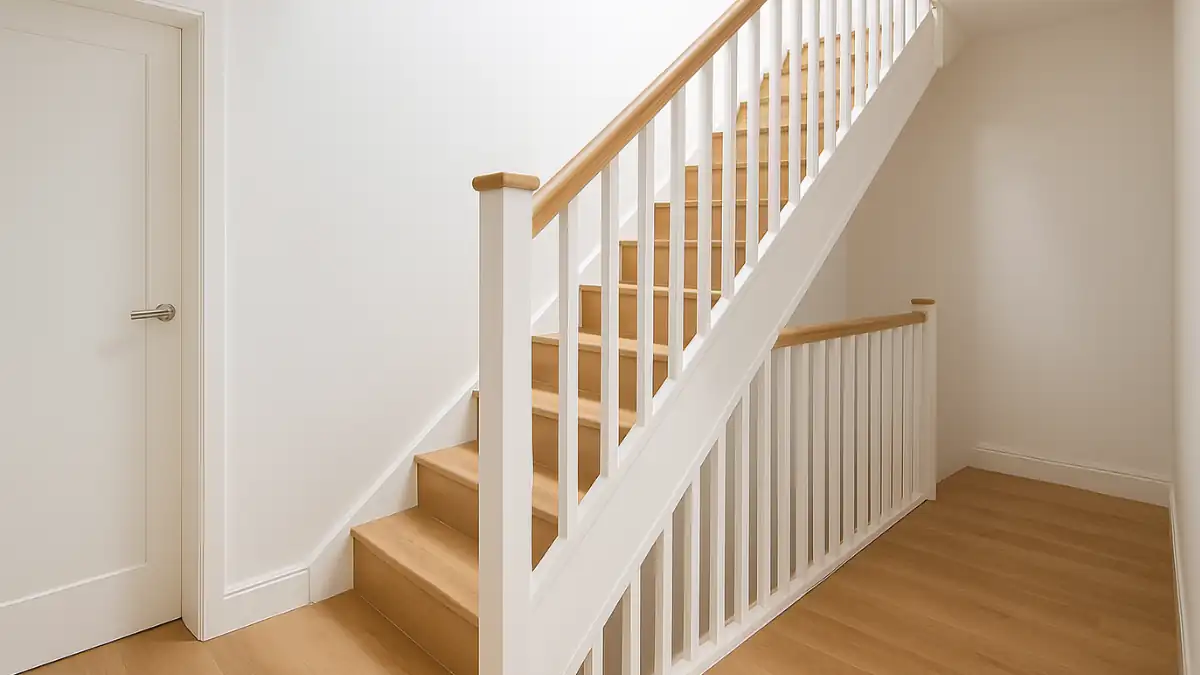
Handrails must be easy to grip and positioned consistently.
- Handrail height: 900–1000mm above pitch line
- Located on at least one side of stairs with two or more risers
- Balustrade gaps: No opening greater than 100mm
- Landings must have guarding to prevent falls
Part M: Accessibility Requirements in Domestic Homes
Although most existing houses only need to follow Part K, Part M (accessibility and usability) applies to new-builds and some material change-of-use projects. In domestic stair design, Part M influences several practical details even if full M4(1) compliance isn’t required.
Key considerations from Part M include:
- Handrails should extend the length of the flight for ease of use.
- Consistent handrail height helps people with reduced mobility.
- Stair widths should be practical to navigate, generally 850mm+.
Homeowners extending or converting should be aware that Building Control may refer to “reasonable provision” under Part M to ensure stair usability for all future occupants.
Not sure if your staircase meets Building Regulations?
We’ll review your drawings, check Part K compliance and highlight anything Building Control might reject.
Step-by-Step: How to Check Your Stairs Against Building Regulations
| Step | What to Check |
|---|---|
| 1. Measure the rise | Ensure each rise is consistent and under 220mm. |
| 2. Measure the going | Check that going is at least 220mm throughout the flight. |
| 3. Calculate pitch | Using rise/going ratio, confirm the pitch is below 42°. |
| 4. Check headroom | Headroom must be 2.0m from pitch line. |
| 5. Inspect handrails | Height 900–1000mm and fitted on at least one side. |
| 6. Test guarding | No gaps over 100mm, including between spindles. |
Common Pitfalls That Cause Building Control Delays
- Inconsistent rises — often caused by miscalculated floor-to-floor height.
- Insufficient landing length, especially where doors open onto stairs.
- Balustrades with decorative openings above 100mm.
- Handrails installed too low or too high.
- Incorrectly positioned stair openings in lofts leading to failed headroom checks.
If your stairs are part of a larger project like a loft conversion or house extension, the staircase also influences fire safety routes and Part B compliance. Coordinating these early helps avoid build-time rework.
FAQs: Building Regulations Stairs
Do I need Building Regulations approval for a new staircase?
Yes. Any new staircase or alteration affecting the rise, going, pitch, structure or safety requires Building Regulations approval. You can apply using a Building Notice or full plans application.
What is the minimum width for stairs under UK regulations?
There is no strict legal minimum for domestic stairs, but 800–900mm is widely accepted as the safe standard. Narrower widths may be accepted in older homes if no better alternative exists.
What are the maximum rise and minimum going?
Maximum rise is 220mm, and minimum going is 220mm. Rise and going must also be consistent within ±6mm tolerance.
How steep can stairs be in a UK home?
The maximum permitted pitch is 42°. This is checked during Building Control inspections.
What’s the minimum headroom over stairs?
Part K requires 2.0m minimum headroom. Limited relaxations sometimes apply in lofts, but only with Building Control agreement.
Key Facts Snapshot
- Main Regulation Approved Document Part K (with Part M influences on usability)
- Max Rise 220mm
- Min Going 220mm
- Pitch Maximum 42°
- Handrails 900–1000mm height
- Balustrade Gaps No openings over 100mm
- Headroom 2.0m minimum above pitch line
Next Steps & Useful Guides
Here are helpful next reads based on your project:
- Building Regulations: Complete Homeowner’s Guide
- Building Control: What It Is and How It Works
- Building Notice vs Full Plans
- Plans for Building Regulations
- Loft Conversions (UK) – Full Guide
- House Extensions – UK Guide
- Building Control Inspections
- Fire Safety: Part B in Domestic Projects
External References
Need compliant stair drawings or Building Control guidance?
Our team prepares fully compliant plans and supports you through approval.
Performance Verified ✅
This page meets PME Optimisation Standards — achieving 95+ Desktop and 85+ Mobile PageSpeed benchmarks. Verified on

